Your ShelfYour Projects

Signs of the Times, Vol. 36, No. 23.

TRUST

Signs of the Times

Jun 16, 1909

Pacific Press Publishing Association · Mountain View, California · Jun 16, 1909

TRUST

Still will we trust, tho the earth seem dark and dreary, And the heart faint beneath His chastening rod, Tho rough and steep our pathway, worn and weary, Still will we trust in God!
Our eyes see dimly till by faith anointed, And our blind choosing brings us grief and pain; Through Him alone, who hath our way appointed, We find our peace again.
Choose for us, God, nor let our weak preferring Cheat our poor souls of good Thou hast designed: Choose for us, God! Thy wisdom is unerring, And we are fools and blind.
So from our sky the night shall furl her shadows, And day pour gladness through her golden gates; Our rough path lead to flower-enameled meadows, Where joy our coming waits.
Let us press on: in patient self-denial, Accept the hardship, shrink not from the loss; Our guerdon lies beyond the hour of trial, Our crown beyond the cross.
—William Henry Burleigh.

Question Corner

[To Our Inquirers.—(1) The name and address of all who ask questions must accompany questions, not necessarily for publication, in token of good faith, and that we may reply by letter if thought best. All communications will be considered confidential if so desired, and no name will be published unless requested. But we have no time to give to anonymous or unsigned epistles or articles. (2) Let the questions be to the point. Do not say, “Explain Josh. 7:1-8,” but state the thing upon which help is desired. (3) Questions can not be answered immediately in this department. Sometimes it will mean a month or more of waiting. We can not reply to the same question frequently. Read answers to other questions; you may find reply to yours. (4) Members of the Bible Band will kindly enclose stamp if answer is desired by letter. Others will please enclose ten cents. This does not begin to meet expenses oftentimes. (5) “Foolish . . . questions avoid.”]

2862.—Belonging to a Church.

“Must we belong to the church called ‘The Church of Christ,’ in order that we may be saved? I ask this in view of the fact that it says, ‘Neither is there salvation in any other, for there is none other name under heaven given among men, whereby we must be saved.’”
L. L. P.
We are not saved by any correlation or combination of letters, whatever those letters may spell. “Name” in the Bible does not mean a mere word. It stands for character, and in this case stands for the personal character of our Lord Jesus Christ. There are many instances of this given in the Bible. Therefore when the child of God is baptized into the name of the Father, and into the name of the Son, and into the name of the Holy Spirit, it does not mean the mere pronouncing over them of these words; it means they are baptized into the very character of the Father, of the Son and of the Holy Spirit—the Father for righteousness in the place of our sins; the Son for self-emptying, self-denial, self-abnegation, that God may fill us; and the Holy Spirit for service. The Lord is not dependent upon any combination of men to save men. He does not save because we go through a certain particular form; He saves because the heart is yielded to Him, and He can come into that heart and make it His own living temple. “For the eyes of the Lord run to and fro throughout the whole earth, to show Himself strong in the behalf of them whose heart is perfect toward Him.” 2 Chron. 16:9. “By grace are ye saved through faith; and that not of yourselves: it is the gift of God.” Eph. 2:8.
There are differences as to what name a church ought to take. The church is sometimes called in the Bible “the church of God;” sometimes the “church of Christ.” The Jesuits have for a name, “The Society of Jesus.” Why should we not take the name “Jesus” just as truly as that of “Christ”? Really it is more a name than “Christ” is. “Christ” simply means “anointed,” and “Jesus the Christ” means “Jesus the Anointed One.”
Simply calling ourselves Christians does not make us so, and to unite with a church that is called Christian does not make us Christians; and there are thousands and thousands of Christians who are not called denominationally by the name Christian. We need not worry, dear soul, about that at all. The Lord saves us when we give ourselves to Him, and accept of all that He gives us in Jesus Christ by faith. Then of course we will walk in His commandments. We will be baptized, we will obey because we have the spirit and the life of obedience, but that may lead us a long way from those churches which arrogate to themselves the name Christian, while they do not always follow the Master. The apostle Paul has stated the condition of salvation very clearly in 1 Cor. 15:1-5, and we find it stated over and over again in many places, but never do we find it: “You shall take such and such a name in order to be saved.”

2863.—The Thief on the Cross.

Jesus told the thief on the cross: “Verily I say unto thee to-day, shalt thou be with Me in Paradise.” Luke 23:43. How is it that you place the comma after “to-day” instead of before as I see you do?
P. G. L.
Punctuation is not a matter of inspiration. The original Scriptures were written not alone without any division of sentences, but without any division of words. Each line was a line of solid letters. First came the division into words; then into sentences, and later on came commas and semicolons, etc. Not all Bibles are punctuated alike, even of the King James Version. And the punctuation itself is merely the understanding of the person who did it.
The explanation of the incident demands the change in the punctuation from what it is given in our Common Version. Let us study the latter. Evidently the thief dying by our Lord’s side had mingled in the crowds which surrounded Jesus from time to time as He preached the Gospel of the kingdom. He had doubtless also been in the judgment-hall, at least a part of the time when Christ was before Pilate. He may have been a Jew and his crime may have largely been a political crime. Being a Jew he may have understood something of the nature of Christ’s kingdom. Notice his request. He did not say, “Lord, remember me when Thou goest into heaven;” but “Lord, remember me when Thou comest into Thy kingdom.” Jesus had taught that the kingdom of God was likened unto “a certain nobleman [who] went into a far country to receive for himself a kingdom, and to return.” Luke 19:12. The dying man evidently understood that Jesus was coming again to receive His kingdom; therefore his request. Note also that that request was made to Jesus when in all probability, from a human point of view, Jesus could never receive it. He had been condemned by His own people; had been adjudged a criminal by Roman law, was hanging upon the cross as was the thief himself; and yet the man’s faith pierced all the darkness, swept past the improbabilities, and took hold upon Christ as a Saviour. As a Saviour, Jesus responds: “Verily I say unto thee to-day,”—notwithstanding all the untoward circumstances that surrounded Him, notwithstanding the fact that seemingly He had no power nor would ever have power to answer the prayer of the thief,—“Verily I say unto thee to-day, shalt thou be with Me in Paradise,” or, to take the expression out of its archaic form, as we would commonly express it, “Thou shalt be with Me in Paradise.”
Rotherham’s Emphatic translation reads: “Verily I say unto thee this day; with Me shalt thou be in Paradise.”
What did our Lord mean by “Paradise”? The word itself means “a garden.” We find two other occurrences of it in the New Testament. One is in 2 Cor. 12:4. What the apostle calls “into Paradise” in the fourth verse, he calls “the third heaven” in the second verse; that is, the heaven where God dwells. The word occurs again in Rev. 2:7, “To him that overcometh, to him will I give to eat of the Tree of Life, which is in the Paradise of God.” By turning to Rev. 22:1, 2, we learn that the Tree of Life and the River of Life will be great characteristics of the new heavens and the new earth,—the River of Life flowing out from the throne of God, and the Tree of Life on either side of the river.
The Paradise, then, to which Jesus promised the thief an entrance, is this earth made new, or Christ’s kingdom which He will take when He closes His work as priest and judge. Moreover, He did not go to Paradise, or to heaven, on that day of His crucifixion. Three days after His conversation with the thief on the cross, He said to Mary: “Touch Me not, for I am not yet ascended to My Father.” John 20:17. Therefore Jesus did not go to Paradise on the day in which He gave comfort to the dying thief. What, then, are we to conclude? That the adverbial phrase “to-day” modifies not the verb “be,” but the verb “say.” It was what our Lord said on that day which should occur at some future time, and not what should be that day. Simply placing the comma so as to indicate this makes everything clear, makes perfect harmony between this text and other scriptures, and gives hope and comfort to every soul who is looking for the second coming of our Lord and Saviour Jesus Christ.

2864.—Gabriel and the Holy Spirit.

Does the Bible teach that Gabriel and the Holy Spirit are one and the same?
B. S.
Nowhere that we know of. The Holy Spirit is the great, all-embracing life of God, carrying everywhere all the power of God, and manifesting in various forms the presence and power of divinity. The Holy Spirit existed before angels and all other creatures. It was God’s potent agency in creation. Gen. 1:2; Job. 26:13; Ps. 104:30.
Gabriel, the mighty angel, is one of the servants of God. He is mighty because of the Spirit of God within him and upon him; but he is still God’s servant, limited in his personality and power. Dan. 8:16; 9:21, 22; 10:11-13; Rev. 19:9, 10; 22:8, 9. God uses the angels, clothes them by His Spirit, and so in a lesser way He uses men, by filling them with His Spirit. Thus they become channels of the Spirit’s working, but not the Spirit.

OUR BIBLE BAND

Schedule for Week Ending June 26, 1909.

Day Month Date Morning Evening
Su. June 20 Esther 1, 2 Acts 5:1-21
Mo. " 21 " 3, 4, 5 " 5:22-42
Tu. " 22 " 6, 7, 8 " 6
We. " 23 " 9, 10 " 7:1-21
Th. " 24 Job 1, 2 " 7:22-43
Fri. " 25 " 3, 4 " 7:44-60
Sa. " 26 " 5, 6, 7 " 8:1-25

Suggestive Notes.

Our Old Testament lessons include the whole of the book of Esther, with seven chapters of Job. The book of Esther covers a striking period in the history of the Jews under the reign of the great Persian king Xerxes, called in the Bible Ahasuerus. It opens with an account of the first world's fair of which we have any record, lasting six months; shows how in the providence of God a Jewish maiden was brought to the throne of Persia; how the Amalekites, the wicked and sworn enemies of God's children, were in the favor of the king, with Haman, the Prime Minister, at their head; Haman's plotting against the Jews to destroy them; and the overruling power of God in saving them from their enemies.
One remarkable thing about the book of Esther is that it does not mention the name of Deity either by noun or pronoun. This is explained on the supposition that the Jews wanted to do nothing that would in any wise offend their Persian conquerors. We are told, however, that in a hidden way the name of God occurs over and over.
The book of Job is probably the oldest book written, and is thought by some to have been written by Moses when he was in the land of Midian. The original language of the book shows that it is among the oldest, ancient words being used that are not found in other parts of the Scripture. It is a wonderful lesson of God's dealing with His children, of the human misunderstanding of God's purposes and the consequent misjudgment. God was trying Job not simply for his own good, but for the good of those who should live after. Job's friends, like many of later ages, thought that prosperity was an evidence of God's favor, and at once accused Job of sins secret and otherwise as the cause of his affliction. The early trials which came upon the old patriarch did not seem in any wise to shake his faith, but the later, perplexing, tantalizing, continued pain of his boils and the even worse conversations of his friends led him almost to despair. This is developed more fully as we proceed with the magnificent poem.
Our New Testament lessons continue the reading in Acts, beginning with the fifth chapter and closing with the twenty-fifth verse of the eighth chapter. The record itself is very clear. Great events and the wonderful power of God's word in working upon hearts are clearly set forth.

Christian Growth

By Mrs. E. G. White
Sanctification is the work, not of a day, nor of a year, but of a lifetime. The struggle for conquest over self, for holiness and heaven, is a life-long struggle. Without continual effort and constant activity, there can be no advancement in the divine life, no attainment of the victor’s crown.
The strongest evidence of man’s fall from a higher state is the fact that it costs so much to return. The way of return can be gained only by hard fighting, inch by inch, every hour. By a momentary act of will one may place himself in the power of evil; but it requires more than a momentary act of will to break these fetters, and attain to a higher, holier life. The purpose may be formed, the work begun; but its accomplishment will require toil, time, and perseverance, patience and sacrifice.
Beset with temptations without number, we must resist firmly or be conquered. Should we come to the close of life with our work undone, it would be an eternal loss.
Paul’s sanctification was the result of a constant conflict with self. He said, “I die daily.” His will and his desires every day conflicted with duty and the will of God. Instead of following inclination, he did God’s will, however crucifying to his own nature.
God leads His people on step by step. The Christian life is a battle and a march. In this warfare there is no release; the effort must be continuous and persevering. It is by unceasing endeavor that we maintain the victory over the temptations of Satan. Christian integrity must be sought with resistless energy, and maintained with a resolute fixedness of purpose.
No one will be borne upward without stern, persevering effort in his own behalf. All must engage in this warfare for themselves. Individually we are responsible for the issues of the struggle; though Noah, Job, and Daniel were in the land, they could deliver neither son nor daughter by their righteousness. Each is responsible for himself.

The Science to Be Mastered

There is a science of Christianity to be mastered,—a science as much deeper, broader, higher than any human science as the heavens are higher than the earth. The mind is to be disciplined, educated, trained; for we are to do service for God in ways that are not in harmony with inborn inclination. There are inherited and cultivated tendencies to evil that must be overcome. Often the training and education of a lifetime must be discarded, that one may become a learner in the school of Christ. Our hearts must be educated to become steadfast in God. We are to form habits of thought that will enable us to resist temptation. We must learn to look upward. The principles of the word of God,—principles that are as high as heaven, and that compass eternity,—we are to understand in their bearing upon our daily life. Every act, every word, every thought, is to be in accord with these principles.
The precious graces of the Holy Spirit are not developed in a moment. Courage, fortitude, meekness, faith, unwavering trust in God’s power to save, are acquired by the experience of years. By a life of holy endeavor and firm adherence to the right, the children of God are to seal their destiny.

The Need of Self-Renunciation

Man’s great danger is in being self-deceived, indulging self-sufficiency, and thus separating from God, the source of his strength. Our natural tendencies, unless corrected by the Spirit of God, have in them the seeds of moral death. Unless we become vitally connected with God, we can not resist the unhallowed effects of self-love, self-indulgence, and temptation to sin.
In order to receive help from Christ, we must realize our need. We must have a true knowledge of ourselves. It is only he who knows himself to be a sinner whom Christ can save. Only as we see our utter helplessness and renounce all self-trust, shall we lay hold on divine power.
It is not only at the beginning of the Christian life that this renunciation of self is made. At every advance step heavenward it is to be renewed. All our good works are dependent on a power outside of ourselves; therefore there needs to be a continual reaching out of the heart after God, a constant, earnest confession of sin and humbling of the soul before Him. Perils surround us; and we are safe only as we feelour weakness, and cling with the grasp of faith to our mighty Deliverer.
Many who are already members of God’s great family know little of what it means to behold His glory, and to be changed from glory to glory. Many have a twilight perception of Christ’s excellence. You long for a fuller, deeper sense of the Saviour’s love. You are unsatisfied. But do not despair. Give to Jesus the heart’s best and holiest affections. Treasure every ray of light. Cherish every desire of the soul after God. Give yourselves to the culture of spiritual thoughts and holy communings. You have seen but the first rays of the early dawn of His glory. As you follow on to know the Lord, you will know that His going forth is prepared as the morning. “The path of the righteous is as the light of dawn, that shineth more and more unto the perfect day.” Having repented of our sins, confessed them, and found pardon, we are to continue to learn of Christ, until we come to the full noontide of a perfect Gospel faith.

Wonderful Possibilities

It is our privilege to reach higher and still higher, for clearer revelations of the character of God. When Moses prayed, “I beseech Thee, show me Thy glory,” the Lord did not rebuke him, but He granted his prayer. God declared to His servant, “I will make all My goodness pass before thee, and will proclaim the name of Jehovah before thee.”
It is sin that darkens our minds and dims our perceptions. As sin is purged from our hearts, the light of the knowledge of the glory of God in the face of Jesus Christ, illuminating His word and reflected from the face of nature, will more and more fully declare Him “merciful and gracious, long-suffering, and abundant in goodness and truth.” In His light shall we see light, until mind and heart and soul are transformed to the image of His holiness.
Wonderful possibilities are open to those who lay hold of the divine assurances of God’s word. Privileges and duties which they do not even suspect to be in the Bible will be laid open before them. As they follow on in the path of humble obedience, doing His will, they will know more and more of the oracles of God.
The precious faith inspired of God imparts strength and nobility of character. As His goodness, His mercy, and His love are dwelt upon, clearer and still clearer will be the perception of truth, higher and holier the desire for purity of heart and clearness of thought. The soul dwelling in the pure atmosphere of holy thought is transformed by intercourse with God through the study of His word. Truth is so large, so far-reaching, so deep, so broad, that self is lost sight of. The heart is softened and subdued into humility, kindness, and love.
And the natural powers are enlarged because of holy obedience. From the study of the words of life, students may come forth with minds expanded, elevated, ennobled. If they are, like Daniel, hearers and doers of the word of God, they may advance as he did in all branches of learning. Being pure-minded, they will become strong-minded. Every intellectual faculty will be quickened. They may so educate and discipline themselves that all within the sphere of their influence will see what man can be, and what he can do when connected with the God of wisdom and power.

The Coming of the Redeemer

By Geo. A. Snyder
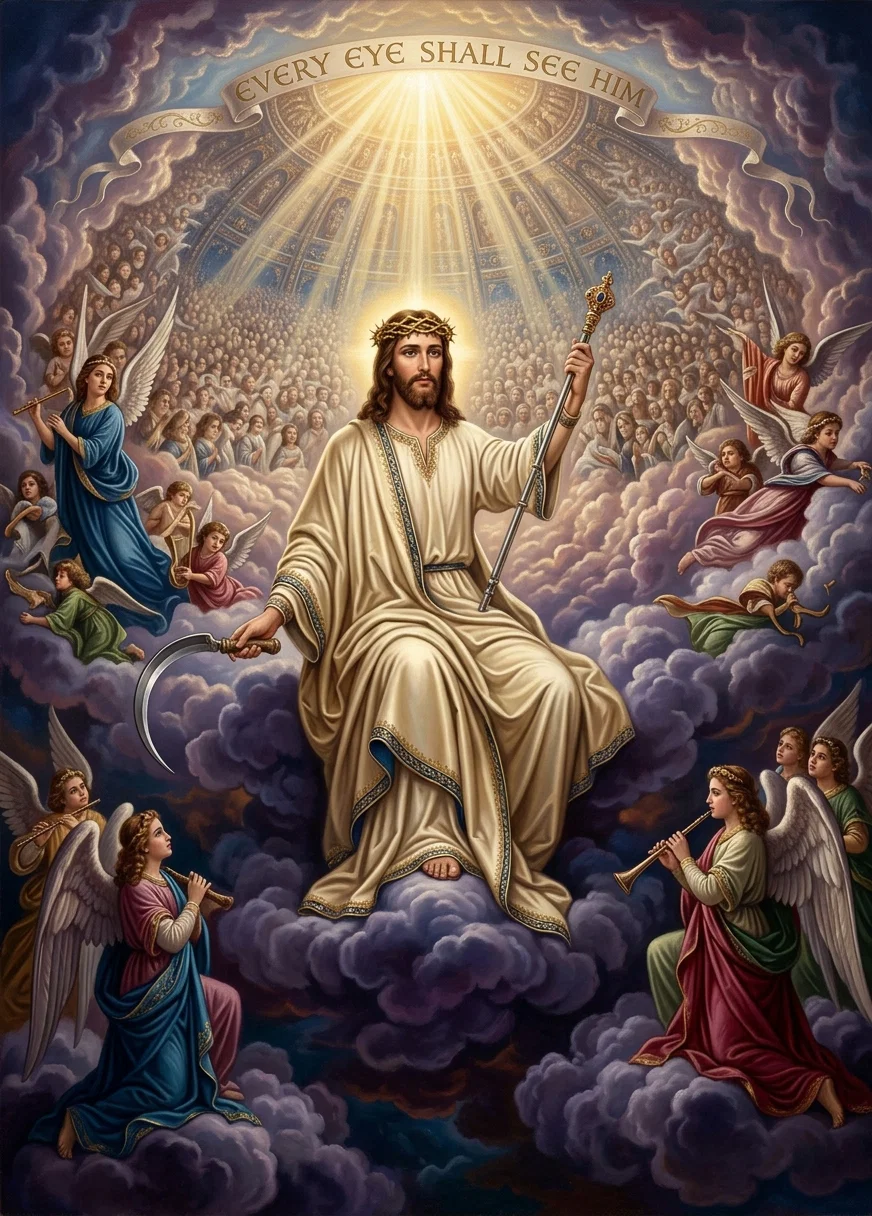
“Every eye shall see Him”

V. What Christ’s Coming Means; To the Wicked; To the Righteous

BEHOLD, He cometh with clouds; and every eye shall see Him, and they also which pierced Him: and all kindreds of the earth shall wail because of Him.” Rev. 1:7. The wail of the wicked at Christ’s second advent is fearful to contemplate. The wise man describes the situation thus: “They would none of My counsel: they despised all My reproof. Therefore shall they eat the fruit of their own way, and be filled with their own devices.” Prov. 1:30, 31. Those who reject the warnings of a loving Father, and persist in their own wicked way to the bitter end, must eat the fruit of their own way. They can not, in the very nature of things, expect to eat the fruit of that which they have openly rejected. There can be no greater error than to presume that God will somehow save those who reject the only means of salvation. Salvation is free to all, and the very fact that it is free precludes the possibility of its ever being forced upon those who still reject it after it has been freely offered for the last time. As responsible beings, they must reap what they have sown.
In order to seek to avoid the awful consequences of sin, some even try to make it appear that they are not responsible for their own wrong course of life. All such theories are self-explosive; for if men were not responsible for their actions, they would never think of trying to make it appear that they are not. Those who seek to shift responsibility from themselves, would be the first to resent the slightest intimation that they are really irresponsible beings in the literal sense of the word.
Space will not permit, in this connection, of a full consideration of the nature of the punishment of the wicked. We may be sure that God will do nothing out of accord with love and justice. Neither will He do anything that will jeopardize the stability of His government and the eternal welfare of His loyal creatures. To infinitely prolong the existence of those who have refused all that God has to offer, would be to perpetuate a state of rebellion from which there would be no hope of reclamation, but only the certainty of endless degradation. The X-ray, properly administered, will at the same time destroy the germs of disease and expand the germs of life. Sunlight performs the same double duty every day. In like manner the glorious effulgence of Christ’s coming will at the same time wither the wicked into the dust, and cause the righteous to rise out of the dust to the plane of the highest aspirations. The immediate and final effect of Christ’s coming on the wicked and the righteous is clearly set forth in the following scriptures: “To you who are troubled rest with us, when the Lord Jesus shall be revealedfrom heaven with His mighty angels, in flaming fire taking vengeance on them that know not God, and that obey not the Gospel of our Lord Jesus Christ: who shall be punished with everlasting destruction from the presence of the Lord, and from the glory of His power.” 2 Thess. 1:7-9. “For, behold, the day cometh, that shall burn as an oven; and all the proud, yea, and all that do wickedly, shall be stubble: and the day that cometh shall burn them up, saith the Lord of hosts, that it shall leave them neither root nor branch. But unto you that fear My name shall the Sun of Righteousness arise with healing in His wings; and ye shall go forth, and grow up as calves of the stall. And ye shall tread down the wicked; for they shall be ashes under the soles of your feet in the day that I shall do this, saith the Lord of hosts.” Mal. 4:1-3. The same principle is strikingly drawnout by the prophet Isaiah. Of the wicked, he says: “Your breath, as fire, shall devour you. And the people shall be as the burnings of lime: as thorns cut up shall they be burned in the fire.” Then follows the question: “Who among us shall dwell with the devouring fire? Who among us shall dwell with everlasting burnings?” The answer is very explicit: “He that walketh righteously, and speaketh uprightly.” Read Isa. 33:11-15. To those who have waited for the glorious appearing of the Saviour, His presence will be as the sunrise to the songbird. While those who love darkness rather than light are calling for the rocks and mountains to fall on them and hide them from the light of His presence, those who love the light and walk in the light will welcome Him as the center and source of light, and the attraction will be so strong that they will rise to meet Him in the air. “The Lord Himself shall descend from heaven with a shout, with the voice of the Archangel, and with the trump of God: and the dead in Christ shall rise first: then we which are alive and remain shall be caught up together with them in the clouds, to meet the Lord in the air: and so shall we ever be with the Lord.” 1 Thess. 4: 16, 17.
When the few of God’s children who are alive when Jesus comes, shall join the many who will be wakened from the tomb by the voice of the Life-giver, and with them rise to meet Him in the air, there will be a meeting which no pen can picture. Then will begin for the righteous the realization of that “eternal weight of glory” to which they have always looked forward with joyful anticipation, but which they have never been able to comprehend. “Now we see through a glass, darkly; but then face to face.” In that day when the kingdoms of earth are dashed in pieces like a potter’s vessel, when the earth is reeling to and fro like a drunken man, when the righteous dead start up from their long slumber, at the voice of the Archangel, when every wicked heart is quaking with fear, when every countenance is falling, when every hope is vanishing and the bitter wail of despair rises from the erstwhile scoffing multitude, then shall the voice of the righteous ascend from amid the wreck: “O Lord, I will praise Thee, for Thine anger is turned away. Behold, God is my salvation: I will trust and not be afraid, for the Lord Jehovah is my strength and my song; He also is become my salvation.”
The reward given to the righteous comes not as the result of their own worth, but through the worthiness of Him whose perfect life and sacrifice merit that high reward. He suffered the extreme penalty for our sins, that we might receive the reward of His perfection. As we by faith accept the Saviour’s perfect righteousness, and strive with true purpose of heart to reflect that righteousness from our own daily lives, He stands as our sponsor before the bar of eternal justice, and we stand accepted in Him. The coming of Christ marks only the beginning of that infinite reward which comes to the righteous through faith in His infinite substitution on their behalf. We can no more measure the fulness of that reward with our finite minds than we can measure the scope of eternity with an hour-glass. God grant that we may be among that ransomed company who will have eternity in which to pursue their soundings of the unfathomable depths of God’s illimitable love.
Continue reading: The Spirit World and a Future Life