Your ShelfYour Projects

Signs of the Times, Vol. 32, No. 44.

MY BOW

Signs of the Times

Nov 14, 1906

Pacific Press Publishing Company · MOUNTAIN VIEW, CALIFORNIA · Nov 14, 1906

"MY BOW."

"I have set My bow in the cloud."
Ere Sorrow's shade had fallen O'er Earth's rejoicing day, The God of Right Had formed the light To chase the night Away; As storm-cloud finds no resting-place Where bursts the sun's bright ray.
Bold Wrong may flaunt its banner, And rule a little day,— But e'er the wrong Was Justice strong,— And Mercy long Held sway; And blighted Earth will know a birth That Sin can never stay.
As oft we see God's rainbow When cloud and sun unite, So surely we Will ever see The victory Of Right,— And know that Justice sits for aye On Mercy's throne of light.
FLORA E. YERGIN.

Furnish the Signs to Your Friends

Only two cents a copy each week. This is what it costs to furnish the SIGNS to your friends.
For ten cents per week you can furnish five homes with this paper.
Subscription and club rates, together with best methods for using the SIGNS OF THE TIMES, contained in the "Signs of the Times Booklet." Request your tract society to send you a copy.

Subscription Price

40c

WORDS OF APPRECIATION.

"I have the SIGNS of October 10. I am highly pleased with this paper. The article 'If and Why' in this issue is a stirring one on the real mission of Christ as the Saviour of sinners. I feel that the SIGNS OF THE TIMES is a standard bearer, holding up the Bible in this infidel age."

A Subscriber’s Testimony

"Yes, I shall continue to subscribe for the SIGNS. I am so thankful that your most excellent paper continues to be published, notwithstanding the calamities of earthquake and fire. God is surely with you, and my prayer is ever for your continued success in your good work. I enclose $1.50 for my renewal, and $1.00 besides that you may send the SIGNS to the address of —— for one year."

An Agent’s Testimony

From an agent :
"The SIGNS is just fine to canvass with. No. 40 was just a model in every way. I suppose you have received the twenty-five subscriptions I sent you a few days ago. Shall soon have another list. "Yours in the good work, "GEO. A. KING, New York."

A Renewing Subscriber’s Testimony

"I am renewing my subscription for the Signs. I enjoy reading it so much, and would not be without it now."

Selling the Signs

"I'm going to try selling papers once more. I've missed the SIGNS so much and can not feel satisfied unless I can sell a few. I shall take only fifty copies a week. Beginning with the November number, please send me fifty every week until I give you notice to discontinue."
"——, Tacoma, Wash."

NEED YOUR HELP.

Valparaiso, Chile.
AN extensive portion of Chile was severely shaken by a terrible earthquake the night of August 16, 1906. Sad, it is, but nevertheless true, that the most of the people that died that awful night were not prepared. Not to all of them had the Gospel been preached. Only a few, if any, really knew what communion with God meant. And we know that in every place (Luke 21:11) have to come great earthquakes and other noted signs of Christ's near second coming. But, O how sad! the people do not know enough of the Gospel even to study the prophecies to see and understand that the end is at hand.
I am so exercised when I think of the fate that awaits the people, that I would like to be one thousand preachers at once, and go to all places to proclaim the message of the judgment. Now it is high time to appeal to Jesus in earnest for forgiveness and power. Yet I am only one, and so I am anxious to awaken others to help. O to help to awaken the people! Dear reader, your help is needed, do not let souls perish without telling to them that Jesus wants them to be holy and saved.
ED. W. THOMANN.

CHOICE TRACTS

TOPICALLY ARRANGED

Since the fire we have made a careful study of our tract publications, and have decided to republish only those numbers for which our field workers urgently call. The following is the list that has stood this test, and which we are now reprinting:

IMMORTALITY QUESTION:

Thoughts for the Candid ........................ (B. S. L., 47) 40c Is Man Immortal? .............................. (A. G. L., 86) 80c

SECOND COMING OF CHRIST:

Without Excuse ................................ (B. S. L., 46) 40c We Would See Jesus ............................ (B. S. L., 173) 80c Waymarks to the Holy City ..................... (B. S. L., 189) 80c Signs of the End .............................. (B. S. L., 194) 80c Coming of the Lord ............................ (A. G. L., 40) 40c Heralds of His Coming ......................... (A. G. L., 85) 80c

THE SABBATH QUESTION:

The Seal of God and the Mark of the Beast .... (B. S. L., 130) $1.50 Why Not Found Out Before ...................... (B. S. L., 52) 40c New Testament Sabbath ......................... (B. S. L., 137) 80c Who Changed the Sabbath? ...................... (B. S. L., 187) 80c From Sabbath to Sunday ........................ (B. S. L., 95) 40c Elihu on the Sabbath .......................... (B. S. L., 192) 80c Identical Seventh Day ......................... (B. S. L., 114) 80c Day of the Sabbath ............................ (A. G. L., 50) 80c The Seventh or One-Seventh .................... (A. G. L., 39) 40c Which Day Do You Keep, and Why? ............... (A. G. L., 75) 40c Is Sunday the Sabbath? ........................ (A. G. L., 76) 40c Sunday in a Nutshell .......................... (A. G. L., 88) 80c Jewish ........................................ (B. S. L., 69) 40c The True Seventh Day .......................... (A. G. L., 78) $1.20

TEMPERANCE:

The Name ...................................... (A. G. L., 72) 80c Demons' Council ............................... (A. G. L., 80) 40c It Does Not Pay ............................... (A. G. L., 82) 80c

SPIRITUALISM:

Spiritualism: Its Source and Character .......... (B. S. L., 112) 80c Try the Spirits ............................... (A. G. L., 48) 40c

MILLENNIUM:

Temporal Millennium ........................... (B. S. L., 121) $1.20

THE LAW:

The Perpetuity of the Law ...................... (B. S. L., 178) 80c Under the Law; or Under Grace ................. (B. S. L., 163) 80c Ceremonial and Moral Law Distinguished ........ (B. S. L., 195) 80c Relation of the Law and Gospel ................ (B. S. L., 166) $1.20

PRAYER:

Prayer, by A. T. Pierson ....................... (A. G. L., 52) 80c

GOSPEL STORIES:

Back to the Old Paths ......................... (A. G. L., 44) 60c How Esther Read Her Bible ..................... (A. G. L., 7) 40c

BIBLE STUDY:

Benefits of Bible Study ....................... (A. G. L., 10) 40c Topical Bible Studies ......................... (B. S. L., 185) $1.20

MISCELLANEOUS:

Way to Christ ................................. (B. S. L., 105) 80c Jesus Died for You ............................ (A. G. L., 63) 40c Great Popular Evils ........................... (A. G. L., 89) 80c

PACIFIC PRESS PUBLISHING CO.

285 Salmon St., Portland, Ore. Mountain View, Cal. 1109 E. 12th St., Kansas City, Mo. REVIEW AND HERALD, Battle Creek, Mich. Takoma Park Station, Washington, D. C.

GOD'S CALL TO THE KINGDOMS OF EARTH.

(Read Exodus, Chapters 1 to 12).
THREE and one-half millenniums ago Egypt ruled the world. Of all the kingdoms of earth she was the greatest. The world acknowledged her might and power and skill and wisdom in statecraft. Her river in its annual overflow fertilized her land and brought abundant substance, and she deified it as one of her gods. The sun joined with the river in producing food, and she worshiped the sun, from whom her kings received their title as the representative of the sun-god upon the throne of men.
AMONG the peoples that sought supplies from her granaries were the few descendants of a nomadic patriarch named Abraham. Only a few years before, one of the same people, a captive slave named Joseph, had taught Pharaoh how to store his grain in plenteous years, that he might become rich in time of famine. At the same time he instituted one of the best land-laws for Egypt the world has ever known, and the rental and the taxes combined were easy for the people. During the time while this truly great young man was prime minister to Pharaoh, Egypt prospered, and the people who lived in Egypt knew no oppression. Nay, more; as long as his memory lived among the rulers of Egypt he was honored, his laws governed, the country flourished, and the people prospered.
BUT a new dynasty arose. A king came to the throne who "knew not Joseph," Egypt's great prime minister of blessed memory, or his people who were in Egypt with him. The king of Egypt saw that people prospering in the province of Goshen. He coveted their property. He envied them in their prosperity. To check their growth, he subjected them to slavery under taskmasters. Finding this insufficient, he declared that all their male children under a certain age should be slain. This was not enough. Learning that their teachers were endeavoring to induce them to be faithful to the God of their fathers, and remember His creative power by observing His Sabbath, the king suppresses this, and lays upon them additional burdens so that they shall be compelled to desecrate their holy day or suffer corporal punishment.
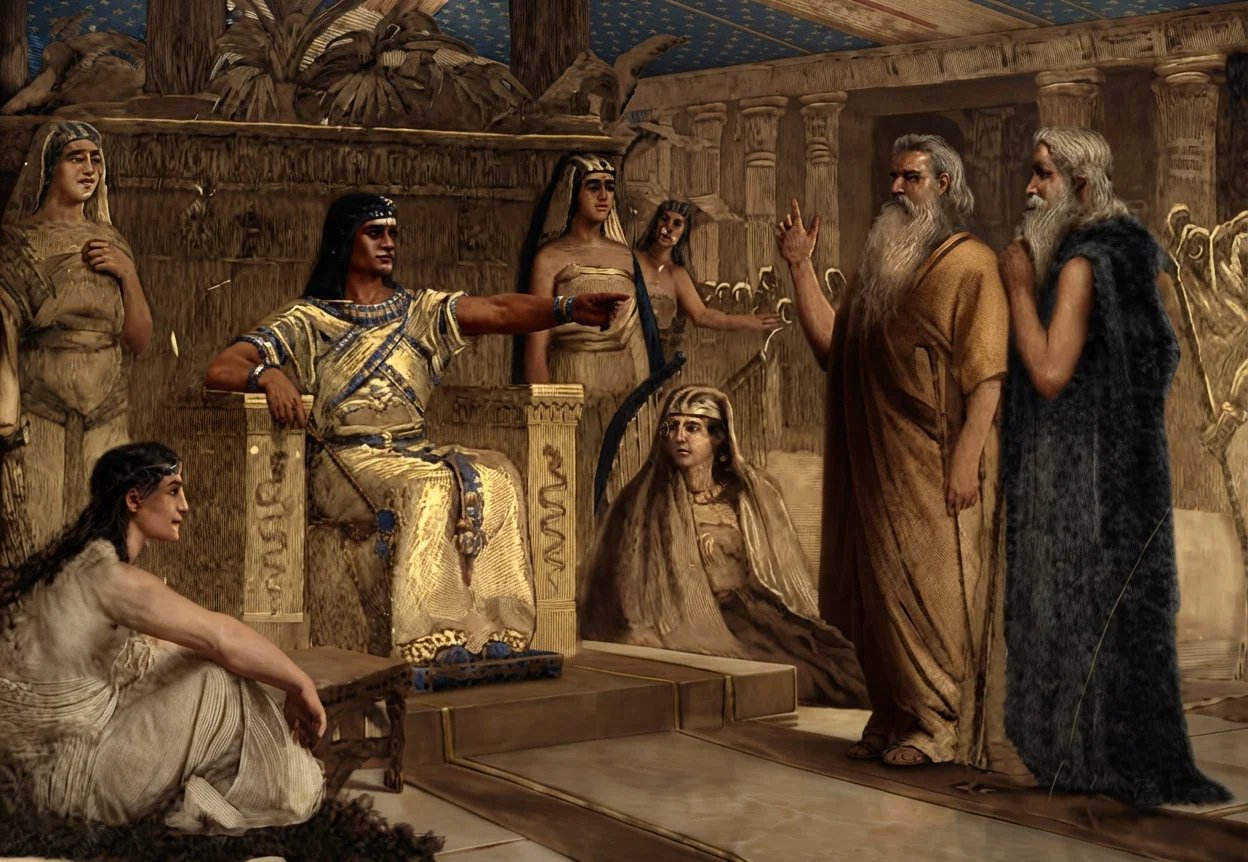
MOSES AND AARON BEFORE PHARAOH.
To the teachers he said, "Ye make them [the people] rest [literally, "sabbatize"] from their burdens." Of the people he said, "They are idle," therefore were they set to make bricks without furnished straw.
THE oppression could not go on forever. God sent His servants to Pharaoh with the reasonable request, "Thus saith Jehovah, the God of Israel, Let My people go that they may hold a feast unto Me in the wilderness." As tho He had said, "All these years Egypt has been enriched by Israel. During all this time you have worshiped as you will your multitude of gods with multiplied ceremonies. This people desire but to worship the One God. You will not let them do it here; they will go into the wilderness to do it. They will keep the simple feast apart from Egypt." If Pharaoh had yielded to that reasonable request, great blessing would have come to him. He would have enjoyed part emancipation from the fearful system of idolatry which held him in thrall.
PHARAOH refused, and pressed the burdens heavier. He proudly declared, "I know not Jehovah, and moreover I will not let Israel go." Jehovah is kind. He would save the king; He would save His people. Therefore He wrought miracles before Pharaoh, and the king's servants seemed to duplicate them, and the ruler's heart was made obstinate. The river is turned to blood, and Pharaoh's god demonstrated to be nothing, but he digs wells and finds water to drink, and again hardens his heart. Once more the man of God comes with the reasonable request, "Thus saith Jehovah, Let My people go, that they may serve Me." Ex. 8:1. Then comes the warning, repeated subsequently again and again, that if Pharaoh refused to let Israel go, all the gods of Egypt and all their worshipers would be humbled. But the king made stubborn his heart, and refused the request.
NOTE always the reasonable request of Jehovah, the Creator, to Pharaoh, the creature, and to all the kings of the earth, for all time, "Let My people go that they may serve Me." Not that God would compel their service, but that they would be able to render free service. No ruler on earth, no religion on earth, pagan or Christian, papal or Protestant, has the right to bind one single soul in bondage. Nor council, nor consistory, nor presbytery, nor conference has the right to throw about one single soul that which will fetter him in his worship or non-worship of God. Let the soul go that he may, if he will, worship. That soul is responsible to God alone. God created him. God redeemed him. To God he belongs. But God made the soul free to choose. Around him He placed the sacred circle of choice that even Deity willnot enter to compel. "Choose ye" is God's message to human souls. Leave them free to choose is His message to the rulers and oppressors of people.
God longed that Pharaoh should learn to know Him by the manifestations of His love, His reasonableness, His power. He longs that all rulers shall learn that "the Most High ruleth in the kingdom of men." He will permit the working out of evil's seed-sowing; He will show the utter powerlessness of the gods which men worship whether carved in gold or wood or stone, whether written in constitutions and laws, whether built into fine houses, or written in stocks or bonds, whether transcribed in creeds or dogmas. Not one must touch the conscience, and Jehovah will show them all to be powerless to make men better or fetter the conscience. If men still refuse to know Him and identify themselves with their golds and their sin, the plagues of God's just wrath, of which Egypt was the type, will devour them, as Egypt's king was destroyed in the Red Sea. That lesson of three and one-half millennia ago is God's lesson to rulers to-day.

THE COVENANT NAME.

IF the only excellence of the American Standard Revised Version was the simple one of leaving untranslated the Name of the God of the Bible, that alone should endear it to the heart of the Bible lover.
The apostle truly says that while "there are gods many and lords many, yet to us there is one God, the Father, of whom are all things." The very word "Baal" means lord, master. The true God did not thus reveal Himself to men.
One of the names He has used is El Shaddai, the Almighty God, the Omnipotent One, who is able to fulfil all He has promised. Thus He came to Abraham and Jacob. With them He made His covenants.
But the great name of the true God is Jehovah. It is His covenant name. It includes His self-existence, His almighty power, His everlasting love. It is His note in blank to His people that they may fill out with all His precious covenant-promises, according to their need and His fulness.
Just take some of these striking passages in the American Standard Revised Version and compare them with the Common Version. Moses did not say to Pharaoh, "Thus saith the Lord, the God of Israel, Let My people go;" nor did Pharaoh answer, "I know not the Lord." Moses came to the spiritually-darkened king with a message from a God he knew not: "Thus saith Jehovah, the God of Israel, Let My people go." And Pharaoh truly replied, "I know not Jehovah." Ex. 5:1, 2.
Moses did not say, "Hear, O Israel: The Lord our God is one Lord." He did say: "Hear, O Israel, Jehovah is our God, Jehovah is one." Deut. 6:4, margin. The covenant God is not many but one.
Our God did not say to Moses when He proclaimed His name, "The Lord, the Lord God, merciful and gracious;" but He did say: "Jehovah, Jehovah, a God merciful and gracious, slow to anger, and abundant in loving-kindness and truth," etc. Ex. 34:6, 7. There were many gods among the nations; Jehovah was the one God, unique in every excellence.
Elijah did not say, "If the Lord be God, follow Him; but if Baal, follow him." It was not a mere decision between two lords; but if Jehovah be God, follow Him; but if Baal [be God], then follow him." 1 Kings 18:21.
Speak it reverently, but with ever-growing assurance: "I will trust, and not be afraid: for Jehovah, even Jehovah, is my strength and song, and He is become my salvation." Isa. 12:2.
Take home to your poor heart God’s note in blank, signed, "JEHOVAH." Are you a sinner?—There is forgiveness. Are you weak?—He is strong for you. Are you in darkness?—He is thy light. And thus with every need.
Read the Word; read it constantly with His covenant name, and rejoice that Jehovah is your God forever and ever.

THE BASIS OF TRUE DOCTRINE.

THE Christian religion is founded on the Word of God. It stands or falls with that Word as revealed in the Holy Scriptures. And, contrary to the popular theology of the day, it is founded on the Word as revealed in the Old Testament, and must stand or fall with the Old Testament. Concerning the false theory that many parts of the Old Testament are mythical and unreliable, and, as some assert, the whole is obsolete, we have the inspired testimony of Paul that "all Scripture is given by inspiration of God, and is profitable for doctrine, for reproof, for correction, for instruction in righteousness; that the man of God may be perfect, thoroughly furnished unto all good works." 2 Tim. 3:16, 17.
Now bear in mind that the Scripture—the "all Scripture"—here referred to is the Old Testament; for the New Testament was not yet recognized as such; in fact it was not all written. So in Paul's day the Old Testament was sufficient to "thoroughly furnish" the man of God with "doctrine" and "instruction in righteousness." Paul was giving his parting counsel to a young minister, one who had been brought into the faith under the apostle's own labors—one who was bearing, and was to continue to bear, important responsibility in the Gospel work, not the least of which was to instruct other teachers after him.
Note particularly that Timothy's mother was a Jewess (Acts 16:1), and had taught Timothy the Scriptures from his childhood (2 Tim. 3:15). Being a Jewess, she would not have taught her son any other Scriptures than those recognized by the Jews, even if the later Testament had been in existence. But Paul, speaking of the "Holy Scriptures" which had been taught to Timothy from childhood by a Jewish mother, said that they were able to make him "wise unto salvation through faith which is in Jesus Christ." So the "unfeigned faith" in Jesus Christ which was in the young man Timothy, and in his Jewish mother and grandmother, was based upon the Old Testament Scriptures.
Note again, in this counsel of Paul to Timothy, he alludes to the close of his own life and labors as being "at hand;" he alludes to the fact that "evil men and seducers shall wax worse and worse, deceiving and being deceived;" but to his fellow-laborer he says: "Continue thou in the things which thou hast learned and hast been assured of, knowing of whom thou hast learned them." So this minister of the Gospel was to continue in the doctrine of Christ as he had learned it from the Word of God as revealed in the Old Testament.
A notable instance in preaching the Gospel from the Old Testament is that of Philip's instruction to the Ethiopian eunuch, recorded in the eighth chapter of Acts. The man was riding in a chariot and reading the prophecy of Isaiah, and pondering over the statement in chapter 53:7, 8. When Philip joined him in his carriage by direct command of the Spirit, the man asked for explanation of the words he had been reading. "Then Philip opened his mouth, and began at the same scripture, and preached unto him Jesus." And so effective was his instruction that it resulted in the eunuch's baptism as they came to a convenient place by the way.
When the New Testament came into existence it was not designed as a substitute for the Old, but as a complement of it. Christ had preached from the Old Testament, and counseled the people to search it for eternal life. It was one witness to His mission and teaching, a witness to the great plan of salvation. But in the mouth of two witnesses every word may be established. The New Testament is a witness corroborating the testimony of the former witness. The New Testament would have no basis whatever but for the testimony of the Old, and no scripture can be made a basis for anything that contradicts its doctrine.
The world is full of doctrines to-day, which purport to be Christian doctrines, yet are out of harmony with the Scriptures. And various doctrines are promulgated for the very purpose of contravening the truths set forth in the Old Testament, as also in the New. All such doctrines are based on some "science falsely so called," and the Scriptures place such theories in the category of "doctrines of devils." In the days of Christ the Old Testament was comprised in three books, known respectively as "Moses," "The Psalms," and "The Prophets," and He indorsed all these books by referring to them and quoting from them. A striking reference to "Moses" and "The Prophets" is that in the parable of the rich man and Lazarus, Luke 16:29-31; also to all the three books in chapter 24:44-48.
When Christ would confirm His bewildered disciples in the Gospel doctrine, after His resurrection, "beginning at Moses and all the prophets, He expounded unto them in all the Scriptures the things concerning Himself." Luke 24:27. It is also said that He opened their understanding, that theymight understand the Scriptures. Verse 45. Surely the basis of true doctrine set by the Master Himself ought to be enough for any professed disciple. G.

PEACE ON EARTH.

THERE never can be a state of peace in the world—that is, genuine, permanent peace—as long as the common notion prevails that one person's prosperity must necessarily mean another's adversity; that one man's gain must needs be through some other man's loss. In the world where such conditions exist, either in theory or in fact, the dove of peace will be kept constantly on the wing. As long as I entertain the thought that there is no place for me unless I can get some other man's place, I will probably strive to get that place. As long as one nation feels that it is not safe for another nation to occupy certain territory; as long as combinations and treaties and alliances of a diplomatic character are deemed necessary between nations in order to avoid conflicts, there can not be more than mere outward peace.
When one race fears to allow another race equal advantage lest the one deemed inferior shall predominate, there can not be peace. As long as there is one people who deem it essential to their prosperity that another people shall be kept down, there can not be permanent peace. In short, a peace that has to be enforced by any power but that of unfeigned recognition of human rights—unselfish recognition of equal rights—is not peace; at best it can be only expediency.
"The peace of God, which passeth all understanding," is based on love, on a love that loves one's neighbor as himself. The peace that is not based on the Golden Rule is not Christian peace. As long as peace must be maintained by standing armies, or great navies, or by any kind of diplomatic compromise, or uncertainty as to relative strength, or a recognized supremacy of man over man, or race over race, or class over class, any cry of peace will be a false cry; any claim of peace will be a false claim.
No true, reliable peace can obtain between man and man, in any capacity or station, that is not the result of a primary peace of individuals with God. And this must come through the mediatorial work of Jesus Christ. "Being justified by faith, we have peace with God through our Lord Jesus Christ." This is the peace that will obtain when the Lord sets up His kingdom in the earth, on the ashes of all other kingdoms. Then "the meek shall inherit the earth; and shall delight themselves in the abundance of peace." G.

Question Corner

1926.—Illegitimate Children.

Will children of unknown fathers be saved? This is a question I was asked and I replied, "Whosoever will may come," and I was referred to Deut. 23:2.
Deut. 23:2 seems to have reference, not to salvation of any sort, but to a place in the recognized congregation of the Lord. Not having recognized part in that did not seem to cut one off from salvation. The assembly here mentioned seems to have been not one which included the whole people, but the ruling body, and that must be composed of men who in outward appearance typified perfection. As to children of unknown fathers, let Eze. 18:20 speak, "The soul that sinneth, it shall die; the son shall not bear the iniquity of the father, neither shall the father bear the iniquity of the son." And Deut. 24:16: "The father shall not be put to death for the children, neither shall the children be put to death for the fathers; every man shall be put to death for his own sin." God is no respecter of persons, and He will not hold a single soul responsible for that which is not that soul's fault.

1927.—The Two Witnesses.

What are the two witnesses of Revelation 11?
The two witnesses in Revelation 11 are the Word of God,—the Word of God as recorded in the Bible and the Word of God as manifested in His living church, both witnesses agreeing together. The one presents before us the Old and New Testaments, and the other the truth of God in the life of His Son and His people.

1928.—The Third Angel's Message.

What is the Third Angel's Message of which you speak so often?
Technically speaking, the Third Angel's Message is found in Revelation the fourteenth chapter, verses nine to eleven, the message which it is said the angel itself proclaims; but in a general way it includes Revelation nine to fourteen. A better term is the great three-fold message, or the three angels' messages. The first goes forth to proclaim the Gospel. Rev. 14:6, 7. The second announces, "Babylon is fallen;" the third pronounces a fearful warning against the mark of the beast and his image; but as each one goes forth it includes the previous one, so the third includes both of the others, and so all are sometimes called the third angel's message. In other words, it is God's great, warning, saving message to the world including in its wonderful scope the entire Word of God.

1929.—The Signs in the Heavens.

You claim the sun and moon have been darkened and the stars already fallen, when it reads to me as if they were all to follow each other as rapidly as possible, and then immediately after those things our Lord is to come. Please explain this.
Many times the Bible language does not indicate what lies between even closely connected parts of sentences. Take for instance Isa. 61:2. Now the second verse reads right in connection with the first telling the wonderful things that Christ was to do, beginning, "The Spirit of the Lord Jehovah is upon Me." Then among the wonderful things that He was to do, the prophet declares, "To proclaim the year of Jehovah's favor, and the day of vengeance of our God." It certainly would seem as tho that would be proclaimed at the same time; but when Jesus quoted that very passage in Luke 4, He stopped at "the year of Jehovah's favor," "the acceptable year of the Lord," closed the book, and sat down. Only so much did He fulfil in person. The "day of vengeance of our God" was reserved to be proclaimed by those who should tell of His second coming in the last days. There may have been a hundred different darkenings of the sun and the moon; there is but one which can fulfil the prophecy. The sun was to be darkened "in those days" of persecution, "immediately after the tribulation" of those days. Mark tells us that the darkening was to come in the days; Matthew says it came "immediately after the tribulation." The tribulation of those days of papal persecution of the Dark Ages ended 1776. The days themselves ended 1798. There was a little period of twenty-two years within which the sun must be darkened according to the prophecy, and it must come soon after the persecution closes. The event occurred just four years after the tribulation, May 19, 1780. The following night the darkening of the moon occurred. The falling of the stars came considerably later than that. A very notable fall in the old world occurred in 1799; but the greatest of all in America in 1833. Now these were to be signs of Christ's coming. They could not be until after the last sign was given. Upon those, in part, at least, was to be based the message of the coming King. That message in its unity could not be said to begin until 1840-44. Then, and since, those signs have been held up to all the world as signs of Christ's coming, and all who have heard have seen them, or perceived them in the light of the prophecies.

1930.—Pledging.

Should pledging be encouraged, and should a Christian who will not pay his pledge be trusted a second time? Should he be placed in office or have authority in church business.
Of course there may be those who have pledged and who by force of circumstances—sickness, or something of that kind—are not able to pay the pledge. Such a thing of course is deplorable, and it ought not to be held against a member, but if one deliberately pledges to any good enterprise and refuses to pay it, he certainly is breaking his word, is a covenant-breaker; and when one occupies that position certainly he should not be placed in a position of trust in connection with God's work, whomsoever he may be. The Bible instruction concerning pledging is good to follow: "Be not rash with thy mouth, and let not thy heart be hasty to utter anything before God, for God is in heaven and thou upon earth; therefore let thy words be few." But on the other hand, "When thou vowest a vow unto God, defer not to pay it, for He hath no pleasure in fools. Pay that which thou vowest. Better is it that thou shouldst not vow than that thou shouldst vow and not pay." Sometimes it is a good thing to encourage pledging, sometimes it is not. Circumstances and the Spirit of God must control in such things.

1931.—Future Probation.

What is there to show that there will be no future probation?
1. The universality of God's law. The transgression of that law is sin, and "all have sinned and come short of the glory of God." Consequently all are condemned to death, because all have sinned, and in the sinner there is absolutely no hope for salvation. 2. The remedy for sin in God's perfectly wise plan is just as broad as the sin, and in it there is salvation for all. It may not come to all men in the full form of the Gospel as it comes to those to whom the written Word is an open book. It may come in one single ray of light alone, but it comes to every soul, for "Christ is that Light that lighteth every man that cometh into the world," and the soul in the deepest depths of idolatry which has but one ray of light, if he follows that ray with all his heart, yields with all his heart to its enlightening powers, allows that light to be dominant in his life, will be saved; while, on the other hand, he who has all the light of the Word, if he rejects one ray of that light will find in that rejection death. God's word is written in His book; God's word is also written in the sun and moon and stars, for "the heavens declare the glory of God, and the firmament showeth His handiwork;" and so God's great ethical, saving school is just as broad as the shining sun and reaches as far as the light of the stars. Compare Psalms 19 with Revelation 10. See also Rev. 22:11, 12, the last part of Proverbs 1, and many other scriptures.

THE PAPACY IN PROPHECY

THE BEAST OF REVELATION XIII.

THE reader will note the different symbols under which the adversary and his agents are set before us in the Revelation. We first have the seven-headed dragon, with his ten horns, existing to the end; secondly, the seven-headed ten-horned beast of chapter 13, working in the end with its associate, the two-horned beast; thirdly, a seven-headed, ten-horned, scarlet beast, ridden and guided by a woman in chapter 17; fourthly, the woman herself as the corruptor of all kingdoms in chapter 18. These represent various phases of the same evil working. A right understanding makes perfect harmony.
Read again the first four verses of Revelation 13:
"And I ["he," Am. Rev. Ver.] stood upon the sand of the sea, and ["I," Am. Rev. Ver.] saw a beast rise up out of the sea, having seven heads and ten horns, and upon his horns ten crowns, and upon his heads the name ["names," A. R. V.] of blasphemy. "And the beast which I saw was like unto a leopard, and his feet were as the feet of a bear, and his mouth as the mouth of a lion; and the dragon gave him his power, and his seat ["throne," Greek], and great authority. "And I saw one of his heads as it were wounded to death ["As tho it had been smitten unto death," A. R. V.]; and his deadly wound was healed; and all the world wondered after the beast. "And they worshiped the dragon which gave power unto the beast; and they worshiped the beast, saying, Who is like unto the beast? who is able to make war with him?"
The dragon we studied last week, and found that he represented the devil, God's adversary, working through the apostate kingdoms of earth, symbolized by the heads. The dragon was a persecutor; for he persecuted the woman, the church. Rev. 12:13. He did this in the decrees he issued against her through these apostate powers. These heads spoke for him through persecuting laws.

The Beast of Chapter 13.

Mark the symbolism of the prophecy. The "sea" upon the sand of which the dragon stood, represents the peoples, and multitudes, and nations, and tongues. Chapter 17:15. As a result of Satan's machinations there arose a great counterfeit system of government in opposition to God, a seven-headed monstrosity.
As with the dragon, the beast has seven heads and ten horns. In fact, the seven heads of the dragon are beast heads, shown on the dragon as the devil's agencies, shown on the beast as the visible foes of God.
The beast is a composite, having combined in it all the forms and nature of the beasts of Daniel 7. It had ten horns (Rome); body was like that of the leopard (Grecia); it had the feet of the bear (Medo-Persia); it had the mouth of a lion (Babylon). It was an agent of the dragon, the devil; for from him the beast received his power, his throne, and great authority. It was antagonistic to God; for upon its heads were names of blasphemy.
These heads are not contemporaneous, but successive, that is, one followed another. Rev. 17:7, 10. The horns, as we learn from Daniel 7, exist at the same time, they are contemporaneous, coming upon the stage of action in only the last agencies of Satan.
It is the head, the brain, the mind, which gives character to the person. While the Babylonian head flourished, the beast was Babylonian, so also with the heads Medo-Persia and Grecia. After Grecia came Pagan Rome, which the devil used to put Christ, the Man-child, to death; but the child was caught up to God and His throne, and the effort of the devil was turned against the church.
Medo-Persia, Grecia, and Pagan Rome are no more as existing dominant powers, all are merged in their successor. Through it all the Babylonian mouth speaks. The fifth head is identical with the little horn of Daniel 7; for they are both persecutors; they both speak great things against God; they both attempt to change His law; they both continue as dominant persecutors the same period of time: namely, 1,260 years. Both are therefore demonstrated to be symbols of the Papacy.

An Evil System.

Again, we say that our contention in these articles is not against Catholics as men and women. Our prayer for them all is that they may be saved. It is the system which is presented in these prophecies; it is our duty to proclaim the prophecy. Note its character:
1. The beast is the legitimate successor of all the beasts before it. Papal Rome is the legitimate successor of all the heathen powers before it. This has been ably and copiously set forth by both Mourant Brock in his "Likeness of Paganism to Catholicism," and by Hyslop's "Two Babylons."
2. The beast is a bearer of blasphemous heads, of which the Papacy is one. Are not the claim of infallibility, the assumption of the power to forgive sin and grant indulgences; the divine titles assumed, and the change which that power has thought to make in God's law, certain evidences, if any could exist, that to that system belongs the name blasphemy.
3. The beast demands and receives worship. "They worshiped the beast," and worshiped the dragon by worshiping the beast. "And all that dwell on the earth shall worship him, every one whose name hath not been written from the foundation of the world in the book of life of the Lamb that hath been slain." Verse 8. The Papacy demands worship in that it requires obedience to the changes it has made in God's law, rather than obedience to the law. The highest form of worship is service. Matt. 4:10. The Papacy demands homage and service contrary to God's law.
4. The beast continues forty-two months, 1,260 days, symbolical of so many years. The Papacy in its dominating power of the churches, as "the corrector of heretics" flourished from 538 to 1798.
5. One of the heads of the beast was wounded unto death. What is comprehended by this? The beast represents a church-and-state system. A civil power, unconnected with religion or church will not persecute, or be intolerant. A religious power, having no connection with civil government can not persecute. The union of the two inevitably makes an intolerant power. When Justinian decreed in the sixth century that the bishop of Rome should be "Head over all the Holy Churches," and "true and only corrector of heretics," there was in that decree a union of church and state. In 538 that union became effective by the suppression of the Ostrogoths, the last of the Arian powers opposed to the Papacy. This union made the head of the beast, and for the time it existed it gave character to the beast.
The wounding of that head to death would be the destruction of that union. That could be effected by the destruction of the ecclesiastical power, a thing in itself unlikely and well-nigh impossible; or the taking away of the power to furnish heresy by the civil government. This was done by the wounding of the vigorous blows of the Reformation, the coming in of a liberal spirit, and the separation in a decided way by the nations of Europe, till the last blow was struck by France in 1798. Since that time that head has been wounded to death. The beast has not been a papal beast. The Church of Rome has ever since been lamenting her widowhood, her separation from the state.
The other, the two-horned beast, in our next.
Continue reading: WHAT ARE THE SIGNS OF THE END?