Your ShelfYour Projects

Signs of the Times, Vol. 40, No. 20.

Question Corner

Signs of the Times

May 20, 1913

Pacific Press Publishing Association · Mountain View, California · May 20, 1913

Question Corner

“IF YE WILL INQUIRE, INQUIRE YE.”
This Inquirer's Department is conducted for the purpose of helping those who are studying the Bible. The answers are oftentimes only suggestive. They are never to be considered infallible, only as they agree with the infallible Word. The writer who may answer them does not consider that his opinion is infallible. He will simply give the best that he has, and plead with the inquirer to search the Word. Such questions only will be answered as, to the editors, seem to minister to the good of the readers and to the mission of the paper. We can not answer repeatedly in the same volume questions upon the same scripture. The name and address must accompany question, not for publication, but as an evidence of good faith, and that answer may be made by letter if deemed advisable. No letters are answered which do not contain the name of the writer. It is well always to enclose stamp for reply.

4074 — The Genealogy of Our Lord

Why the difference in the genealogy of Christ as given by Matthew and Luke? Is it true that one is tracing the lineage of Joseph and the other of Mary?
F. F. P.
This would clearly seem to be the case. In Matthew 1 the genealogy is traced through the royal family; and as that came through the male, it is the genealogy of Joseph, for Jesus was the legal son of Joseph, and therefore the heir of the throne. We have also the tracing to Abraham, because the promises came through Abraham. Note how the two are connected in the first verse,—“The book of the generation of Jesus Christ, the son of David, the son of Abraham;” and then from Abraham we have the reigning house traced through David to Joseph. But in Luke there is a different purpose. Here we have the genealogy of Jesus traced not as the son of Abraham, or the heir to the throne of David, but as the son of Adam, the son of man, traced back to Adam, “the son of God;” and here, too, Joseph is named simply because he is the male member of the house. Heli is supposed to be the mother of Mary; and Joseph, as the husband of Mary, was counted the son of Heli. This certainly shows harmony, and we know nothing against the view.

4075 — God's Anger

I am an infidel, but I take the “Signs” in order to read both sides of the question. I believe the “Signs of the Times” to be the most consistent Christian paper published in the West, but I do not believe the Bible. It seems to me that the God of the Bible is given to anger and revenge and crimes, much like the rest of us, and that He was “no better than the people who created Him.” He was so angry at the Israelites that He wanted to destroy them, but was influenced by the petitions of Moses, and repented of the wrong He had intended to do. A. E. F.
There are some things in the Bible which are hard to understand. We were once where our inquirer seems to be to-day; but we have learned, in the reading of that Word, that God's anger is not man's anger, and God's wrath is not man's wrath. He has revealed His will to us through the very best channels that were at His disposal always. Sometimes the instrument has been an unworthy instrument. Human instruments are, at the very best. Some of the soft, sweet tunes and lullabies that our mothers sang would not sound so sweet to us if they were sung in some harsh voice, or played on a bagpipe, but they would be the same tunes and the same message still; and when the Word expresses the feelings, or sentiments—if we may use that term—of God, it must use the language in which human people think, and that language is not capable of expressing the divine things in their fullest sense and beauty. There are African tribes which have been discovered, having twenty words for murder and none for love.
Truly, God had cause to be justly angry with the Israelites; but in the instance to which our inquirer refers, was it not, after all, a test with Moses? A large number of people who had been in the depths of Egyptian idolatry were to be carried through to a promised land, the inhabitants of which had been given up wholly to the lowest and basest kind of wickedness. They needed a shepherd, one infinitely tender, and God chose Moses. He was not only educating and instructing a people, but He was developing a character which would be an inspiration and instruction to all the world from that time forward, namely, Moses. He was testing Moses.
Let us read these expressions in the light of stronger, clearer expressions of God's character, such as “His mercy endureth forever;” “I have loved thee with an everlasting love:” “As I live, saith the Lord Jehovah, I have no pleasure in the death of the wicked; . . . turn ye, turn ye from your evil ways; for why will ye die?” “Let the wicked forsake his way, and the unrighteous man his thoughts; and let him return unto the Lord, and He will have mercy upon him; and to our God, for He will abundantly pardon.” This must be a striking thought to our correspondent, as it has been to others,—that notwithstanding the fact that Israel itself has been condemned repeatedly in the Scriptures, they have preserved the Scriptures which condemned them; which shows very clearly that they did not create in their own minds, or by their own theories, the God of the Bible, but that He was, considered in every way, above and beyond them. And thus does He always reveal Himself in that word as the one God, having, of course, all the faculties of infinite perfection, which are expressed in fallen humanity in finite imperfection; forced also, in the very nature of the case, to endeavor to express Himself to that humanity through imperfect human channels. Repentance on God's part is a human expression showing God's infinite sorrow because men have turned from Him. It is endeavoring to give the poor, fallible human an idea of the awfulness of sin. At the time of the Deluge, God repented that He had made man. If that had been the end, certainly there was reason for repentance at that time. And so God uses it to mean at that time, as showing how seemingly futile were God's plans and purposes. But out of all the evil, of which there was sorrow of heart on the part of the Infinite at the time, God will bring eternal and future good. While sorrowing for the sins of men, He does not change His plan. That is eternal. He does not repent or regret the standard of character that He demands of the world, does not regret the sacrifice which Heaven made to win men back, does not regret the lavish gifts which Heaven has poured out to win man to Himself,—“the gifts and calling of God are without repentance,”—but His sorrow of heart is because of the persistency of man in sin.
Let us make this suggestion to our infidel brother. Take God's word and read it from the beginning. The things that you do not believe, pass by; the things that you do believe, mark. Read, as far as possible, without prejudice. Read with a desire to know just what the Book itself teaches. Read as a mortal being longing for a Saviour from death, a sinful being longing for a Saviour from sin, as one who sees the injustice of this world longing for a world in which justice is done. Ask, as you read, if the plan and the conception of that plan in its general whole is not reasonable. Was it not a proper way, in starting mankind upon the earth, to have them all spring from one family? After man had sinned, and God's plan itself seemed thwarted, could any more be done than God did do in giving the choicest Gift of heaven to save men, not in sin, but from sin?
These are only crudely suggested questions. Let us ask our doubting reader again to mark the passages which seem good and wise and right and reasonable, and leave the others for a time. Search the Word for the good that is in it, rather than for the seemingly bad or obscure that is in it; and let us hear from you again.

4076 — Was Jesus a Mason?

There are some who tell me that Jesus was a Mason, and they think they can prove it. I. O.
We do not know any better words to prove that our Lord was not a Mason, and belonged to no secret society, than His own words. In the very nature of the case, our Lord would give special instruction to His disciples. He could not educate the great mass, but He could educate a few. He instructed them in the great things of the kingdom of God. But He did not do this in order that they might keep it among themselves, to form some secret society in which His instruction should be sealed. This is His instruction to His disciples: “What I tell you in the darkness, speak ye in the light; and what ye hear in the ear, proclaim upon the housetops.” Again, when He was arraigned before the Sanhedrin, the high priest asked Him of His teaching, and Jesus answered him: “I have spoken openly to the world; I ever taught in synagogues, and in the temple, where all the Jews come together; and in secret spake I nothing.” John 18:20. Certainly this seems to be very clear.
Regarding the question of our Lord's whereabouts between the ages of twelve and thirty, we would say that God has given us all that is necessary concerning that, as to both whereabouts and conduct, in Luke 2:51, 52: “And He went down with them [that is, His parents], and came to Nazareth; and He was subject unto them: and His mother kept all these sayings in her heart. And Jesus advanced in wisdom and stature, and in favor with God and men.” He was not serving as priest or prophet at this time. He was simply living the life which was to prepare Him for future service, and that life was a life of righteousness before God, and of proper submission to parental authority,—just the kind of life that every youth ought to lead. That is all that it is necessary for us to know. That He did not go away to India, or some of the mystic centers of the world, is clearly evident from the simple record that is given.
Regarding the further question asked, “Did not Christ become our Advocate, our Saviour, until 1844?” Jesus has been our Advocate all the way through. In a special sense, of course, He entered upon the judgment work in 1844, which did not begin until that time; but during all the past He has been our Advocate. He has been our High Priest from the time that He entered into heaven immediately after His death. When He died, all sacrifices ceased.

4077 — Like God

Did not man become more like God after he had sinned?
A. B. M.
Surely not. He was made in God's likeness in the beginning. This we are expressly told. Satan told him that if he would partake of the forbidden fruit he would become like God, and that is one of the baleful lies which Satan made the race believe in the beginning, and has led them to believe more or less all the way through; and one of the attributes of Deity which they are claiming on account of that is immortality. He was told that he would know good and evil. Of course he did learn it by sad, fearful experience. God wanted him to learn the difference between good and evil from His own word. Satan wanted him to learn it in experience, and so become evil; and man learned the evil and failed of the good. Otherwise he would have learned the experience of the good, and known of the evil by what God said. Man only becomes like God now by being converted to Him through our Lord Jesus Christ.

Our Bible Band

Schedule for the Week Ending May 24, 1913
Sunday | May 18 | 1 Kings 11, 12 Monday | " 19 | " 13, 14 Tuesday | " 20 | " 15, 16 Wednesday | " 21 | " 17, 18 Thursday | " 22 | " 19, 20 Friday | " 23 | " 21, 22 Sabbath | " 24 | Psalms 35, 36
Our readings continue with the Kings, beginning with chapter 11 and closing with chapter 22. We are told, in the very beginning of the lesson, of the great mistake that Solomon made in multiplying wives to himself. No wonder that they turned away his heart! It seems as tho a man that divided his heart among a thousand different women did not have very much left for God; and yet it seems that in the last days he repented of all this, when he penned Ecclesiastes. Because of his mistakes the kingdom was divided,—two and a half tribes in Judah, ten tribes in Israel; and from that time on there was war and strife between the two divisions.
Solomon's son Rehoboam was a deplorably weak king; and Jeroboam, the strong young man who induced Israel to revolt, was in some respects a much stronger king. His great mistake was in setting up altars against the altar of God; and the 13th chapter records the prophecy of God against his altar, by the unknown prophet who disobeyed. Then follows the reign of Abijah in Judah, and Asa; and in the kingdom of Israel we have Nadab, and Baasha, and Elah, and Zimri, and Omri, and the wicked Ahab. We have Elijah, God's great and mighty prophet. Devoted and earnest in God's work, he under God could slay the prophets of Baal—which Israel in themselves ought to have done—and still pray that God would send the rain, and the Lord answered his prayer: and yet we read that even this prophet, great as he was, overcome by weariness, became discouraged. Yet God translated him. Psalms 35 and 36 close our reading for the week,

The Setting Up of Christ’s Kingdom

[A recent Bible lecture by Pastor D. P. Miller at College View, Nebraska]
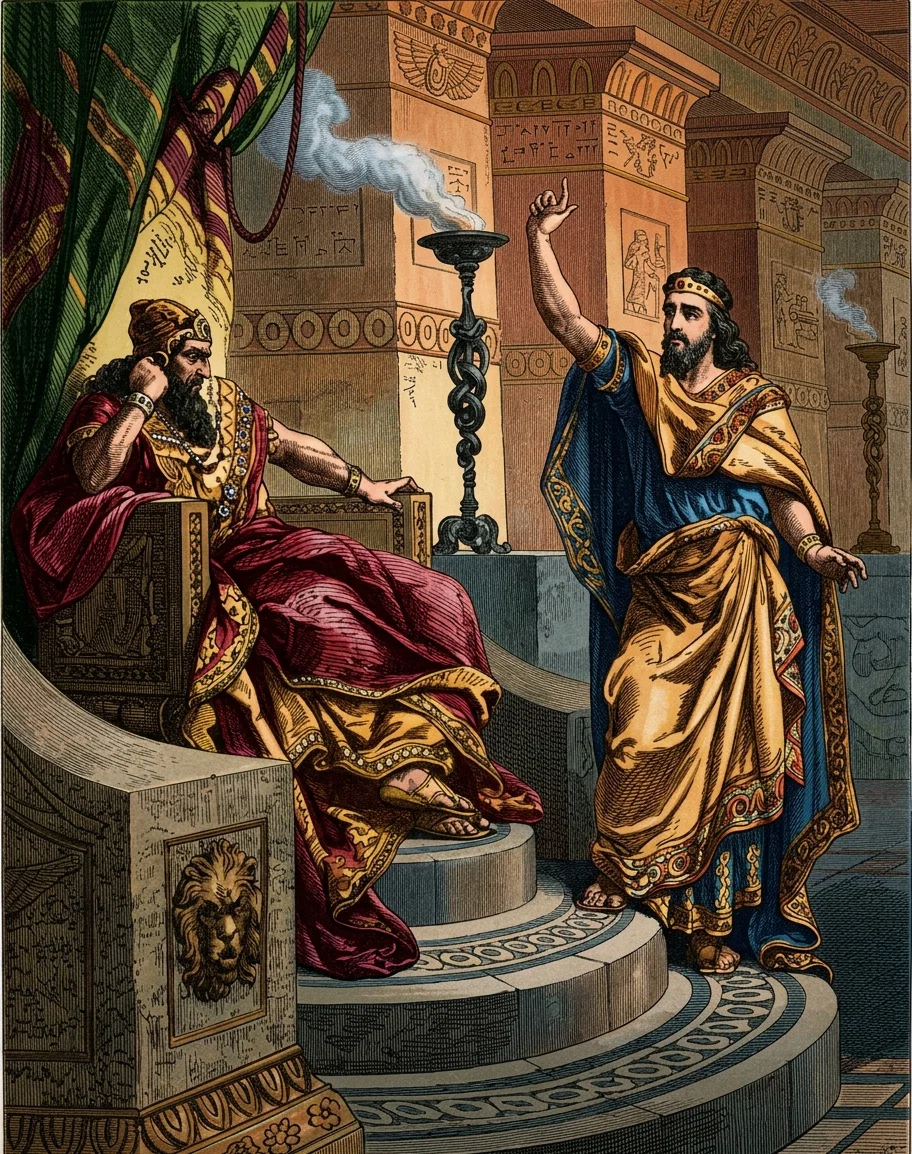
Daniel telling the king his dream and its interpretation
In all the ages of the past, when God’s word has been ignored, and human wisdom exalted in its place, confusion has reigned and final destruction has resulted.
Nimrod was leader in a movement which meant deliberate defiance of God’s word, and the result was confusion and dispersion. Gen. 10: 8-10; 11: 1-9.
The children of Israel failed to follow the Lord’s instructions, until God’s wrath was kindled against them, and Nebuchadnezzar king of Babylon, came and slew thousands with the sword, and destroyed their city, and carried the remainder captive to Babylon. 2 Chron. 36: 17-20. But not until warning after warning had been given them; for the record says: “And the Lord . . . sent to them by His messengers, rising up betimes, and sending. . . . But they mocked the messengers of God, and despised His words, . . . till there was no remedy.” Verses 15, 16; Jer. 25: 8-11.
The universal kingdom of Babylon reached just such a state of pride and independence, and was humbled in the dust, and finally overthrown; and that, too, in the face of explicit warning from the Almighty. “Lift ye up a banner upon the high mountain, exalt the voice unto them, shake the hand, that they may go into the gates of the nobles. . . . They come from a far country, from the end of heaven, even the Lord, and the weapons of His indignation, to destroy the whole land. . . . Behold, I will stir up the Medes against them. . . . And Babylon, the glory of kingdoms. . . . shall be as when God overthrew Sodom and Gomorrah.” Isa. 13: 2, 5, 17, 19.

Nebuchadnezzar’s Troubled Dream

Nebuchadnezzar, the proud king of Babylon, had a dream one night, which troubled him greatly, so much so that “his sleep brake from him.” Then the king commanded to call his wise men to show him the dream and the interpretation, but they were unable to do so. And “for this cause the king was angry and very furious, and commanded to destroy all the wise men of Babylon.” Dan. 2:1-13. Truly God’s thoughts are not our thoughts, neither are our ways His ways. Isa. 55: 8, 9.
In taking the four Hebrew youth, Daniel, Hananiah, Mishael, and Azariah, captive from Jerusalem to Babylon, by the hand of Nebuchadnezzar, the Lord was preparing the way for a mighty revelation of His divine power. The Israelites failed to carry out God’s purpose to convert the heathen from idolatry to the worship of the true God; but instead, transgressed very much after all the abominations of the heathen, until God could no longer suffer them to pollute His holy house. But there were a few faithful ones whom the Lord could make His channels, and do through them what He could not do through a whole nation. Daniel and his three companions were for three years in the king’s palace, where they were taught the tongue of the Chaldeans (Dan. 1:3, 4); and at the end of three years, the king found them to be ten times wiser than all the magicians and astrologers in his realm. Dan. 1:19, 20. Finally Daniel was classed among the wise men, whom the king in his fury commanded to be slain; but Daniel presented the matter before the Lord, and was rewarded by the revelation of both the dream which Nebuchadnezzar had seen, and its interpretation, in a night vision. Dan. 2:16-23.

The Dream and Interpretation Revealed

Then Daniel came before the king to make known to him the dream and the interpretation. In utter astonishment the king said to Daniel, “Art thou able to make known unto me the dream which I have seen, and the interpretation thereof?” Verse 26. Daniel answered: “The secret which the king hath commanded can not the wise men . . . show unto the king; but there is a God in heaven that revealeth secrets, and maketh known to the king Nebuchadnezzar what shall be in the latter days.” Verses 27, 28. A wonderful double stroke which no finite mind could devise—the idolatrous religion of Babylon exposed, and the God of heaven revealed!
A few words and a great image, and the history of the world is given from 603 B.C. to Christ’s second coming to set up His eternal kingdom. Four universal kingdoms were to arise in succession; first Babylon, represented by the head of gold, and another represented by the breast and arms of silver, and a third kingdom of brass. The fourth kingdom was to be as strong as iron, and finally divided into ten kingdoms. Dan. 2: 36-41.
The latter symbol—the ten toes—was part iron and part clay, portraying the broken, ever-to-be-divided state of the fourth kingdom. And altho royalty, by intermarrying, would attempt to bind the ten kingdoms into one again, yet they would not cleave any more than iron and clay would mix. Verses 42, 43.
How true this has been! and how strikingly has this prophecy been fulfilled! It was said of the late queen of Great Britain, that she was grandmother to all Europe. But unity was impossible. Why?—Because God had said it, and nothing that men can do will ever bring about universal peace on this earth. Men may try to arbitrate between nations, and talk disarmament all they please; but God’s word says, “Sudden destruction cometh upon them.” 1 Thess. 5:1-3.

The Four Universal Monarchies of the Vision

Babylon was overthrown when God’s limit of mercy was reached by Belshazzar, in his memorable feast with his lords, his wives, and his concubines; for they drank wine in the sacred vessels of the Lord’s house, and praised the gods of silver and gold. Dan. 5:18-23. The Medes under Darius, and the Persians, led by Cyrus, Darius’s nephew, took the city by stratagem,B.C. 538. The record says: “In that night was Belshazzar . . . slain. And Darius the Median took the kingdom.” Verses 30, 31. Thus the symbol, the breast and arms of silver, represented the Medes and Persians. Dan. 2: 32, 39. The Medo-Persian kingdom met its fate B.C. 361, when Alexander the Great, king of Grecia, took the kingdom. Dan. 8: 4-7, 19-22. Thus the brass represented Grecia.

The Last One Broken into Ten

Rome, the fourth and last universal kingdom, was divided into exactly ten kingdoms; namely, the Alemanni and the Franks in A.D. 351; the Burgundians, the Vandals, and the Suevi in A.D. 406; the Visigoths in A.D. 408; the Anglo-Saxons in A.D. 449; the Ostrogoths and the Lombards in A.D. 453; the Heruli in A.D. 475.
Dear reader, what should concern you and me most to-day, is the statement in Dan. 2:44; for it says, “And in the days of these kings [kingdoms] shall the God of heaven set up a kingdom, which shall . . . break in pieces and consume all these kingdoms, and it shall stand forever.” In the face of such facts and evidences given in God’s word, which prove that we are in the closing days of earth’s history, what is there for us to do but to obey God’s truth, and prepare for the coming of Christ, the eternal King!
The Lord is not dealing with a single nation now, but with all nations; and those who do not obey the gospel, and are deceived by the cry of peace and safety and better times ahead, will meet the doom foretold in God’s warning word. 2 Thess. 1: 7-9; Rev. 6:14-17. Unmixed wrath is to be poured out upon the world, because of idolatrous worship, and rebellion against God’s commandments. Rev. 14: 9, 10. Past history should enable us to see that the limit of God’s mercy is almost reached, and His Spirit will soon give up striving for men, and will leave the rebellious to the full control of Satan for a season of confusion, to end in complete destruction.
But, thank God, there will be a covering for His people, and every obedient soul will be saved out of that destruction. Dan. 12:1; Ps. 91: 7-11. Then shall the Stone become a great mountain, and fill the whole earth; for the dead in Christ shall rise, and swell the ranks of the waiting, triumphant host (1 Thess. 4:14-17); and when the earth is made new, the second Adam will have accomplished what the first Adam failed to do, namely, to replenish the earth with a righteous people. Gen. 1: 28; 2 Peter 3:10-13. Glorious day, hasten on!

The Foundation of Character; Instruction to the Youth

By Mrs. E. G. White
Never did greater responsibilities await the youth than await them now. Never was it more important that a right mold be given to the character of the rising generation. Upon every youth, God has bestowed varied capabilities, mental, moral, and physical; and He requires that those be cultivated and improved. We are formed for activity; every power of mind and body must be developed, strengthened, and increased by use. No one should feel that he is his own master, and can do as he pleases with his time and his intellect. Time and talents belong to God, and He has entrusted them to us, to be employed for His glory.
Christ has purchased us with an infinite price. All that we are, and all that we possess, is His. His mercy and tenderness have been exercised toward us throughout our life, and He justly claims our gratitude, our reverence and love. He claims our obedience also. We should respect His laws in every particular. They are given, not to deprive us of any good, but to guide our feet into safe paths,—the paths of peace and happiness.

Due to Our Creator

Furthermore, our love and obedience are due to God as our Creator. He who has bestowed upon us every blessing which we enjoy, He who has formed us, who understands our needs, and who rejoices in the happiness of the creatures He has made,—He is entitled to our implicit faith and ready obedience. To obey God is to accept the guidance of infinite love and wisdom. It is to pursue a course which will ennoble the character and strengthen the intellect, and which alone will prepare us for a life of true enjoyment and real usefulness. “The fear of the Lord is the beginning of wisdom.”
We are not placed in this world merely to seek the enjoyment of the present life; but by forming a true and noble character, we are to prepare for the future, immortal life. Dear youth, you have a work to do which no other can do for you. Be determined that you will possess a right character. You can not receive this as a birthright, you can not buy it with money, you can not procure it by fraud; but you may have it, if you will seek it in the right way. A noble character must be formed, must be built up by your own patient, painstaking effort, while you rely in faith upon the merits of Christ your Saviour.

Not to Drift with Circumstances

None should look with indifference upon this important matter. We must not leave our character to be formed by circumstances. The farmer who through indolence or neglect leaves his field uncultivated, reaps a harvest of briars and thorns. So the youth who slothfully neglects the cultivation of mind and heart, will possess a deformed, unlovely character. He will not respect himself, and he will not be happy, try hard as he may.
The youth can not afford to float carelessly along, exposed to the many influences that are ready to draw them away from the truth, from religion, from peace and happiness, receiving any impression that Satan may choose to make upon the mind. There are stern battles to fight against hereditary and cultivated faults of character and disposition. Satan watches every opportunity to divert the mind from thoughts of God. He seeks to prevent us from searching the heart, from studying the law of God and comparing our life and character with its perfect standard. We must guard against his wiles. We should ever remember that life is short, and if we would attain to that perfection of character which Christ requires of us, every hour of our probation must be wisely improved as a treasure more precious than gold.
The formation of a good character involves hard work and severe self-denial; but it richly repays the effort. It is a resistance of the devil. It is the obtaining of daily victory over selfishness, pride, and folly, and the daily cultivation of love, mercy, and beneficence.
Satan is constantly seeking to strengthen the evil traits of character, that your influence may be exerted to lead others to a wrong course. Resolve in the strength of God to defeat his purpose. Set your mark high, and conquer self at any cost. Persevering, well-directed labor will succeed.

The Strength for Our Exertion

While excellence of character can never be attained except by your own exertion, do not forget that at every step you need and may obtain help and grace from Christ. He Himself passed through all the experience of childhood and youth, and He knows how to sympathize with the young. He will never forsake a soul that trusts in Him. He will listen to the prayer of the contrite, and will be a present help in every time of need. Do not, then, become discouraged in your efforts. Labor more earnestly for a symmetrical character than for silver or gold. You will meet with disappointments and discouragements. Your efforts may not be appreciated, your failures may call forth severe censure. But do not yield to discouragement. The Saviour pities your weakness, He reads the desire of your heart, and He marks every sincere effort to do the right.
Then be of good courage. Look in faith to Jesus. Be much in prayer. While you are engaged in your work, at home, or at school, or even while walking in the street, let the heart’s silent petitions ascend to God. Have also regular times for prayer, and let them not be neglected. In this course you may be successful in overcoming the evils of your nature; you may enjoy peace, hope, and joy in Christ, and by words and example you may exert an influence to encourage others in the right way.
Do not fear to stand firm for the right under any and all circumstances. Do not think it uncourteous to meet with a decided “No,” those who would suggest evil thoughts, or would urge you to any act which God would not approve.
When “sinners entice thee, consent thou not.” Do they sneeringly call you a coward,tell them that if it is cowardly to fear to do wrong, then you are a coward. The bravery that is evinced in sacrificing principle, for fear of ridicule, is a low, satanic spirit that you should ever hold in contempt.
“Dare to be a Daniel! Dare to stand alone! Dare to have a purpose firm! Dare to make it known!”

One Sabbath

THE Old Testament Sabbath and the New Testament Sabbath are one and the same. There has been no change either in letter or in spirit. The law of God stands to-day the same that it was when spoken from Sinai. Men may invent plausible theories, but God’s word, not man’s, is always the test of truth. “To the law and to the testimony: if they speak not according to this word, it is because there is no light in them.”—L. A. Smith.

Faith, Hope, and Love

“FAITH, hope, love; . . . the greatest of these is love.”
Continue reading: THE WITNESSING OF GOD: THE BASIS OF OUR CONFIDENCE