Review and Herald, Vol. 92, No. 55 Extra No. 11

The Sanctuary

Review and Herald

Nov 8, 1915

Review and Herald Publishing Association · Takoma Park, Washington, D. C. · Nov 8, 1915

The Sanctuary

The Atonement in Type and Antitype

By Mrs. E. G. White
The apostle Paul, in the epistle to the Hebrews, says: “Then verily the first covenant had also ordinances of divine service, and a worldly sanctuary. For there was a tabernacle made; the first, wherein was the candlestick, and the table, and the showbread; which is called the sanctuary. And after the second veil, the tabernacle which is called the holiest of all; which had the golden censer, and the ark of the covenant overlaid round about with gold, wherein was the golden pot that had manna, and Aaron’s rod that budded, and the tables of the covenant; and over it the cherubims of glory shadowing the mercy seat.”

The Tabernacle in the Wilderness

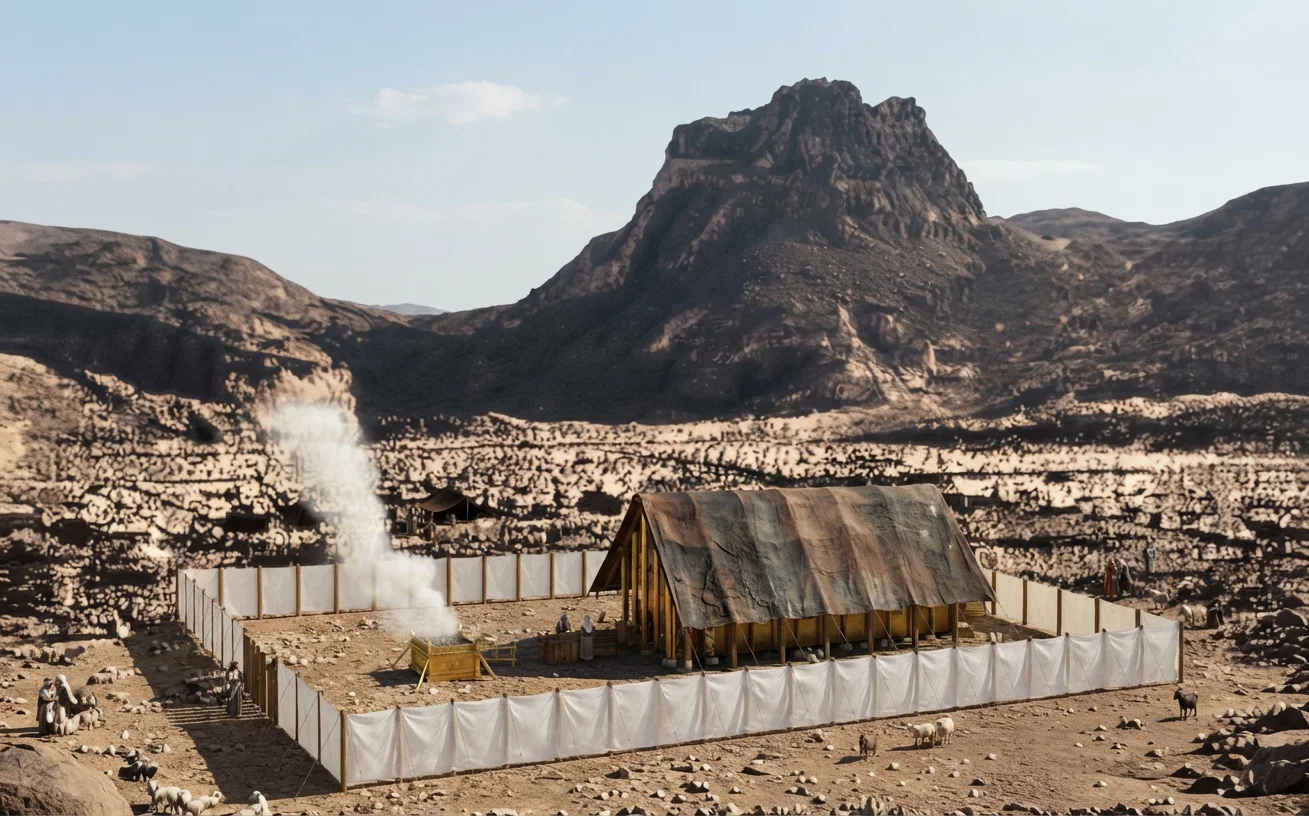
The sanctuary to which Paul here refers was the tabernacle built by Moses at the command of God, as the earthly dwelling place of the Most High. “Let them make me a sanctuary; that I may dwell among them,” was the direction given to Moses while in the mount with God. The Israelites were journeying through the wilderness, and the tabernacle was so constructed that it could be removed from place to place; yet it was a structure of great magnificence. Its walls consisted of upright boards heavily plated with gold, and set in sockets of silver, while the roof was formed of a series of curtains or coverings, the outer of skins, the innermost of fine linen beautifully wrought with figures of cherubim. Besides the outer court, which contained the altar of burnt offering, the tabernacle itself consisted of two apartments called the holy and the most holy place, separated by a rich and beautiful curtain, or veil; a similar veil closed the entrance to the first apartment.
ON THE RIGHT HAND OF GOD
In the holy place was the candlestick, on the south, with its seven lamps giving light to the sanctuary both by day and by night; on the north stood the table of showbread; and before the veil separating the holy from the most holy was the golden altar of incense, from which the cloud of fragrance, with the prayers of Israel, was daily ascending before God. In the most holy place stood the ark, a chest of precious wood overlaid with gold, the depository of the two tables of stone upon which God had inscribed the law of ten commandments. Above the ark, and forming the cover to the sacred chest, was the mercy seat, a magnificent piece of workmanship, surmounted by two cherubim, one at each end, and all wrought of solid gold. In this apartment the divine presence was manifested in the cloud of glory between the cherubim.

Solomon’s Temple

After the settlement of the Hebrews in Canaan, the tabernacle was replaced by the temple of Solomon, which, though a permanent structure and upon a larger scale, observed the same proportions, and was similarly furnished. In this form the sanctuary existed—except while it lay in ruins in Daniel’s time—until its destruction by the Romans in A. D. 70.
This is the only sanctuary that ever existed on the earth, of which the Bible gives any information. This was declared by Paul to be the sanctuary of the first covenant. But has the new covenant no sanctuary? Turning again to the book of Hebrews, we find that the existence of a second, or new covenant, sanctuary was implied in the words of Paul already quoted: “Then verily the first covenant had also ordinances of divine service, and a worldly sanctuary.” And the use of the word “also” intimates that Paul has before made mention of this sanctuary. Turning back to the beginning of the previous chapter, we read: “Now of the things which we have spoken this is the sum: We have such an high priest, who is set on the right hand of the throne of the Majesty in the heavens; a minister of the sanctuary, and of the true tabernacle, which the Lord pitched, and not man.”

The Heavenly Sanctuary

Here is revealed the sanctuary of the new covenant. The sanctuary of the first covenant was pitched by man, built by Moses; this is pitched by the Lord, not by man. In that sanctuary the earthly priests performed their service; in this, Christ, our great high priest, ministers at God’s right hand. One sanctuary was on earth, the other one is in heaven.

Patterns of Things in the Heavens

Further, the tabernacle built by Moses was made after a pattern. The Lord directed him, “According to all that I show thee, after the pattern of the tabernacle, and the pattern of all the instruments thereof, even so shall ye make it.” And again the charge was given, “Look that thou make them after their pattern, which was showed thee in the mount.” And Paul says that the first tabernacle “was a figure for the time then present, in which were offered both gifts and sacrifices;” that the holy places were “patterns of things in the heavens;” that the priests who offered gifts according to the law, served “unto the example and shadow of heavenly things;” and that “Christ is not entered into the holy places made with hands, which are the figures of the true, but into heaven itself, now to appear in the presence of God for us.”

A Glorious Type of God’s Dwelling Place

The sanctuary in heaven, in which Jesus ministers in our behalf, is the great original, of which the sanctuary built by Moses was a copy. God placed the Jews upon the borders of the earthly sanctuary. The artistic skill displayed in its construction was a manifestation of divine wisdom. The walls had the appearance of massive gold, reflecting in every direction the light of the seven lamps of the golden candlestick. The table of showbread and the altar of incense glittered like burnished gold. The gorgeous curtain which formed the ceiling, inwrought with figures of angels in blue and purple and scarlet, added to the beauty of the scene. And beyond the second veil was the holy Shekinah, the visible manifestation of God’s glory, before which none but the high priest could enter and live. The matchless splendor of the earthly tabernacle reflected to human vision the glories of this heavenly temple where Christ our forerunner ministers for us before the throne of God. The abiding place of the King of kings, where thousand thousands minister unto him, and ten thousand times ten thousand stand before him; that temple, filled with the glory of the eternal throne, where seraphim, its shining guardians, veil their faces in adoration, could find, in the most magnificent structure ever reared by human hands, but a faint reflection of its vastness and glory. Yet important truths concerning the heavenly sanctuary and the great work there carried forward for man’s redemption, were taught by the earthly sanctuary and its services.

John’s Vision of the Sanctuary in Heaven

The holy places of the sanctuary in heaven are represented in the two apartments in the sanctuary on earth. As in vision the apostle John was granted a view of the temple of God in heaven, he beheld there “seven lamps of fire burning before the throne.” He saw an angel “having a golden censer; and there was given unto him much incense, that he should offer it with the prayers of all saints upon the golden altar which was before the throne.” Here the prophet was permitted to behold the first apartment of the sanctuary in heaven; and he saw there the “seven lamps of fire” and the “golden altar,” represented by the golden candlestick and the altar of incense in the sanctuary on earth. Again, “the temple of God was opened,” and he looked within the inner veil, upon the holy of holies. Here he beheld “the ark of his testament,” represented by the sacred chest constructed by Moses to contain the law of God. Thus from a study of this subject is found indisputable proof of the existence of a sanctuary in heaven. Moses made the earthly sanctuary after a pattern which was shown him. Paul teaches that that pattern was the true sanctuary which is in heaven. And John testifies that he saw it in heaven.

God’s Righteous Law the Foundation of His Throne

In the temple in heaven, the dwelling place of God, his throne is established in righteousness and judgment. In the most holy place is his law, the great rule of right by which all mankind are tested. The ark that enshrines the tables of the law is covered with the mercy seat, before which Christ pleads his blood in the sinner’s behalf. Thus is represented the union of justice and mercy in the plan of human redemption. This union infinite wisdomalone could devise, and infinite power accomplish; it is a union that fills all heaven with wonder and adoration. The cherubim of the earthly sanctuary, looking reverently down upon the mercy seat, represent the interest with which the heavenly host contemplate the work of redemption. This is the mystery of mercy into which the angels desire to look,—that God can be just while he justifies the repenting sinner, and renews his intercourse with the fallen race; that Christ could stoop to raise unnumbered multitudes from the abyss of ruin, and clothe them with the spotless garments of his own righteousness, to unite with angels who have never fallen, and to dwell forever in the presence of God.

Christ Our Intercessor

The work of Christ as man’s intercessor is presented in that beautiful prophecy of Zechariah concerning him “whose name is The Branch.” Says the prophet: “He shall build the temple of the Lord; and he shall bear the glory, and shall sit and rule upon his [the Father’s] throne; and he shall be a priest upon his throne; and the counsel of peace shall be between them both.”
“He shall build the temple of the Lord.” By his sacrifice and mediation, Christ is both the foundation and the builder of the church of God. The apostle Paul points to him as “the chief corner stone; in whom all the building fitly framed together groweth unto an holy temple in the Lord: in whom ye also,” he says, “are builded together for an habitation of God through the Spirit.” “He shall bear the glory.” To Christ belongs the glory of redemption for the fallen race. Through the eternal ages, the song of the redeemed ones will be, “Unto him that loved us, and washed us from our sins in his own blood, . . . to him be glory and dominion forever and ever.” He “shall sit and rule upon his throne; and he shall be a priest upon his throne.” Not now “upon the throne of his glory;” the kingdom of glory has not yet been ushered in. Not until his work as a mediator shall be ended, will God “give unto him the throne of his father David,” a kingdom of which “there shall be no end.” As a priest, Christ is now set down with the Father in his throne. Upon the throne with the eternal, self-existent One, is he who “hath borne our griefs, and carried our sorrows,” who “was in all points tempted like as we are, yet without sin,” that he might be “able to succor them that are tempted.” “If any man sin, we have an advocate with the Father.” His intercession is that of a pierced and broken body, of a spotless life. The wounded hands, the pierced side, the marred feet, plead for fallen man, whose redemption was purchased at such infinite cost. “And the counsel of peace shall be between them both.” The love of the Father, no less than of the Son, is the fountain of salvation for the lost race. Said Jesus to his disciples, before he went away, “I say not unto you, that I will pray the Father for you: for the Father himself loveth you.” God was “in Christ, reconciling the world unto himself.” And in the ministration in the sanctuary above, “the counsel of peace shall be between them both.” “God so loved the world, that he gave his only-begotten Son, that whosoever believeth in him should not perish, but have everlasting life.”

What Is the Sanctuary?

The question, What is the sanctuary? is clearly answered in the Scriptures. The term “sanctuary,” as used in the Bible, refers, first, to the tabernacle built by Moses, as a pattern of heavenly things; and, secondly, to the “true tabernacle” in heaven, to which the earthly sanctuary pointed. At the death of Christ the typical service ended. The “true tabernacle” in heaven is the sanctuary of the new covenant. And as the prophecy of Dan. 8:14 is fulfilled in this dispensation, the sanctuary to which it refers must be the sanctuary of the new covenant. At the termination of the 2300 days, in 1844, there had been no sanctuary on earth for many centuries. Thus the prophecy, “Unto two thousand and three hundred days; then shall the sanctuary be cleansed,” unquestionably points to the sanctuary in heaven.

What Is the Cleansing of the Sanctuary?
But the most important question remains to be answered: What is the cleansing of the sanctuary? That there was such a service in connection with the earthly sanctuary, is stated in the Old Testament Scriptures. But can there be anything in heaven to be cleansed? In Hebrews 9 the cleansing of both the earthly and the heavenly sanctuary is plainly taught. “Almost all things are by the law purged with blood; and without shedding of blood is no remission. It was therefore necessary that the patterns of things in the heavens should be purified with these [the blood of animals]; but the heavenly things themselves with better sacrifices than these,” even the precious blood of Christ.
THE TABERNACLE IN THE WILDERNESS

Cleansing With Blood

The cleansing, both in the typical and in the real service, must be accomplished with blood; in the former, with the blood of animals; in the latter, with the blood of Christ. Paul states, as the reason why this cleansing must be performed with blood, that without the shedding of blood is no remission. Remission, or putting away of sin, is the work to be accomplished. But how could there be sin connected with the sanctuary, either in heaven or upon the earth? This may be learned by reference to the symbolic service; for the priests who officiated on earth, served “unto the example and shadow of heavenly things.”

The Service of the Earthly Sanctuary

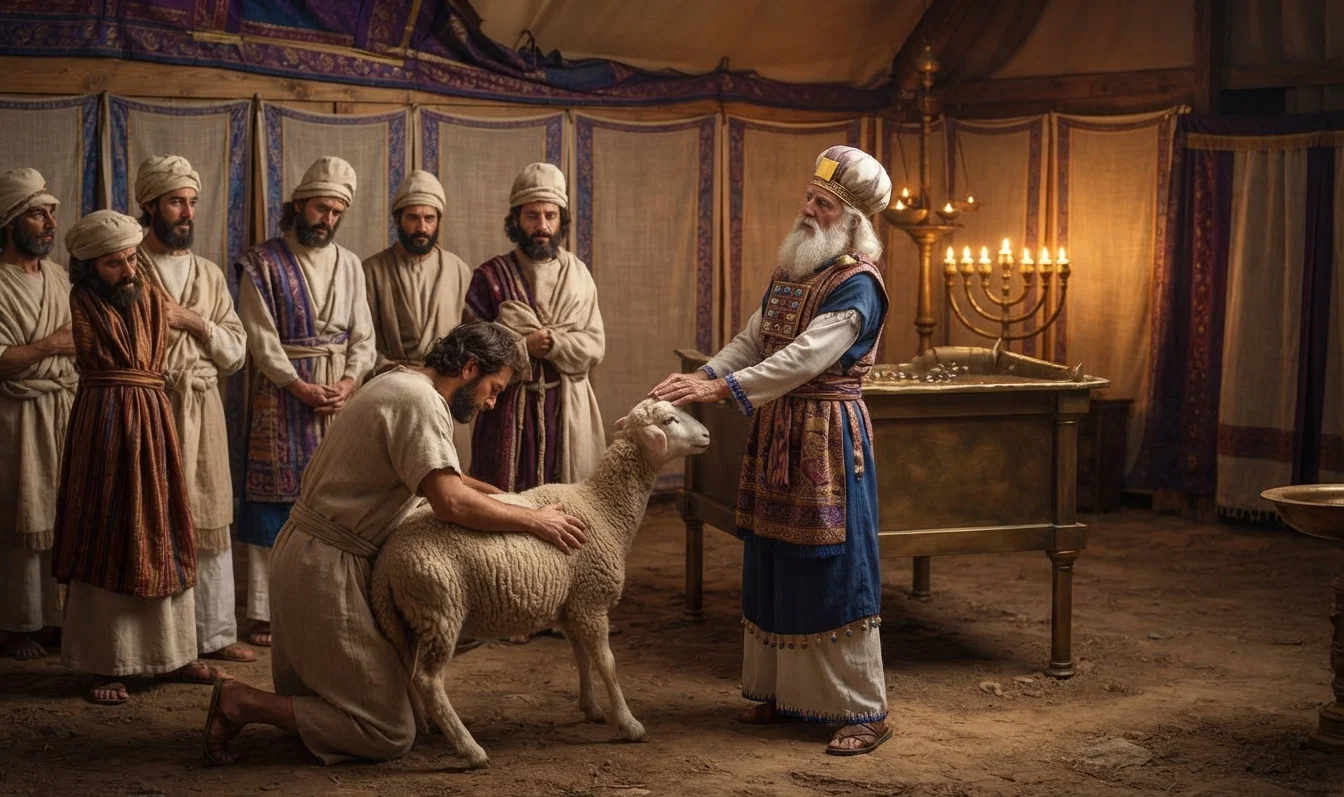
The ministration of the earthly sanctuary consisted of two divisions: the priests ministered daily in the holy place, while once a year the high priest performed a special work of atonement in the most holy, for the cleansing of the sanctuary. Day by day the repentant sinner brought his offering to the door of the tabernacle, and placing his hand upon the victim’s head, confessed his sins, thus in figure transferring them from himself to the innocent sacrifice. The animal was then slain. “Without shedding of blood,” says the apostle, there is no remission of sin. “The life of the flesh is in the blood.” The broken law of God demanded the life of the transgressor. The blood, representing the forfeited life of the sinner, whose guilt the victim bore, was carried by the priest into the holy place and sprinkled before the veil, behind which was the ark containing the law that the sinner had transgressed. By this ceremony the sin was, through the blood, transferred in figure to the sanctuary. In some cases the blood was not taken into the holy place; but the flesh was then to be eaten by the priest, as Moses directed the sons of Aaron, saying, “God hath given it you to bear the iniquity of the congregation.” Both ceremonies alike symbolized the transfer of the sin from the penitent to the sanctuary.

The Great Day of Atonement

Such was the work that went on, day by day, throughout the year. The sins of Israel were thus transferred to the sanctuary, and a special work became necessary for their removal. God commanded that an atonement be made for each of the sacred apartments. “He shall make an atonement for the holy place, because of the uncleanness of the children of Israel, and because of their transgressions in all their sins; and so shall he do for the tabernacle of the congregation, that remaineth among them in the midst of their uncleanness.” An atonement was also to be made for the altar, to “cleanse it, and hallow it from the uncleanness of the children of Israel.” Once a year, on the great day of atonement, the priest entered the most holy place for the cleansing of the sanctuary. The work there performed completed the yearly round of ministration. On the day of atonement two kids of the goats were brought to the door of the tabernacle, and lots were cast upon them, “one lot for the Lord, and the other lot for the scapegoat.”
The goat upon which fell the lot for the Lord was to be slain as a sin offering for the people. And the priest was to bring his blood within the veil, and sprinkle it upon the mercy seat, and before the mercy seat. The blood was also to be sprinkled upon the altar of incense, that was before the veil. “And Aaron shall lay both his hands upon the head of the live goat, and confess over him all the iniquities of the children of Israel, and all their transgressions in all their sins, putting them upon the head of the goat, and shall send him away by the hand of a fit man into the wilderness; and the goat shall bear upon him all their iniquities unto a land not inhabited.” The scapegoat came no more into the camp of Israel, and the man who led him away was required to wash himself and his clothing with water before returning to the camp. The whole ceremony was designed to impress the Israelites with the holiness of God and his abhorrence of sin; and, further, to show them that they could not come in contact with sin without becoming polluted. Every man was required to afflict his soul while this work of atonement was going forward. All business was to be laid aside, and the whole congregation of Israel were to spend the day in solemn humiliation before God, with prayer, fasting, and deep searching of heart.

The Meaning of This Typical Service

Important truths concerning the atonement are taught by the typical service. A substitute was accepted in the sinner’s stead; but the sin was not canceled by the blood of the victim. A means was thus provided by which it was transferred to the sanctuary. By the offering of blood, the sinner acknowledged the authority of the law, confessed his guilt in transgression, and expressed his desire for pardon through faith in a Redeemer to come; but he was not yet entirely released from the condemnation of the law. On the day of atonement the high priest, having taken an offering from the congregation, went into the most holy place with the blood of this offering, and sprinkled it upon the mercy seat, directly over the law, to make satisfaction for its claims. Then, in his character of mediator, he took the sins upon himself and bore them from the sanctuary. Placing his hands upon the head of the scapegoat, he confessed over him all these sins, thus in figure transferring them from himself to the goat. The goat then bore them away, and they were regarded as forever separated from the people.

The Work of Christ Our Great High Priest

Such was the service performed “unto the example and shadow of heavenly things.” And what was done in type in the ministration of the earthly sanctuary, is done in reality in the ministration of the heavenly sanctuary. After his ascension, our Saviour began his work as our high priest. Says Paul, “Christ is not entered into the holy places made with hands, which are the figures of the true; but into heaven itself, now to appear in the presence of God for us.” The ministration of the priest throughout the year in the first apartment of the sanctuary, “within the veil” which formed the door and separated the holy place from the outer court, represents the work of ministration upon which Christ entered at his ascension. It was the work of the priest in the daily ministration to present before God the
blood of the sin offering, also the incense which ascended with the prayers of Israel. So did Christ plead his blood before the Father in behalf of sinners, and present before him also, with the precious fragrance of his own righteousness, the prayers of penitent believers. Such was the work of ministration in the first apartment of the sanctuary in heaven. Thither the faith of Christ’s disciples followed him as he ascended from their sight. Here their hopes centered, “which hope we have,” said Paul, “as an anchor of the soul, both sure and steadfast, and which entereth into that within the veil; whither the forerunner is for us entered, even Jesus, made an high priest forever.” “Neither by the blood of goats and calves, but by his own blood he entered in once into the holy place, having obtained eternal redemption for us.”
For eighteen centuries this work of ministration continued in the first apartment of the sanctuary. The blood of Christ, pleaded in behalf of penitent believers, secured their pardon and acceptance with the Father, yet their sins still remained upon the books of record. As in the typical service there was a work of atonement at the close of the year, so before Christ’s work for the redemption of men is completed, there is a work of atonement for the removal of sin from the sanctuary. This is the service which began when the 2300 days ended. At that time, as foretold by Daniel the prophet, our High Priest entered the most holy, to perform the last division of his solemn work—to cleanse the sanctuary.

The Cleansing of the Sanctuary in Heaven

As anciently the sins of the people were by faith placed upon the sin offering, and through its blood transferred, in figure, to the earthly sanctuary; so in the new covenant the sins of the repentant are by faith placed upon Christ, and transferred, in fact, to the heavenly sanctuary. And as the typical cleansing of the earthly was accomplished by the removal of the sins by which it had been polluted, so the actual cleansing of the heavenly is to be accomplished by the removal, or blotting out, of the sins which are there recorded. But before that can be accomplished, there must be an examination of the books of record to determine who, through repentance of sin and faith in Christ, are entitled to the benefits of his atonement. The cleansing of the sanctuary, therefore, involves a work of investigation—a work of judgment. This work must be performed prior to the coming of Christ to redeem his people; for when he comes, his reward is with him to give to every man according to his works.—“The Great Controversy,” pages 411-422.

The Subject Introduced

By Uriah Smith
The sanctuary — what is it? when is it? where is it? What are its uses, and why? What its relations, and how extensive? What part does it act in the great scheme of human redemption? What prominence is given to it on the inspired pages of the Book of God's revelation to men? What bearing has it upon the interpretation of the prophecies? How is its past history calculated to interest, or how does its present work concern us? What claims has it upon our attention? In what way are our dearest interests connected with it?
The traveler who visits those marked spots where nature has displayed her most marvelous works or her profoundest mysteries, avails himself of the aid of a guide, who has explored each perilous path, knows the way to wonders and beauties hidden from a stranger's eye, and understands what dangers beset the steps of the unwary. We have to some extent explored this remarkable subject, and would be glad to point out to him who has not made it his study some of the beauties we have discovered, though we may have been able to explore but a small proportion of the whole. Those who have acquainted themselves with what the Bible teaches upon this question, will understand the correctness of the following statements. To those who have not, we will offer abundant proof of their truthfulness, if they will go with us in this investigation.

The Center of the Gospel Plan

Let us then say, by way of anticipation, that the sanctuary is a great central object in the plan of salvation. Next to our Lord himself and his work, it claims our attention, as the place where the wonderful process of a world's redemption is carried forward.
There is no one subject which so fully as this unites together all parts of revelation into one harmonious whole. The spokes of a wheel, considered by themselves and apart, may be symmetrical and beautiful; but their uses are made apparent and their utility demonstrated only when, fixed together by a central hub and exterior fellies, they appear as component parts of a perfect wheel. In the great wheel of truth, the sanctuary occupies this central position. In it, the great truths of revelation find their focal point. From it, in every direction, they radiate. It unites the two great dispensations, the Mosaic and the Christian, and shows their relation to each other. It divides with no other subject the high honor of explaining the purpose and work of our Lord Jesus Christ. Like a brilliant lamp introduced into a darkened room, it illuminates the whole Mosaic economy. In the light of this subject, the books of Moses, with their detail of offerings and sacrifices, their minutiae of rites and ceremonies, usually considered so void of interest and use, if not of meaning also, become animated with life and radiant with consistency and beauty.

A Key to Prophecy

It is a key to the interpretation of the most important prophecies which are having their fulfillment at the present time. We confidently assert that no person who either ignores this subject or misapprehends it can rightly interpret the prophecies for this time. With this subject understood, it is almost as difficult to come to wrong conclusions as it is otherwise impossible to reach correct ones. These may seem like bold and rash assertions; but they are uttered only under the firmest conviction that they can be made good to the mind of every intelligent and candid reader.
We therefore call the attention of all to the subject of the sanctuary as one of great importance, interest, and profit.
It is a subject of great importance on account of the position it holds in the divine plan.
It is one of interest, so intimately is it connected with the work of our redemption.
Received, it will affect the life, to elevate and sanctify, and so be found at last to be one of infinite profit.—Introduction to "The Sanctuary."

Christ Our High Priest

“Now of the things which we have spoken this is the sum: We have such an high priest, who is set on the right hand of the throne of the Majesty in the heavens; a minister of the sanctuary, and of the true tabernacle, which the Lord pitched, and not man.” Heb. 8: 1, 2.

Christ in Type and Shadow

By S. N. Haskell
ETERNITY can never fathom the depth of love revealed in the cross of Calvary. It was there that the infinite love of Christ and the unbounded selfishness of Satan stood face to face. The entire system of Judaism, with its types and symbols, was a shadow of the cross, extending from Calvary back to the gate of Eden, and contained a compacted prophecy of the gospel.
At the present day the person who comes to the study of the New Testament through the interpreting lights of the types and symbols of the Levitical services, finds a depth and richness in the study that are found in no other way. It is impossible to have exalted views of Christ's atoning work if the New Testament is studied without a previous knowledge of the deep, blood-stained foundations in the Old Testament gospels of Moses and the prophets.
"In every sacrifice, Christ's death was shown. In every cloud of incense his righteousness ascended. By every jubilee trumpet his name was sounded. In the awful mystery of the holy of holies his glory dwelt."
THE DAILY SACRIFICE
THE DAILY SACRIFICE
In the light shining from the sanctuary, the books of Moses with their detail of offerings and sacrifices, their rites and ceremonies usually considered so meaningless and void of interest, become radiant with consistency and beauty. There is no other subject which so fully unites all parts of the inspired Word into one harmonious whole, as the subject of the sanctuary. Every gospel truth centers in the sanctuary service, and radiates from it like the rays from the sun.
Every type used in the entire sacrificial system was designed by God to bear resemblance to some spiritual truth. The value of these types consisted in the fact that they were chosen by God himself to shadow forth the different phases of the complete plan of redemption,made possible by the death of Christ. The likeness between type and antitype is never accidental, but is simply a fulfillment of the great plan of God.
In the cross of Christ I glory, Towering o'er the wrecks of time; All the light of sacred story Gathers round its head sublime.
When the woes of life o'ertake me, Hopes deceive, and fears annoy, Never shall the cross forsake me; Lo! it glows with peace and joy.
When the sun of bliss is beaming Light and love upon my way, From the cross the radiance streaming Adds new luster to the day.
Bane and blessing, pain and pleasure, By the cross are sanctified; Peace is there that knows no measure, Joys that through all time abide.
In the cross of Christ I glory, Towering o'er the wrecks of time; All the light of sacred story Gathers round its head sublime.
Continue reading: The Sanctuary