Your ShelfYour Projects

Review and Herald, Vol. 88, No. 51.

Have You Seen It?

Review and Herald

Dec 21, 1911

Review and Herald Publishing Association · Takoma Park Station, Washington, D. C. · Dec 21, 1911

Have You Seen It?

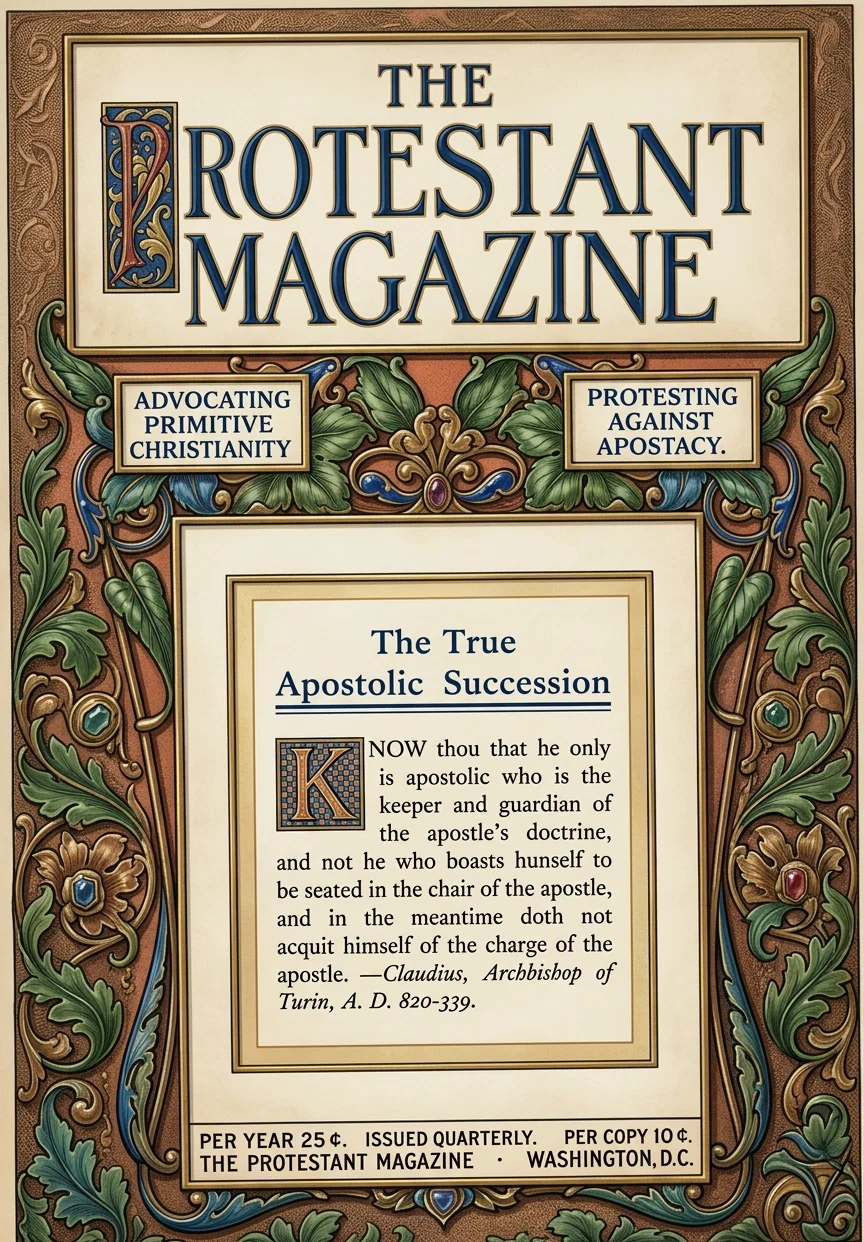
The “Roman Peril” Number of

The Protestant Magazine

Is Already Creating a Sensation in the Literary World
The striking double-frontispiece pictures showing the Pope in contrast with the humble “Christ before Pilate” preach a most eloquent sermon, which appeals to honest Catholics as well as true Protestants.
25 Cents a Year, 10 Cents a Copy

ROME EVER THE SAME

The following brief extracts are taken from an editorial one foot long which appeared in the “Catholic Columbian” (Columbus, Ohio), August 18, 1911:—
“The ‘Protestant Magazine’ will be repudiated by all decent Protestants, no matter of what denomination. Thousands of copies of these lying and scurrilous publications are being distributed free. The enemies of free representative government seem to be able to secure funds to carry on their nefarious work. Let us meet their foul propaganda by distributing Catholic literature at every opportunity.
“It is in no way lawful to demand, to defend, or to grant promiscuous freedom of thought, of speech, of writing, or of religion, as if they were so many rights which nature had given to man.”—Pope Leo XIII, in Encyclical on Liberty, issued June 20, 1888.
“Resolved, That the Congress of the United States be earnestly requested to amend Section 3893 of the revised statutes of the United States relating to the mailing of ‘obscene, lewd, and lascivious’ literature so that the same may include the mailing of books, papers, writings, and prints which outrage religious convictions of our citizens, and contain scurrilous and slanderous attacks upon Faith.”—Resolutions, Ninth Annual Convention, American Federation of Catholic Societies, New Orleans, La., Nov. 13-16, 1910. See page 12 of “Bulletin of A. F. of C. S.,” for September-October, 1911.

MAKING MANY FRIENDS

Hundreds of letters of congratulation are pouring into this office accompanied by long lists of yearly subscriptions.
A government official in Washington, D. C., writes:—
“American Protestantism is in need of just such a publication as you are putting out in the ‘Protestant Magazine.’ If you are selling through the news agencies, you may expect to have your orders from these sources stopped at any time. Trust you will not use my name. These pamphlets will not stand for reason and meet arguments in an open-handed manner, but instead, resort to the boycott.”
Accompanying his second list of subscriptions, a Lutheran pastor of Iowa writes:—
“I shall continue to get new subscribers. I shall always remember you and the work you are connected with, in my prayers.”

Special Offer on Ten, One Year

10 or more copies, one year, to one address, or to 10 separate addresses, cash with order, only 15 cents each. Sender may include his own name as one of the ten.
A good proposition for agents. Send 10 cents for sample copy and particulars.

Order Through Your Tract Society

“The church has persecuted. Only a tyro in church history will deny that. . . . We have always defended the persecution of the Huguenots, and the Spanish Inquisition. . . . When she thinks it good to use physical force, she will use it. . . . But will the Catholic Church give bond that she will not persecute at all? Will she guarantee absolute freedom and equality of all churches and all faiths? The Catholic Church gives no bonds for her good behavior.”—Editorial in “Western Watchman” (Catholic), Dec. 24, 1908.
The Massachusetts Religious Liberty Association has already collected sufficient funds to send “Liberty,” one year, to 500 public-school superintendents and principals in that State. Is your list in?
Until January 15, fifteen numbers of “Life and Health” for $1. See offer below. Now, JUST NOW, is the time to circulate “Liberty” and the “Protestant Magazine”! Why? Read Rome’s plan to exclude anti-Catholic publications from the United States mails. Are your State legislators supplied for one year?

The January Number of

LIFE & HEALTH

IS SELLING FAST!

Cover Design Printed in Three Colors
To see it is to know why. The beautiful snow scene on the cover, “Winter in Yosemite Valley,” is a work of art, and well worth more than 10 cents.
Until Jan. 15, 1912, all subscribers for one year will receive, in addition to the 12 numbers for 1912, the beautiful October, November, and December issues free of charge,—15 months for $1.

New Department

In “Questions and Answers,” the editor will reply to all reasonable questions by subscribers. Subscribe now. Send $3 for 5 years’ subscription; $2 for 3 years’; or $1 for 15 months’, as offered above.
We want you as our agent in your town. Send 10 cents for sample copy and particulars. Also induce your friends to become agents.
Cover Design Printed in Three Colors

SOME FEATURES

Frontispiece — “Cathedral Spires,” Yosemite Valley, Cal.
The Benediction of the Snow, by George Wharton James. (6 illustrations.) “It falls upon the just and the unjust, the beautiful and the ugly.” Article written especially for this magazine.
What Is True Success? by F. W. Fitzpatrick. A great personal question. What notable dying people have said. A valuable analysis.
How Two Mothers Cared for Their Babies: Why One Succeeded and the Other Failed, by Lauretta Kress, M. D., of the Loma Linda (Cal.) Sanitarium staff. (5 illustrations.) The third and final article, telling how Mrs. Franklin’s baby boy was saved through the advice of Mrs. Lake.
Health Work in Milwaukee, by Carl D. Thompson, city clerk. (7 illustrations.) What a socialist city government is doing to solve the problems of public health, wages, and the abolition of slums and other insanitary conditions.
The Significance of Feeble-Mindedness, by Henry H. Goddard, M. D. (Chart showing feeble-minded family tree.) A leading cause of crime, prostitution, and pauperism. How to prevent these terrible conditions.
Paper-Bag Cookery (illustrated), by Geo. E. Cornforth, chef, New England Sanitarium. A revolution in modern cookery fully explained. How to avoid the cleaning of dirty pots and kettles. Many valuable recipes.
Questions and Answers. A new department of great value to every subscriber or reader of this magazine.
Chicago Vice Commission’s Report Barred From the Mails.
Experiences of a Nurse in Uruguay.
Total Abstinence as a Business Proposition.
Report of Minneapolis Vice Commission.
Drink and Higher Education.
The Brewers’ Show in Chicago, and 63 other articles.

Earn Your Own Subscription

By sending us two new subscriptions at $1 each, you may earn your own yearly subscription, including the three extra numbers offered above. These three extra numbers will also be sent to your two subscribers.
Send $2 for 50 copies; sell 20 to get your money back; then sell or give away the other 30 copies in the interests of true health reform.

PRICES

$1.00 a Year, 10 Cents a Copy; 5 to 40 Copies, 5 Cents each; 50 or More Copies, 4 Cents Each.

Send all Orders Through Your Tract Society

• Come and Be at Rest

JAMES POE-CRYDER
I HAVE no light; the way is wrapped in gloom, While far I stray; I fear the awful mist that shrouds the tomb, That bars my way. Come thou, O Christ, a little nearer come, And with thy changeless light, light thou me home.
What holds the silent grave, the voiceless grave? I faint with fear! Is there no God of love that still can save, That yet can hear? O loving Christ! I cast my fears on thee. Come thou, thou fount of love, O come to me!
“I am the way,” I hear thy voice at last, “The way and light, To him who sees by faith, the night is past, The mist of night. Then come to me, and lie upon my breast, Thou one of sorrow, come and be at rest.”
Gillespieville, Ohio.

The Privilege of Prayer

E. K. SLADE
THE throne of grace is too little appreciated by the children of God. It has been provided at an infinite sacrifice. To make it possible, it was necessary to satisfy the demands of heaven's broken law by the sacrifice of the sinless Son of God, by which act the law was magnified and made honorable. Through this sacrifice there came into existence a dispensation of grace, or favor. The kingdom of grace and the throne of grace have been in existence, and the privilege of prayer has been granted to sinners, for nearly six thousand years. That that dispensation, that kingdom, that throne, and the privilege of prayer will soon all come to an end, can not be questioned by the student of prophecy. Imagine, if possible, the hopeless state of humanity if suddenly and without warning the privilege of entering into the presence of the King should come to an end.
When it was known by Mordecai that all the Jews of the kingdom were doomed to die, he immediately appealed to his niece, Esther the queen, to go into the presence of the king and intercede for her people. She declined to do so on the ground that it was an offense punishable by death for one uninvited to enter into the inner court before the king, no matter how urgent the mission. Nothing could save her unless the king should graciously extend his scepter to her. The gravity of the situation in this instance was urged upon her; and after much prayer in her behalf by the Jewish people, she ventured into the forbidden place and stood before the king. But a way had been provided whereby she escaped immediate punishment by death. We read: “And it was so, when the king saw Esther the queen standing in the court, that she found favor in his sight. . . . Then said the king unto her, What wilt thou, Queen Esther? and what is thy request? it shall be even given thee to the half of the kingdom.” This remarkable experience is always read with deep interest. Ordinarily it meant death for one to do as Esther did, but through favor found in the sight of the king, her life was spared, and the privilege of prayer was granted to her.
We still have a throne of grace, or favor. Through Christ, the scepter “full of grace,” extended to us, we are permitted to enter into the royal presence, and find favor in the sight of the King. Though deserving to die, we are permitted to live and make our requests known unto God, with the assurance that they will be granted. Esther went before Ahasuerus with great fear and trembling. For us the way is fully open, and the favor ample, for “the grace of God that bringeth salvation hath appeared to all men,” making it possible for us to come boldly to the throne of grace. The preciousness of the privilege of prayer should be understood and appreciated. The price paid for this privilege is beyond our comprehension. We need to pray, not to inform God of our needs, nor to awaken in him an interest in us, for he knows all our needs, but that we may be prepared to receive his gifts. “Seek ye the Lord while he may be found, call ye upon him while he is near.”
Mount Vernon, Ohio.

Why Church Attendance Is on the Decline

K. C. RUSSELL
THE June number of the Hampton Columbian Magazine contains an extended article on the subject of revivals and revivalists, by Dr. Thomas E. Green, in which he mentions many of the reasons why church attendance is on the decline, as follows:—
“The decline of popular belief in the fundamental statements of doctrinal Christianity.”
“The demolition of the Bible as an inspired book by the alleged assertions of modern scholarship.”
“The improbability, or at least the unprovability, of the future life, at the hands of the most advanced science.”
“The unfortunate, to use the mildest word possible, the unfortunate fact of the divisions and denominations into which our religious world is scattered.”
“The character of the preaching in many pulpits as not appealing to thoughtful minds.”
“The fact that owing to the poor material support accorded to it, the pulpit is not attracting strong men to the ministry, but rather the reverse.”
“The fact that services and the public worship are dry and unattractive, often crude and inartistic, and that attendance upon them is a burden rather than a pleasure.”
“That life has become so strenuous, and its constant duties so onerous, that one needs every possible spare hour for relaxation and repose.”
“The fact that the punitive side of theology has been entirely abandoned, and that men are no longer afraid not to be religious.”
“The fact, most often urged as explanatory, that the constant supply ofreading-matter—books, magazines, and papers—precludes the old-time willingness, not to say desire, to listen to sermons.”
“The fact that, to a large degree, organized labor has declared itself as entirely out of sympathy with the church—the evangelical Protestant church—because it conceives the church to be entirely opposed to its well-being and its betterment. Organized labor declares the church, in its teaching and in its operation, to be under the influence of the forces that are hostile to labor’s rights and advancement.”
While we would not say that all the foregoing reasons are responsible for the decline in church attendance, it must be admitted, however, that some of the reasons assigned unquestionably lie at the foundation of the increasing lack of interest in religious things. This situation is but the sure harvest that is being reaped after years of sowing disbelief and skepticism concerning the Word of God, and especially a disregard for God’s eternal law.
Takoma Park, D. C.

Caesar's Household

MRS. E. G. WHITE
The gospel has ever achieved its greatest success among the humbler classes. “Not many wise men after the flesh, not many mighty, not many noble, are called.” It could not be expected that Paul, a poor and friendless prisoner, would be able to gain the attention of the wealthy and titled classes of Roman citizens. To them vice presented all its glittering allurements, and held them willing captives. But from among the toil-worn, want-stricken victims of their oppression, even from among the poor slaves, many gladly listened to the words of Paul, and in the faith of Christ found a hope and peace that cheered them under the hardships of their lot.
Yet while the apostle’s work began with the humble and the lowly, its influence extended until it reached the very palace of the emperor.
Rome was at this time the metropolis of the world. The haughty Cæsars were giving laws to nearly every nation upon the earth. Either king and courtier were ignorant of the humble Nazarene, or they regarded him with hatred and derision. And yet in less than two years the gospel found its way from the prisoner’s lowly home into the imperial halls. Paul was in bonds as an evil-doer; but “the word of God is not bound.”
In former years the apostle had publicly proclaimed the faith of Christ with winning power; and by signs and miracles he had given unmistakable evidence of its divine character. With noble firmness he had risen up before the sages of Greece, and by his knowledge and eloquence had put to silence the arguments of proud philosophy. With undaunted courage he had stood before kings and governors, and reasoned of righteousness, temperance, and judgment to come, until the haughty rulers trembled as if already beholding the terrors of the day of God.
No such opportunities were now granted the apostle, confined as he was to his own dwelling, and able to proclaim the truth to those only who sought him there. He had not, like Moses and Aaron, a divine command to go before the profligate king, and in the name of the great I AM rebuke his cruelty and oppression. Yet it was at this very time, when its chief advocate was apparently cut off from public labor, that a great victory was won for the gospel; for from the very household of the king, members were added to the church.
Nowhere could there exist an atmosphere more uncongenial to Christianity than in the Roman court. Nero seemed to have obliterated from his soul the last trace of the divine, and even of the human, and to bear the impress of Satan. His attendants and courtiers were in general of the same character as himself, fierce, debased, and corrupt. To all appearance it would be impossible for Christianity to gain a foothold in the court and palace of Nero.
Yet in this case, as in so many others, was proved the truth of Paul’s assertion that the weapons of his warfare were “mighty through God to the pulling down of strongholds.” Even in Nero’s household, trophies of the cross were won. From the vile attendants of a viler king were gained converts who became sons of God. These were not Christians secretly, but openly. They were not ashamed of their faith.
And by what means was an entrance achieved and a firm footing gained for Christianity where even its admission seemed impossible? In his epistle to the Philippians, Paul ascribed to his own imprisonment his success in winning converts to the faith from Nero’s household. Fearful lest the Philippians might think that his afflictions had impeded the progress of the gospel, he assured them: “I would ye should understand, brethren, that the things which happened unto me have fallen out rather unto the furtherance of the gospel.”
When the Christian churches first learned that Paul was to visit Rome, they looked forward to a signal triumph of the gospel in that city. Paul had borne the truth to many lands; he had proclaimed it in great cities. Might not this champion of the faith succeed in winning souls to Christ, even in the metropolis of the world? But their hopes were crushed by the tidings that Paul had gone to Rome as a prisoner. They had confidently hoped to see the gospel, once established at this great center, extend rapidly to all nations, and become a prevailing power in the earth. How great their disappointment! Human expectations had failed, but not the purpose of God.
Not by Paul’s sermons, but by his bonds, was the attention of the court attracted to Christianity. It was as a captive that he broke from so many souls the bonds that held them in the slavery of sin. Nor was this all. He declared: “Many of the brethren in the Lord, waxing confident by my bonds, are much more bold to speak the word without fear.”
Paul’s patience and cheerfulness during his long and unjust imprisonment, his courage and faith, were a continual sermon. His spirit, so unlike the spirit of the world, bore witness that a power higher than that of earth, was abiding with him. And by his example, Christians were impelled to greater energy as advocates of the cause from the public labors of which Paul had been withdrawn. In these ways were the apostle’s bonds influential, so that when his power and usefulness seemed cut off, and to all appearance he could do the least, then it was that he gathered sheaves for Christ in fields from which he seemed wholly excluded.
Before the close of that two years’ imprisonment, Paul was able to say, “My bonds in Christ are manifest in all the palace, and in all other places;” and among those who sent greetings to the Philippians he mentions chiefly them “that are of Cæsar’s household.”
Patience as well as courage has its victories. By meekness under trial, no less than by boldness in enterprise, souls may be won to Christ. The Christian who manifests patience and cheerfulness under bereavement and suffering, who meets even death itself with the peace and calmness of an unwavering faith, may accomplish for the gospel more than he could have effected by a long life of faithful labor. Often when the servant of God is withdrawn from active duty, the mysterious providence which our short-sighted vision would lament, is designed by God to accomplish a work that otherwise would never have been done.
Let not the follower of Christ think, when he is no longer able to labor openly and actively for God and his truth, that he has no service to render, no reward to secure. Christ’s true witnesses are never laid aside. In health and sickness, in life and death, God uses them still. When through Satan’s malice the servants of Christ have been persecuted, their active labors hindered, when they have been cast into prison, or dragged to the scaffold or to the stake, it was that truth might gain a greater triumph. As these faithful ones sealed their testimony with their blood, souls hitherto in doubt and uncertainty were convinced of the faith of Christ, and took their stand courageously for him. From the ashes of the martyrs has sprung an abundant harvest for God.
The zeal and fidelity of Paul and his fellow workers, no less than the faith and obedience of these converts to Christianity, under circumstances so forbidding, rebuke slothfulness and lack of faith in the minister of Christ. The apostle and his associate workers might have argued that it would be vain to call to repentance and faith in Christ the servants of Nero, subjected, as they were, to fierce temptations, surrounded by formidable hindrances, and exposedto bitter opposition. Even should they be convinced of the truth, how could they render obedience? But Paul did not reason thus; in faith he presented the gospel to these souls; and among those who heard were some who decided to obey at any cost. Notwithstanding obstacles and dangers, they would accept the light, and trust God to help them let their light shine forth to others.
Not only were converts won to the truth in Cæsar’s household, but after their conversion they remained in that household. They did not feel at liberty to abandon their post of duty because their surroundings were no longer congenial. The truth had found them there, and there they remained, by their changed life and character testifying to the transforming power of the new faith.
Are any tempted to make their circumstances an excuse for failing to witness for Christ? Let them consider the situation of the disciples in Cæsar’s household—the depravity of the emperor, the profligacy of the court. We can hardly imagine circumstances more unfavorable to a religious life, and entailing greater sacrifice or opposition than those in which these converts found themselves. Yet amidst difficulties and dangers they maintained their fidelity. Because of obstacles that seem insurmountable, the Christian may seek to excuse himself from obeying the truth as it is in Jesus; but he can offer no excuse that will bear investigation. Could he do this, he would prove God unjust, in that he had made for his children conditions of salvation with which they could not comply.
He whose heart is fixed to serve God will find opportunity to witness for him. Difficulties will be powerless to hinder him who is determined to seek first the kingdom of God and his righteousness. In the strength gained by prayer and a study of the Word, he will seek virtue and forsake vice. Looking to Jesus, the author and finisher of the faith, who endured the contradiction of sinners against himself, the believer will willingly brave contempt and derision. And help and grace sufficient for every circumstance are promised by him whose word is truth. His everlasting arms encircle the soul that turns to him for aid. In his care we may rest safely, saying, “What time I am afraid, I will trust in thee.” To all who put their trust in him, God will fulfil his promise.
By his own example the Saviour has shown that his followers can be in the world, and yet not of the world. He came not to partake of its delusive pleasures, to be swayed by its customs, and to follow its practises, but to do his Father’s will, to seek and save the lost. With this object before him, the Christian may stand uncontaminated in any surroundings. Whatever his station or circumstances, exalted or humble, he will manifest the power of true religion in the faithful performance of duty.
Not in freedom from trial, but in the midst of it, is Christian character developed. Exposure to rebuffs and opposition leads the follower of Christ to greater watchfulness, and more earnest prayer to the mighty Helper. Severe trial endured by the grace of God develops patience, vigilance, fortitude, and a deep and abiding trust in God. It is the triumph of the Christian faith that it enables its follower to suffer and be strong; to submit, and thus to conquer; to be killed all the day long, and yet to live; to bear the cross, and thus to win the crown of glory.

Teach Us to Pray

T. E. BOWEN
THE disciples, returning on one occasion to their temporary abode, found their Master in earnest prayer. There was something about that prayer that captivated them. After listening to Jesus pray, the thought seemed to steal over them whether they had ever really prayed; evidently they had never prayed as Jesus was pouring out his supplications to God. At last one of them had the courage to say, “Lord, teach us to pray.” They wanted to get at the secret of really entering into the purposes of God, so that a living connection would be formed between heaven and their souls. Jesus gave them, in the few words following, the true principle of prayer. Not a set form of words, not even these identical words he gave, would bring the blessing. No; but the child of earth, in heart, in soul, in spirit, must enter into God’s purposes for him, for others, upon the points Jesus here outlines, termed the Lord’s prayer. We are to recognize the fatherhood of God; truly reverence him; manifest anticipation of, and consequent preparation for, his future eternal kingdom; be in subjection in everything to his will; depend upon him for daily food; expect his forgiveness of our sins in the same ratio that we forgive those who injure us; shun temptation; constantly recognize that the kingdom, the power, and the glory all belong to God.
Thus, Jesus outlined the principles that should ever govern effectual, prevailing prayer. How little human qualification, desire, or acquirement figures in all this, is worthy of careful consideration. True prayer, then, leads the suppliant away from his human weaknesses and selfish desires to the contemplation of the infinitude of God’s greatness and power, to the entering into his plans and purposes, and to the seeking to do his will.
The results of such petitions only the Lord can measure. It is said that a minister once dreamed that he saw rows of beautiful diadems, studded with precious jewels. “Is that large one for me?” he asked of the angel, as he thought of the wonderful revival in his church, when many had turned to the Lord. “No, not for you,” was the reply; “that one is for the poor old deaf man who used to sit by your pulpit stairs, and plead with God for souls in the congregation while you preached to them.”
While men pray, not for themselves, but for others, God works. The church was at prayer late into the night for Peter, while the angel was leading him out through the barred doors to liberty.
We may not be able to send out all the missionaries we would like to, but some one has said that through prayer their efficiency can be doubled. The prayers act as sharp sickles in the hands of the reapers.
“Prayer makes the darkest cloud withdraw; Prayer climbs the ladder Jacob saw, Gives exercise to faith and love, Brings every blessing from above.
“Restraining prayer, we cease to fight; Prayer makes the Christian armor bright; And Satan trembles when he sees The weakest saint upon his knees.
“Have you no word? Ah! think again; Words flow apace when you complain, And fill your fellow creatures’ ears With the sad tale of all your cares.
“Were half the breath thus vainly spent To heaven in supplication sent, Your cheerful song would oftener be, ‘Hear what the Lord hath done for me.’”
Takoma Park, D. C.

Emmanuel

(God With Us)
ALEXANDER RITCHIE
EMMANU-EL,—the Lord of Hosts, The King of kings, whom Heaven adores, Whose praise moves e'en the very posts Of heaven's everlasting doors.
Emmanuel,—from his glorious face Earth's darkness fled in haste away; 'Twas he who left his royal place, And low in Bethlehem's manger lay.
Emmanu-el,—my God enshrined Within my lowly flesh and bone, O mystery of love refined That he should leave his royal throne!
Emmanu-el,—what tongue can show The depths of love within thy breast, Which brought thee to this world below, To bring the heavy-laden rest?
Emmanu-el,—O blessed name! The wealth of heaven to sinners given; To lift us from the pit of shame His hands were pierced, his side was riven.
And now in human flesh 'he stands Before his Father's throne of grace, Redemption written on his hands For every soul of Adam's race.
But though to heaven again he rose, He still is our Emmanu-el; His spirit gives our souls repose, And quenches all the darts of hell.
Emmanu-el,—God with us still; When pressed by Satan's evil host, Who wage a deadly war to kill, O then Emmanuel is our boast!
Emmanu-el, abide with me, Thy name my tower, while here I dwell; And when at last thy face I see, Thy name still more Emmanu-el.

The Saints’ Inheritance

MRS. M. E. STEWARD
“Eye hath not seen, nor ear heard, neither have entered into the heart of man, the things which God hath prepared for them that love him.” 1 Cor. 2:9.
The promise to Abraham:—
1. The Lord said unto Abraham: “I will give unto thee, and to thy seed after thee, the land wherein thou art a stranger.” Gen. 17:8.
2. “He gave him none inheritance in it, no, not so much as to set his foot on: yet he promised that he would give it to him for a possession, and to his seed after him.” Acts 7:5.
3. Since God can not lie, Abraham and his children will yet receive that land. “Now to Abraham and his seed were the promises made. He saith not, And to seeds, as of many; but as of one, And to thy seed, which is Christ.” “And if ye be Christ’s, then are ye Abraham’s seed, and heirs according to the promise.” Gal. 3:16, 29.
The duration of the promise to Abraham:—
1. It is “an everlasting possession.” Gen. 17:8.
2. “Flesh and blood can not inherit the kingdom of God; neither doth corruption inherit incorruption.” 1 Cor. 15:50. Abraham in his mortal state could not have received an “everlasting possession;” he necessarily died without it.
3. “Behold, I show you a mystery; . . . this corruptible must put on incorruption, and this mortal must put on immortality.” Verses 51-53. “We shall all be changed.” Then Abraham and his children will receive the “everlasting possession.”
Events in the future:—
1. At the end of a thousand years after Christ’s second advent, he will come to earth again. At his second coming he will raise his people from their graves. When he comes at the end of the thousand years, they will all come with him. Zech. 14:5. He descends, and stands on the Mount of Olives, which cleaves asunder and makes a “very great valley.” Then the New Jerusalem comes down from God out of heaven (Rev. 21:2) upon this great plain.
2. Christ raises the wicked dead all over the world. Satan goes out to deceive them (Rev. 20:8) with the idea that they can take the holy city. They all gather around it, when fire comes down from God out of heaven, and devours them. Verse 9. This is the time when “the elements shall melt with fervent heat, the earth also and the works that are therein shall be burned up.” 2 Peter 3:10. The world becomes the lake of fire. The New Jerusalem is preserved on its bosom as Noah’s ark was in the flood. That day will be “the day of judgment and perdition of ungodly men.” Verse 7.
3. “Nevertheless we, according to his promise [the promise made to Abraham concerning his inheritance, Rom. 4:13], look for new heavens and a new earth, wherein dwelleth righteousness.” “Behold,” says God, “I make all things new,” not all new things. Rev. 21:5.
The new earth:—
1. Isaiah saw the new earth in holy vision. He says it “shall rejoice, and blossom as the rose.” Isaiah 35. Again, “Behold, I create new heavens and a new earth. . . . They shall build houses, and inhabit them; and they shall plant vineyards, and eat the fruit of them.” There always comes a time when this can not be said of any mortal being; for man dies and leaves all he possesses. “They shall not hurt nor destroy in all my holy mountain.” Isa. 65:17-25. The Bible makes the saints’ inheritance a very real, material thing.
2. Abraham “looked for a city which hath foundations, whose builder and maker is God.” Heb. 11:10. This can be none other than the New Jerusalem. The revelator saw this “holy city . . . coming down from God out of heaven, prepared as a bride adorned for her husband.” Rev. 21:2. Indescribably beautiful, transcendently glorious, is the city of gold and pearls and precious stones! It is to be the metropolis of the new earth, and the capital of all the universe; for “the throne of God and of the Lamb shall be in it.” Rev. 22:3.
3. “Be ye glad and rejoice forever in that which I create: for, behold, I create Jerusalem a rejoicing, and her people a joy. And I will rejoice in Jerusalem, and joy in my people: the voice of weeping shall be no more heard in her.” Isa. 65:18, 19. This glad world, redeemed from the curse (Rev. 22:3), will eternally testify to the unspeakable love, the marvelous salvation of our God. When our God “creates his people a joy,” no joy of any other creature can compare with theirs, and this will be increased by seeing the joy of the Lord.
Sanitarium, Cal.

The Difference

S. THURSTON
SUPPOSE there is a row of seven plain blank silver pieces. The United States places its dollar stamp upon the seventh one. That stamp doubles the value of that piece of silver. But suppose some individual or corporation within the jurisdiction of that government should place its stamp upon the first one in the row. It does not increase its value in the least. When in the dark, men might not be able to discern any difference, but let the light appear, and the difference is readily detected. But why this difference in value?—Because of the difference between the government and the individual or corporation, and between the power and authority that each has.
Just so with the seventh-day Sabbath of Eden and the Sunday of the dark ages. Christ was creator. John 1:1-14; Col. 1:14-16; Heb. 1:1, 2. In honor of creation, Christ stamped one side of the seventh day with rest, blessing, and sanctification. Gen. 2:1-3. And in the honor of his work of redemption, which was also finished upon the sixth day of the week (John 19:30, 31), he stamped the other side of the seventh day, by resting in death, in the newly chiseled tomb of Joseph. Both stamps bore the signet of the government of heaven, and much more than doubled the value of the day. Both stamps are indelible, and remain intact. Both are at par in the heavenly government, and ought to be in the earthly.
But how different with Sunday, the first day of the week. One side of it bears the pagan stamp in honor of sun-worship, instituted presumably at Babel, in the sunny land of Shinar. While upon the other side of the day, we find the stamp of the Roman emperor Constantine, affixed early in the fourth century. Both stamps remain intact, but neither increases the value of the day; for at best, they are only human stamps of earthly governments; and earthly governments can not by legislation make religious or holy things out of common things; nor increase the value of things already made holy. The government of heaven alone can do this, leaving man free to worship, or to observe holy things, or not, as he may choose.
When men are standing in the dark, as with the dollars so with the days; they may not be able to discern any difference, and often say, “One day is as good as another,” but just let them step into the light of the Word of God, and the difference is readily detected. Said the Redeemer, “Men loved darkness rather than light.” Why? John 3:19. It is a crime to counterfeit, or even to disfigure the silver dollar, or any other coin of the United States, for the coin represents the government. Men seldom thus transgress. Is it not a crime against the government of heaven to counterfeit God’s seventh-day Sabbath, that represents the government of heaven and is embodied in the heart of his law? or even to disfigure it by making such an arrangement of time that the day shall begin at midnight instead of at eventide, as God appointed? Where is the counterfeiter or mutilator who would dare to face the government of the United States, and expect to go clear? True, he might secure a lawyer who would plead his case before the court; but who that is guilty of counterfeiting God’s Sabbath will dare take such a chance at the bar of God in the great court-room of heaven? I ask, What advocate will he be able to secure, who would be allowed to plead such an unreasonable case in that court? There is but one Advocate who has been found worthy to plead in that court; and his services must be secured before that tribunal opens. Sinner, “behold, now is the accepted time: behold, now is the day of salvation.” 2 Cor. 6:2.
Ventura, Cal.

The Sleep of Life

“We talk about the sleep of death. How much deeper, how much sadder, is the sleep of life — the unresponsive heart, the unawakened mind, the hand palsied by lack of will to do!”
Continue reading: The Photograph and the Press