[The Following Paragraph Is from Lord Macaulay's Essay on "Southey's Colloquies," and Is Strikingly Applicable at the Present Time]
HE ark of God was never taken till it was surrounded by the arms of earthly defenders. In captivity, its sanctity was sufficient to vindicate it from insult, and to lay the hostile fiend prostrate on the threshold of his own temple. The real security of Christianity is to be found in its benevolent morality, in its exquisite adaptation to the human heart, in the facility with which its scheme accommodates itself to the capacity of every human intellect, in the consolation which it bears to the house of mourning, in the light with which it brightens the great mystery of the grave. To such a system it can bring no addition of dignity or of strength that it is part and parcel of the common law. It is not now for the first time left to rely on the force of its own evidences and the attractions of its own beauty. Its sublime theology confounded the Grecian schools in the fair conflict of reason with reason. The bravest and wisest of the Cæsars found their arms and their policy unavailing, when opposed to the weapons that were not carnal and the kingdom that was not of this world. The victory which Porphyry and Diocletian failed to gain is not, to all appearance, reserved for any of those who have, in this age, directed their attacks against the last restraint of the powerful and the last hope of the wretched. The whole history of Christianity shows that she is in far greater danger of being corrupted by the alliance of power, than of being crushed by its opposition. Those who thrust temporal sovereignty upon her treat her as their prototypes treated her Author. They bow the knee, and spit upon her; they cry "Hail!" and smite her on the cheek; they put a scepter in her hand, but it is a fragile reed; they crown her, but it is with thorns; they cover with purple the wounds which their own hands have inflicted on her; and inscribe magnificent titles over the cross on which they have fixed her to perish in ignominy and shame.
With Our Inquirers
By Editor
"If ye will inquire, inquire ye."
[All questions to this department will be answered which to the editors will seem to minister to the good of the readers and to the mission of the paper. The same question can not be answered repeatedly in the same volume. The name and address must accompany question, not for publication, but as an evidence of good faith, and that answer may be made by letter if deemed advisable. It is well always to enclose a stamp for reply.]
2372.—The Wife and Family Worship.
Please tell me what is a wife's duty regarding family worship where the husband is not a professed Christian. Should she conduct family worship if he is willing, and return thanks at meals if her husband wishes her so to do? Could you suggest a short form of blessing or thanks at table which would also be comprehensive or appropriate?
READER.
We certainly see no objection whatever to a wife's holding family prayers if her husband has no objection, or asking a blessing at the table if he so desires. We knew one woman who was converted while her husband was not. She took up family worship as a duty, to which he had no objection. By and by he joined her in the reading of the Bible, and a little later on prayed with her, and afterward became a Christian. No wife, however, ought to demand such things, and our correspondent seems to be the farthest from this. As to the duty, we must leave that with the individuals themselves. We see no sacrifice of propriety, however, when a wife does this. She might by request induce her husband to read the Scripture for her; one who believes in prayer in that way would, after awhile, if he had a consistent life before him, unite with her in the worship of God.
As to returning thanks at meals, it is the custom in England, and now and then we find it in the United States, for each member of the family to give thanks in turn; sometimes all join together in giving thanks at meals. Some of the old hymn-books give the song-prayers used on such occasions. We do not like to give a form of prayer; we would prefer the individuals to compose their own form. This, however, it seems to us ought to be comprehended in such an offering of the lips: Thanks to God for His fatherly kindness and care, for the provision which He makes for our maintenance of life, the food which He supplies from day to day, asking Him to sanctify that food to His glory and our good, and to remember with us, and give us hearts to remember, those who are deprived of such blessings; and all in the Master's name.
The apostle talks of dying, and if so, how can he be with Christ?
H. D. L.
The passage is as follows: "For me to live is Christ, and to die is gain. But if I live in the flesh, this is the fruit of my labor; yet what I shall choose I wot not. For I am in a strait betwixt two, having a desire to depart, and to be with Christ; which is far better." It will be noticed that the apostle had three things in mind: the dying, the living in the flesh, and the departing and being with Christ. It would magnify Christ should he die or should he live (verse 20); therefore he could not decide between these two; but there was a thing which he preferred to either of the two, and that was to be with Christ.
The query then rises, when are the children of God with Christ? Let the same apostle speak. 1 Thess. 4: 16, "For the Lord Himself shall descend from heaven with a shout, with the voice of the Archangel, and with the trump of God: and the dead in Christ shall rise first: then we which are alive and remain shall be caught up together with them in the clouds, to meet the Lord in the air: and so shall we ever be with the Lord." The words of Jesus are to the same import in Matt. 16: 27; 25: 31, that it is not until the second coming of Christ and the resurrection of the dead that the children of God go to be with Him.
For this the apostle longed. The word "de-parting" may be applied to various things, for it is used in Luke 12: 36 of Christ's returning: "And ye yourselves like unto men that wait for their Lord, when He will return from the wedding." The word "return" comes from the same root as "depart." It was for the second coming of Christ, for the resurrection and the translation, that the apostle Paul longed, and which to him was preferable to either dying or living.
2374.—The First Peopling of the Earth. Gen. 2: 11-14.
Do you understand that the earth was first peopled between the Caspian and Black Seas to the south according to Holinan's Map No. 1? According to the A.R.V., it would seem that Havilah was Ethiopia, and that Pison was either one branch of the Nile or perhaps the whole river.
To our mind no one can tell from present conditions in this world where the Garden of Eden was located. True, there are the names of several streams which we find later on in the world's history. Those may have been the original names of those streams. They have meanings beyond the names. For instance, Pison means to spread, dispersive; Gihon, to issue, to gush forth; etc. Some of these same names may have been given to later streams, either on the supposition that they were the original ones or to perpetuate the names. The first names as given in Genesis were those of the characters of the streams; the names as applied to the streams this side of the Flood may have been given for the meaning of the name or the supposition that they were the same rivers, as before stated. Why we do not believe that the location of the Garden of Eden can be determined is, first, that there is no locality presenting the characteristics described in Genesis 2, and this is shown from the fact that there is no agreement among those who have investigated the matter thoroly. Secondly, the Apostle Peter expressly tells us in referring to the world before the Flood, the cosmos, the arrangement, "the world that then was, being overflowed with water, perished." We have, it seems to us, almost every reason to believe not only from what the Lord says thru Peter, but from what we find in the earth itself, that its conformation was altogether different than at present. On some of the highest mountains and table-lands we find the fossils of marine shell-fish.
2375.—Lamech.
H. C. M.—There is nothing in the Scriptures which would indicate that Lamech killed Cain. All that we know about him at all is given to us in Gen. 4: 19-24. That record seems to indicate that Lamech had slain a young man, purely in self-defense: "I have slain a man to my wounding, and a young man to my hurt." And then follows his prophecy that if the Lord would avenge any one for slaying Cain, seven-fold, surely He would avenge seventyfold one who slew Lamech, who slew in self-defense. The A.R.V. has it, "I have slain a man for wounding me, and a young man for bruising me."
2376.—The Garden of Eden.
What is the meaning of verses 10 to 14 of the second chapter of Genesis?
H. C. M.
These verses simply tell us of the four rivers that were in the Garden of Eden. The thought is that they arose from one place, from one great fountain, and from there spread out into the four streams, flowing thru the land and watering it, something similar to the irrigating systems of to-day, large at the source rather than at the mouth. The rivers of to-day drain the land of its richness and pour it out into the great salt sea. The primal rivers of earth drew their supply from the fountain of life and sent it out into all the world, percolating and watering the soil rather than washing it away. We have no means of identifying those rivers with anything that exists at the present time. At the time of the Flood, "the world that then was," the cosmos, the arrangement which then existed, "being overflowed with water, perished." 2 Peter 3: 6.
Concerning the expression in Gen. 1: 2, "And the earth was waste and void; and darkness was upon the face of the deep," do you understand that it was vacancy, nothingness, or the organization of matter?
H. J. F.
To us it seems as tho the matter of which the earth was made was in existence, as stated in the first verse, "In the beginning God created the heavens and the earth;" but it was in the condition expressed in the second verse, waste and void, empty, dark. "Waste and void" does not mean vacancy or nothingness, for the earth could not be said to be the earth if that were the case. It was without the organized form that appeared later. It was chaos instead of cosmos. The six days which God wrought brought the beautiful cosmos, or arrangement, which He pronounced "very good," out of the chaos which was waste and void. Is there not a difference between creating and making?
Please explain the latter part of Gen. 3: 15.
H. C. M.
The whole verse reads, "And I will put enmity between thee and the woman, and between thy seed and her seed; it shall bruise thy head, and thou shalt bruise His heel." The words are spoken to the serpent prophetically, of the representatives of both the serpent and the woman. While Satan, thru the serpent, had triumphed over the woman, there would come a time when the seed of the woman should triumph over the serpent, and that Seed would finally bruise Satan's head, or utterly destroy him. That Seed of the woman is Christ, and that bruising of the serpent's head is the utter destruction of Satan at last. Heb. 2: 14. The bruising of the heel is the persecution of God's children and of Christ at the instigation of Satan thru his agents.
2379.—Genealogy of Jesus.
The genealogy of Mary the mother of Jesus is puzzling to us. How could Christ come of the line of David when Joseph was not His father?
B. S.
One of the genealogies gives the royal line, the heirship in law, and must of necessity give it thru Joseph, who was the legal father of Jesus. This is given in Matthew 1. Joseph was a descendant of David thru the royal line. Luke gives the literal blood descent thru Mary, but as it was not the custom to count the genealogy thru the female, the genealogy is given as thru Joseph. Heli, the father of Joseph, was probably his father-in-law, the real father of Mary.
Please explain Gen. 1: 28. It looks as tho the earth had been peopled before Adam, God telling them to replenish or repeople it.
S. S.
"Replenish" means in English "to fill again." The original word, however, from which it comes, does not necessarily mean this. It comes from the Hebrew mala, meaning to fill or to be filled, and is rendered filled, confirm, consecrate, being at an end, satisfy, etc.
It is utterly impossible in this department to comply with any such request as the one before us, "Please explain Isaiah 35." Such questions are altogether too indefinite, and we can not use our Inquirers' Department for an extended commentary on long passages of scripture. Inquirers must state the special points on which they desire light and help; if we can give it, we will.
Christ the Teacher and Healer
By Ellen G. White
By Mrs. E. G. White
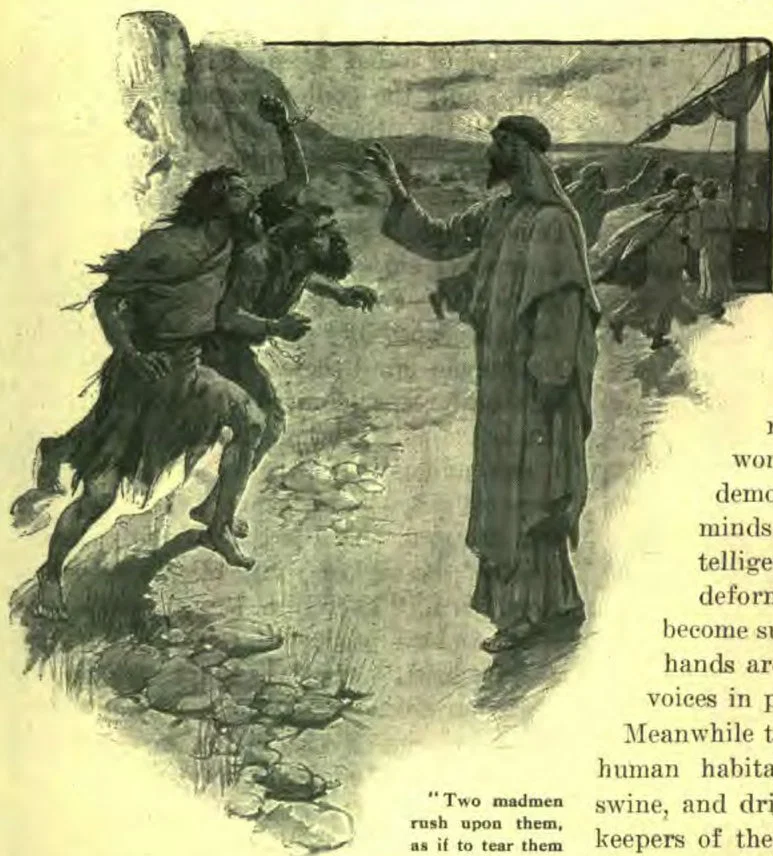
"Two madmen rush upon them, as if to tear them in pieces."
Saved to Serve.
It is morning on the Sea of Galilee. Jesus and His disciples have come to shore after a tempestuous night on the water, and the light of the rising sun touches sea and land as with the benediction of peace. But as they step upon the beach, they are greeted with a sight more terrible than the storm-tossed sea. From some hiding-place among the tombs, two madmen rush upon them, as if to tear them in pieces. Hanging about these men are parts of chains which they have broken in escaping from confinement. Their flesh is torn and bleeding, their eyes glare out from their long and matted hair, the very likeness of humanity seems to have been blotted out. They look more like wild beasts than like men.
The disciples and their companions flee with terror; but presently they notice that Jesus is not with them, and they turn to look for Him. He is standing where they left Him. He who stilled the tempest, who has before met Satan and conquered him, does not flee before these demons. When the men, gnashing their teeth and foaming at the mouth, approach Him, Jesus raises that hand which has beckoned the waves to rest, and the men can come no nearer. They stand before Him, raging but helpless.
With authority He bids the unclean spirits come out of them. The unfortunate men realize that One is near who can save them from the tormenting demons. They fall at the Saviour's feet to entreat His mercy; but when their lips are opened, the demons speak thru them, crying, "What have we to do with Thee, Jesus, Thou Son of God? art Thou come hither to torment us?"
The evil spirits are forced to release their victims, and a wonderful change comes over the demoniacs. Light shines into their minds. Their eyes beam with intelligence. The countenances so long deformed into the image of Satan become suddenly mild, the blood-stained hands are quiet, and the men lift their voices in praise to God.
Meanwhile the demons, cast out from their human habitation, have entered into the swine, and driven them to destruction. The keepers of the swine hurry away to publish the news, and the whole population flock to meet Jesus. The two demoniacs have been the terror of the country. Now these men are clothed and in their right mind, sitting at the feet of Jesus, listening to His words, and glorifying the name of Him who has made them whole. But those who behold this wonderful scene do not rejoice. The loss of the swine seems to them of greater moment than the deliverance of these captives of Satan. In terror they throng about Jesus beseeching Him to depart from them, and He complies, taking ship at once for the opposite shore.
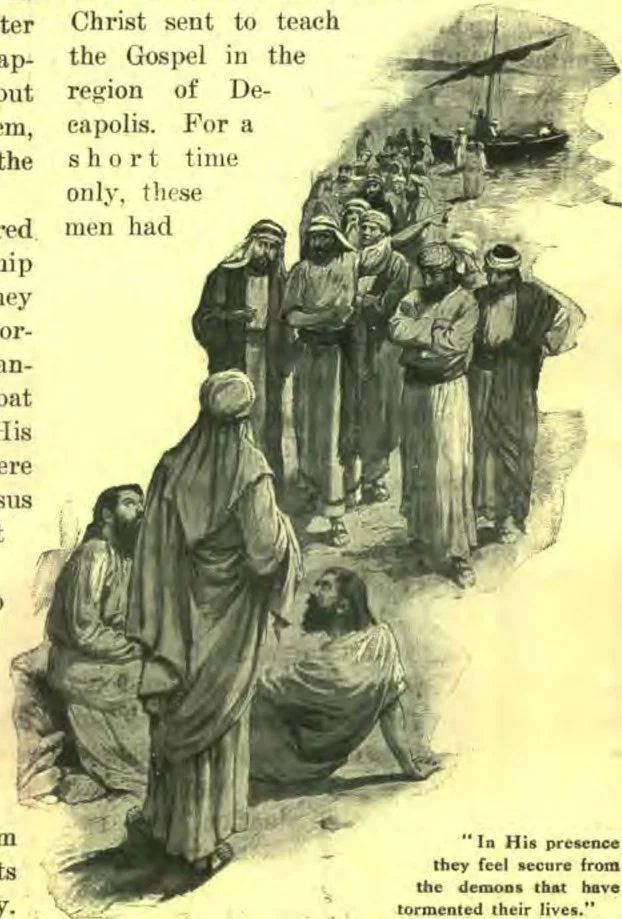
Far different is the feeling of the restored demoniacs. They desire the companionship of their Deliverer. In His presence they feel secure from the demons that have tormented their lives and wasted their manhood. As Jesus is about to enter the boat they keep close to His side, kneel at His feet, and beg to remain near Him, where they may listen to His words. But Jesus bids them go home, and tell what great things the Lord has done for them.
Here is a work for them to do,—to go to a heathen home and tell of the blessings they have received from Jesus. It is hard for them to be separated from the Saviour. Great difficulties will beset them in association with their heathen countrymen. And their long isolation from society seems to have disqualified them for this work. But as soon as He points out their duty, they are ready to obey.
Not only did they tell their own households and neighbors about Jesus, but they went thruout Decapolis, everywhere declaring His power to save, and describing how He had freed them from the demons.
Tho the people of Gergesa had not received Jesus, He did not leave them to the darkness they had chosen. When they bade Him depart from them, they had not heard His words. They were ignorant of that which they were rejecting. Therefore He sent the light to them, and by those to whom they would not refuse to listen.
In causing the destruction of the swine, it was Satan's purpose to turn the people away from the Saviour, and prevent the preaching of the Gospel in that region. But this very occurrence roused the country as nothing else could have done, and directed attention to Christ. Tho the Saviour Himself departed, the men whom He had healed remained as witnesses to His power. Those who had been mediums of the prince of darkness became channels of light, messengers of the Son of God. When Jesus returned to Decapolis, the people flocked about Him, and for three days thousands from all the surrounding country heard the message of salvation.
"In His presence they feel secure from the demons that have tormented their lives."
Power of the Gospel.
The two restored demoniacs were the first missionaries whom<br Christ sent to teach<br the Gospel in the<br region of De-<br capolis. For a<br short time<br only, these<br men had4listened to His words. Not one sermon from His lips had ever fallen upon their ears. They could not instruct the people as the disciples who had been daily with Christ were able to do. But they could tell what they knew; what they themselves had seen and heard and felt of the Saviour's power. This is what every one can do whose heart has been touched by the grace of God. This is the witness for which our Lord calls, and for want of which the world is perishing.
The Gospel is to be presented, not as a lifeless theory, but as a living force to change the life. God would have His servants bear testimony to the fact that thru His grace men may possess Christlikeness of character, and may rejoice in the assurance of His great love. He would have us bear testimony to the fact that He can not be satisfied until all who will accept salvation are reclaimed, and reinstated in their holy privileges as His sons and daughters.
Even those whose course has been most offensive to Him He freely accepts. When they repent, He imparts to them His divine Spirit, and sends them forth into the camp of the disloyal to proclaim His mercy. Souls that have been degraded into instruments of Satan are still, thru the power of Christ, transformed into messengers of righteousness, and are sent forth to tell how great things the Lord hath done for them, and hath had compassion on them.
The Law of Rest in the Healing of Disease
By G. D. Ballou
By G. D. Ballou, for Many Years a Devoted Student of Physical and Mental Therapeutics
GOD has written His word full of the law of rest. Every hopeful promise, every faithful assurance is designed to create that calm feeling of repose without which there is neither peace nor enjoyment. These full assurances,—"And we know that all things work together for good to them that love God, to them who are the called according to His purpose;" and that He is "able to do exceeding abundantly above all that we ask or think"—if believed, become a basis for full appreciation and obedience to the law of rest as found in Psalm 37 and other places. "Rest in the Lord, and wait patiently for Him." "Commit thy way unto the Lord; trust also in Him; and He shall bring it to pass. And He shall bring forth thy righteousness as the light, and thy judgment as the noonday." "Fret not thyself because of him who prospereth in his way, because of the man who bringeth wicked devices to pass." "Fret not thyself, it tendeth only to evil-doing," A.R.V. "Come unto Me, all ye that labor and are heavy-laden, and I will give you rest. Take My yoke upon you, and learn of Me; for I am meek and lowly in heart; and ye shall find rest unto your souls. For My yoke is easy, and my burden is light." Matt. 11: 28-30.
Results of Mental Anxiety.
The state of mind which accrues to the individual from obedience to this law of his being leaves and keeps the body also in a blessed state of quietness. The worrying and fretting and the mental anxieties and cares which come from a failure to recognize this law of rest are the cause either directly or indirectly of about nine-tenths of all human ailments.
Have you ever known a case where a person lost appetite thru mental anxiety, or had reached a point where there was a sighing for breath, had really forgotten to breathe, or was lying awake nights, and could not sleep because of the continuous grind? Thousands of such cases exist, and the existence of these conditions paves the way for malnutrition and poor elimination, the two things which lay the foundation for every constitutional ailment except diseases of heredity, many of which no doubt are due to the same causes in the ancestry. This worry is a mental disorder which nothing but faith and hope can permanently cure. Insanity is directly caused by it, and insanity affects the body as surely as it does the mind.
Removing the Cause the Only Remedy.
Now God has made it a law of our nature that removal of the cause alone will at least give relief in every case of diseased conditions, and will bring cure in all cases that have not gone beyond the possibilities of recuperation. In other words, if the diseased condition has not become so chronic that the tissue cells can not be rebuilt, removal of the cause will effect a cure. Hence rest of mind—peace in the soul—becomes almost a panacea for the fruits of fretting and anxiety. If nine-tenths of all diseases are due to worry, it is safe to say that about four-fifths will yield to hope, courage, good cheer, and mental preoccupation. So, rest in God and His Son Jesus is the true Heaven-ordained remedy for nearly all human ills. The failure of Christianity has been upon this point.
With the Master's injunction fully before them—to take no anxious care about food or raiment—the spirit of this world has prevailed until the majority of church-members are as destitute of true restful faith and trust in God as the veriest heathen in China or anywhere else. The greed for mammon, bad diet, stimulants, and the chasing of senseless fashions have helped to aggravate and deepen the difficulty. At this point in history comes into the arena as one of the chief actors
Christian Science.
It comes to us with just enough of mystery and occultism in it to appeal to the love of the marvelous in human nature and with a promise of relief from all moral responsibility, only the godless responsibility to believe all the utterances of Mrs. Mary Baker G. Eddy, and urges them upon the attention of the world. I say "promise of relief from all moral responsibility" because when a sense of sin,—the transgression of God's moral law,—and a sense of future judgment—the responsibility for sin—are blotted from the human mind there can not be a shadow of moral responsibility left. This blotting out is the chief aim of Christian Science, if I can understand it. To get rid of this responsibility is to bring peace and rest into the soul. This is the way to peace instead of the way of justification set forth in Rom. 5:1, "Therefore being justified by faith, we have peace with God thru our Lord Jesus Christ." Let us adapt this text to Christian Science: Therefore having blotted out of our minds a sense of the existence of sin and future judgment, we have peace with ourselves thru Christian Science.
Its Denial of God and Facts of Creation.
With its denial of the doctrine of a personal God and of the facts of Creation, the reality of all substance, the existence of sin, the doctrine of forgiveness and the atonement, the evidence of the senses and all human reason based on the observations of the senses, it asks its devotees to rest and find peace in the doctrine of the nothingness of all human existence except soul, the allness of God, that is, that God is soul or spirit and pervades all things, and that all the realness in man is the god—the soul—within. It asks the seeker to find rest, comfort, and satisfaction in attempting to convince himself that there is no such thing as sickness or disease or pain or suffering, that these are only "errors of mortal mind," "old beliefs" which Christian Scientists will be able someday to surmount and forget. This hodgepodge of heathenism, occultism, absurdity, nonsense, folly, and promise of relief from all distress and trouble, gives the poor deluded seekers something to think about and believe in besides themselves—it just keeps them busy—until the effects of their former worrying and fretting wear off and they actually find health returning and in some cases fully restored.
How It Leads to Health.5
There is no use denying that Christian Science does lead the way to health just as outlined above. It is a deep and crooked philosophy sufficiently dark and mysterious to absorb all of any person's mind and attention. In this preoccupation and in the faith in its promises of cure, the cause of their maladies—anxious care—is left out until the effects disappear, so that Christian Science has in it a subtle substitute for rest in God which looks on the outside to be a panacea for mental ills as well as all the diseases that flesh is heir to. But let the Scientist undertake to cure smallpox, spinal meningitis, pneumonia, typhoid fever, broken bones, sprained ankles, bubonic plague, blood poisoning, consumption, etc., without rational or hygienic agencies, and he will soon prove himself to be a fool. To be sure, patients sick with some of these diseases do recover if nothing whatever is done for them only to give rest and water and pure air. In such cases Christian Science has no claims to advance if the patient does recover. Not all smallpox or pneumonia patients die, by any means.
If Mrs. Eddy had taught the doctrine of trusting in a God that created the world and a Saviour that came to redeem a lost world, there would have been just so much Christianity in her scheme. If she had recognized the laws of nature and hygiene there would have been so much of real science in it. But her system is entirely innocent of any such truths. She even scouts every attempt to do for the sick anything outside of her formulas. That she was fully inspired, the writer will most gladly admit. But the inspiration is of such a character that when her readers stand before the people and one reads the Scripture and the other her science to explain it, the Scriptures either cease to have any sensible meaning whatever or else are said to mean just the opposite of what they say. It must be plain that an inspiration which thus nullifies the word of God and substitutes mysticism for its realities can not be from the same source.
The Testimony of a Convert from Hindu Philosophy.
What Pandita Ramabai, a living authority on Hindu philosophy, said when this system was presented before her, ought to have weight with all Christian people:
"I can tell you that I have sounded the depths of that philosophy; and what did I find? I will give you an idea in my own language. It means just this: You are to take the whole universe as nothing but falsehood. You are to think that it does not exist. You do not exist. I do not exist. When you realize that, that is philosophy. Can you realize it? There was once upon a time a great being called Brahma, and that person was no person at all, but something like air, full of joy and knowledge. Can you think of air as being full of joy and knowledge? I can not understand it; but philosophy tells you that you must believe that this being, full of joy and knowledge, without any personality, existed once upon a time. That being had no mind. It did not want to say anything, nor to have anything near it; and therefore, of course, it did not understand anything. Then there came another being just like itself, and that being was nothing but darkness. It was all falsehood. Now this air united with that darkness, and assumed personality. It became male and female; and as that person has formed all things, the logical inference is that everything is falsehood. The birds and beasts that you see do not exist. You do not exist. When you realize that you have no personality whatever,—that you have no life, no knowledge, nothing,—then you have attained the highest perfection of what is called Yoga, and that gives you liberation; then you are liberated from your body, and you become like him, without any personality. You draw on the blackboard zero, plus zero, minus zero, multiplied by zero, divided by zero, and it equals zero. It is just that, nothing more.
"And what has that philosophy done for the people of India? A tree is judged by its fruits. An apple-tree can not bring forth a pear, but it will bring forth of its own kind. The grandeur and beauty of that philosophy must be judged by its fruit. You are a people of some feeling. Everything is real. You feel that when other people are starving, you ought to give them something to eat; but out in India they do not feel so. Men do not feel any sympathy for others. They do not feel for people who are starving or being killed in war. In the recent famine our philosophers felt no compassion for sufferers, and did not help the needy. Why should they help, when they claimed that the suffering was not real, neither were the dying children real? The first result, then, of this Hindu philosophy is the basest cruelty and selfishness,—no compassion for sufferers, supreme egotism.
"To study Hindu philosophy, it is best to visit India and experience it. Plenty of opportunities are afforded, even if you go only to Bombay. That city is very large, and it is very hot there; but that will make no difference to philosophers who never experience heat. The people of India and the philosophers who have studied with the learned men, ought to feel alike toward all people and all beings, but they never show a particle of kindness to women, whose lives are made so unbearable that they want to kill themselves. These philosophers have shown mercy toward all lower animals. They have established hospitals for animals, but they have never established hospitals for women. The preachers who have come over here to preach Buddhism to the American people have established a hospital for animals in Bombay. In that hospital there is a ward devoted to bugs, and a man is hired to feed these bugs on his blood every night. They never take any thought of the women who are dying under the weight of this philosophy, but they show their charity toward the bugs. I recommend that hospital for the edification of American students of Buddhism. Let them stay one night in that bug ward. That will pay them for all their labors in studying that philosophy."
Other Worlds.
By Geo. E. Tack
O WORLDS that flame in yon blue sky,
God's watch-fires on His outposts far;—
O silver path that leads on high,
Whose shining dust is many a star,
Are ye but vacant worlds that swing
Eternal thru the realms of space,
And with your ceaseless rhythm sing
Of One who gave you matchless grace?
Could He who formed this tiny sphere,
And gave it man to be its king,
Form all thy systems, far and near,
And place none there His praise to sing?
Have not mine eyes read words of love,
On scroll divine, a message deep,
"Rejoice, ye dwellers in heavens above,"
Great worlds that past the white throne
sweep?
Ye nine and ninety in the fold,
Where breaks no heart with each clock-beat,
And sinless souls shall ne'er grow old,
But deathless dwell in union sweet,
I know that He who framed this star,
To be the home of creatures fair,
Formed not in vain thy worlds afar.
God in His love placed dwellers there.
GEO. E. TACK.
Disrespect for Rulers.
By Editor
THE Recorder has no sympathy with the spirit of disrespect for rulers, so prevalent in the United States. It is enough to make the blood of any true citizen boil, to read the irreverent and contemptuous language of the average newspaper, applied to the President of this great nation. The horrid and malicious representations in cartoons of our chief magistrate are too brutal and low to be tolerated. Nothing but evil can come from them. They are especially adapted to arouse the most brutal passions of low-lived men. They breathe the very spirit of anarchy, and tend to engender the hatred that sharpens the assassin's dagger. They put a premium upon the overt act of murder, which is seen in its incipient stages in the venom of hearts that can produce such expressions of feelings as are brought out in these infamous cartoons. The only wonder is that some crank, inspired by these, has not actually carried out the final act which such venomous pictures suggest. They would be appropriate only for a demon, and yet they represent somebody's feeling toward our President!
America might profit from some good lessons taught by other nations, in the line of loyal respect for the one who more than any other stands for the nation itself. In England it is "Her Royal Highness, the Queen," or "His Royal Highness, the King;" but in America it is "Buck and Breck," "Old Abe," "Grover," and "Teddy," with the coarsest and most disgusting caricature that can be invented! It is too bad!—Sabbath Recorder.
In Time of Storm.
By Max Hill
OFT had I read of One whose hands
Are strong to aid the weak,
Who by His faithful children stands
If they His guidance seek.
But never did that presence seem
So near and dear to me
Until when sin's tempestuous stream
Bore me far out to sea.
Until my light and life and hope
Were shipwrecked on the rock,
Till stranded I was left to grope
In darkness, storm, and shock.
Then called I my long-slighted Guide,
For my own strength was gone,
"O save from death," I humbly cried,
"Save, Lord, and lead me on.
"I can not, dare not, strive alone,
My Saviour, show Thy will!"
Then Jesus made His presence known,
And bade the waves be still.