Your ShelfYour Projects

Review and Herald, Vol. 90, No. 12.

JOHN HALL

Review and Herald

Mar 20, 1913

Review and Herald Publishing Association · Takoma Park Station, Washington, D. C. · Mar 20, 1913

JOHN HALL

Evil-Speaking

JOHN HALL

Keep clear of personalities in conversation. Talk of things, objects, thoughts. The smallest minds occupy themselves with persons. Do not needlessly report ill of others. As far as possible, dwell on the good side of human beings. There are family boards where a constant process of depreciating, assigning motives, and cutting up character goes forward. They are not pleasant places. One who is healthy does not wish to dine at a dissecting table. There is evil enough in man. But it is not the mission of every young man and woman to detail and report it all. Keep the atmosphere as pure as possible, and fragrant with gentleness and charity. — Selected.

What About Your Body?

Don’t Neglect nor Abuse This Wonderful Creation of God
MOST men and women are only about 50 per cent efficient. Why? Simply because they are daily transgressing the laws of their physical being. The thirty odd articles in the April “Life and Health” will help you to become better acquainted with the needs and the ills of your earthly tabernacle.
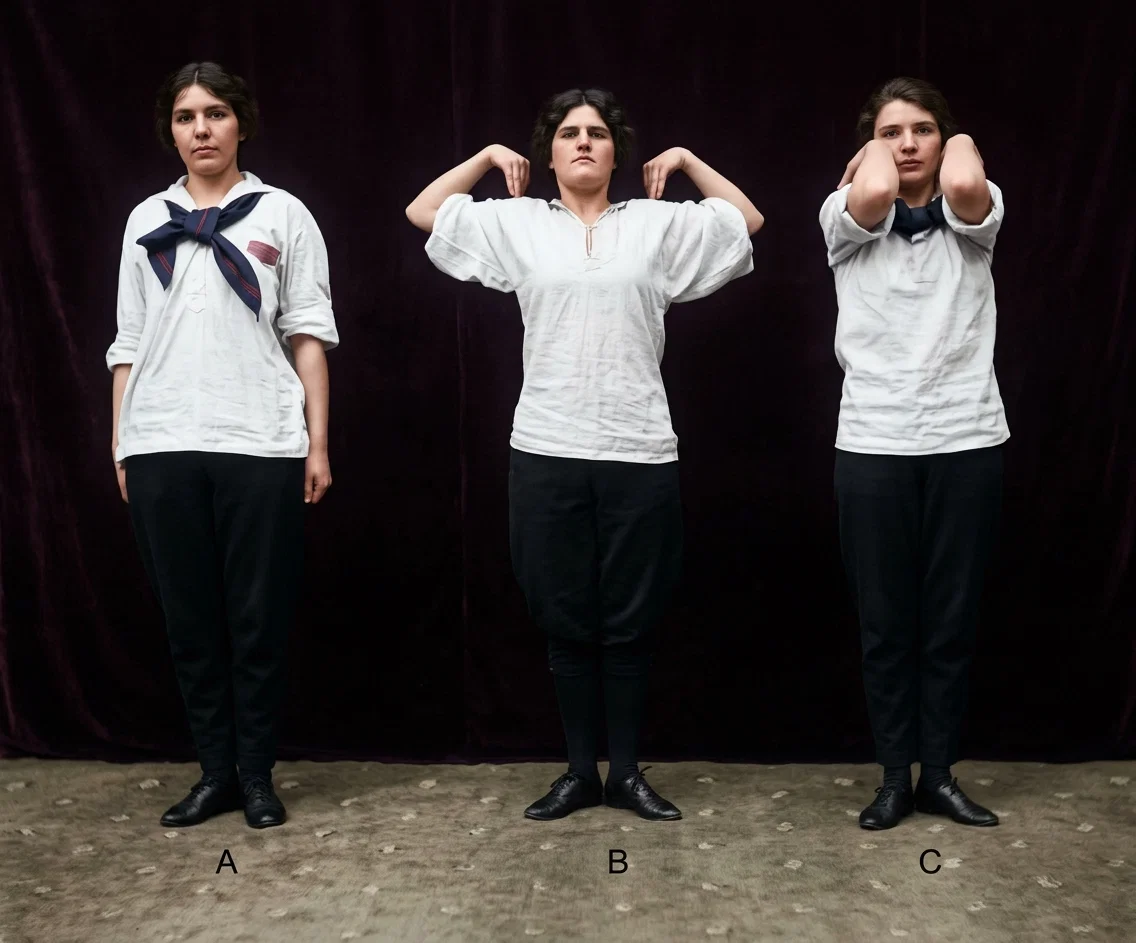
This Photograph Illustrates but One of the Many Valuable Features in This Special “Vegetarianism,” “Spring Fever,” and “Physical Culture” Number
Fig. 5. From position A, place finger-tips on shoulders, elbows front, as in position C, and inhale deeply as shoulders are forced back as in position B. Exhale from position B to C.
WE WANT YOU to act as our agent in your locality.
Send $1.00 for 20 copies, or $2.00 for 50. Single copy, 10 cents; 5 to 40 copies, 5 cents a copy; 50 or more copies, 4 cents a copy.
AN EASY SELLER The cover-picture alone will sell it.
A FEW APRIL FEATURES
“Vegetarianism” “Physical Culture” “Spring Fever” “Hygiene of Deep Breathing” “Treatment of Flat Foot” “Is the Stomach to Blame?” “The Food of the Future” “Alcohol a Habit-Forming Drug”
“Non-Drug Treatment” “Cause of Pellagra” “Questions and Answers” “Treatments for Constipation” “Magnetic Appliances” “Bed-Wetting” “Shingles” “Water-Brash,” etc.
PRICES, POST-PAID Yearly subscription ........................................ $1.00 Six months ...................................................... .50 (Subscriptions for less than six months not accepted) Three years (or three subscriptions one year) ........ 2.00 Five years (or five subscriptions one year) ............ 3.00 Five copies, one year, to one or more addresses ....... 3.00
No Extra Charge on Foreign Subscriptions.
Order Through Our Nearest Agency
(If you do not know the address of our agency, ask “Life and Health,” Washington, D. C.)

A. G. DANIELLS

Does the History of Turkey and Egypt Since 1798 Fulfil the Prophecy of Dan. 11: 40–44?

— No. 9

A. G. DANIELLS

ALEXANDRIA was taken by the French July 2, 1798. Napoleon began at once the entire reorganization of affairs, with the view of placing the country under the government of France. Of this the historian says:—
“Napoleon remained in Alexandria but six days. During this time he devoted himself, with a zeal and energy which elicited universal admiration, to the organization of equitable laws, the regulation of police, and the development of the resources of the country. The very hour of their establishment in the city, artisans and artists and engineers all were busy, and the life and enterprise of the West were infused into the sepulchral streets of Alexandria. “Preparations were immediately made for improving the harbor, repairing the fortifications, erecting mills, establishing manufactories, founding schools, exploring antiquities; and the government of the country was placed in the hands of the prominent inhabitants, who were interested to promote the wise and humane policy of Napoleon.”—The Life of Napoleon Bonaparte, by John S. C. Abbott, Vol. I, chap. 11, page 188. “Every act thus showed that his design was not a temporary occupation, but the foundation of a permanent colony.”—History of the Egyptian Revolution, by A. A. Paton, Vol. I, page 109.

The March to Cairo

“Leaving three thousand men in Alexandria, under the command of General Kleber, who had been wounded in the assault, Napoleon set out, with the rest of his army, to cross the desert to Cairo. . . .
“Napoleon despatched a large flotilla, laden with provisions, artillery, ammunition, and baggage, to sail along the shore of the Mediterranean to the western branch of the Nile, called the Rosetta mouth, and ascend the river to a point where the army, having marched across the desert, would meet it. The flotilla and the army would then keep company, ascending the Nile, some fifty miles, to Cairo. The army had a desert of sixty miles to cross. It was dreary and inhospitable in the extreme. A blazing sun glared fiercely down upon the glowing sands. Not a tree or a blade of grass cheered the eye. Not a rivulet trickled across their hot and sandy path.
“After five days of inconceivable suffering, the long-wished-for Nile was seen, glittering through the sand-hills of the desert, and bordered by a fringe of the richest luxuriance. . . .
“The flotilla now appeared in sight, having arrived at the destined spot at the precise hour designated by Napoleon.”—The Life of Napoleon Bonaparte, by John S. C. Abbott, Vol. I, chap. 11, pages 188–192.

The Battle of the Pyramids

“After a march of seven days, during which time they had many bloody skirmishes with the enemy, the army approached Cairo. . . .
“Murad Bey had there assembled the greater part of his Mamelukes, nearly ten thousand in number, for a decisive battle. These proud and powerful horsemen were supported by twenty-four thousand foot-soldiers, strongly entrenched. Cairo is on the eastern bank of the Nile. Napoleon was marching along the western shore. On the morning of the twenty-first of July, Napoleon, conscious that he was near the city, set his army in motion before the break of day. Just as the sun was rising in those cloudless skies, the soldiers beheld the lofty minarets of the city upon their left, gilded by its rays, and upon the right, upon the borders of the desert, the gigantic pyramids rising like mountains upon an apparently boundless plain. “The whole army instinctively halted, and gazed, awestricken, upon those monuments of antiquity. . . . The whole plain before them, at the base of the pyramids, was filled with armed men. The glittering weapons of ten thousand horsemen, in the utmost splendor of barbaric chivalry, brilliant with plumes and arms of burnished steel and gold, presented an array inconceivably imposing. Undismayed, the French troops, marshaled in five invincible squares, pressed on. There was, then, no alternative. Napoleon must march upon those entrenchments, behind which twenty-four thousand men were stationed with powerful artillery and musketry to sweep his ranks, and a formidable body of ten thousand horsemen, on fleet and powerful Arabian steeds, awaiting the onset, and ready to seize upon the slightest indications of confusion to plunge, with the fury which fatalism can inspire, upon his bleeding and mangled squares. . . .
“It was, indeed, a fearful spectacle. Ten thousand horsemen, magnificently dressed, with the fleetest steeds in the world, urging their horses, with bloody spurs, to the most impetuous and furious onset, rending the heavens with their cries, and causing the very earth to tremble beneath the thunder of iron feet, came down upon the adamantine host. Nothing was ever seen in war more furious than this charge. Ten thousand horsemen form an enormous mass. Those longest inured to danger felt that it was an awful moment. It seemed impossible to resist such a living avalanche. The most profound silence reigned through the ranks, interrupted only by the word of command. The nerves of excitement being roused to the utmost tension, every order was executed with most marvelous rapidity and precision.The soldiers held their breath, and, with bristling bayonets, stood shoulder to shoulder to receive the shock. “The moment the Mamelukes arrived within gunshot, the artillery at the angles plowed their ranks, and platoons of musketry, volley after volley, in uninterrupted discharge, swept into their faces a pitiless tempest of destruction. Horses and riders, struck by the balls, rolled over each other by hundreds on the sand. They were trampled and crushed by the iron hoofs of the thousands of frantic steeds, enveloped in dust and smoke, composing the vast and impetuous squadrons. But the squares stood as firm as the pyramids at whose base they fought. Not one was broken; not one wavered. The daring Mamelukes, in the frenzy of their rage and disappointment, threw away their lives with the utmost recklessness. They wheeled their horses round, and reined them back upon the ranks, that they might kick their way into those terrible fortresses of living men. Rendered furious by their inability to break the ranks, they hurled their pistols and carbines at the heads of the French. The wounded crawled along the ground, and with their scimitars cut at the legs of their indomitable foes. They displayed superhuman bravery, the only virtue which the Mamelukes possessed.”
“But an incessant and merciless fire from Napoleon’s well-trained battalions continually thinned their ranks, and at last the Mamelukes, in the wildest disorder, broke and fled. The infantry in the entrenched camp, witnessing the utter discomfiture of the mounted troops, whom they had considered invincible, and seeing such incessant and volcanic sheets of flame bursting from the impenetrable squares, caught the panic, and joined the flight. . . .
“The victors, with their accustomed celerity, pursued, pitilessly pouring into the dense masses of their flying foes the most terrible discharges of artillery and musketry. The rout was complete—the carnage awful. The sun had hardly reached the meridian before the whole embattled host had disappeared, and the plain, as far as the eye could extend, was strewn with the dying and the dead.”—Id., pages 193–196.
“Thus were in a great measure destroyed the finest cavalry, considered as individual horsemen, that were ever known to exist. ‘Could I have united the Mameluke horse to the French infantry,’ said Bonaparte, ‘I would have reckoned myself master of the world.’ The destruction of a body hitherto regarded as invincible, struck terror, not through Egypt only, but far into Africa and Asia, wherever the Moslem religion prevailed.”—The Life of Napoleon Bonaparte, chap. 30, page 251, by Sir Walter Scott.
“The justice that never fails had overtaken the iniquities of the Mamelukes. . . . The fiat of heaven itself was against them, and the decree of their doom went forth as infinitely more inexorable than the laws of the Medes and the Persians as Omnipotence is to impotence.”—Bonaparte in Egypt, page 93, by Haji A. Browne.

Egypt Conquered

“After the battle, Napoleon, now the undisputed conqueror of Egypt, quartered himself for the night in the country palace of Murad Bey. . . .
“Cairo contained three hundred thousand inhabitants. Its population was degraded, inhuman, and ferocious. The capital was in a state of terrible agitation, for the path of Oriental conquerors is ever marked with brutality, flames, and blood. Napoleon immediately despatched a detachment of his army into the city to restore tranquillity, and to protect persons and property from the fury of the populace. The next day but one, with great pomp and splendor, at the head of his victorious army, he entered Cairo, and took possession of the palace of Murad Bey. With extraordinary intelligence and activity, he immediately consecrated all his energies to promote the highest interests of the country he had conquered.”—The Life of Napoleon Bonaparte, Vol. I, chap. 11, pages 196, 197, by John S. C. Abbott.
“Lower Egypt was completely in the hands of the French, and thus far the expedition of Bonaparte had been perfectly successful. But it was not the will of Heaven that even the most fortunate of men should escape reverses, and a severe one awaited Napoleon.”—The Life of Napoleon Bonaparte, chap. 30, page 252, by Sir Walter Scott.
We now have before us the main facts regarding the French invasion and conquest of Egypt, and the resistance offered by the latter. This event holds a prominent place in every standard history of that part and age of the world, and all accounts agree in the main features of the affair.
We have now to decide whether this event fulfils that specification of the prophecy which says: “At the time of the end shall the king of the south push at him.”
The “time of the end” began in the year 1798. The “king of the south” was Egypt. In that very year Egypt was invaded and conquered by the armies of France, one of the greatest of the European powers. Alison describes the part taken by France in this event as a “celebrated undertaking,” and says: “Seldom had a more splendid armament appeared on the ocean.” Of this expedition Scott says, “A finer and more formidable one than which never sailed on so bold an adventure.” Abbott declares that “Napoleon’s expedition to Egypt was one of the most magnificent enterprises which human ambition ever conceived.”
From the standpoint of prominence among the nations, there is no reason why France might not be the power called “him” in the prophecy, and against which Egypt was to “push.” The purpose, the preparation, and the execution of the undertaking are all of a character to allow the event to have a place in the prophecy. Egypt’s part in this conflict accords with the prophecy. The landing of an army into Egypt by France came upon the inhabitants like a thunderbolt. Alexandria was attacked without an hour’s warning. Three weeks later the French and Mameluke forces met near Cairo in full strength. The defense made by the Egyptians was all that was possible under the circumstances. Their charge upon the French was terrible, but it was not the kind required to successfully meet the modern methods of warfare adopted by the French. They pushed at their invader, but went down in doing so.
The prophecy does not foretell the result of the conflict. It simply states that it would come, and marks the time. The history we have here given of the French invasion of Egypt is all that has been made up to the present time which can possibly be referred to as the fulfilment of the prophecy.

God Holds the Key

God holds the key of all unknown, And I am glad. If other hands should hold the key, Or if he trusted it to me, I might be sad.
What if to-morrow’s cares were here Without its rest? I’d rather he’d unlock the day, And as its hours swing open, say, “My will is best.”
The very dimness of my sight Makes me secure, For groping in my misty way I feel his hand, I hear him say, “My help is sure.” — Selected.

Conditions of Spirit Filling

The Holy Spirit—No. 10

Conditions of Spirit Filling

G. B. THOMPSON
In the heart of every child of God there is an intense longing for spiritual power. For this he has earnestly prayed. Must he ask, and not receive? seek, and not find? knock, and the door not open? We can not so believe.
In this article we purpose to begin a study of that personal fellowship and communion with the Holy Spirit which is promised,—a study of how we can personally receive the fulness of spiritual power in our experience and labors which we so much need and long for. This is of vital concern to us. The Spirit is here; but unless he abides in us, his presence will do us but little good.
It is not implied that we have not experienced the work of the Holy Spirit in the heart. The Spirit is omnipresent. He is seeking a place in every heart. Conversion is the work of the Spirit. God’s people everywhere have a measure of his Spirit. But there is a fulness that is lacking. There is a gift of the Spirit for service that is not looked for and experienced as it should be. The disciples had experienced the work of the Spirit in their lives, but they needed a greater fulness, a baptism for service. This is our need also.
We must understand clearly how we can receive the Spirit into the heart, not as a transient visitor, but as our abiding guest. If we fail in this, all is lost. But we need not fail. God’s promises are sure; he has marked out the path very clearly, and when we follow his counsel the promised blessing will surely be realized.
In Eph. 5:18 we read: “Be not drunk with wine, wherein is excess; but be filled with the Spirit.” Here is a plain command of universal application. Be not intoxicated with wine, but “be Spirit-filled men,” the apostle seems to say. Why is this experience not realized?The trouble is just here; before the filling there is an emptying. The emptying may be painful, doubtless is; but it is absolutely necessary to being filled.
“In the great and measureless gift of the Holy Spirit are contained all of heaven’s resources. It is not because of any restriction on the part of God that the riches of his grace do not flow earthward to men. If all were willing to receive, all would become filled with his Spirit.”—“Christ’s Object Lessons,” page 419.
All of heaven’s resources at our command through the Spirit, but held in check, and we destitute, cold, and lifeless because we are unwilling to receive, unwilling to be emptied that we might be filled! We need not mourn longer over the reason of our lack of spiritual power. This reaches the root of the difficulty. It is because we love sin in some form, and are unwilling to give it up.
There is a preparation, a getting ready, to receive the Heavenly Guest. The Spirit is as free as air, free for the asking; yet there is a price to be paid, not once, but daily and hourly. This is the point. There are terms, certain conditions, upon which “Christ’s Representative” takes his abode in the temple of our bodies. Is he asked to share the throne with another, or is he to be the sole occupant? We must settle this question. Christ, through the Spirit, will be Lord of all, or he will not be Lord at all.
The Representative of Christ in this world is sovereign; he will not sit on the throne with an idol. Here is where many fail, and the longing cry for Spirit-filling goes unanswered. They set up some idol, some pet, keepsake sin, some darling indulgence, set up their own will in opposition to the Spirit’s and refuse to do his bidding, and then ask the Spirit to sit enthroned with this unclean thing by his side. What a presumptuous insult to offer to the Holy Spirit! It is a clean temple he demands, not some den of impurity and wickedness, where selfishness, pride, and lust hold sway. When the Spirit takes up his abode in us, he is enthroned in the mind. It is a pure, clean mind that he wants to fill. Vile thoughts must be stamped out; unchaste, lascivious imaginations must be cast down. All our affections must be centered in God. Though our flesh remain the same, there must be a new mind, created after the image of Christ. In short, the rubbish of sin must be put away, the “vessel” must be cleansed if it is to be used by the Master. We must be purged from all unrighteous things.
Among the things that hinder the infilling of the Spirit might be mentioned:—
  1. Regarding iniquity in the heart.
  2. Censoriousness.
  3. Self-dependence.
  4. Gossiping, talebearing, backbiting.
  5. Resisting conviction.
  6. Dishonesty in dealings, driving sharp bargains, scheming.
  7. Refusing to confess to those we have wronged.
  8. Refusing to make restitution where we should.
  9. Being prejudiced and uncandid.
  10. A revengeful spirit; carrying some old grudge in the heart.
  11. Worldly ambitions.
  12. Being resentful, envious, jealous.
  13. Quenching the Spirit by wrongdoing.
  14. Grieving the Spirit by dissension.
  15. Indulgence of bad temper.
  16. Impatience and fretfulness.
  17. Vain and trifling conversation.
  18. Various forms of selfishness, covetousness, stinginess.
  19. Neglect of prayer.
  20. Neglect to study the Bible.
  21. Lack of consecration.
  22. Hatred in the heart.
“Now the works of the flesh are manifest, which are these; Adultery, fornication, uncleanness, lasciviousness, . . . variance, emulations, wrath, strife, seditions, heresies, envyings, . . . and such like: of the which I tell you before, as I have also told you in time past, that they which do such things shall not inherit the kingdom of God.” Gal. 5: 19-21.
What an unclean brood is all this! And it is such a “den of thieves” as the foregoing that robs us of the abundant blessings which the Lord has promised. But while we are repeatedly assured that the Spirit of the pure and holy God will not live in a temple where such thieves are welcomed, if we are willing to have the temple cleansed the Spirit will come in with a whip of cords and drive out these unholy traffickers, illuminate every dark corner where the cobwebs of sin have been allowed to accumulate, and make the heart a fit habitation. It is ours to will; it is the Spirit’s to do.
“Christ has promised the gift of the Holy Spirit to his church, and the promise belongs to us as much as to the first disciples. But like every other promise, it is given on conditions.”—“Desire of Ages,” page 672.
It is intensely interesting to study the Bible in search of the conditions upon which the Lord has promised to bestow upon us the gift of the Holy Spirit. We shall notice some of these as mentioned in the Word, not necessarily in the order of their importance:—
1. Thirst. “In the last day, that great day of the feast, Jesus stood and cried, saying, If any man thirst, let him come unto me, and drink. He that believeth on me, as the scripture hath said, out of his belly shall flow rivers of living water. (But this spake he of the Spirit, which they that believe on him should receive: for the Holy Ghost was not yet given; because that Jesus was not yet glorified.)” John 7: 37-39.
We must desire the Spirit. We must hunger and thirst for it as for food. Those who do, the Lord has promised to fill. “He hath filled the hungry with good things; and the rich he hath sent empty away.” Luke 1: 53. I remember hearing a man relate how he had experienced real thirst. He was lost on the plains. He wandered about seeking to find his way. The earth was parched, the sun was hot. He began to grow thirsty. His tongue began to swell, and every pore in his body began to cry, “Water! water!” He said he finally reached the place where he would gladly have given all his land and money for a good drink of pure, cold water. This was real thirst, such as the psalmist expresses: “As the hart panteth after the water brooks, so panteth my soul after thee, O God.” Ps. 42: 1.
When our thirst for the fulness of the Spirit becomes so great that we are willing to yield all to God that we may drink from this refreshing spring, we shall be filled. And this is a blessed experience. To the woman at Jacob’s well, Jesus said, “But whosoever drinketh of the water that I shall give him shall never thirst; but the water that I shall give him shall be in him a well of water springing up into everlasting life.” John 4: 14.
It is indeed true, as the Saviour said, that those who drink of any earthly fountain, no matter how inviting it may be, will receive no permanent satisfaction. They will thirst again. We see about us those who are seeking satisfaction by drinking at the fountain of wealth. But it does not satisfy. The wise man declares, “He that loveth silver shall not be satisfied with silver.” Eccl. 5: 10. I heard of a dying capitalist who had spent all his life in the accumulation of wealth. In his dying hours a friend asked him how much money it took to satisfy a man. His answer was, “One dollar more.” The fountain of wealth does not bring happiness or satisfaction.
We find others seeking satisfaction by drinking at the fountain of pleasure. Many have tried it for years, but can testify that it was a failure. The husks and pods of sin do not satisfy the real cravings of the heart. Some we see drinking at the fountain of fame. For a time it lures them on, but in the end there is an aching void. When death begins to feel for the heart-strings, when circumstances change and our fame begins to wane, when former friends begin to desert us and the infirmities of the flesh begin to assert themselves, the real emptiness of earthly things begins to appear.
Some are drinking at the muddy fountain of human philosophy; but philosophy affords no foundation upon which to stand, no rock upon which to build the structure of life.
How different the spring of life, the Holy Spirit! It is always with us in its freshness and power. When sick or in distress; when circumstances and environments are against us; when without friends and afflicted; when called, perhaps, to stand by the casket and view for the last time a most cherished loved one; even in the hour of sore bereavement, in cloudy days and starless nights, this fountain, like a perennial spring, gushes forth and fills our souls with joy and peace, and the heart, though broken, finds comfort.

Pitying One’s Self

In the world around us we see many objects worthy of interest and sympathy. The cry of sorrow comes up from every quarter. Grieved and burdened hearts, pain-racked bodies, grief and sorrow and anguish we find on every side. Multitudes to-day need the touch of a helping hand, and the manifestation of a kindly interest. Thousands are sad and sick and dying. Many a poor heart is crying out in anguish, “No one cares for my soul.”
The recognition of this great field for missionary effort will lead to self-forgetfulness. There will be no time for self-pitying. How can we be self-centered when men and women around us everywhere are dying spiritually and physically for want of help? Sad indeed is it to see professed Christians, instead of trying to alleviate these untoward conditions among their fellows, nursing personal grievances.
Before us hangs a motto which reads, “He who falls in love with himself will have no rivals.” Many to-day are in love with themselves. They think only of their own interests. With one of old, they say, “Behold, and see if there be any sorrow like unto my sorrow.” The most miserable creature in all the world is the man who goes through life pitying himself.
Let us fight against this spirit. Let us seek a broader outlook than our own little field of experience. Let us lift up our eyes and behold the fields how they are white for the harvest, and recognize the call of God sounding in our ears to go forth to do valiant service for our fellows. Forgetting our own troubles and seeking to help other people out of theirs is the surest road to happiness in this life and to eternal happiness in the life beyond.

Easy to Faith

WORLDLY wisdom makes very difficult the things that are easy to faith. A writer in the Outlook, dealing with religious experience in children, tells the following story:—
The other day I heard a little girl recounting to her young uncle, learned in the higher criticism, the story of the creation. “Just only six days it took God to make everything,” she said; “think of that!”
“My dear child,” remonstrated her uncle, “that isn’t the point at all—the amount of time it required! As a matter of fact, it took thousands of years to make the world. The word day, in that connection, means a certain period of time, not twenty-four hours.”
“O!” cried the little girl in disappointment, “that takes all the wonderfulness out of it!”
“Not at all,” protested her young uncle. “And, supposing it did, can you not see that the world could not have been made in six of our days?”
“Why,” said the child in surprise, “I should think it could have been!”
“For what reason?” her uncle asked, in equal amazement.
“Because God was doing it!” the child exclaimed.
Her uncle did not at once reply. When he did, it was to say, “You are right about that, my dear.”
Truly, many a thing that is hid from the wise and prudent is easily understood by those who are but babes in worldly wisdom. The child’s belief in a God that could do things allowed of no difficulties or impossibilities. The theories of the evolutionary or million-year development of this earth are designed merely to take away “the wonderfulness” of the workings of God in creation and salvation. “Through faith we understand that the worlds were framed by the word of God, so that things which are seen were not made of things which do appear.” It is easy to understand it, “because God was doing it,” as the little child said.                                                                             W. A. S.

One Way of Salvation

God has provided one means and one only whereby salvation may be obtained. That one means is through the Lord Jesus Christ. He himself declares: “I am the way, the truth, and the life.” “Neither is there salvation in any other: for there is none other name under heaven given among men, whereby we must be saved.” “I, even I, am the Lord; and beside me there is no Saviour.”
In answer to the inquiry of the jailer, “What must I do to be saved?” the word was given, “Believe on the Lord Jesus Christ, and thou shalt be saved, and thy house.” This acceptance of Christ becomes a transforming power in the heart and life. “As many as received him, to them gave he power to become the sons of God, even to them that believe on his name.”
In offering salvation to the human family God makes no class distinctions. The reason for this is that one great universal malady afflicts the human family. None is exempt or immune from its power. “All have sinned, and come short of the glory of God.” “There is none righteous, no, not one: . . . there is none that doeth good, no, not one.” This universal, all-pervading malady of sin requires a universal, all-pervading remedy. To every heart there is needed the application of cleansing power.
Every man needs a Saviour. No soul can fall back upon his wealth, his education, his social position, his royal blood, his godly parentage, or any other consideration whatsoever. “Thus saith the Lord, Let not the wise man glory in his wisdom, neither let the mighty man glory in his might, let not the rich man glory in his riches: but let him that glorieth glory in this, that he understandeth and knoweth me.”
Man has nothing, absolutely nothing, to commend him to God's favor. He possesses a perverted nature, a sinful, corrupt heart, a mind at enmity with God, feet whose natural tendency is to run to evil and destruction. He has no power within himself. He can not create any environment which will change his inherent condition. He may seek by penances and fastings, by scourgings and floggings, by benefactions and beneficences, to obtain the precious boon of righteousness, but all this will not avail.He can not train himself into holiness. He can not be born into the spiritual life, “of blood, nor of the will of the flesh, nor of the will of man.”
There is one power and only one that can come in and take away the enmity of man's natural heart, and remove its corruption and defilement; that can give peace for unrest, cleansing for impurity, strength for weakness, wisdom for foolishness; that can change the current of his thoughts and purposes and motives; that can fill his mouth with blessing instead of cursing, and set his feet in the upward path to life: and that is the recreative power which comes through the acceptance by simple faith of the Lord Jesus Christ.
The life of the one who receives this power will not be fruitless. Good results will follow this union of man with his Saviour. Love will prompt the giving of the body to be burned, if need be, the bestowal of goods to feed the poor; and the service will not be as sounding brass or as a tinkling cymbal, but as a sweet savor, showing forth the excellences and virtues of the indwelling Christ. “For by grace are ye saved through faith; and that not of yourselves: it is the gift of God: not of works, lest any man should boast. For we are his workmanship, created in Christ Jesus unto good works, which God hath before ordained that we should walk in them.”
F. M. W.

The Personal Touch of Faith

THE relationship of the Christian to his Saviour requires the personal touch of faith. It is not enough for us to see Christ as a historical character; it is not enough that we recognize him as the Saviour of mankind. In order for his sacrifice to be effective in our own individual cases we must see him as our Saviour.
Many to-day come to Christ as did the multitude who thronged his steps two thousand years ago. They read his words, they profess faith in his name, but the character of their lives shows that after all there is no real contact with divine power. We have the record of one, a poor diseased woman, who pressed through the throng and touched the hem of his garment. This touch had in it that which brought immediate recognition from the Master. It was a cry for personal help in a soul’s great need. We need to-day to reach out after Christ in the same manner. We may be assured that as he responded to the appeal of this poor woman, so he will respond to-day to the personal touch of faith.
Continue reading: Counterfeiting Heaven's Ways