Pacific Press Publishing Association · Mountain View, California · Aug 27, 1912
"IF YE WILL INQUIRE, INQUIRE YE."
By Editor
This Inquirers' Department is conducted for the purpose of helping those who are studying the Bible. The answers are oftentimes only suggestive. They are never to be considered infallible, only as they agree with the infallible Word. The writer who may answer them does not consider that his opinion is infallible. He will simply give the best that he has, and plead with the inquirer to search the Word. Such questions only will be answered as, to the editors, seem to minister to the good of the readers and to the mission of the paper. We can not answer repeatedly in the same volume questions upon the same scripture. The name and address must accompany question, not for publication, but as an evidence of good faith, and that answer may be made by letter if deemed advisable. No letters are answered which do not contain the name of the writer. It is well always to enclose stamp for reply.
I would thank you many times if you would give me more light on 1 Cor. 15: 44-55. Especially I do not understand about flesh and blood not inheriting the kingdom of God. What, too, is the difference between corruptible and mortal, in verse 53? R. S. H.
Our explanation will necessarily have to be brief. Verse 44 declares that "it is sown a natural body; it is raised a spiritual body. If there is a natural body, there is also a spiritual body"—that is, having reference, of course, to mortal man. "Natural body" is really "soulical body." Verse 45 explains this,—"The first man Adam became a living soul"—he had a soulical body, and after he had sinned he lost that life connection with his Lord, and had simply the life of the body common to all animal creation. But such a one as that in the Lord Jesus Christ receives by faith the spirit-life, and when he dies he lays down the natural body, but receives in the resurrection the spiritual body. Of course we can not comprehend the nature or character of that spiritual body, but it is just as truly a body as the natural body, and will be the body of the resurrection, even as was Christ's body after it was raised from the dead. "The first man Adam became a living soul. The last Adam became a life-giving spirit," but possessing the spiritual body, and bearing the marks that were in the natural body transmuted by the power of God into a spiritual body.
Verse 46 shows that the natural comes first; then after, that which is spiritual. All who are of the seed of Adam are after the first man, earthly; the second man is the Lord from heaven. All mortal men have followed in the way of Adam and died; but all who have truly accepted of the Lord Jesus Christ, will bear His image when He shall come and the resurrection shall take place. The same thought is expressed in character in Rom. 6:5.
But the apostle would have us understand that we do not inherit the kingdom of God in these corruptible bodies. That evidently is all that is meant by "flesh and blood,"—men in the present state of things, the natural man. This is emphasized by the last clause, "Neither doth corruption inherit incorruption." God's kingdom is a spiritual kingdom, and all who inhabit that will be spiritual beings, real beings, literal beings with spiritual bodies, none the less real than here, but different in nature, not composed of flesh and blood as is corruptible man. May it not be true, as now man's life is in the blood—that is, the natural life (Lev. 17:11)—that then, in the kingdom of God, when man receives his resurrection body, the life will not be the blood life, but spirit life, nevermore to be lost, corrupted, or depraved?
Verse 51 declares that not all God's children shall sleep; we shall not all sleep, but all will be changed, as well those who sleep as those who wake and are ready at Christ's coming. All this change will occur by the creative power of God in one moment. The dead shall be raised incorruptible. That is, the coming forth from the very earth will itself be a change—they are raised in that way, and the righteous living shall be changed. The dead the apostle designates the "corruptible," the living he designates as "mortal." The dead, the "corruptible," will put on "incorruption;" the "mortal," the living saints, will put on "immortality." "And when this corruptible [the dead] shall have put on incorruption, and this mortal [the living] shall have put on immortality, then shall come to pass the saying that is written, Death is swallowed up in victory."
This, in brief, outlines the glorious change which will take place in the nature of all those whose characters have been formed in Christ Jesus.
Salvation Offered to Sinning Angels
By E. N. D.
In the first place, our Lord did not take two steps downward before He could become man's Redeemer. If man had been the only order of creation below God, there would have been but the one step; but there were other beings involved in sin. Sin had entered in among the angels, and our "God is no respecter of persons." We know that His mercy endureth forever, and we know that He had the same tender care and solicitude toward "the angels that sinned" as He had toward man who sinned. But the Bible is not a revelation to the angels, but to us. If it had been, God would have given us all the particulars, with all the appeal which He must have made to them, and we would have had told us the effort that He put forth to save them; but He has given us enough of the revelation of His character that we may know that He had angels in mind in the sacrifice of the Redeemer as truly as He did man. Read Eph. 4:8, 9: "Wherefore He saith, When He [Christ] ascended on high, He led captivity captive, and gave gifts unto men. (Now this, He ascended, what is it but that He also descended into the lower parts of the earth? He that descended is the same also that ascended far above all the heavens, that He might fill all things.)" There is not one single vacancy which sin has made or can make in the universe of God, but what will be filled with the
fulness of the Lord Jesus Christ. Consequently there was salvation held out to the angels through Christ, just as truly as there was to man. Read the article on "Christ as Michael the Archangel," in No. 3 of this series, by G. W. Reaser. We have the fact set before us again and again that Christ the Lord was the Angel of God's presence, Michael the Archangel, the Angel of Jehovah, the One who served through all the past in behalf of God's children, an Example to angels both good and evil, and that this service continued until our Lord became human and took upon Himself the nature of the other class, that of man. These suggestions, with the article referred to, we are sure will help our inquirer to understand that the great plan of salvation was full enough to include every sinner in the universe, whether that sinner be angel or man. We do not need the statement that He was made an angel, when we read that He was the Creator of the heavens and the earth, and then read that He was an angel. Certainly somewhere the transformation took place, but when He became flesh He continued not in the nature of angels; He took upon Himself the nature of man—descended as low as death can carry one, and by right of character ascended far above all things, that He might fill all vacancies. See Dan. 12:1; John 5:28; 1 Thess. 4:16; Jude 9; Rev. 12:7; Ex. 23:20, 21.
3836 — The Saints of God
By Editor
Who are the "sons of God" spoken of in Genesis, chapter 6, as marrying the "daughters of men"? H. H. C.
Evidently the men who profess the religion of God. Division came after sin entered. This is indicated by various expressions. For instance, in chapter 4:26 we read, "Then began men to call upon the name of Jehovah," or, as the margin reads, "to call themselves by the name of Jehovah." The children of Seth were those who had faith in God. The children of Cain became the sons of men, and looked simply to this earth life. They did not have the faith in God that was manifest in Abel, and afterward in Seth. The one class were men of the world; the other, children of God. But the children of God, with their human desires, looked upon the daughters of men, and saw that they were fair, and took them wives of all that they chose; and just the same as Solomon's heart and the hearts of others were weaned away from God by their wives, just so the sons of God became corrupted in this way. Mighty men sprang from them, but these men themselves were corrupt and wicked at heart.
The passage is a prophecy of Israel's backsliding and defection, and the cutting off of the people as a nation. See the fulfilment of this in Matt. 13:14; Mark 4:12; Luke 8:10; Rom. 11:8; that is, the people hardened their own heart by turning away their ears from the truth until the Lord withdrew His Spirit from them, and they went on to their own destruction, choosing another king than Jesus, and rejecting God's message of salvation.
That, of course, began to take place before our Lord's time; it was true when Israel was carried down to Babylon. His people were removed far away, as the prophecy indicates, and only a very small portion left in the land; and even they journeyed to Egypt until the land lay desolate for seventy years. A few returned, and yet very few of all God's children, but they were the remnant. And so it was when we come to the time of our Lord; the large majority of the Jewish nation forsook Christ, and yet the remnant remained faithful. See Rom. 11:5. "Even so then at this present time also there is a remnant according to the election of grace." See the reference to Isaiah 6 in verse 8, also verse 25: "That blindness in part is happened to Israel, until the fulness of the Gentiles be come in." That is, as a nation they were cast off. Christ the fulness came in and opened the great door of salvation to Jew and Gentile alike, all who accepted Christ the fulness becoming a part of Israel, grafted into the true Vine.
3840 — Saw No Corruption
I have always understood from the Scriptures that none but our Saviour ever died and saw no corruption, but I have recently been told that Moses saw no corruption. Is this provable by the Bible? Also please state who compose the investigative judgment court now going forward in heaven, and who will compose the court which will judge the wicked. J. W. C.
The first is not provable by the Bible in so many words. We can only infer it,—first, that Moses was a type of Christ; secondly, that the devil disputed with Michael the Archangel regarding the body of Moses. Inasmuch as that notable servant of God was raised from the dead, it would seem quite clear that he was not left long in the tomb. He sinned one great sin, driven to it by the clamors of the people, becoming impatient over their backslidings, and for the moment forgetting God. For that he died, but he sincerely repented, as shown by his own words in the record which he himself left of his own sin; and while he could not lead that people into the promised land, he was raised from the dead, and appeared on the mount of transfiguration with Elijah. We could infer very readily, taking this in connection with the fact that he was a type (see Rom. 5:14; Deut. 18:15-18), that his resurrection took place shortly after his death.
The judgment court is in figure described in Dan. 7:9, with the Ancient of Days upon the throne, with ministers of light around Him, and our Lord Jesus Christ is there pleading as Advocate. But in the judgment of the wicked, we will have our Lord Jesus upon the throne, and associated with Him will be the righteous of all ages. Compare 1 Cor. 6:1-3 and Rev. 20:4, with other scriptures.
Schedule for the Week Ending September 7, 1912
3839 — Our Lord and Michael
By E. N. B.
I notice that in your answer to question No. 3783 you state that "our Lord Himself stepped down from His high estate of reigning with the Father, and took upon Himself the form of a creature, in order to save, and the first step in that downward career of sacrifice was to become an angel — Michael the Archangel." Please give me in your "Question Corner" your Scriptural authority or text for making this statement, as it is a new thought to me that our Lord took two steps downward before He could become man's Redeemer. We have the Scripture where He was made a little lower than the angels (Heb. 2:9), but can find no statement where He was made an angel from a higher order of being. Also tell me, whom was He to save in that first downward step, and how?
The readings begin with Matthew 16, giving the wonderful lesson of self-denial taught to us through Peter; Matthew 17 of the transfiguration; 18, God's marvelous mercy and man's inhumanity; 19, our duty toward the law; 20, the remarkable parable of the laborers and the lesson of Jesus to the sons of Zebedee; 21, the riding into Jerusalem, the cleansing of the temple, the lesson of the fig-tree, and the parables of the two sons and the wicked husbandmen, and the marriage feast. Our Sabbath reading is Psalm 90, "A Prayer of Moses the Man of God;" Psalm 91, the blessedness of trust in God and His marvelous kindness; and 92, a song for the Sabbath day. The author of these last two psalms is not named.
EDITORIAL
By Editor
Among the Doctors
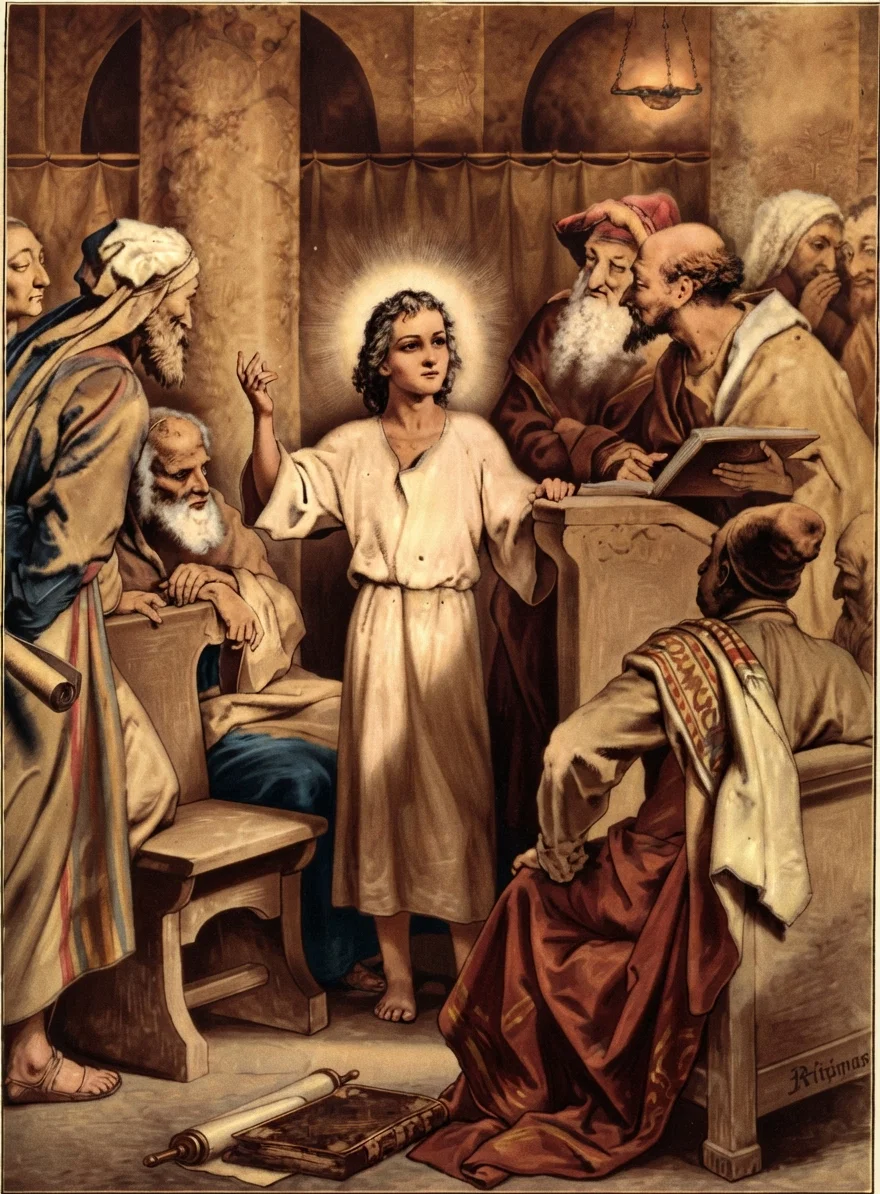
WE left our Lord, in our last article, as He was entering Jerusalem at the age of twelve, at His first Passover as a son of the law. We next find Him in a company of the aged men of the temple, listening to their instructions and asking them questions.
THERE were various events between the entering of Jerusalem and His presence with the great men of the temple. Some of these are not thought worthy of mention in the inspired record. He went through the usual forms of the Passover service with His parents. He witnessed the sacrifices, saw the cloud of incense arise, heard the chantings of the priests and the prayers of devout people. He probably saw its meaning in a deeper sense than did either parents or doctors, but in His human limitations He was still learning, yet His Teacher was God.
THE great day of the Passover was the first. After that, we are told, the people could properly return home, and many availed themselves of this privilege. Joseph and Mary may also have done this. In the vast number of Jews at Jerusalem there must have been much confusion. But uniting with some company northward bent, probably from Nazareth, the parents of Jesus take up their journey. Not until night are they aware that Jesus is not in the company. They suppose, doubtless, that He is with other boys, or talking in other tents, which would show that the Boy was normal in His associations.
BUT searching in their own company, among friends and acquaintances, with hearts growing more and more perturbed, they do not find Him. He is left behind in the great city, lost. How the mother's heart must have pained her for neglect of duty! How the words of the angel and prophet, spoken of her Child, must have come to her with added force! She had been derelict in duty, and the Boy was lost, left in Jerusalem by them.
THEY return, and seek a whole day in Jerusalem, three days including the first day's journey northward, the day in returning, and the whole day in Jerusalem. They find Him at last in a company or school of the teachers, or doctors, in the temple. He is listening to their instruction. After the custom of the times, He is asking questions, and His questions lead the learned doctors to question Him. They are amazed at the understanding revealed in His questions; they are amazed at His answers to their questions. Untaught in their schools, He has more knowledge and wisdom than they. The truth of Daniel's psalm is demonstrated in Him.
IN THE TEMPLE WITH THE DOCTORS
"O how love I Thy law!
It is my meditation all the day.
Thy commandments make me wiser than mine enemies;
For they are ever with me.
I have more understanding than all my teachers;
For Thy testimonies are my meditation.
I understand more than the aged,
Because I have kept Thy precepts.
I have refrained my feet from every evil way,
That I might observe Thy Word.
I have not turned aside from Thine ordinances;
For Thou hast taught me.
How sweet are Thy words unto my taste!
Yea, sweeter than honey to my mouth!
Through Thy precepts I get understanding;
Therefore I hate every false way."
IN that room of the sacred edifice, before those learned doctors, there was revealed the mighty truth, "The fear of the Lord is the beginning of wisdom: a good understanding have all they that do His commandments." The education of children which leaves God out, or which makes Him secondary, is bound to fail in accomplishing what ought to be the object of all true education,—the formation of right and enduring character, which is entitled thereby to everlasting life and immortality.
FINDING the Boy where they did, and as He was engaged, astonished the parents, but did not prevent the mild reproof and reproachful look of the mother: "Son, why hast Thou thus dealt with us? behold, Thy father and I have sought Thee sorrowing." There is a lesson here for us. How often we go a whole day without the known presence of Christ! We mean to do God's will. In4a general way we do no evil. We live on a sort of elevated, self-complacent plane, our own life, with our own immediate wants or environments, molding our conduct; and when night, or darkness, or trouble comes, we find that we have journeyed long and far without the Master, and tears are shed and hearts are broken before we find Him. The lesson is, Abide in Him. Let His words abide in you. Hold by living, constant faith His presence in your heart. Make it a part of character fiber by identifying yourself, your time, your interests, with Him.
His parents were not prepared for His answer to their question: "How is it that ye sought Me? knew ye not that I must be about My Father's business?"—literally, "in the things of My Father?" There had opened to the Boy more of the meaning of life. He had in those sacrifices and paschal offerings given Himself to God in a newer, fuller, more comprehensive meaning. Responsible to God as a Son, He gave to God full-hearted service. Henceforth He saw that His whole life must be "about His Father's business." Human inclination, desire for pleasure, fame, ease, emolument, all must not mold His life nor hinder His work. His Father's business and the things of His Father, in the Father's way, were henceforth His work of life.
But until God's time to call to the larger field, His work lay at home. His parents did not know what He meant. He must live the life with them and before them; He must live it for all the boys of this world who should come after; He must, in God's plan, be able to cover their failures, if they came to Him, and to set them a divine example by being subject, obedient, to His parents. Such purpose could have no other effect than resulting as the record tells: "And Jesus advanced in wisdom and stature, and in favor with God and men." Luke 2: 52. W.
A Matter of Conscience
By W.
"My conscience does not condemn me," is a plea frequently put forth, in these days of enlightenment, by professed Christians, to excuse them in some habit or course of action over which they have sometime felt condemned, and which, perhaps, they know to be contrary to the Word of God. The duty is perhaps urged by some friend who has an interest in them, and the last excuse is, "My conscience does not condemn me." And this may be true. Conscience is a very uncertain quantity, even tho it be so greatly exalted in these latter days. It is one of the unsafest of standards; in fact, God never gave it as a standard of right or wrong. It is only as men have perverted God's design that they have offered such a plea as the above. Conscience is not a standard of character or morality. It was not designed of God to be the standard which determines between right and wrong. "What is conscience, then? and what is its office?" asks a reader.
"Conscience" comes from the Latin "conscire, to know," and is defined by Webster to be "the faculty which decides on the lawfulness or unlawfulness of our actions and affections." Or the Schaff-Herzog Encyclopedia, "the moral sense which sides with the requirement of the law," that which holds us to some standard of right or wrong.
With this definition we have no particular fault to find. It expresses the meaning as well, perhaps, as it could be expressed. Let us study the office of conscience:
1. Conscience is not the law of conduct. The law is prior; conscience decides as to whether or not the action is in harmony with the law. Just as the judge is related to the actions of a man arraigned before him on a criminal charge, so the conscience is related toward the actions of the person. The judge is not the law. Neither does the judge sit in judgment on the law. He simply interprets the law. It is the law which condemns the criminal; the judge merely shows how the law was broken, and makes application of its penalty. Just so conscience does not take the place of God's standard of right or wrong. "Fear God, and keep His commandments: for this is the whole duty of man" (Eccl. 12:13), and "So speak ye, and so do, as they that shall be judged by the law of liberty" (James 2:12), are expressions of man's duty from both Old and New Testaments. Conscience has for its duty to bring home that great standard of right to each individual act. Conscience acquits or condemns only as it does this through the law. Conscience is a friendly judge, which makes application of the law now, teaching us its holy principles, that it may not condemn us by and by.
2. As it is the duty of the judge to honor the law, likewise it is also the office of conscience to exalt God's great moral standard. A judge honors and upholds a good law; if he did not, he would arouse against himself a storm of indignation. He would be unjust and corrupt. Thus it would be with a conscience which did not honor and exalt the law of God; it would be a corrupted conscience. Therefore the apostle says that to "them that are defiled and unbelieving is nothing pure; but even their mind and conscience is defiled." Titus 1:15.
3. Conscience must be informed in regard to the great moral standard of God. A good judge is one that is well versed in the law and its meaning and intent. If he is ill informed, his judgment will be partial, and he will thereby dishonor the law. If conscience is ill informed, it will be a one-sided or perverted conscience.
4. Conscience can not be a standard by itself. The constitution and laws always circumscribe a judge; the eternal law of God is designed as a standard to which conscience is to bring every motive and act. It would be as unreasonable for each man to set up his conscience as sole judge or standard of right as it would for each to make a standard timepiece of the watch which he carried. Men have too much sense to do such a thing in the matter of time. It would disarrange all manner of business, and be the means of endless strife and confusion. But in the realm of morals and religion, matters of paramount and eternal interest, man sets up uncertain conscience as a certain guide, a perverted conscience as a perfect judge; and he not only judges his own acts and those of his neighbors by that conscience, but he sits in judgment on God's great standard of morality, and degrades it by erecting in the judgment-seat an "evil conscience."
Many of the numerous divisions in Christendom may be traced to times in the church when the consciences of men refused to follow the truth of God, or new light shining out from that truth. They rested in error, content with the thought, "My conscience does not condemn me." Such turn from the worship of God to the worship of self, from God's great moral chronometer to their own fallible "cylinder escapements."
5. There is a reason why conscience should not be depended upon; namely, it is a creature of education. Man may educate his conscience to do without a qualm that which would horrify others. He who has no standard outside of himself will ever find himself changing by his surroundings. Many young Christians start out in the battles of life with "hearts sprinkled from an evil conscience" (Heb. 10:22), and run well for a season. But in a little time they return to habits which they once abhorred; they practise, uncondemned by conscience, that which once would have caused them intense pain. What is the reason? — They have ceased to look upon God in secret communion; they have ceased to study His Word; they have turned from the perfect rule of His law and the perfect example of His Christ to their own heart and conscience, and their conscience has become defiled, seared.
Paul thought with himself that he ought to persecute the church of God (Acts 26:9-11); the Hindu mother feels that she is doing a worthy act as she casts her child into the sacred Ganges; and our Lord assures us that "the time cometh, that whosoever killeth you will think that he doeth God service." (John 16:2). And all this, He declares, is done because men know not the Father nor Christ. John 16:3. As one writer truly says: "A terrible array of conscientious errors and persecutions, which have infested and afflicted the church in all ages, warns us of our individual need of perfect light and sanctifying grace. A 'good' and 'pure' conscience (1 Tim. 1:5; 3:9) is sprinkled with Christ's blood, clearly discerns the will of God, and urges us to obey it from gospel motives. In proportion as we thus obey God's will, conscience is void of offense (Acts 24:16), and its approbation is one of the most essential elements of happiness." A "weak" or irresolute or blind conscience (1 Cor. 8:7), or a "defiled" conscience (Titus 1:15), is the slave of a corrupt heart, and will finally become so seared that God's truth will never be able to affect it.
Dear reader, think not that you are in no danger. The only standard of moral conduct is God's holy law, of which "it is easier for heaven and earth to pass, than one tittle" "to fail" (Luke 16:17), and our only example is our Lord Jesus Christ, "who did no sin" (1 Peter 2:22), in whose life shone in all its beauty God's perfect law. Would you have a good conscience? Take the law as your regulator of conduct, Christ Jesus as your Saviour and example, His Spirit as your life. W.
Disappointment, His Appointment
“DISAPPOINTMENT, His-appointment;
Change one letter, then I see
That the thwarting of my purpose
Is God’s better choice for me.”