Your ShelfYour Projects

Signs of the Times, Vol. 22, No. 23.

The Betrayal

Signs of the Times

Jun 11, 1896

Pacific Press Publishing Company · Oakland, California · Jun 11, 1896

The Betrayal
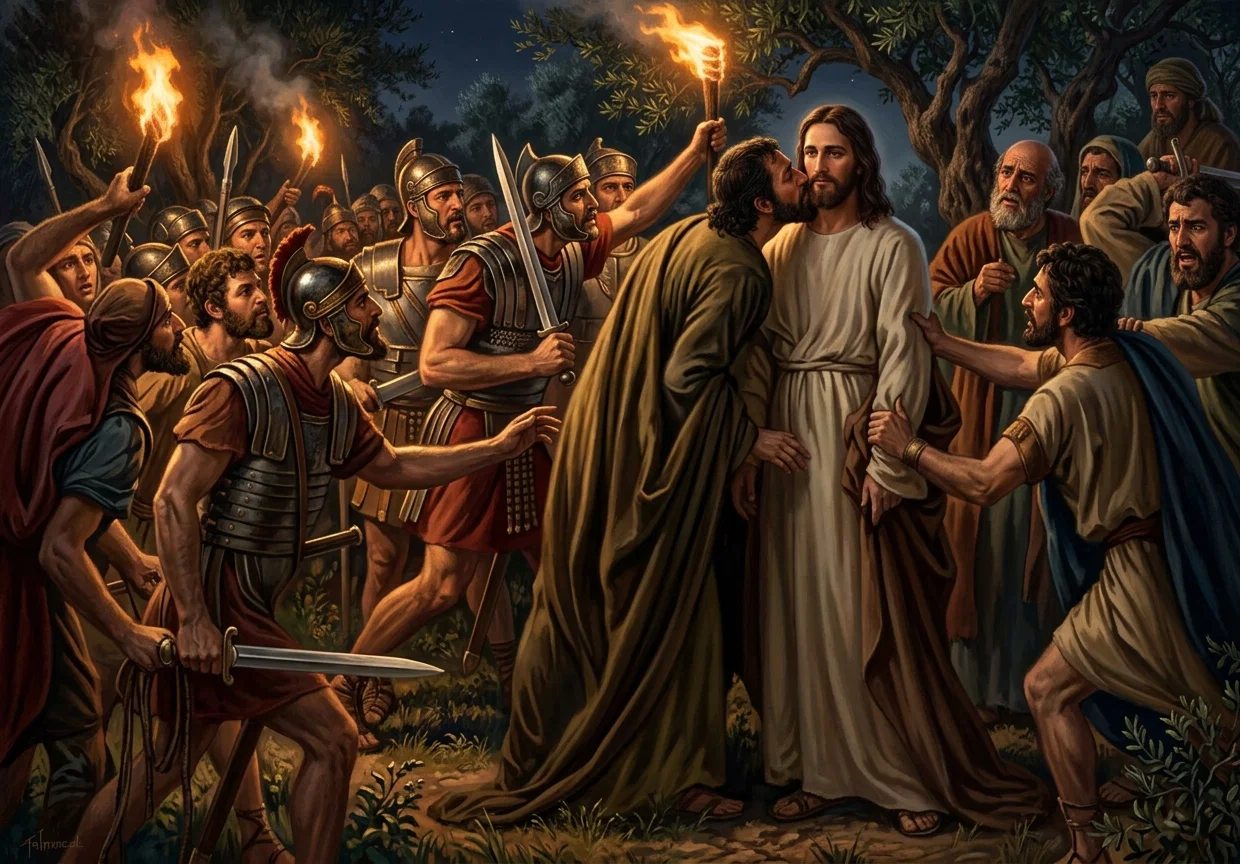
The Betrayal.—In our illustration the artist has given us what would seem to be a fairly good conception of the betrayal and arrest of our Lord.
The Account.—The story is found in all four of the evangelists’ accounts, the fullest, perhaps, in John and Matthew. We give a combination of all from the “Interwoven Gospels:”
“Now Judas also, one of the twelve, who betrayed him, knew the place; for Jesus oftimes resorted thither with his disciples. Judas then, having received the band of soldiers, and officers from the chief priests and the Pharisees, and the elders, cometh thither, while he yet spake, with lanterns and torches and with swords and staves. Jesus therefore, knowing all the things that were coming upon him, went forth, and saith unto them, Whom seek ye? They answered him, Jesus of Nazareth. Jesus saith unto them, I am he. And Judas also, who betrayed him, was standing with them. When therefore he said unto them, I am he, they went backward, and fell to the ground. Again therefore he asked them, Whom seek ye? And they said, Jesus of Nazareth. Jesus answered, I told you that I am he; if therefore ye seek me, let these go their way; that the word might be fulfilled which he spake, Of those whom thou hast given me I lost not one.
“Now he that betrayed him gave them a sign, saying, Whomsoever I shall kiss, that is he; take him and lead him away safely. And straightway he came to Jesus, and said, Hail, Rabbi; and kissed him. And Jesus said unto him, Friend, do that for which thou art come. Betrayest thou the Son of man with a kiss? Then they came and laid hands on Jesus, and took him. And when they that were about him saw what would follow, they said, Lord, shall we smite with the sword? Simon Peter therefore having a sword drew it, and struck the high priest’s servant, and cut off his right ear. But Jesus answered and said, Suffer ye thus far. And he touched his ear and healed him. Now the servant’s name was Malchus. Jesus therefore said unto Peter, Put up the sword into the sheath; the cup which the Father hath given me, shall I not drink it? All they that take the sword shall perish with the sword. Or thinkest thou that I can not beseech my Father, and he shall even now send me more than twelve legions of angels?”
The Central Figure.—The central figure is Jesus Christ to both friend and foe. He is the one calm person in all that midnight assembly. He is seemingly the one with the greatest interest at stake, and the one who will suffer most, yet the least disturbed.
The secret of his calmness, his placidity, his strength of character, was the Gethsemane pleading with God but a little while before. There—alone with God—the great struggle took place, the mighty Agonizer won by yielding, and he was ready for whatever might await him. This is a lesson for us all. We never prepare ourselves for the great conflicts of life by waiting till the conflict comes. We are always prepared for all conflicts by meeting every duty as it comes. Dark as Gethsemane may be, the right use of it, the yielding to God, gives a noble foundation for victory in coming trials. For all true, permanent victory lies in the operation of God’s will, and we win by yielding to that will. Note also the absolute unselfishness of our Lord: “If therefore ye seek me, let these [the disciples] go their way.” He gave his life for others.
The Betrayer.—Judas is a fitting type of cherished sin. His nature was selfish. His sin was overweening covetousness. Christ in mercy associated him with himself, placed before him constantly the teaching of his wondrous life and ministry of unselfish love, that Judas might receive it, overcome his covetousness, and live. He was one of those who followed Christ for worldly gain. As treasurer he had stolen the scanty contributions given to the disciples, instead of using the money for the purposes for which it was given. He had found fault because costly balm had been used upon our Lord—and all because of the covetousness his heart had cherished. Winding its tendrils about every affection, enthralling every noble and unselfish impulse, his cherished sin at last leads him, for a few paltry pieces of silver, falsely to betray his Lord, whom he had said he would follow to prison and death. He doubtless reasoned that Jesus would by his mighty power release himself from his enemies, and he, Judas, would be a few shekels the gainer. Poor, mistaken man—duplicated so often in the lives of others since—he was selling not his Lord, but his own soul. He had rejected the last warning, had refused the last reproof; he had chosen sordid gain, and with it death, dishonor, and eternal infamy. It is not safe to cherish one known sin for one moment. It will prove a traitor within the heart’s walls, which opens its gates to a legion of other and worse sins. Its presence darkens the mind, stupefies the conscience, hardens the heart, and ruthlessly destroys every high and holy and unselfish thought and aspiration. Let Christ cleanse the heart by his word of reproof and forgiveness. Let him abide there in all his purity, and by his presence “keep thy heart with all diligence; for out of it are the issues of life.”
“Not by Might, nor by Power.”—The betrayal has for us another important lesson in the course of another disciple. He was not one who betrayed his Master; he would have died for him then and there. Bold, impetuous Peter wanted Christ delivered, but he wanted it in his way, by the force of human might and power. Before this, Jesus had said repeatedly that the way of victory was the way of betrayal, suffering, the cross, the grave. Peter could not have it so. He desired earthly triumph. He wanted his Master to triumph as do earthly conquerors. His proud heart could not brook the humiliation; and he carried out what the others asked, “Lord, shall we smite with a sword?” Peter smote, and from his graciously loving Master received a rebuke, which is an eternal truth,—“All they that take the sword shall perish with the sword.” A man is no stronger than his means of defense. If the church trusts to the sword, with the sword she shall perish. If she trusts to the arm of flesh, she will reap the inevitable curse of the trust; the arm of flesh will fail in the most trying hour. Israel trusted in Assyria and Egypt, and both Assyria and Egypt failed her and spoiled her. They were as a staff upon which one leans, which breaks and pierces him who depends upon it for support. It has been so with the Christian church in the past; it is living over the life of apostate Israel to-day. In the demand for law, civil law, and civil penalties for Sunday observance and the like, the church is appealing to the sword instead of to God, and showing by her appeal that she has no sure faith in God, that she has not learned the lesson of Christ. It looked dark at his betrayal, and Peter thought something should be done, and done then. He tried in his way and failed. Many look at the ever-increasing wickedness, and it seems as tho the kingdom of Christ—their ideas of his kingdom—would never materialize, and something must be done; and therefore Sunday laws, and the help of the civil power. God does not need such help. Pitifully he heals the wound which the unholy zeal causes, but he rebukes the zeal. He has all heaven’s power at his command; he could wipe out all wickedness; but love, divine, eternal love must first be permitted to plead with men, even tho love’s keeper for the time dies. But love does not die. Righteousness can not perish. “Truth crushed to earth will rise again.” In his own intrinsic worth, Christ, and all of Christ, will triumph. Let the rash hand of force sheathe its blade; let God’s will be done. Not by army or power will he conquer, but by his Spirit in the hearts of men. Not by human power will his kingdom enter; “the zeal of the Lord of hosts shall perform this.” Whenever force has been used in connection with Christ’s cause or to advance its interests, it has always been at the expense of suffering to the innocent and irresponsible, and the ultimate defeat, and sometimes the eternal loss, of those who have chosen the force of flesh for the love of God. Reader, where do you stand? Will you learn these lessons of the betrayal?

THE UNSPEAKABLE GIFT.

Our study this week is inseparably connected with that of last week. Only lack of space prevented the verses of each being studied together. The student, however, will read very thoughtfully the preceding verses before beginning this present study, thus preserving the connection. We have learned about our relation to God through the Spirit, and of the help which the Spirit gives us in prayer, as well as of the assurance that “all things work together for good to them that love God, to them that are the called according to his purpose.” The grounds for that assurance are infinitely strengthened in the verses that follow:—
“For whom he did foreknow, he also did predestinate to be conformed to the image of his Son, that he might be the first-born among many brethren. Moreover, whom he did predestinate, them he also called; and whom he called, them he also justified; and whom he justified, them he also glorified. What shall we then say to these things? If God be for us, who can be against us? He that spared not his own Son, but delivered him up for us all, how shall he not with him also freely give us all things?” Rom. 8:29–32.

Questions on the Text.

How may we be sure that all things work together for good to them that love God, who are the called according to his purpose?
“For whom he did foreknow, he also did predestinate to be conformed to the image of his Son.”
Why did he predestinate them to be conformed to the image of his Son?
“That he might be the first-born among many brethren.”
What is said of those whom he thus predestinated?
“Them he also called.”
What of those whom he called?
“Them he also justified.”
And what of those whom he justified?
“Them he also glorified.”
What shall we then say to these things?
“If God be for us, who can be against us?”
What has God done, to show that he is for us?
“Spared not his own Son, but delivered him up for us all.”
What then must necessarily follow?
That he must “with him also freely give us all things.”

Foreknowledge and Foreordination.

“For whom he did foreknow, he also did predestinate to be conformed to the image of his Son, that he might be the first-born among many brethren.” The word “predestinate” is the same as “foreordain,” which is found in the Revised Version. Volumes of speculation have been written about these terms, but a few words are sufficientfor us to know the fact. With the explanation we have nothing to do.
That God knows all things, is plainly set forth in the Scriptures. Not only does he know the things that are past, but he sees the future as well. “Known unto God are all his works from the beginning of the world.” Acts 15:18. “O Lord, thou hast searched me, and known me. Thou knowest my down-sitting and mine uprising; thou understandest my thought afar off.” Ps. 139:1, 2. Thus God can tell what men even yet unborn will do and say.
This does not make God responsible for the evil that men do. Some men have foolishly thought it necessary to apologize for the Lord, and to relieve him of the charge that if he is omniscient he is responsible for the evil if he does not prevent it, by saying that he could know if he wished, but that he chooses not to know many things. Such a “defense” of God is both foolish and wicked. It assumes that God would be responsible for the evil if he knew it beforehand and did not prevent it, and that in order not to be in a position to prevent it, he deliberately shuts his eyes from it. Thus their “defense” really puts the responsibility for all evil upon God. Not only so, but it limits him. It makes him like a man.
God knows all things, not by study and research, as man learns the little he knows, but because he is God. He inhabits eternity. Isa. 57:15. We can not understand how this can be any more than we can understand eternity. We must accept the fact, and be not only content, but glad, that God is greater than we. All time, past, present, and future, is the same to him. It is always now with God.
The fact that God knew the evil that men would do, even before the foundation of the world, does not make him responsible for it, any more than the fact that a man can see by means of a telescope what a man is doing ten miles distant, makes him responsible for that other one’s actions. God has from the beginning set before men warnings against sin, and has provided them with all the necessary means for avoiding it; but he can not interfere with man’s right and freedom of choice without depriving him of his manhood, and making him the same as a stick.
Freedom to do right implies freedom to do wrong. If a man were made so that he could not do wrong, he would have no freedom at all, not even to do right. He would be less than the brutes. There is no virtue in forced obedience, nor would there be any virtue in doing that which is right, if it were impossible to do wrong. Moreover, there could be no pleasure or satisfaction in the professed friendship of two persons, if one associated with the other just because he could not avoid it. The joy of the Lord in the companionship of his people is that they of their own free-will choose him above all others. And that which is the joy of the Lord is the joy of his people.
The very men who rail against God for not preventing the ills that he foresees, since he is all-powerful, would be the very first to charge him with cruelty if he did arbitrarily interfere with their freedom, and make them do that which they do not choose. Such a course would make everybody unhappy and discontented. The wisest thing for men to do is to stop trying to fathom the ways of the Almighty, and accept the fact that whatever he does is right. “As for God, his way is perfect.” Ps. 18:30.

About Predestination.

The text shows that “whom he did foreknow, he also did predestinate to be conformed to the image of his Son, that he might be the first-born among many brethren.” God’s thoughts toward men are thoughts of peace, and not of evil. Jer. 29:11. He ordains peace for men. Isa. 26:12. We read nothing about men being foreordained to destruction; the only thing that God has predestinated is that men should be conformed to the image of his Son.
But it is only in Christ that we become conformed to his image. It is in Christ that we come “unto the measure of the stature of the fulness of Christ.” Eph. 4:13. Therefore it is that men are foreordained or predestinated only in Christ. The whole story is told in the following passage of Scripture:—
“Blessed be the God and Father of our Lord Jesus Christ, who hath blessed us with all spiritual blessings in heavenly places in Christ; according as he hath chosen us in him before the foundation of the world, that we should be holy and without blame before him in love; having predestinated us unto the adoption of children by Jesus Christ to himself, according to the good-pleasure of his will, to the praise of the glory of his grace, wherein he hath made us accepted in the beloved.”
Everything is in Christ. We receive all spiritual blessings in him; we are chosen in him unto holiness; in him we are predestinated unto the adoption of children; in him we are accepted; and in him we have redemption through his blood. “God hath not appointed us to wrath, but to obtain salvation by our Lord Jesus Christ.” 1 Thess. 5:9.
That is God’s purpose and foreordination concerning man. Still further, “whom he did foreknow, he also did predestinate to be conformed to the image of his Son.” Whom did he foreknow?—There can be no limit; he must have foreknown all. If there were any exception, then God would not be infinite in knowledge. If he foreknows one person, then he foreknows every person. There has not been a person born into the world whose birth God did not foreknow. “Neither is there any creature that is not manifest in his sight; but all things are naked and opened unto the eyes of him with whom we have to do.” Therefore, since every person has been known to God, even before the foundation of the world, and those whom he foreknew he predestinated to be conformed to the image of his Son, it follows that God has purposed salvation for every soul that has ever come into the world. His love embraces all, without respect of persons.
“Then everybody will be saved, no matter what he does,” some one will say. Not by any means. Remember that the purpose of God is in Christ. It is only in him that we are predestinated. And we are free to choose for ourselves whether we will accept him or not. Man’s will has been forever set free, and God himself will not presume to interfere with it. He holds the choice and will of each individual sacred. He will not carry out his own purpose contrary to man’s will. His will is to give man whatever man decides will best please him. So he sets before man life and death, good and evil, and tells him to choose which he will have. God knows what is best, and has chosen and prepared that for man. He has gone so far as to fix it beyond all possibility of failure, that man shall have that good thing if he chooses it. But the wonderful kindness and courteousness of the great God is seen in this, that he defers in everything to man’s wishes. If man, in his turn, will but defer to God’s wishes, there will be the most delightful and loving companionship between them.

Called. Justified. Glorified.

“Moreover, whom he did predestinate, them he also called; and whom he called, them he also justified; and whom he justified, them he also glorified.” This is completed action. We need not stumble over it, if we will but remember that everything is in Christ. In Christ we have already been blessed with all spiritual blessings. All men are called to that which God has prepared for them, but none are “the called according to his purpose,” unless they have made their calling and election sure by submitting to his will. Such ones are predestinated to be saved. Nothing in the universe can hinder the salvation of any soul that accepts and trusts the Lord Jesus Christ.
And all such are justified. The death of Christ reconciles men to God. “He is the propitiation for our sins; and not for ours only, but also for the sins of the whole world.” 1 John 2:2. His death has secured pardon and life for all. Nothing can keep them from salvation except their own perverse will. Men must take themselves out of the hand of God, in order to be lost. Much more, then, those who accept the sacrifice, are justified. “God commendeth his love toward us, in that, while we were yet sinners, Christ died for us. Much more then, being now justified by his blood, we shall be saved from wrath through him. For if, when we were enemies, we were reconciled to God by the death of his Son; much more, being reconciled, we shall be saved by his life.”
“And whom he justified, them he also glorified.” Have we not read in the prayer of Christ for his disciples, not only for those who were with him in the garden, but also for all them that should believe on him through their word, and therefore for us, “The glory which thou gavest me, I have given them”? Peter said that he was a partaker of the glory that shall be revealed. God has left nothing undone. Everything that Christ has we have if we accept him. All that remains is that it should be revealed. “The earnest expectation of the creature waiteth for the manifestation of the sons of God.” When God asks concerning his people, “What could have been done more tomy vineyard, that I have not done in it?” who shall presume to say that there is something that he has overlooked?

All Things Ours.

But we have anticipated the apostle. Hear him: “What shall we then say to these things? If God be for us, who can be against us? He that spared not his own Son, but delivered him up for us all, how shall he not with him also freely give us all things?”
“How shall he not?” That is, How can he avoid giving us all things? In giving Christ for and to us, God could not do otherwise than give us all things, “for in him were all things created, in the heavens and upon the earth, things visible and things invisible, whether thrones or dominions or principalities or powers; all things have been created through him, and unto him; and he is before all things, and in him all things consist.” Col. 1:16, 17, R. V.
“Therefore let no man glory in men. For all things are yours; whether Paul, or Apollos, or Cephas, or the world, or life, or death, or things present, or things to come; all are yours; and ye are Christ’s; and Christ is God’s.” 1 Cor. 3:21–23. This, then, answers the question, “Who can be against us?” Everything is for us. “All things are for your sakes.” 2 Cor. 4:15.
A general once telegraphed to the seat of government, “We have met the enemy, and they are ours.” This is what every child of God is privileged to say. “Thanks be to God, which giveth us the victory through our Lord Jesus Christ.” 1 Cor. 15:57. “This is the victory that hath overcome the world, even our faith.” 1 John 5:4, R. V. This is what makes us know that all things work together for good to them that love God. No matter how dark and forbidding the things may seem, if we are in Christ, they are for us, and not against us. E. J. W.

Triumph

Triumph.—In all the suffering Christ triumphed. Through death he destroyed him that had the power of death, the devil. And as in it all he conquered, so by submitting to him in all things, we may conquer gloriously with him at last.

SALVATION IS COME TO THINE HOUSE.

BY MRS. E. G. WHITE.
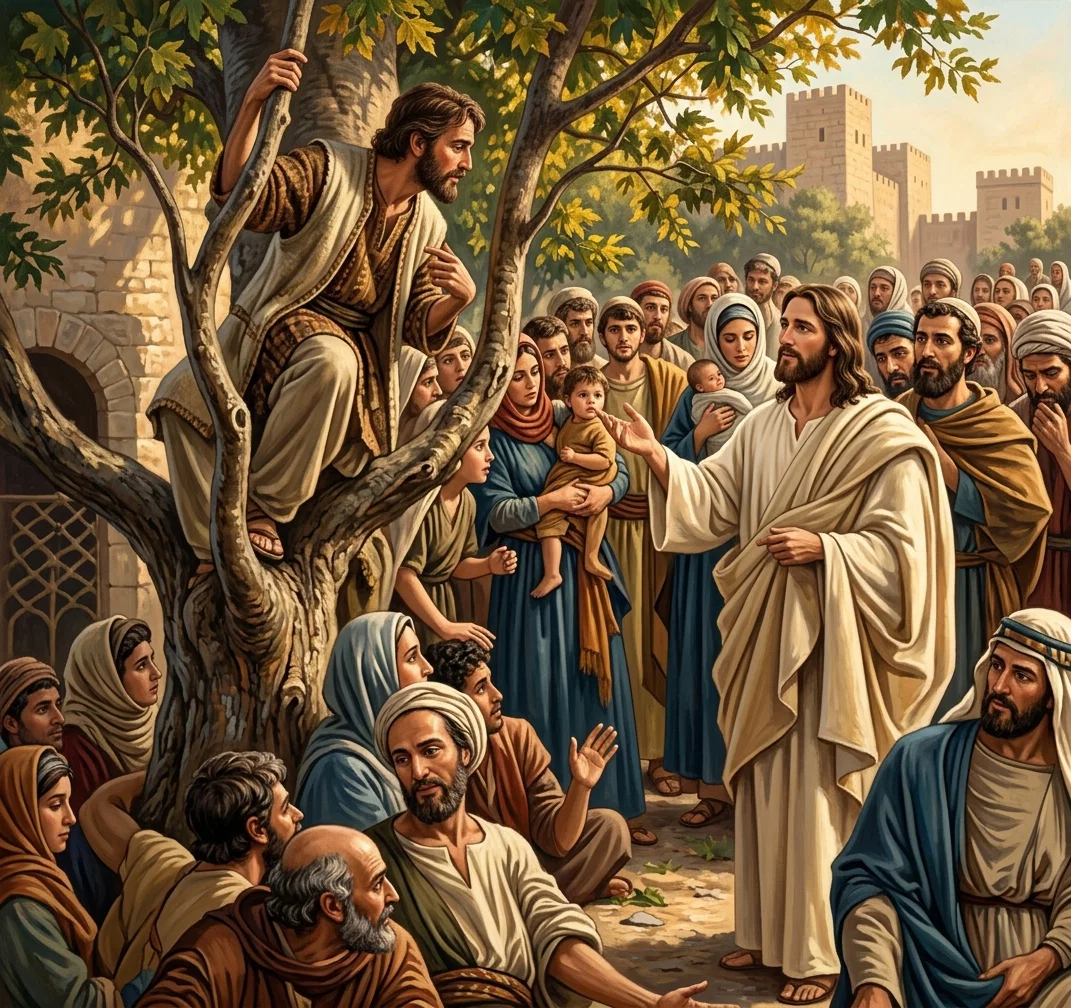
“And Jesus entered and passed through Jericho. And, behold, there was a man named Zaccheus, which was the chief among the publicans, and he was rich. And he sought to see Jesus who he was, and could not for the press, because he was little of stature. And he ran before, and climbed up into a sycamore tree to see him; for he was to pass that way. And when Jesus came to the place, he looked up, and saw him, and said unto him, Zaccheus, make haste, and come down; for to-day I must abide at thy house. And he made haste, and came down, and received him joyfully.”
The reception of Christ by Zaccheus was one of the bright spots in the Saviour’s experience as he journeyed through Jericho. The members of his own family did not believe on him as the world’s Redeemer, and their unbelief brought anguish to the Saviour’s heart. He knew that they were losing precious opportunities to become acquainted with him, and to receive the precious lessons of truth which he was giving to his people. He had been rejected by the scribes and Pharisees, and by the chief priests and religious leaders of his own nation, because his teachings did not harmonize with the teaching of the professed people of God. They could not be reconciled to the fact that Jesus, who was unrecognized as a religious teacher by the rabbis and scribes, should teach as one having authority. Neither could they bear the manifestation of love and mercy that he gave to those who were considered outcasts and sinners.
Zaccheus was a Jew, and yet a publican.
He was even chief among the publicans, having oversight of those who gathered in the taxes in behalf of the Roman Government. A publican was one who was despised by the Jewish people, and the fact that Zaccheus was a Jew, and still occupied this position, made him doubly offensive. They looked upon him with contempt, altho he was a man of considerable wealth and of some influence in the position which he held. Some looked upon Christ with hatred, and thought themselves much better than Zaccheus; but they did not respond to his heavenly teaching or yield to the drawing influence of the Holy Spirit. They were surprised to see Zaccheus accept Christ so readily. They were astonished to see him come down joyfully from the tree to give the hospitality of his house to one who was apparently poor in earthly possessions. They did not understand that Christ had become poor for humanity’s sake, in order that through his poverty they might be made possessors of eternal riches.
Zaccheus had heard of Christ’s merciful works, had listened to the repetition of his wonderful teaching, and had longed to see Christ for himself. The words of the Saviour that had been reported to him by those who had heard him, had taken deep hold of his heart, and had made him realize that he needed to reform in his life. He felt deeply the need of repentance, of making restitution to those whom he had unjustly taxed, and of whom he had demanded exorbitant rates. He desired to know more of the principles and doctrines of this wonderful Teacher. The seed of truth had been sown in his heart, and he had nurtured it, and it was about to bring forth a harvest unto the glory of God.
The scribes and Pharisees murmured among themselves as they heard the words of gracious favor to Zaccheus. They were eager to find something with which to accuse Christ, and to lead the people to reject him. Christ was the Prince of God, yet he was not honored even as are earthly princes. He did not come in splendid state, and pass through the cities of men in gorgeous equipage. He made one of the multitude among which he traveled. He spoke words of encouragement to the despondent, relieved those who were suffering, healed the sick and afflicted, and blessed those who came within the sphere of his influence. He came as the missionary of heaven to represent the Father, and he rejoiced whenever he met a soul who received him without prejudice, and responded to the gracious drawing of the Spirit of God. The scribes and Pharisees murmured that favor had been shown to Zaccheus, his heart rejoiced as Jesus said, “I must abide at thy house.”
Zaccheus could hardly think that he had heard aright. He was overwhelmed with the condescension of the great Teacher in choosing his home as the place of his abode. It had been in his power to oppress those from whom he was appointed to gather the taxes. He was convicted that his practice was out of harmony with the Old Testament Scriptures. He knew the Scriptures, and under the influence of the words that had been reported to him, that had come from the lips of the great Teacher, he had become aware that he was a sinner in the sight of God. He began at once to follow the conviction that had taken hold upon him, and to make restitution to those whom he had robbed. This was an evidence of genuine conversion. The scribes and Pharisees expressed their indignation, saying that Christ had gone to be the guest of a man that was a sinner; but the fact of the matter was the Holy Spirit was working upon this man’s mind, and the multitude had a clear evidence of the fact. “And Zaccheus stood, and said unto the Lord: Behold, Lord, the half of my goods I give to the poor; and if I have taken anything from any man by false accusation, I restore him fourfold.”
In thus doing Zaccheus was following out the very instructions which the Lord had given in the Old Testament Scriptures, and showed himself to be a doer of the words of Christ. When the publicans had come to be baptized of John in the Jordan, they asked, “What shall we do? And he said unto them, Exact no more than that which is appointed you.” In restoring fourfold for what he had taken in extortion, he was following the word of the prophet when he said, “He shall restore the lamb fourfold because he did this thing, and because he had no pity.” Jesus recognized his sincere repentance, and accepted his work toward reformation. “And Jesus said unto him, This day is salvation come to this house, forasmuch as he also is a son of Abraham.” Not only was Zaccheus blessed, but all his household with him.
What a lesson is there for us in the history of Zaccheus’ conversion! If we have injured others through any unjust business transaction, if we have overreached in trade, or defrauded any man, even tho it be within the pale of the law, yet if we are Christians, we shall confess our wrong, and make restitution as far as in us lies. We should give evidence that there is a genuine work of grace within our hearts. If earthly courts award to us property that is not justly ours, we are not to accept the decision of unjust judges. Tho we may be clear on the records of men, yet in the books of heaven we will be written as oppressors, and the case will go against us when judgment shall take place in the courts of God.
Before Zaccheus had looked upon the face of Christ, he had begun the work that makes him manifest as a true penitent. Before being accused by man, he had confessed his wrong. He had yielded to the convictions of the Holy Spirit. He had begun to carry out the spirit of the words written for ancient Israel, as well as for ourselves. He said to the Saviour, “The half of my goods I give to the poor.” The Lord had said long before: “If thy brother be waxen poor, and fallen in decay with thee; then thou shalt relieve him; yea, tho he be a stranger, or a sojourner; that he may live with thee. Take thou no usury of him, or increase; but fear thy God; that thy brother may live with thee. Thou shalt not give him thy money upon usury, nor lend him thy victuals for increase. I am the Lord your God, which brought you forth out of the land of Egypt, to give you the land of Canaan, and to be your God.” “Ye shall not therefore oppress one another; but thou shalt fear thy God.” These words had been spoken by Christ when he was enshrouded in the pillar of cloud. The same Teacher had spoken these words as had spoken the sermon on the mount. It was Christ who had said, “Ye shall do my statutes, and keep my judgments.” Christ had presented the same principles on the mount of beatitudes as he had on Mount Sinai. He had said that on the principles of love to God and to our neighbor, hung all the law and the prophets.
When the human agent is awakened by the Holy Spirit, the least that he can do is to acknowledge his wrong, and to work earnestly to restore both principal and interest to those whom he has defrauded.
Among the publicans existed a confederacy, so that these men could oppress the people, and sustain one another in the fraudulent practices. Zaccheus by his repentance and reformation protested against this confederacy. He restored fourfold to those whom he had oppressed. If we have wronged any one by taking away that which was justly his due, we should consider that it is right for us to restore not only that which we have taken, but all that it would have accumulated if it had been put to a wise and right use during the time it has been in our possession.
To Zaccheus the Saviour said, “This day is salvation come to this house.” Christ went to his home to abide with him, to give him lessons of truth, to instruct his household in the things of his kingdom. Salvation comes to the soul when Christ is received as a personal Saviour. The case of Zaccheus was a most grateful token to Christ as he journeyed on his way. Tho the scribes and the Pharisees accused Zaccheus of being a sinner, and murmured against Christ because he had condescended to be his guest, yet the Lord looked upon the matter in an altogether different light. Instead of denominatingZaccheus a sinner, he recognized him as a “son of Abraham.” He had made it manifest that he was worthy to be called a son of Abraham; for he resembled Abraham in character, and was full of faith, accepting Christ as his Saviour, as did also the “father of the faithful.” Of himself Christ said, “The Son of man is come to seek and to save that which was lost.” Those who had condemned others, who thought themselves beyond the need of repentance, were shown to be greater sinners than those they condemned. Those whom they accused would go into the kingdom of heaven, and those who thought themselves righteous, and who vindicated their own course, would be cast out. Jesus had come, as he said, not to call the righteous, but sinners to repentance, and those who receive him joyfully, will recognize the fact that salvation has come to their souls.
Continue reading: The Sabbath and the Gentiles