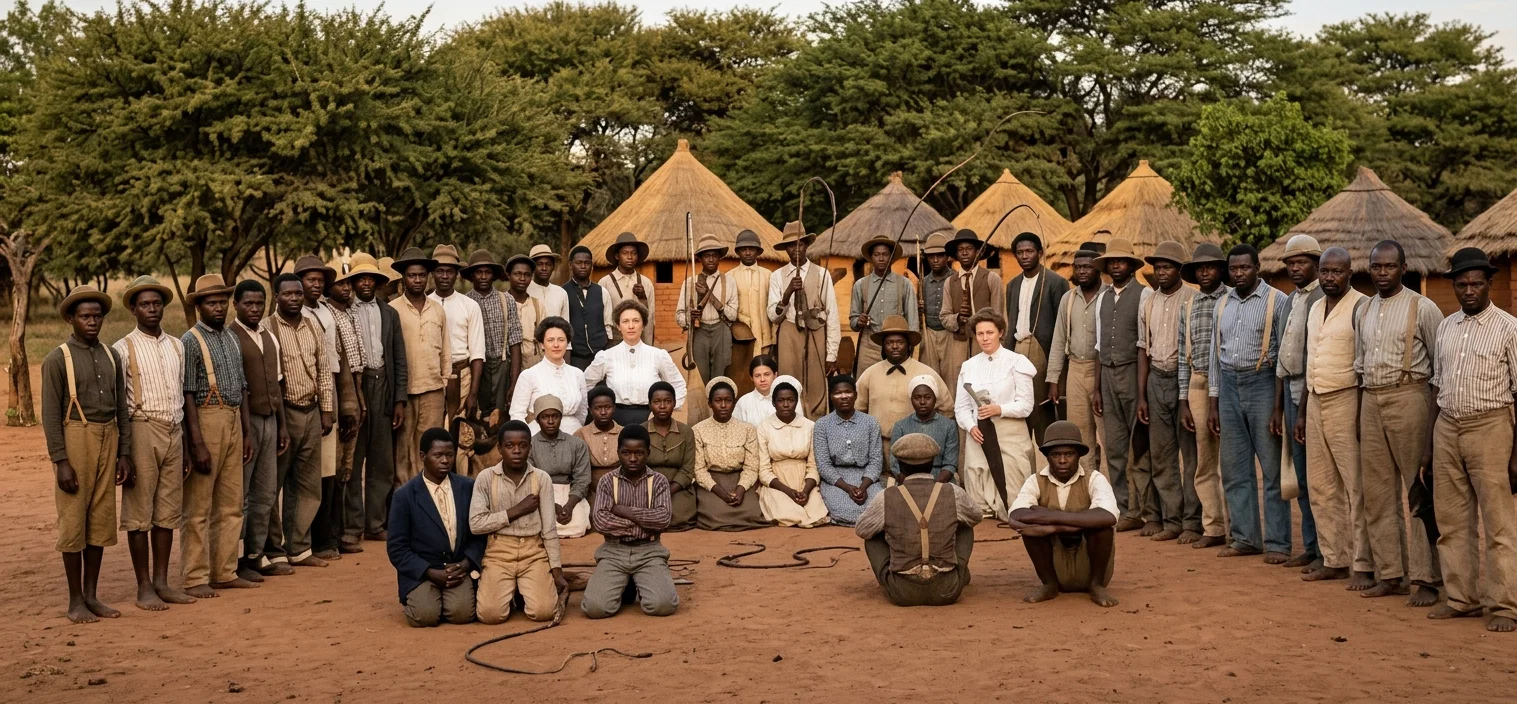
Much has been written about Solusi, and there is still much that could be written. This mission is a busy place all the year round. We have a large native school of about one hundred students, and there are ten outschools. The farm consists of eight thousand acres, nearly three hundred of which are under cultivation. There are two hundred and fifty head of cattle and six mules. About sixty of the cattle are milch cows, sixty are working oxen, and the rest are young stock. All this, with our store, through which passes each year six or seven thousand dollars’ worth of goods, makes the life of the workers a busy one.
The day’s work begins just before daylight, when one hears the rattle of milk cans and buckets. The milkboys are going to milk. It would amuse our American farmers to witness the milking process here in Africa. The idea prevails that the calf must begin in order to induce the mother to give down her milk. Then the small boy who attends each milker takes off the calf and holds him until a good portion of the milk is taken, after which the calf is allowed to finish his breakfast at leisure. The cows do not always submit kindly to being milked. Sometimes a screen has to be thrown over their horns and tied down before they will allow of milking.
SUPERINTENDENT'S COTTAGE, SOLUSI MISSION
Elder and Mrs. R. P. Robinson — Visitor — Elder and Mrs. W. C. Walston
Soon after the milkboys are astir there is a good deal of shouting and cracking of whips. The ox drivers are inspanning for their morning’s work. These long whips have a stock like a fish pole, and a lash nearly twenty feet long. The drivers crack them so they sound like pistol shots. A team for transporting is sixteen oxen; for farm work, less. We have three teams of oxen and our mule team, which are kept busy all the time. While the drivers are inspanning the foreman blows his police whistle, and the whole mission family is soon astir. There are many duties to be attended to, and soon all are busy, some in the field, others about the buildings.
It is planting time now (December). The teams are plowing, harrowing, and planting. Some of the white workers drive the planter, as it is difficult for the native to go in a straight line. The work of the morning goes on until seven o’clock, when the bell rings for worship and breakfast. All come in, except those with the teams. They continue until eight o’clock, and then outspan until three o’clock in the afternoon.
After breakfast the bell rings again, and the beginners have school work until 10:15, when they are dismissed, to take their turn in the field, while the older students come in. At 1:45 P. M. school is out, and the whole family prepare for dinner, which comes at two o’clock.
“Who cooks the dinner?” some one inquires. This is done by the girls as shown in the illustration on the first page.
At three o’clock the bell rings for all to go to work again, which continues until sundown, when everybody comes in and an hour is spent in play. All have a good time, and are pretty noisy, but we do not mind.
At seven o’clock the bell calls all the students in for night school, which is really but the preparation of lessons for the following day, except for the herdboys, who are out all day with the cattle. They recite what they have learned on the veldt during the day, as they always take their books with them while they herd. At eight-thirty school closes, and at nine the silence bell rings. Quiet is supposed to reign until morning, though sometimes it takes more than the tap of the bell to induce quietness. This schedule is carried out through the whole year, with the exception of four vacations of two weeks each.
SOLUSI MISSION SCHOOL, WITH TEACHERS
Notice boys in rear with long ox whips.
We have our difficulties on these mission stations. Some of the stations are a long way from a repair shop, and it is necessary that there should be some one at hand who is an all-round workman, for when there is a break in some implement it would mean a long delay to send thirty miles for repairs.
Here is one day’s experience: The superintendent starts out with the planter. The foreman comes to him and says, “Teacher, the calf that was sick is dead.” “Very well, take off his skin and bury the calf.” He reaches the field only to find that the driving chain that revolves the plates in the planter has been tampered with, and the planter does not work. A small boy must be called to hold the mules while a return is made to the mission to find the lost section of chain. When it is found and adjusted, the planter starts, but gets only about half-way across the field when one of the plowboys comes running to tell the teacher that the plow is broken. Again the small boy holds the mules, while the teacher goes to fix the plow. Returning, he makes one or two turns, when another plowboy rushes up to tell him the disc plow has gone wrong. He spends thirty minutes setting it right, and then the work goes merrily on until something else is wrong. The natives have very little idea of how to use modern farm implements properly, and there are many breaks.
We are all of good courage here at Solusi Mission, and are the recipients of many blessings in our work. We ask our friends in the message to pray for us.
Even the Smallest Fault Is a Fault Just the Same
“Even the smallest fault is a fault just the same.”
A Bit of Experience
A MOTHER
SOME months ago a dear little girl of seven came into our home. It was a pleasure to teach her with my own little six-year-old daughter, and I should like to tell other mothers some of the things we accomplished while she was with us.
Both children completed the first grade of school work. They also learned to mend and darn and patch neatly, to make creditable buttonholes, and to embroider and cross-stitch.
We had three rules for our work and for our play: (1) I will do my very best, because Jesus sees me all the time, and I want to please him; (2) I will not do anything today that I should not want mother and teacher to know; (3) Before I sleep, I will tell all my troubles to Jesus, and ask mother about anything I do not understand. The first two resolutions were repeated each morning, the third the last thing at night. I did my best to help the children make a practical application of each rule.
If I did not have to correct or punish them through the day, each child received a penny, not so much as a reward as an encouragement. The penny was not “pay” for “being good,” neither was it the highest motive placed before them. That was always to please Jesus. But it did serve as a reminder to faithfulness in the performance of their duties, and to be cheerful and courteous in their behavior. Each penny was carefully kept until ten had been earned; then one was laid aside for tithe, and the remaining nine went into their pocketbooks. Out of this money came Sabbath school donations, also chalk, pencils, and other small school supplies.
I do not believe in cramming or crowding, but children form habits easily, and our daily program was about as follows:—
Repeating our daily rules, feeding poultry and pets, setting the breakfast table (one put on the food, the other the china and silver), worship, and breakfast. Then one packed the dishes, while the other cleared away the food. After this came an hour for study and recitation. They played until time to set the table for dinner, and after the dishes were washed and put away, they spent an hour on needlework. Following this they played till time for evening chores. If any duty was neglected, or if they failed to come promptly when called, the penny was withheld, and besides this, if they had trouble with each other, the one at fault gave a penny from her store. However, discipline of this kind was seldom needed.
On Sabbath we drove six miles to church. The children were much interested in the Sabbath school lessons, and at the end of the year could repeat every memory verse for the twelve months. On the way to and from church we learned many Bible chapters, and also a number of good poems.
Surely it is a blessed privilege to deal with children, and teach them faithfulness and diligence. It requires patience, self-control, and time, but in the end you will be amply repaid for your efforts. Encourage the little ones to take you into their confidence, and never leave an opportunity unimproved to gain their cooperation in what you have in mind for them. May the Lord help every mother to do her full duty in training the children who have been intrusted to her care.
Loma Linda, Cal.
Why She Was Not Popular
By Martha E. Warner
MARTHA E. WARNER
I was half asleep in my chair on the hospital veranda when I heard a voice at my right say, “She is not very popular with the young people. Oh, there she comes now to visit her aunt! Speak of angels—”
Looking up, I saw a young girl and her brother coming up the steps. They took13possession of the little lady at my left, so I could not help hearing their conversation.
The aunt spoke of attending three symphony concerts during her lifetime. The girl remarked, “Why, my dear, surely you have been to more than three! I have heard you speak of going. You think!” The aunt did think, and proved to the girl that she had spoken the truth.
Her brother began to relate some boyish prank that was carried out the preceding Tuesday.
“Are you sure it happened Tuesday?” asked the girl.
“Yes,” he replied, and started his story again.
“I think it was Monday,” persisted his sister.
“Bother the day!” the boy exclaimed, and again tried to finish his tale, only to be again interrupted. Leaning back in his chair at last, his face showed his displeasure plainly. His scowl disappeared, however, as an elderly man joined the group.
“Going to Stafford Fair with me tomorrow?” asked the newcomer of the invalid. A smile flitted over her face, and she was about to reply when the girl said, “The idea! Stafford Fair was over long ago.”
“Stafford Fair begins tomorrow,” answered the man very decidedly.
The girl lifted a flushed face, and with a pained look said, “My grandmother lives at Stafford, and she wrote me some time ago to be sure to visit her during the fair. The fair is over.”
My nurse came just then, so I heard no more, but I knew that the girl was wrong. To me it was very evident why she was not popular. She was rude, and so busy keeping other people straight that she had no time to spend in training herself. Unless she changes, she will be a very disagreeable woman. No friend has had the courage to tell her her fault; but if she would only stop and take an inventory of herself, she would not have to be told.
Back of it all, however, lies the fact that some mother failed in her duty to her daughter. A child should be taught to listen quietly when another is speaking, and never to interrupt even his playmates unless it is really necessary to give some information. If this lesson is learned in childhood, the youth will never be guilty of such a crime against good form as the young woman in question committed.
Clintonville, Conn.
A Prayer for Love
By Arthur W. Spaulding
ARTHUR W. SPAULDING
LORD, not for power I pray, in need or
whim
To make men gape at splendor of my
rule;
Though much is his, and much is due
from him,
That binds the froward and outwits
the fool.
But not for power to make supreme my
sway,
No, not for power to rule for thee, I
pray.
Lord, not for eloquence to charm the
crowd
With sounding periods voiced, or
plaudits sung,
Though blest is he that can abase the
proud
And cheer the humble by his facile
tongue;
Yet, Lord, for fervor of the spoken word,
For eloquence, let not my prayer be
heard.
Not, Lord, for judgment do I make my
prayer,
For keen and critic insight into wrong;
Though he that judgeth doth all honor
bear,
To help the feeble and to guide the
strong,
Yet now I covet not the piercing sword:
Give me not judgment with my frailty,
Lord.
But one full boon from thee, O Lord,
I crave:
The gift of loving, not to be denied;
That though myself I cannot, would not
save,
I may reveal the spirit of the Crucified;
That whether loved or hated, bound or
free,
I may, by loving, make men more like
thee,
“Bring Back What You Borrow”
By Lora E. Clement
LORA E. CLEMENT
“The rain, it rains ’most every day Upon the just and unjust fellers, But chiefly on the just, because The unjust have the just’s umbrellers!” chanted Bob as he dodged into the sheltered doorway where I stood, and gazed ruefully at the deluged landscape.
“Why!” I exclaimed, in surprised dismay, “why did you start without an umbrella? Wasn’t it raining when you left home?”
“Well, yes,” and a whimsical smile crept out as he bowed low and shook the water from the brim of his derby, “it did sprinkle a bit as I sprinted for the car, but I’m feeling damply benevolent this morning. You see last week I lent my umbrella in an ill-guarded moment, forgetting the weakness of my fellow mortals.”
“We are rather an erring lot when it comes to returning what we borrow,” I admitted, “but you certainly have struck fertile soil for sympathy. Ever since I awoke this morning, I have been throttling a desire to ring a certain doorbell and inquire whether or not I could borrow a raincoat. Mine has been ‘staying there’ for the last three weeks.”
“Yes, and I’ll venture Grace has never thought of it since she asked its loan to wear to the concert,” sputtered Bob. “Now why do you suppose that persons who know better—who would be insulted if you told them they were not polite—and do not concern themselves about returning borrowed articles promptly? Anybody likes to be accommodating, but why, oh, why, don’t folks cooperate with a fellow when he tries to follow the golden rule?”
The downpour was slackening, and with the remark that he guessed he’d “make a run for the office,” my neighbor was gone. I was glad he did not wait for an answer to his question. I couldn’t give one. Can you? But as I plodded up the flooded street, I resolved that the next time necessity demands that I “borrow,” I will remember to “bring back.”
Conducted by Mrs. I. H. Evans, Takoma Park, Washington D. C
By Mrs. I. H. Evans; Miss Lora E. Clement
Assisted by Miss Lora E. Clement
Through the columns of this department, hints will be given on all matters pertaining to the home life. Short articles and letters are solicited from home makers, telling of their everyday experiences,—their joys and sorrows, their failures and successes.
“Our Incorrigibles”
By Marion Harland
A PRECOCIOUS four-year-old boy saw a plate broken by the fall of a fork upon it. His mother picked up the fragments, and inspected the edges of the fracture. “It was cracked already,” she pronounced, “or it would not have broken so easily.”
An hour later the boy had a grievous fall, and she ran to pick him up. “My darling! have you broken your poor little head?” “I fink so!” sobbed the sufferer. “But it was c’wackit a’weady, or it wouldn’t have b’woke so easy!”
The anecdote recurs to me with whimsical persistency in reading disquisitions upon “The Modern Girl,” set agoing in secular and religious papers by the appeal of a New York mother to the law for assistance in restraining her young daughter from associating with undesirable companions and from extravagant expenditure of liberal means. “Incorrigibility” was the form of arraignment before the court. The plea of the parent that she had done her best to restrain the wilful creature, who at seventeen supplied “copy” for the daily prints all over the United States, was confirmed by the evidence of friends and relatives.
It is not my intention to dwell upon the details and the result of this particular instance of defective family government. What struck me as significant in the affair was that so few expressed surprise at the revelation. One mother had confessed openly that she had been driven to extremity. If public opinion, as conveyed in newspaper and conversation, were to be credited, society, in all walks of American domestic life, is so familiar with the idea of daughter’s domination and mother’s vassalage that the aforesaid extreme case caused scarcely a week’s wonder.
The residuum of the ferment of talk was the general inquiry, “Who is to blame for this monstrous wrong to family and community?” With marvelous unanimity the verdict was rendered: “The mothers are more culpable than the daughters. What are they thinking of that they do not put an end to lawlessness of speech and behavior? The remedy is in their hands. Let them act, and promptly!”
“Incorrigibility,” we are told, should not be so much as named in connection with the débutante. She should be wax in the deft fingers of the mother who bore her, and to whom she owes love and obedience. The root of the evil is in the absorption of the matron of this generation in fashionable frivolities, and almost as fashionable philanthropies and politics, to the shameful neglect of home and offspring.
As I have said, it is in listening to these faultless theories that the story of my four-year-old’s apology for his broken head comes back to me:—
“It was c’wackit a’weady!”
The mother who begins to “control” her prankish daughter when she is on the edge of early womanhood, is a matter of eighteen years too late. The noxious weed of incorrigibility is not the growth of a single night,—nor of one season. The fine china of character was cracked already, or it would not have broken so easily. . . .
The nursery in which our grandmothers bore rule was “a despotic monarchy.” Our children flourish under a republic. Self-development according to natural laws, the God-given right of the newly-made being to live its own life and enjoy its own individuality, are no longer themes open to discussion. They are axiomatic. The rod is as obsolete as the thumbscrew; they are regarded as equally barbarous.
I would guard the reference to corporal punishment before I go a step farther. In some of the happiest and most wisely governed households I have ever had the happiness to know, the rod, as a mode of chastisement, was unknown. But I have yet to see a well-managed nursery in which punishment of some kind for wrong-doing is a dead letter. Wilful transgression and the consequent penalty, sin and suffering, should stand for cause and effect the world over.
“When should I begin my child’s education?” asked a young mother of a matronly friend.
“It should have been begun the day she was born!” was the rejoinder. “Weeds spring up sooner than flowers, and grow faster.”
A disciple of the new school of child training caught up the word:—
“That is the cant of maternal servitude. I recognize the heading of ‘Chapter First.’ My dear lady, are you still lingering in the shadows of the Middle Ages?”
I maintain, in defense of the “Middle Ages,” that motherhood, so far from being servitude, is the noblest mission to which a woman can be called. Moreover, I challenge contradiction of the assertion that there is the same difference between characters and minds molded by the mother who estimates aright her high and holy calling, and those committed to hirelings (no matter how faithful and expert), as between homemade and “contract” manufactures.
Sixty years ago a schoolgirl said to me, “When I am in doubt as to the right or wrong of any course I am disposed to take, I ask myself, ‘Can I tell mother what I mean to do?’ If I am not altogether willing to talk it over with her, I know there is something wrong about it.”
This simple test was, for the daughter, the touch of Ithuriel’s spear. She had learned by heart, and for life, the meaning of the first word of the commandment with promise. She “honored” her mother in word and in deed. . . .
Harking back to the homely illustration with which my talk began, I submit another and yet more apposite figure. A builder once explained to me that hardwood, even of excellent quality, must undergo a certain process of seasoning and manipulation before it can be warranted against “checking.” “That is, going into little cracks all over the surface,” he explained at my look of inquiry. “When that happens, nothing can be done for it.”
I set down the quaint phrase in my notebook. It fits partly into the study of the eighteen-year-old “incorrigible” and her congeners.—Marion Harland, in the Mother’s Magazine.
Home Ruled According to God’s Word
WHEN home is ruled according to God's Word, angels might be asked to stay a night with us, and they would not find themselves out of their element.—Spurgeon.
W. H. SMITH
By W. H. Smith
Florida
JACKSONVILLE.— It is two years and a half since I left Newark, N. J., and began work in the great Southern city of Jacksonville. It rejoices our hearts as we look back over the two and one-half years that we have spent in this field, to note some of the marked indications of the blessing of God upon the feeble efforts that we have put forth.
The Lord has not only blessed us in giving us souls for our hire, but a new church has been built and dedicated, and will be free from debt when the pledges are paid. We can now see more fully than ever before that it was the hand of God that led us to build a larger church, for it would have been impossible to get our present congregation into our old church building. Our church, which will seat nearly three hundred, is well filled every Sabbath. The attendance at our Sunday night meetings has more than doubled since the new church was built.
Last Sabbath was a jubilee day for us. The report of our Sabbath school secretary for the quarter ending March 25 showed that the donations from the Sabbath school alone amounted to $419.20, the thirteenth Sabbath offering reaching $237. When we take into consideration the hard times through which the people of the South have passed during the last year, we are compelled to say, “What hath God wrought!”
We are planning to pitch our tent for a strong summer’s effort, and we earnestly solicit the prayers of all our people that the results of the summer’s work may be the gathering of many souls into the kingdom of God.
W. H. SMITH
Southeastern Union Conference
By Frederick Griggs
The fourth biennial session of the Southeastern Union Conference was held in Atlanta, Ga., March 29 to April 5. This meeting was preceded by a bookmen’s convention, March 26 to 28. The convention was a success in every way. Those present were not only instructed in the details of their work, but were greatly benefited spiritually. Our colporteurs are carrying forward their work in the same devoted spirit as the ministry, and their efforts are resulting in a rich harvest of souls. During the past two years nearly $105,000 worth of our literature has been distributed in the five conferences of this union. This is an increase of more than six thousand dollars above that of the previous biennial period.
During the first part of the conference a ministerial institute was conducted by Elders I. H. Evans and G. B. Thompson. Elder Evans’s study on the victorious life, and Elder Thompson’s on soul-winning, gave a spiritual tone to the conference, and led to a deep consecration on the part of the delegates for the finishing of the work in this field.
The biennial period now closed has been a prosperous one. There has been an increase in membership of 596, and this in face of losses from various causes. The present membership of the union is 3,253. In 1908, when the union was organized, its membership was 1,424. It now has 140 church organizations and 80 meetinghouses. There are 140 Sabbath schools, with 3,671 members. These schools have given $21,114.27 to the mission interests during the last two years. There are 139 regular laborers in the conference. Nearly $84,000 tithe has been received from the membership. This is an increase of about ten thousand dollars over that of the preceding biennial term. Nearly $45,000 has been given to missions.
The Negro mission department of this union presents a very encouraging growth. At the time of its organization seven years ago, it had 232 members. At the present time there are about nine hundred. It has thirty-two church organizations and fourteen meetinghouses.
The school interests of the union received considerable attention during the conference session. The Southeastern and Southern Unions have a feature of school work that does not exist in any of our other unions. There is being carried forward by devout men and women a self-supporting work for the people of the rural sections. This is a needy work, for scattered throughout the mountain districts of the South are many communities of honest, earnest men and women who can best be reached by a teacher of the truth living permanently among them. This work was begun a number of years ago, quite independently of conference connection; but during the past two years there has been a careful study of the whole situation, and action was taken at the last fall council which has brought this work into a close connection with our organized work. The leaders of these rural schools in this union were invited to the conference, and seated as delegates, and one session was devoted to a study of the problems of their work. This study was an informal but a very profitable one.
The reports of the various departments and from the local conferences were highly encouraging. Our home missionary interests, by which the rank and file of our people are brought into working organization, are producing very substantial results in the winning of souls.
The conference voted to extend the length of its term from two to four years. There was but little change in the personnel of the officers. Elder W. H. Branson was reelected president. Brother W. E. Abernathy was elected secretary and treasurer, in place of Brother W. H. Williams, who has responded to a call to the secretary-treasurership of the South American Division Conference. A spirit of courage and devotion possessed the delegates as they closed the conference and returned to their fields of labor.
FREDERICK GRIGGS.
Entering North Africa with the Large Books
By H. A. B. Robinson
My last report was sent from Melilla, a growing Spanish city of North Africa. It has about 30,000 inhabitants, but not even one representative of the third angel's message. Leaving Melilla by boat in the evening, I arrived at Oran next morning. Oran is a nice, clean city of 150,000 people. It stands on a rocky bluff, part of which juts out into the blue waters of the Mediterranean. It is one of the chief cities of French Algeria, and is growing in importance as a North African port. Brother W. E. Hancock is now in charge of the work there for the Spanish population.
Among the small group of believers in Oran there is a Spanish brother who has been selling our papers for a short time. I had been invited to help him get started on the large books, so we went to work at once. We were able to secure orders from the Spanish consul (who paid cash for a half-leather book), the best Spanish doctor in the city, and several other prominent persons, with which to start the list. Many of the orders were taken in French, as the younger generation of Spanish families understand French better than their native tongue. In about twenty hours' work the15Lord gave us 250 pesetas' ($50) worth of foreign orders, and the last report from Oran tells of successful deliveries.
Returning to Spain, I held meetings with the believers in Cartagena and Murcia, and then went to Alicante, where I passed the Sabbath and enjoyed the association of the brethren forming the little company that was raised up there by Elder Frank Bond. Then I visited some colporteurs in Valencia, and returned home to Barcelona, having been just five weeks on the trip.
Workers are greatly needed here to take care of the interests we already have. We have about a dozen colporteurs at work scattering the books and papers, and this year [1915] the total deliveries will probably be more than $10,000 worth of literature, despite the war conditions among our next-door neighbors, and the fact that we must sell here at much lower prices than in the countries of the New World. Our prayer is that God will send us more workers.
H. A. B. ROBINSON.
There is Work for All
By Emily Hutchins Jackson
EMILY HUTCHINS JACKSON
As she read the reports of others,
How souls to Christ are won,
And of those with finished labors
Who wait the glad “Well done,”
She longed to report for action
In the battle waged world wide,
To watch with Christ’s faithful soldiers,
To bravely stand on his side.
“O Father,” she cried in anguish,
“I am bound by fetters strong.
I would not go empty-handed
To join the ransomed throng.
“Just a little work for Jesus
Before the night comes down!
Oh! grant that in thy kingdom
Some stars may deck my crown.”
And a still small voice made answer,
“You can pray, and you can write,
Though you may not join the warriors
In the forefront of the fight.
“The infinite ear of heaven
Is listening to your cry;
‘Whatsoever ye ask, believing,’
Is the promise from on high.”
Then she plead for the needy missions
In far-off heathen lands,
That men and means be sent them,
And strength for the weary hands.
Ah, many a lonely pilgrim
Who mourns an idle life
Can send arrows of prayer faith-pointed,
To hasten the age-long strife.
As Aaron and Hur helped Moses,
Upholding his weary hands,
God’s people may all be helping
His workers in other lands.
Fennville, Mich.
Southern Union Conference
By George B. Thompson
The sixth biennial session of the Southern Union Conference was held in the chapel of the Southern Publishing Association, at Nashville, Tenn. The regular session was preceded by the annual meeting of the publishing association. The Lord has greatly blessed this institution during the past year, and a substantial reduction was made in the indebtedness. The outlook for the future is most encouraging.
A bookmen’s convention was also held for a few days preceding the meeting. The prospect for selling our publications in this field was never brighter. God is working miracles in the sale of our publications in the Southland, as well as elsewhere.
The first few days of the session of the conference here, as in other unions, were devoted to institute work, which was attended by the blessing of God. The studies were given by Elder I. H. Evans and the writer.
The reports rendered at the conference showed progress in all lines. I take the following from the report of the president of the union:
“At the beginning of the period the membership of the union was 2,273; at the close of 1915 it was 3,054, or an actual gain in membership of 781. At the beginning there were 28 ordained ministers, 9 licensed ministers, and 41 licensed missionaries, or a total of 78 workers; at the close of this period there were 26 ordained ministers, 13 licensed ministers, and 39 licensed missionaries, making the same total—78. From many family altars prayers are being offered for the salvation of souls. The workers are not alone in this plea for converts. There is a real forward move to accomplish the task set for the church. This brings consecration, which makes the government of the church easy, and leaves the ministers free, giving them more time for evangelistic work. Home missionary work has contributed its share to the success in this line, though as yet we have no home missionary secretary for the union.
“Through the liberality of the Division Conference, self-denial week, and private donations, the association deficit was reduced $8,384.56. The increase in the amount of foreign mission funds was $6,278.67. During the year 1915, the amount raised for missions was nearly as much as was raised during the previous biennial period. There was $6,591.91 tithe in excess of the previous period. When we look at these figures in this way, it seems very encouraging; but when we look at the statistics and find that the per capita in tithe and foreign mission offerings is growing less every year, it is not so encouraging. It seems that as we increase our membership, we increase the total amount of tithe and offerings, but we have not been able to increase the per capita ratio.
“At the beginning of this period there were 78 colporteurs in the field, while now there are 56. These evidently have been doing excellent work, as we find there is an increase of $28,360.97 in the sale of books. This is evidence that the success of this work does not depend on numbers.”
Unity is manifested in the work. Elder S. E. Wight was unanimously re-elected president for the coming quadrennial term. The other officers were also reelected. The plans for the future look toward strong evangelical work in each conference; and a strong effort will be made to double their membership during the next four years.
Consideration of future plans for the Graysville school brought a number of workers together from outside the union, who shared in the blessings and responsibilities of the meetings.
This field presents many local difficulties, yet God is working for the advancement of his cause. Unity in the educational interests as well as in other lines, is being manifested in this field as never before. Let us pray for the work in the South.