Your ShelfYour Projects

Signs of the Times, Vol. 38, No. 48.

SIGNS OF THE TIMES

Signs of the Times

Dec 5, 1911

Pacific Press Publishing Association · Mountain View, California · Dec 5, 1911

SIGNS OF THE TIMES

IF YE WILL INQUIRE, INQUIRE YE

This Inquirers' Department is conducted for the purpose of helping those who are studying the Bible. The answers are oftentimes only suggestive. They are never to be considered infallible, only as they agree with the infallible Word. The writer who may answer them does not consider that his opinion is infallible. He will simply give the best that he has, and plead with the inquirer to search the Word. Such questions only will be answered as, to the editors, seem to minister to the good of the readers and to the mission of the paper. We can not answer repeatedly in the same volume questions upon the same scripture. The name and address must accompany question, not for publication, but as an evidence of good faith, and that answer may be made by letter if deemed advisable. No letters are answered which do not contain the name of the writer. It is well always to enclose stamp for reply.

3612 — Baptized for the Dead, 1 Cor. 15:29

Please explain 1 Cor. 15:29, and oblige. L. D. S.
It seems to us the only true explanation of the text lies in the context. The whole chapter itself abounds in an argument that there is a resurrection of the dead, and all that is centered in our Lord Jesus Christ, so that if Christ is not raised from the dead, there is no resurrection; preaching is vain, faith is vain, and they that are fallen asleep in Christ are perished. Christ is forever dead, if there is no resurrection; and all who trusted in Him are also forever dead. But Christ rose again. The three great facts of redemption are, as stated in the first verses of the chapter, He died, He was buried, He rose again. Baptism sets that forth — death, burial, resurrection (Rom. 6:4-6). Now those who are baptized are baptized with the hope of the resurrection. They are baptized with the hope that they themselves shall rise from the dead in Christ, with all who are Christ's.
Bingham, in his "Christian Antiquities," volume 3, pages 447 and 448, says that later in the church an absurd practice prevailed among certain heretics, called "vicarious baptism." It was that when any one died without baptism, another was baptized in his stead; and it is said that when one died unbaptized, a living man was hid under the bed. Then coming to the dead man, they asked him whether he would receive baptism, and the man under the bed answered that he would be baptized in his stead. "And so they baptized the living for the dead, as if they were acting a comedy upon the stage; so great was the power of Satan in the minds of those vain men." Afterward, when challenged regarding the practice, they pleaded the apostle's authority for it in 1 Cor. 15:29. Chrysostom shows the foolishness of pleading that authority by saying, "If this were allowed, in vain had God threatened those that died unbaptized. For, by this means, any Jew or Gentile might easily be made a Christian, by having another, after his death, baptized for him." And Tertullian declares that "they did but in vain allege the apostle's authority for this practice, as if he had argued from it for the truth and confirmation of the resurrection. For the apostle speaks of but one baptism, and that was of the living for themselves." Bingham also tells us that none of the worthy ancients interpreted the passage of the apostle to have reference to vicarious baptism. Chrysostom declares that it referred to the custom of every candidate "at his baptism, with his own mouth" declaring "his belief of the resurrection of the dead," "and so being baptized into that faith, or hope, of the resurrection of the dead." "So that 'baptizing for the dead' is an elliptical expression for 'being baptized into the faith or belief of the resurrection of the dead.'"
The expression of the apostle is an emphatic declaration that all those who have been baptized into Christ are without hope, if the dead rise not.

3611 — The Psalms and Our Lord

Some time ago the following statement was in the "Signs": "The psalms express the fulness of the experience of our Lord." I have since read the book of Psalms with deeper interest, and yet I can not understand fully how all of them do, and sometimes fail to make clear to others what is not clear in my own mind.
M. L. M.
Now by that statement it is not meant that every psalm expresses the fulness of Christ. And we would not say that every psalm expresses any of the experience of Christ. But the psalms taken all together do express His fulness. Some of these psalms, of course, are psalms of historic character, like 78, for instance, and 104, 105, 106, pointing out God's wonderful deliverances. Of course these deliverances were wrought through our Lord Jesus Christ, the Angel of God's presence, who was with His people. The 22d Psalm is simply filled with the experience of Jesus standing in the place of the sinner when He was here upon the earth. Some of the psalms teem with expressions which indicate the experiences which our Lord passed through and will pass through. Let us not try to force them. If we will keep the thought in mind that our Lord Himself stood in the place of the sinner and passed through, for our sakes, just what the repentant sinner must pass through—yea, He passed through what even the lost must pass through, in giving Himself to die upon the cross—we can see more and more in all the Scriptures pointing to our blessed Lord.
But there are also the experiences of others given, as well. And in many cases the thought in the mind of the writer must have been his own experience, and the things which surrounded him; but God, speaking through him, led his thoughts for later generations into much wider fields.
It is marvelous how broad and comprehensive the psalms are. They cover all phases and conditions of human experience, and give hope and encouragement in all times of sadness and trial. When we look upon it from the divine plan, this is just as it ought to be. They were the songs which God's children were to sing, expressive of their pilgrimage journey and the triumph at last.
—★—

3613—The Gifts

Why is it that all the gifts mentioned in 1 Corinthians 12 are not in the church to-day? If God set them there, why are they not all seen in the church now?
This question might be answered by another one: If God gave all those gifts, why were they not in the church a thousand years ago? Why were they not in the church one hundred years ago? They were there in apostolic times. The reason is that the church wandered away from God. Some of these gifts could not be maintained in the church unless the law of God itself was honored. That is the great test of all doctrines, of all gifts. On that very law and its nature is based the Gospel of Jesus Christ. Its transgression demanded the Gospel. And as God's people come back to the great standard of morality and the fulness of the Gospel of His grace, these gifts will be restored more fully. There are some of them given as needed. Take the gift of tongues, for instance; that is not needed where the language is understood. As to the other gifts, it seems as if most of them, and especially the important ones, are in the church at the present time. Take those, for instance, of which it is said that "God hath set some in the church, first apostles"—those sent of God with a mission; "secondarily prophets, thirdly teachers, after that miracles, then gifts of healings, helps, governments, diversities of tongues." The most important are mentioned first, the least important last. These are not of human appointment, let us remember. They are of God's appointment. It will not make the church a true church of God to say that we will choose twelve men and call them apostles. It will not make the church a true church of God to set aside some man and say, He is a prophet, or for a man to set aside himself and claim that he is a prophet. All these must meet the test of God's Word, and the appointment is of God. When we will heed His Word, when it becomes to us everything, when there is absolute consecration to Him, and the whole church is doing that, when the testimony of Christ is confirmed in them, then may we expect that they will come behind in no gift, waiting for the coming of our Lord Jesus Christ, 1 Cor. 1:7. Neither is it best for the church to seek these special gifts, as some are seeking for the gift of tongues, and the devil answers sometimes in a strange sort of gibberish that means nothing. The more excellent way which the apostle points out is that of love—earnest, devoted love to God; and the man who thus loves God, will have bestowed upon him by the Spirit just the gift that he can use best for God, 1 Cor. 12:11.
Right in connection with this is what our correspondent asks on Acts 8:14-17; 10:44-46, saying that the apostles looked for some outward manifestation on the part of the convert as an evidence that the Holy Spirit was received. We can not see from these scriptures that that conclusion necessarily follows. It was the convert himself who seemed to testify regarding this. "Have ye received the Holy Spirit since ye believed?" the apostle Paul asked of brethren whom he met; and they had not heard that the Holy Spirit had been poured out. Regarding the laying on of hands for the reception of the Holy Spirit, that, it would seem to us, would be a matter of faith on the part of those concerned. It can not be brought about mechanically in any way. There were some who received the Holy Spirit in the days of the apostles and of our Lord without laying on of hands. There were some that received it by that. It is not for us to work the Spirit of God. That works according to God's will. It is for us so to yield ourselves to Him that the Spirit can mold us, and thus God will bestow whatever gifts we can use to His glory.

3614—The Seventh Trumpet

When did the time of the seventh trumpet begin, 1840, 1844, or has it to come yet? Is there a difference between the "time" and the "sounding" of the trumpet? M. H. W.
This was treated quite fully in the articles on the Revelation during our last series, and we have only space to treat it very briefly in our Question Corner.
The sixth trumpet ceased its sounding in 1840, it seems quite clear with the ending of the 391 years of the Turkish dominancy. The seventh trumpet is to follow that. In the tenth chapter and the seventh verse we read, "But in the days of the voice of the seventh angel, when he is about to sound, then is finished the mystery of God, according to the good tidings which He declared to His servants the prophets." From the time that the sixth trumpet ceased its sounding to the time when the seventh trumpet sounds is the waiting time, and working time, and finishing time. The time of that trumpet was put in 1844, but the sounding of that trumpet, to our mind, will not take place until the Lord shall come. Then, as recorded in Rev. 11:15, the seventh angel sounded, and there followed great voices in heaven, and they said, "The kingdom of the world is become the kingdom of our Lord, and of His Christ: and He shall reign forever and ever." We are living in the days when it is about to sound—God's waiting time for His children, the indefinite days, or years, of the time of the end. It seems to us that this is the meaning of the exact words of the prophecy. Definite time ended in 1844. No one knows the day and the hour when that period of time will end which follows, but through it all God's children ought to have a sense of the nearness of the time of the end, when the seventh angel is about to sound.

3615 — Satan and the Deluge

Where were Satan and his angels during the time of the great Noachic Flood? for he seems to have been in the earth soon after man was created.
We do not know. The apostle Paul tells us he is the "prince of the power of the air." He may have been in the storms and the tempests which raged during that time. Possibly some of his minions may have possessed the unclean beasts that Noah carried in the ark. The question is one which is curious, but not important. He may have gone to the moon, for aught we know.

Schedule for Week Ending December 16

Schedule for Week Ending December 16
Schedule for Week Ending December 16 Sunday December 10 2 Timothy 1-4 Monday " 11 Psalms 107-110 Tuesday " 12 " 111-117 Wednesday " 13 " 118-119:72 Thursday " 14 " 119:73-176 Friday " 15 Hebrews 1-6 Sabbath " 16 " 7-10
—★—
The week begins with the apostle Paul's last epistle extant, 2 Timothy, covers Psalms 107 to 119 inclusive, and the first 10 chapters of Hebrews. What a wonderful week's reading it is, and how filled with precious instruction! These psalms are among the very best there are—so full are they of real, vital religion and religious experience. Psalm 119 seems to have been written by Daniel. At least, of all the Old Testament characters, it would seem as if it echoed his experience more than that of any other.
Hebrews is thought to have been written by the apostle Paul, but it does not bear any of the characteristics of Paul's epistles, in beginning or closing. Other epistles of the apostle declare that he received not his Gospel from men, nor was he taught it by men; but the writer of Hebrews seems to indicate that the truth which he first received came through the apostles themselves. See chapter 2:3: "How shall we escape, if we neglect so great a salvation? which having at the first been spoken through the Lord, was confirmed unto us by them that heard." Some scholars take the ground that it was written by Apollos; others argue for Barnabas, and still others for Priscilla. Whoever it may be that wrote it, it bears the genuine marks of inspiration, and gives us a wonderful amount of instruction concerning our Lord Jesus Christ, His glory and unity with the Father, His great sacrifice, and His priesthood.

The True Light

By Mrs. E. G. White
BEFORE sin entered our world through the transgression of God's law, it was the glory of Adam and Eve to obey God's requirements. They lived in perfect conformity to His will. Not a cloud rested upon their minds to obscure their view of God. There was no doubt or uncertainty in regard to their moral obligations, and all the strength of their affections was given to their heavenly Father. A beautiful soft light, proceeding from God, enshrouded the holy pair, and was reflected from every object upon which they looked. God was their teacher, and in the beauties of nature around them His lessons were repeated. The invisible things of God were clearly seen and understood by the things which He had made.
Had man remained true to God, the light of Heaven would have continued to guide him. But when sin entered, he severed his connection with Jehovah, and the light which had enshrouded him departed. Sin so defaced the image of God in him, so darkened his understanding, that it became necessary for God to send His only-begotten Son to shine as the light of the world.
Ever since his fall from the purity of heaven, it has been the object of Satan to instil his spirit into the sons of men, and cause them to follow the same path that he traveled when he sought to become equal with God. He has led sinful, erring men, transgressors of God's law, to attach to their names "Reverend" and "Right Reverend" — names which should be applied to none but God Himself. These are not following the example which Christ gave us in His life on earth. He has said, "Blessed are the poor in spirit: for theirs is the kingdom of heaven." And He invites His followers, "Learn of Me; for I am meek and lowly in heart." "For thus saith the high and lofty One that inhabiteth eternity, whose name is Holy; I dwell in the high and holy place, with him also that is of a contrite and humble spirit, to revive the spirit of the humble, and to revive the heart of the contrite ones." Those who "follow on to know the Lord," will know that "His going forth is prepared as the morning."
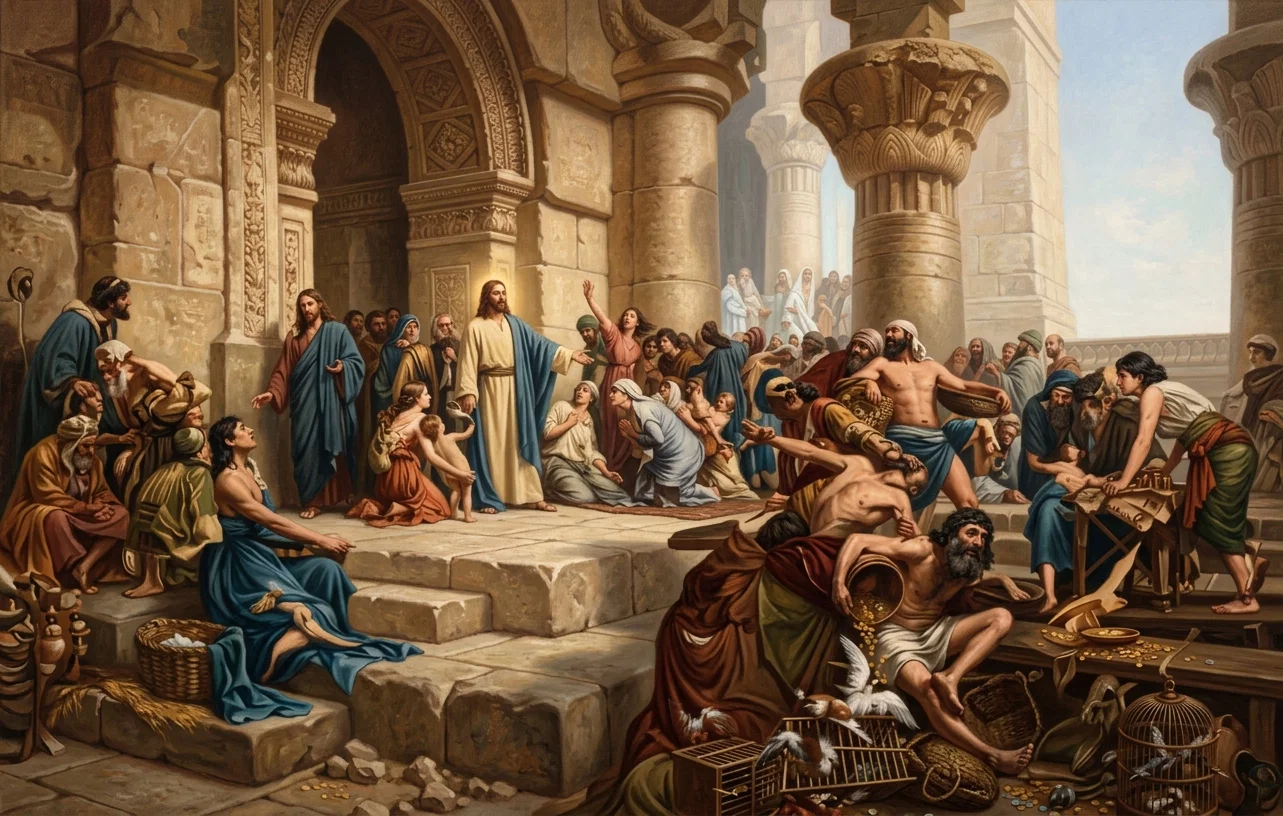
JESUS IN THE TEMPLE
JESUS IN THE TEMPLE

Why Refuse His Yoke?

Why is it that men to whom the Lord has given capabilities and talents, resist the drawing of Christ, refuse to wear His yoke and bear His burdens? It is because they are proud of their knowledge and influence, "puffed up" with the favor and applause they receive because of these talents. They make their boast of science and philosophy, and place these above Christ, the God of science and true philosophy. Thus these worldly-wise men magnify themselves, seeking to eclipse by their flashing meteors the Light of the world. But are these men above Christ? Can the stars outshine the sun? Can the whole firmament of heaven do more than declare the glory of God?
The Lord calls these men fools because they place such value upon the gifts bestowed upon them, while they despise the Fountain of supply, and reject the Source of all wisdom and light, who can make these gifts to increase constantly. The principle that prompts men to place their human ideas first, leads to many false conjectures and delusions. Christ has made no man independent. He has given men talents, that they may improve them by exercise, learning of Him how to use them wisely. He has said, "I am the light of the world: he that followeth Me shall not walk in darkness, but shall have the light of life."
Reason was never given man to lead him to suppose that he can climb higher than the Source from which that reason flows. God gave man his reasoning powers, and He can remove them, as in the case of Nebuchadnezzar, when they are not used to His glory. In Noah's day the inhabitants of the earth sought out many inventions. They were wise to do evil. The imaginations of their hearts were only evil continually, and God swept them from the face of the earth.
Through His prophet the Lord exhorts us: "Let not the wise man glory in his wisdom, neither let the mighty man glory in his might, let not the rich man glory in his riches: but let him that glorieth glory in this, that he understandeth and knoweth Me, that I am the Lord which exercise loving-kindness, judgment, and righteousness, in the earth: for in these things I delight."

The Revelation of God's Glory

The glory of God is seen in the life and character of Christ. In the pure, lofty piety exhibited in His life in humanity we have an example of what pure religion is. His life of uncompromising holiness creates in the hearts of those who are in rebellion against God, a desire to follow their own inclinations, as did the inhabitants of the antediluvian world: for "the carnal mind is enmity against God: for it is not subject to the law of God, neither indeed can be." The Lord has said, "Come out from among them, and be ye separate." But men rebel against the light because the path it marks out involves a cross.
Perfection of character can be attained only through Jesus Christ. He alone is able to dispel the darkness that has gathered about the souls of men. He will lift fallen humanity into a pure and holy atmosphere, if men will believe on Him as their personal Saviour. He will inspire in their hearts and minds an enthusiasm that will make them noble, and mold them after the divine similitude.
The Christian believer possesses the key to true philosophy. In connection with Christ, coöperating with Him in good works, he may shine amid the darkness of the world. Christ is the truth, the life, and the light of the world; and by beholding Him, His followers will be changed into the same image, from glory to glory.
Satan would cast his shadows across our pathway, to prevent the light of heaven from shining into the chambers of the mind, into the soul temple; but the mists from beneath can not dim the bright beams of the Sun of Righteousness. The true Light brightens beyond the clouds of doubt and unbelief.
The words, "I am the light of the world," have been sounding down through the ages to the present time. They are no less true now than they were in Christ's day, and to-day they have the same comfort for the follower of Christ, the same hope for those that sit in the darkness and shadow of death. God appeals to His children to uplift before the world the Man of Calvary, that with Him human nature may be lifted up. "Ye are a chosen generation, a royal priesthood, a holy nation, a peculiar people: that ye should show forth the praises of Him who hath called you out of darkness into His marvelous light."

Christian Science

By Walter Clair Thompson

IV—Its Philosophy in the Light of Reason and Revelation

(Continued)
BRIEFLY stated, Christian Science means to deny reality and ignore environment. But despite all their metaphysics and "ethereal theories," Christian Scientist experiences are not unlike those of the balance of humanity. Life is made up of experiences. We must have experience of some kind before we can have thoughts. We may call these experiences what we please, it does not alter them. Call them illusions or realities, the experience remains unchanged.
In theory we may call matter material, illusion, or "sensation in the sensationless," but in practise the material must not be ignored. To illustrate, if one wishes to catch rain-water, he must use a barrel instead of a clothes-basket,—it matters not whether he be orthodox or Christian Scientist.

The Reality of Experience

What Prof. Borden P. Bowne has to say of the reality of experience is very much to the point:
The experience remains the same under one system of metaphysics as another. Thus Berkeley, Mill, Hume, Reid, and Hamilton differed widely in their metaphysics, but practically they had to live in the same way. Kant, with his ideality of space and time, found it no easier to get around the world than the ordinary realist on that subject. Berkeley found his butcher bills and his grocery bills just as important a matter and just as difficult to pay as Reid. So on the plane of experiences we are all alike, and the philosophers can not help us. . . . If the philosophers can do anything it must be in the way of interpreting experience, not in the way of producing or verifying it. In this sense experience is real and carries its truth or verification in itself.
Evidently Christian Science will not stand the search-light of investigation and reason, much less will it stand the Bible test. As revelation and matter have a common authorship, and that divine, we find that all things that do not harmonize with the one, are also in conflict with the other. It is because this philosophy is unbiblical that it is so contrary to nature and nature's laws. Instead of being science, it is its antithesis; it may be metaphysics—clearly it is not science.

Who Is Responsible?

A question that arises to the rational mind in pursuing this anomalous religion, and which, like Hamlet's ghost, will not down, is, If sin, sickness, and death, and the sensibility of matter, are only illusions of mortal mind, who is responsible for this nightmare in which the world has been enthralled for so many centuries? Using the Christian Science formula for reasoning, and God is the guilty party. There is no escaping this conclusion. I repeat the formula, that you may see the force of the conclusion:
God is all in all. God is good. Good is Mind. God, Spirit, being all, nothing is matter. Life, God, omnipotent good, deny death, evil, sin, disease.
God, then, is responsible? No, they won't allow us to put it that way. True, it is the result of inevitable sequence, but it simply won't do, that is all, and we must not fall into the error of reasoning adversely, cautions our Christian Science friend. But he has forgotten that there is no such thing as error. "Error is mortal mind. Mortal mind does not exist." Driven to the extremity of his logic, he admits that, while there is no sin, there is a something—not very clearly defined—which they call "malicious animal magnetism."
You ask, "What is malicious animal magnetism?" You may as well spare yourself the trouble and fatigue of witnessing his mental gymnastics to escape the perils of the situation that logic has forced him into. Does he extricate himself? Well, not very gracefully, we should think, unless we lack appreciation; but, lacking appreciation himself, or refusing to recognize the dilemma, or renouncing its reality, he appears to come out triumphant—at least he is satisfied. That he frequently has to abandon his position, does not trouble him as such things would the uninitiated.

Will Not Stand the Test of Reason

The facts of the case are, Christian Science will not stand the test of reason. Logical conclusions always get them into difficulties. No doubt this is why we read in "Science and Health" that "knowledge impedes progress" in this science. It also explains why ignorance is at such a premium, and why all literature aside from "legitimate metaphysics" is renounced as refuse material. Catholicism in the darkest midnight of its career never put a more rigorous ban upon education than does this cult in this enlightened twentieth century.
Recognizing that education militates against its progress, a fundamental principle in Christian Science is to repudiate all learning other than prescribed by their ritual; thus we find such proscriptions against education as the following:
Mortal mind is the chief husbandman of error.—"Science and Health," page 171.
The so-called laws of matter are nothing but false beliefs in the presence of intelligence where mind is not.—Id., page 171.
Physiology is one of the apples from "the tree of knowledge."—Id., page 165.
Obedience to material law prevents full obedience to spiritual law.—Id., page 182.
The so-called laws of health are simply laws of mortal belief.—Id., page 184.
The brain can give no idea of God's man.—Id., page 191.
The senses are illusive.—Id., page 191.
Many a hopeless case of disease is induced by a single post-mortem examination.—Id., page 196.
How thinking and apparently intelligent people can be gulled into accepting such reason-impeaching sophistry is difficult to comprehend. However, there is an explanation that throws much light on the question; it is a Scriptural one:Having the understanding darkened, being alienated from the life of God through the ignorance that is in them, because of the blindness of their heart.
And for this cause God shall send them strong delusion, that they should believe a lie.

The Contrast

Let us now contrast the principal tenets of the so-called Christian Science with Bible doctrine and observe how opposed it is to the plainest Scriptural teachings:
BIBLE CHRISTIAN SCIENCE
Teaches reality of matter: Denies the reality of matter:
And the Lord God formed man of the dust of the ground, and breathed into the nostrils the breath of life; and man became a living soul. Gen. 2:7. Matter and death are mortal illusions.—"Science and Health," page 289. All must be mind or else all must be matter.—Id., page 551.
Affirms the existence of sin: Denies the existence of sin:
Wherefore, as by one man sin entered into the world, and death by sin; and so death passed upon all men, for that all have sinned. Rom. 5:12. In reality there is no evil. Sin exists so long as the mortal illusion of mind in matter remains.—Id., page 311.
Teaches vicarious atonement: Denies vicarious atonement:
Being justified freely by His grace through the redemption that is in Christ Jesus: whom God hath set forth to be a propitiation through faith in His blood, to declare His righteousness for the remission of sins that are past, through the forbearance of God. Rom. 3:24, 25. One sacrifice, however great, is insufficient to pay the debt of sin. That God's wrath should be vented upon his beloved son is divinely unnatural. Such a theory is man made.—Id., page 23.
Would space permit, these comparisons could be greatly multiplied, but these, cited on the most vital points, will suffice to show Christian Science to be fatally unscriptural. Being thus arrayed against both science and the fundamentals of Christianity, it is proved to be neither Christian nor science. Its title therefore is a misnomer; a mask worn that it might parade before the world in acceptable form to bid for disciples from both the church and the world.
In summing up the matter, we find that, as pertaining to religion, it is unbiblical and antichristian; and as pertaining to science, it is the despair of reason and a discordant note in the realm of nature. In the words of the apostle Paul, it is "science falsely so called: which some professing have erred concerning the faith."
Let us also heed the apostolic admonition: Beware lest any man spoil you through philosophy and vain deceit, after the tradition of men, after the rudiments of the world, and not after Christ.

Happiness

By C. H. Meiers
True happiness comes not from being Submerged with blessings rare and fine; It comes alone through power of seeing Some good in everything of thine.
Continue reading: What Christ’s Coming Means to the Earth