Your ShelfYour Projects

Signs of the Times, Vol. 24, No. 25.

LOOKING UNTO JESUS

Signs of the Times

Jun 23, 1898

Pacific Press Publishing Company · Oakland, California · Jun 23, 1898

LOOKING UNTO JESUS.
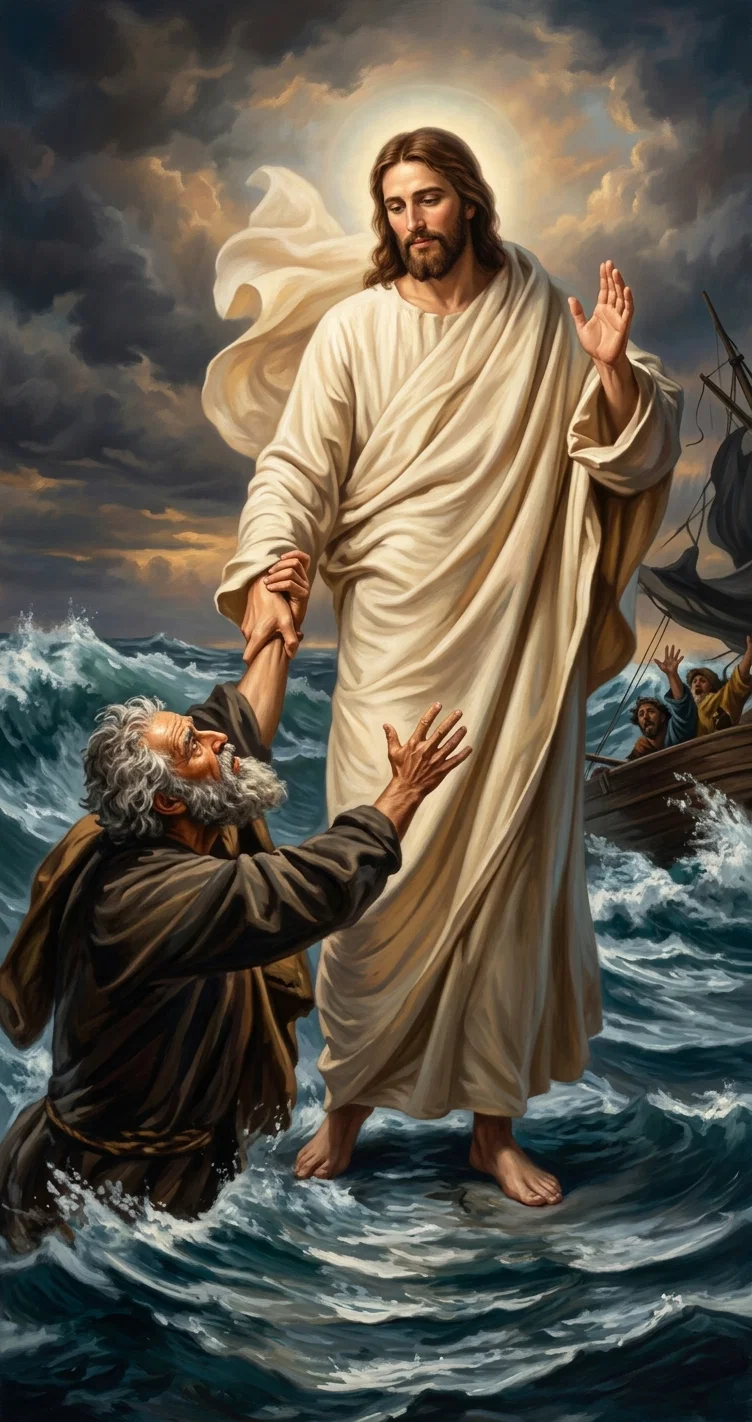
“And Peter answered Him and said, Lord, if it be Thou, bid me come unto Thee on the water. And He said, Come. And when Peter was come down out of the ship, he walked on the water, to go to Jesus. But when he saw the wind boisterous, he was afraid; and beginning to sink, he cried, saying, Lord, save me. And immediately Jesus stretched forth His hand, and caught him, and said unto him, O thou of little faith, wherefore didst thou doubt?” Matt. 14:28–31.
“O thou of little faith, wherefore didst thou doubt?”
This question is asked of you to-day, even as it was asked of Peter by the Master on the waves of Galilee nineteen centuries ago. Rather, it comes in modern form, present tense,—Why do you doubt?
The bidding may or may not be for you to step forth and walk upon the water. The act itself enters not into the account where perfect faith exists in the word of Him who bids us act. There is nothing in the account of Matthew of this incident,—nothing elsewhere to teach us that we ought to emulate this act of Peter. It appears to have been a sudden impulse, characteristic of the impetuous nature of the man, and born at the moment he realized that it was indeed his Lord and not a messenger of evil. Whatever may have been his motives as the reality of the scene with its meanings and possibilities burst upon him, the Master, knowing the heart of the disciple altogether, embraced the opportunity to teach Peter and the others an important lesson, and bade him, “Come.” And the lesson is for us to-day.
It is a sad fact that we are inclined to become careless of our regard for the Bible and the wonderful truths it contains for us. We read the words, but unless we meditate upon them, feed upon them, believe them, and order our lives by them, as the voice of God to us, they will accomplish nothing for us except our condemnation. The record of Jesus’ mighty works becomes so common that we often fail to realize what is involved in them. We are inclined to judge that we would not have been as careless as was Peter. But this was really a remarkable thing, for a man to walk upon water, and that Peter’s courage gave way is after all not particularly strange. Place yourself by the side of a body of water and imagine, if you can, what would be involved in actually walking safely over those unstable, lapping waves, and what the faith to do it would comprehend. But, you reply, circumstances alter cases; were my Lord walking there, showing that such a thing was possible, it would inspire confidence, and if He bade me come, it would be an easy thing to do. No, I think under the same circumstances not one of us would do better than Peter did.
This well illustrates our attitude at the present day toward the Word, and it places far greater responsibility upon us for our conduct than we adjudge rested upon the actual participants in the events themselves. We feel that we would not fail where they failed. This is virtually saying that we grasp the situation in all its bearings, and know what it means for us. We thus leave ourselves without excuse. It really becomes a serious matter when we begin to apply the lesson at home. If the example of our Master before our eyes, and His word, “Come,” would, we think, have inspired us to action—and it ought to—we are brought face to face with the question whether or no we really believe that word now. Aye, there is the point; for the scene is before us. The Master, our Example, says, “I am with you alway, even unto the end of the world;” and that word, which “endureth forever,” rings in our ears across the centuries, “Come.”
Had Peter faithfully complied with all that was implied in that simple command and invitation—for it was both—he could not possibly have failed. It proceeded from Him who formed the waters, and as it went forth, there went with it power to enable the one to whom it was addressed to do all that the occasion required. It was a foundation solid as a rock, a pathway paved with omnipotence. Peter stepped forth upon it; the waters became firm beneath him; but “when he saw the wind,”—the waves tossed by the wind,—he was afraid, and began to sink. What a lesson, what instruction, for us!
Power superhuman, the power of God, became his to use, and worked for him the moment he assented to the fact that it was able to do the work and showed his belief and trust in it by acting. But that wonderful force, at his service by that simple mental operation and the physical act that responded to it, worked for Peter only so longas the word rang in his ears, and his eyes were fixed on his Source of power. This is the definition of faith derived from this incident. Note his failures: he allowed other things to distract his attention; his mind wandered; his eyes turned from the Saviour, and the word faded away, and its power ceased to sustain him.
How is it to-day? Has that Source of power failed? Is the outflow less now than it was then? Are not these things written for our admonition, upon whom the end of the world is come? Then are not the words spoken directly to you and to me? Do you believe them? If so, they will be an incentive charged with divine power to stimulate us to action as real as was Peter’s. We will take every blessed promise in the whole Bible as the word of God; we will see Jesus our Master, and the Father, before us, and will hear the gracious invitation, Come up higher, into a fuller knowledge and realization of the Christian’s privileges; know what the power of God is. Dear friend, let us grasp the situation, and prove the power that awaits the first step upon that which humanly seems, from all human experience, nothing but yielding waters.
But for your soul’s sake remember the lesson of faith: let there be no, “If Thou be the Lord,” but, “I know whom I have believed.” Keep your eyes fixed upon the heavenly vision; concentrate your mind, your all, upon the Source of power and the Word; do not think of self, or what others may think or say or do; mind not the surroundings, and be not distracted by air, nor water, nor fire, nor “height, nor depth, nor any other creature,”—see Jesus only, and the power will not cease its mighty working, tho the earth be removed. That time is coming soon, when the air shall pass away with a great noise, when the elements shall melt with fervent heat, and the earth will be removed as a cottage. In that day there will be nothing substantial to stand upon but the Word of God. Let us learn how to stand and walk upon that Word to-day, that we may not be afraid then. L. A. PHIPPENY.

ENCOURAGING VENGEANCE.

A LITTLE magazine published in Boston, organ of a philanthropic association, prints an extract of a letter from a young man, formerly a beneficiary of the association. This letter is published as evidence of the good done by the society, whose superintendent points with considerable pride to this product of its work. The letter, which comes from a war ship at Key West, says:—
I am first captain of a 6-pounder rapid-fire gun. Yesterday I received a prize of $10 for shooting with a rifle. Inclosed find $25, which deposit with the other. If I die, give all to my old grandmother. If I am killed, I shall die for my country, remembering the Maine.
It is a pity that from a society designed and desiring to do good, and eminently successful in a certain line, there should go forth to the world an approval of a young man’s ambition to die with vengeance in his heart. By the way, this so-called “Christian nation,” and many of her professed Christian teachers, are using every endeavor to inculcate a spirit of vengeance in the hearts of the young, as well as the old. The present war was professedly undertaken in the cause of liberty for the Cubans. The plea was that the people there were starving, but the first thing the war did was to blockade the ports, so that no provisions could be taken where many thousands were so badly in need. Such is the philanthropy of war. Then there suddenly developed the erstwhile latent fact that retaliation for the disaster to the battle-ship Maine was the inspiration of the cry for war. “Remember the Maine,” became the slogan. Even a large order for crackers given by the government was to have that inscription upon each one. It is heard in Congress, and in state Legislatures, and in the secular press, and sometimes in the religious press, and in many a religious social circle. So it is no wonder that ambitious young men think it glorious to die “remembering the Maine.” A contributor to the Sabbath Recorder notes that while delayed at a railroad station he saw several train-loads of soldiers passing, and adds this significant remark: “The soldiers were very young men, many of them beardless. A corporal said to me, as the train waited, ‘We are going to avenge the history of Spanish wrong-doing for the last two hundred years.’”
But “vengeance is mine; I will repay, saith the Lord.” Vengeance is a dangerous weapon for men to handle. It belongs to God, and He only knows how to use it. The Christian who undertakes to handle such a weapon, and persists in so doing, will surely kill himself. And the people who raise the cry, and hoist the banner, and take on the armor of vengeance, would better disclaim the name of Christian. They are surely taking the name of the Lord in vain. W. N. G.

MATTHEW’S FEAST.

When the Saviour invited Matthew to follow Him, the publican did not stop to think of earthly loss. He considered nothing so profitable to him as discipleship to Christ; and without framing one excuse, without waiting to ask what he should do to obtain a livelihood, he arose and followed Christ.
In his grateful humility, Matthew desired to show his appreciation of the honor bestowed upon him; and, calling together those who had been his associates in business, in pleasure, and in sin, he made a great feast for the Saviour. If Jesus would call him, who was so sinful and unworthy, He would surely accept his former companions, who were, thought Matthew, far more deserving than himself. Matthew had a great longing that they should share the benefits of the mercies and grace of Christ. He desired them to know that Christ did not, as did the scribes and Pharisees, despise and hate the publicans and sinners. He wanted them to know Christ as the blessed Saviour.
At the feast the Saviour occupied the most honored seat. Matthew was now the servant of Christ, and he would have his friends know in what light he regarded his Leader and Master. He would have them know that he felt highly honored in entertaining so royal a guest.
Jesus never refused an invitation to such a feast. The object ever before Him was to sow in the hearts of His hearers the seeds of truth,—through His winning conversation to draw hearts to Himself. In His every act Christ had a purpose, and the lesson which He gave on this occasion was timely and appropriate. By this act He declared that even publicans and sinners were not excluded from His presence. Publicans and sinners could now bear the testimony that Christ honored them with His presence and conversed with them.
The Pharisees beheld Christ sitting and eating with publicans and sinners. He was calm and self-possessed, kind, courteous, and friendly; and while they could not but admire the picture presented, it was so unlike their own course of action that they could not endure the sight. The haughty Pharisees exalted themselves, and depreciated those who had not been blessed with such privileges and light as they themselves had had. They hated and despised the publicans and sinners. Yet in the sight of God their guilt was the greater. Heaven’s light was flashing across their pathway, saying, “This is the way, walk ye in it;” but they spurned the gift. Turning to the disciples of Christ, they said, “Why eateth your Master with publicans and sinners?” By this question they hoped to arouse the prejudice which they knew had existed in the minds of the disciples, and thus shake their weak faith. They aimed their arrows where they would be most likely to bruise and wound.
Proud but foolish Pharisees, who fast for strife and debate, and to smite with the fist of wickedness! Christ eats with publicans and sinners, that He may draw them to Himself. The world’s Redeemer can not honor the fasts observed by the Jewish nation. They fast in pride and self-righteousness, while Christ eats in humility, with publicans and sinners.
Since the fall, the work of Satan has been to accuse, and those who refuse the light which God sends, pursue the same course to-day. They lay open to others those things which they consider an offense. Thus it was with the Pharisees. When they found something of which they could accuse the disciples, they did not speak to those whom they thought to be in error. They spoke to Christ of the things which they thought to be so grievous in His disciples. When they thought that Christ offended, they accused Him to the disciples. It was their work to alienate hearts.
The world’s Redeemer heard every word uttered against Him by the Pharisees. “When Jesus heard that, He said unto them, ‘They that be whole need not a physician, but they that are sick. But go ye and learn what that meaneth, I will have mercy, and not sacrifice; for I am not come to call the righteous, but sinners to repentance.’” These self-righteous men, who felt no need of help, could not appreciate the work of Christ. They placed themselves where they could not accept the salvation which He came to bring. They would not come unto Him that they might have life. The poor publicans and sinners felt their need of help, and they accepted the instruction and aid which they knew Christ was able to give them.
“For God so loved the world, that He gave His only-begotten Son, that whosoever believeth in Him should not perish, but have everlasting life.” Christ came to seek and to save those that were lost. He came to reach to the very depths of human woe and misery. He placed Himself where He could reach theneedy, the suffering, the oppressed, just where they were; and, altho to all appearance they were the most unpromising, with what intense interest did He work for them! What holy joy arose in His heart as He saw them opening their hearts to Him, that He might fill them with His transforming grace, and imbue them with His spirit of self-denial and self-sacrifice. He came to honor men with the privilege of being participants in the blessings of His kingdom. He called upon them to repent of their sins, receive of His pardoning love, and unite with Him in sowing the seeds of truth, laboring for the souls that were ready to perish.
It is not possible to give to Christ more service than is His due. If you have, as had the Pharisees, a self-complacent spirit, if you wrap about you the garments of self-righteousness, and leave sinners in darkness and transgression, you give evidence that you are not converted; and those whom you deem publicans and sinners will go into the kingdom of heaven before you. Those who would object to eating with publicans and sinners should closely criticise their own course of action. They have important lessons to learn. What saith the Scriptures?—“To do justice and judgment is more acceptable to the Lord than sacrifice.” “For I desired mercy, and not sacrifice; and the knowledge of God more than burnt-offerings.”
The follower of Christ is not to live to himself. He who lives to himself is not a Christian. He has not been created anew in Christ Jesus. From the moment the sinner views Christ upon the cross, every barrier is broken down. He sees sin in its offensive character, and exercises repentance toward God, and faith toward the Lord Jesus Christ. He lays hold of the merits of a crucified and risen Saviour. Then all his transformed powers will be held as sacred to God’s service. Every talent, every qualification, reason, knowledge, affection, speech, property, will be appreciated as a precious trust. He will live with an eye single to the glory of God. He will be a man of prayer, that he may have the spirit and wisdom of Christ to win souls from sin to holiness, from error to truth.
The disciple who loves Christ will love the souls for whom Christ has died, and will devote himself unreservedly to Christ. He will work as Christ worked; he will do as Christ did. He will go where the sinner is. He will educate all his powers, his tact and ability, that he may become a laborer together with God. He will hold the secret of the cross before those who do not know God. Every soul who is indeed united with Christ, will be a laborer together with God for the uplifting and saving of humanity. No other being in the world has the shadow of a claim upon our service. Every part of our nature, every moment of our existence, has been purchased with the precious blood of the Son of God.
MRS. E. G. WHITE.

OPEN THE WINDOWS.

OPEN the windows that look toward the morning; Let the bright sunshine enliven your hours; Let the fresh breezes sweep in through the casement, Bearing upon them the fragrance of flowers; Let the sweet songs sung by birds in the tree-tops, Set all the silence a-tremble with joy; Why should you shut yourself up in the darkness, And cherish the things that will only destroy?
Open the soul-windows looking toward heaven; Too long have you breathed the miasma of earth; Too long has your spirit been poisoned by vapors, Which in foul lowlands and marshes have birth. Let zephyrs celestial, with life-giving influence, Drive all the death-dealing vapors away; Let odors from lands of the blessed surround you, And anthems angelic make holy life's day. O, turn a deaf ear to the sounds from beneath you, Of strife and contention with which earth is riven, And let the sweet, heart-thrilling words of your Father Come in through the soul windows looking toward heaven!
VIOLA E. SMITH.

THE OVERSHADOWING CURSE; THE COMFORTING MESSAGE.

(A Dream.)
DURING the night of Feb. 22, 1898, I dreamed a dream, in which, with my husband and two children, I was living in a southern city. Our house was on the southwest corner of the block, facing the west. The season, late in summer; the hour, about 2 P. M. The weather was extremely hot and dry, much more so than any I had ever known. Before our open windows hung wet sheets, that the air might be cooled by the evaporation of the water. My children lay sleeping on the bed, which had been pulled out in the middle of the room. But there was not a particle of breeze or draft of air, so I sat on the bedside fanning them. My husband sat outside engaged in conversation with a visitor.
All was unusually quiet in the city. Nothing animate could be seen on the streets, for the heat from the sun’s rays was so intense that even in the house it was almost unendurable.
Suddenly a shadow fell across the bed, so deep and peculiar a shadow I immediately hastened to the door to ascertain the cause; for well I knew that not a cloud had dimmed that burning light for many and many a day. Quickly I raised my eyes to the sky, and there, in most terrible distinctness, stretching from north to south, so that its awful shadow fell on all the land, was a monstrous skeleton of human form, its feet to the north, its head to the south, its horrible face downward and grinning in exultation as it gazed upon this southern land. My astonishment at seeing so extraordinary a sight can not be expressed. I had noneed to inform my husband or the man with whom he had been talking; for they had been made aware of its awful presence as soon as I, and were now beholding in speechless awe.
Not knowing how soon this strange sight might vanish, and with the thought that my children might in after time regret that they too had not seen it, I hurried to them and tried first one way and then another to awake them, but could not, neither did I know why they slept so soundly.
As I stood wondering, a sound so dismal was borne to my ears that I listened intently, thinking perchance I might discern its nature should it occur again.
I had only a moment to wait, and again a more dismal wail than before smote upon my ears. But so uncommon a sound I could not understand; and as it came from the east, I went through an adjoining room, and opened the south door next the side street. Not far down the street and coming toward me were three lovely young girls, clinging to each other, and so weeping that they saw not nor seemed to care where they were going. Their anguish seemed so deep it grieved me to witness it, so I stepped back and closed the door; but, with my heart full of sympathy, I silently prayed that God would help them, whatever their trouble or need might be.
In answer to my prayer came a silent command, “Go comfort them.” I dared not but obey, tho at first it seemed a heavy cross to bear.
Again I opened the door, and stepped out in the street just before the weeping girls, who as yet had not seen me. I opened my arms to receive them. I told them how since the fall of man in Eden, the curse of death had fallen on the human race and blighted human happiness; that all must pass under its terrible shadow; but that in Christ Jesus, the Life-giver, there was hope. He had passed through that shadow for all; that now in Him was life and hope for all. They believed and were comforted.
Then again from the east came shrieks and wails of anguish and terror. We looked, and saw that a congregation was just leaving a church, down the street, and that each one, as they stepped out, were under that baleful shadow. As each one looked to see the cause and ascertained it, all were filled with such fear and dread of some impending calamity that they became a mass of terror-stricken people.
I hastened to comfort the advancing ones, and soon found myself standing on a new pine box in the center of an open plot of ground, and before and around me was that multitude of wailing, weeping people. I told them over and over again, with but little variation, how we all were, and had been all our lives, under the shadow of death, but that the hope in Christ of life beyond the realms of death was offered freely and constantly to all; and yet we are careless of either until God sends us some warning to arouse us to a sense of our danger and our needs.
Very many ceased weeping, and lost their frightful terror of that awful skeleton whose shadow still covered us; yet they listened intently as I still told it to others who had not heard distinctly because of so much weeping and their distance from me.
Then I awoke, but so deep an impression had been made upon my mind that I remembered every detail with most vivid distinctness. Neither will it ever fade from my memory. And now, knowing it to be perfectly true in the sense it was shown me in the dream, I believe it to be a merciful warning from God, to arouse us to a sense of our true condition and only hope, and a slight warning only of the troublous times ahead.
There is a “more sure word of prophecy,” in which are declared things which must shortly come to pass. A student of God’s Word who will observe the signs of the times need not be in darkness, but by taking heed thereto may escape. Realizing, in part at least, the seriousness and solemnity of the situation, I beg the kindness of the editor to permit me to publish my mite of warning, and to permit me to ask exchanges to please copy.
MRS. CLARA R. WINTERTON.
De Queen, Arkansas.

Origin of Sabbath Observance.

There are but two institutions to-day in vogue and practise among mankind which carry the mind back to the primeval period. These institutions are the Sabbath rest and holy wedlock. That both have been misunderstood, maligned, and misused, does not abate one iota from the holy character of these twin sisters. Each has had its imitators; both have been trampled in the dust; the history of one has been largely the history of the other.
It is our purpose in this paper to speak particularly of the Sabbath institution. When we come to consider its origin, its scope, its intent, and the people to whom it was given, we are impressed with the strength of the principles underlying its perpetuity and obligation in all ages and among all classes of people. In the second chapter of Genesis and first three verses we have the record of its creation.
(a) “On the seventh day God ended His work which He had made; and He rested on the seventh day from all His work which He had made.” This made the seventh day the rest day of God. “He rested and was refreshed”—not from physical weariness, but refreshed in spirit, refreshed in quiet contemplation of the new world which He had brought into existence. By resting on the seventh day, it became in the very nature of the case God’s rest day, or Sabbath.
(b) “And God blessed the seventh day.” The blessing of God upon the seventh day made that day blessed. The blessing of God upon a sinner separates him from his iniquity, and indeed makes him the blessed of the Lord. And so the Lord in placing a special blessing upon the seventh day separated it from all of its fellows, from the other members of the cycle, and gave it a blessed character that it might be a blessing. Thus the seventh day became not alone God’s Sabbath day, but it became God’s blessed Sabbath day.
(c) Then God “sanctified it.” To sanctify is to set apart, to separate, to a holy or sacred use. The question arises, To whose use did God set apart this holy day? Not for His own, evidently; for He had used it previous to this sanctifying process. Christ, the Author of the Sabbath, says, “The Sabbath was made for man.” Hence in making the day holy, and in setting it apart for a holy use, the Creator had in view the good of man, and bestowed the Sabbath upon him as a heritage and blessing.
With a revelation of this truth, that the Sabbath was made for man, other propositions present themselves to the mind suggestive of the great principles of perpetuity and obligation lying at the foundation of this institution. A few of these may be considered with profit.
I. The Sabbath was designed as a great memorial of creation. It was the birthday of the world. Just as long as the created works of God exist, the keeping of the Sabbath by the human family was designed to commemorate that event. Every recurring seventh day would be a reminder to them of the Creator of the universe, the Author of their beings, and would call forth from their hearts new expressions of prayer and praise to Him who is the beneficent Giver of all their blessings.
2. The Sabbath institution was designed for the whole race of mankind. This is proved by the fact that it was given to the father and mother of the race. In giving the Sabbath to Adam and his companion, God designed it for their children in every age.
3. The Sabbath originally was designed for a holy race. It was not given to Adam after sin entered, but before. It was set apart for his use while he still was in his purity and innocency. Had the dark shadow of sin never enshrouded the world, had Adam and his descendants always remained pure and holy, the Sabbath still would have been kept by them as the memorial of God. Thus, had sin never entered, and time continued until the present, if we who now exist had then existed, the whole world to-day, including ourselves, would have been observers of the one true Sabbath given to man at the beginning. And as the Sabbath was designed for a holy race, the statement that men cleansed by the blood of Christ are above its claims is of little force. The vilest sinner in coming to Christ to-day, in the observance of the Sabbath of the Lord, is but following God’s original purpose concerning the inhabitants of this earth.
4. The Sabbath is equally adapted to the needs of a sinful race. While the Sabbath originally was designed for man in his sinlessness, the change wrought by sin in the character of the human family did not change their relation to Sabbath observance nor the relation of the Sabbath to them. This is evidenced by the fact that the children of God after the fall were still required to keep His commandments and observe His rest day. Gen. 26:5; Ex. 20:8–11.
5. As the Sabbath was instituted before sin entered, it had no natural relation to the sin-offerings or types or ceremonies or sacrifices introduced into the ritual of the Jewish church in consequence of sin. Hence the expiration of those types, the abolishing of sacrifices, affected in no degree the perpetuity of the Sabbath institution.
6. The Sabbath was instituted before the Jews existed as a nation; hence it is in no sense Jewish in its origin or character. We must therefore conclude that as the Sabbath formed a part of God’s great eternal purpose, related alike to all nations, conditions, climes, and countries, no local claims of time or nation could affect its far-reaching import or its everlasting perpetuity. As long as the handiwork of God shall be witnessed in the heavens above or in the earth beneath, the seventh-day Sabbath will stand as the great memorial of the creative work. No more could the birthday of an individual be changed than the birthday of the world. It must therefore be concluded that the Sabbath to-day is as binding upon the children of men as when instituted by the Lord six thousand years ago. To deny its claims is to deny the power of God. But to honor and revere the day which the Lord hath made is to honor and revere the Lord of the Sabbath, even our Creator and Redeemer. F. M. W.

The Apostasy Developing

THE THREE BABYLONS. NO. 9.

The Apostasy Developing.

WONDERFUL transformations of character were wrought by the Gospel in its purity. Would that its force and energy had ever continued. But as we turn to the “sure word of prophecy,” we find that an apostasy is to come. The same word tells us the reason. Men will turn away their ears from the truth (the Word of God, John. 17:17), and be turned unto fables. Truly, that is the only possible way for an apostasy to take place. Let us behold this apostasy working, as is told in ecclesiastical history.
During the first century of the Christian era the church remained comparatively pure, but the apostle tells us that the “mystery of iniquity doth already work,” only Christ in the hearts of His people held it back so much that we find a comparatively pure church at the end of the first century.
The historian Mosheim tells us that it is not to be denied that even in this century the perverse Jewish custom of making the Bible of none effect by forced and frigid allegories found admirers in the Christian church.
At the beginning of the second century, when every apostolic voice was hushed, the work of apostasy began in earnest. We are going to study the teachings of the greatest Christian teachers for the next two centuries, and we wish it borne in mind that the history of any association is but the history of the working out of the principles of the honored and trusted leaders of that association. But few men think for themselves; they rather follow their leader, as a flock of sheep a shepherd. Let this be borne in mind, I say, as we study the leaders of the Christian church during the second, third, and fourth centuries, and we have the history of the church for that time.
There was born in the city of Shechem about 114 A.D. a boy that in manhood was to shape to quite an extent the history of the Christian church. This boy was Justin Martyr. Born of non-Christian parents, he chose heathen philosophy as a pursuit. After having become thoroughly indoctrinated in the false principles of philosophy, he accepted the Christian religion. He ever after his professed conversion wore his philosopher’s cloak, and if the outside is an index to the inside, we must conclude that he ever remained a heathen philosopher.
Dr. Killen says of him:—
Justin ever after his conversion continued to cherish an undue regard for the wisdom of the pagan sages. His mind was never completely emancipated from the influence of a system of false metaphysics; and thus it was that, while his views of various doctrines of the Gospel remained confused, his allusions to them are equivocal if not contradictory.—Ancient Church, period 2, sec. 2, chapter 1, par. 6.
Justin not only thought much of the pagan sages, but he thought it his duty to recommend them to the youth who attended the divinity school of which he was head. But heathen philosophy at best is man’s wisdom, and that is what caused all the heathenism that ever existed. And to teach men who are studying for Gospel ministers to study heathen philosophy is to trap them into studying that which will effectually nullify all the power of the Gospel. Not that it is stronger, but the Gospel is powerful only when trusted, and if something else is trusted as much, the Gospel loses all its power in the unbelieving heart.
But if Justin cherished “an undue regard” for heathenism, he did not trust the Word of God. Either he never had learned its power, or he had forgotten it before he could recommend heathen philosophy; and the church that accepted his views must first have left God’s Word. He was allegorical; that is, he did not think the Bible meant just what it says; for he said the angels never ate the food prepared for them by Abraham. But the Word says, “They did eat.” Gen. 18:8. When one finds himself called upon to say the plain Word (where there is no possibility of a figure of speech) does not mean what it says, he simply puts his word against God’s. To accept it is to reject God.
Then the quotations of Justin are so loose that they reveal the one who quotes them as one who does not understand the sacredness of God’s Word. He quotes Eze. 14:20 thus: “If Noah and Jacob and Daniel should beg either son or daughter, the request would not be granted them.”
Thus we see that the sense of the sacredness of the Word was lost in Justin and naturally in those whom he taught. He was one of the foremost teachers of his time, and is highly prized even to-day.
The church was not entirely backslidden in Justin’s day, but with the sacredness of the Word on the wane and their minds inoculated with the idea that heathen philosophy—the very antithesis of the Gospel—was a good thing, they were in a good position to be led terribly wrong. C. L. EMERSON.

GERIZIM

IN thy shadow, mount of blessing, I would pitch my tent for rest, Happy on my way, confessing Him whose beauty crowns thy crest. Golden stairways seem descending From the canopies above; Come, sweet messengers, befriending, From the throne of Him we love.
Did the tribes in vision tarry For thy benediction sweet? Lighter burdens did they carry? Quicker were their pilgrim feet? Happy voices from the brightness, Falling as the mountain spray, As a cloud of silver whiteness— Didst thou cheer them all the way?
I have seen thee; holy mountain, I have found my Gerizim; Blessing as a living fountain, Yes, as I believe in Him, Only Him who loved me, leading Through the wilderness my feet; Only Him who, interceding, Won me to His rest complete.
—Rev. Dwight Williams, in Christian Advocate.

Making Creation Better

SUBDUE mutiny, discord, widespread despair by manfulness, justice, mercy, and wisdom. O, it is great, and there is no other greatness! To make some nook of God’s creation a little faithfuller, better, more worthy of God, to make some hearts a little wiser, more manful, happier, more blessed, less accursed—it is a work for a God.—Carlyle.
Continue reading: HIGH EXPLOSIVES