Your ShelfYour Projects

Signs of the Times, Vol. 28, No. 46.

THE REVELATION OF JESUS CHRIST

Signs of the Times

Nov 12, 1902

Pacific Press Publishing Company · Oakland, California · Nov 12, 1902

“THE REVELATION OF JESUS CHRIST.”

IV. The “Desirable” Church.

Chapter 2:1–7.

SEVEN churches in Asia Minor are taken as the types of seven conditions of the church of Christ throughout the Christian age. The Spirit does not choose these seven because they are more worthy than others; for in Roman Asia were the churches of Troas and Colosse. They were typical of conditions which would be manifest in the people of God in after generations.
The first of these churches is Ephesus. The word by some authorities is said to mean “desirable,” by others, “permitted.” Be the meaning what it may, the early church at Ephesus represented a desirable condition. The church was founded by the apostle Paul. He found there opened before him “a great door and effectual,” but “many adversaries.” But notwithstanding all the opposition, the Word of God prevailed mightily. Idolators and sorcerers gave themselves to God and burned their books to the value of over $25,000. Their practices were wrong, and were given up. The books were bad, and were not kept as curiosities or mementoes, but were destroyed. Acts 19. Every link connecting with the dark and evil past was broken. They had been dead in trespasses and sins, but God had quickened them. They had been children of wrath, but through Christ they became the children of God. They had been “aliens from the common-wealth of Israel, and strangers from the covenants of promise,” but in Jesus they had become “fellow citizens with the saints, and of the household of God.” Ephesians 2. Paul thanked God for the faith they had in the Lord Jesus, and the love which they manifested toward all the saints. Eph. 1:15. See Paul’s farewell address to its elders in Acts 20:17–28. This was the church which the Spirit chose to typify the first stage of the church in this dispensation.

The Letter of Jesus to the Church in Ephesus.

Rev. 2:1–7. A.R.V.
(1) “To the angel of the church in Ephesus write: “These things saith He that holdeth the seven stars in His right hand, He that walketh in the midst of the seven golden candlesticks: (2) I know thy works, and thy toil and patience, and that thou canst not bear evil men, and didst try them that call themselves apostles, and they are not, and didst find them false; (3) and thou hast patience and didst bear for My name’s sake, and hast not grown weary. (4) But I have this against thee, that thou didst leave thy first love. (5) Remember therefore whence thou art fallen, and repent and do the first works; or else I come to thee, and will move thy candlestick out of its place, except thou repent. (6) But this thou hast, that thou hatest the works of the Nicolaitans, which I also hate. (7) He that hath an ear, let him hear what the Spirit saith to the churches. To him that overcometh, to him will I give to eat of the tree of life, which is in the Paradise of God.”
To whom is this letter addressed?
“To the angel of the church in Ephesus.”
Who sends it?
“He that holdeth the seven stars in His right hand, He that walketh in the midst of the seven golden candlesticks.”
What is His first solemn, yet assuring, statement?
“I know thy works, and thy toil and patience.”
What was the attitude of the church toward evil men?
“Thou canst not bear evil men.”
How was this proved?
“Thou didst try them that call themselves apostles, and they are not, and didst find them false.”
What motive and spirit did the church show in service?
“Thou hast patience, and didst bear for My name’s sake, and hast not grown weary.”
What reproof does the Saviour give?
“I have this against thee, that thou didst leave thy first love.”
What admonition does He give?
“Remember therefore whence thou art fallen.”
What appeal does He make?
“Repent and do the first works.”
What will follow failure to heed this appeal?
“Else I come to thee, and will move thy candlestick out of its place, except thou repent.”
For what did He commend the church?
“Thou hatest the works of the Nicolaitans, which I also hate.”
Of how wide application is this instruction?
“He that hath an ear let him hear what the Spirit saith to the churches.”
What is the promise to the overcomer?
“To him that overcometh, to him will I give to eat of the tree of life, which is in the Paradise [margin “garden”] of God.”
1. “The angel of the church,” the messenger of the church, as before explained, the faithful minister or ministers who bear God’s message unalloyed to His people.
2. “He that holdeth.”—In constantly changing kaleidoscopic glory Jesus manifests Himself, ever bringing out some added loveliness of character, something which appeals to us to trust Him. To Ephesus He appears in one phase, to Smyrna in another, to Pergamum in another, and so on; but it is the same Jesus. Neither is He acting a part to deceive. All are real manifestations of His manifold grace and wisdom. To those in Ephesus He comes as the director of His own messages, as the supporter of and upholder of all His servants, represented by the seven stars; as the One who takes cognizance of all the churches, symbolized by the seven candlesticks. From Him naught can be hidden. He who knows all their griefs, woes, trials, is able “to save to the uttermost.” What a pledge of comfort is His constant presence and power.
3. “I know.”—“All things are naked and laid open before the eyes of Him with whom we have to do.” “There is no creature that is not manifest in His sight.” Heb. 4:13. We may hide from men our deeds, but we can not hide even our thoughts from the Master. But He does not exercise His knowledge to condemn, but to save. “By His knowledge shall My righteous Servant justify many; for He shall bear their iniquities.” Isa. 53:11. He knows that we may know and let Him put away the evil and receive the good. He knows the work of faith, the labor, the toil, of love, the patience, the endurance of hope (1 Thess. 1:3), and He recognizes all.
4. “Thou canst not bear.”—This text does not imply that the church did not labor to save evil men; that is what she is here for. Jesus came to save sinners. The church is left here to carry on His work. But she can not do this work through evil, designing men. “Be ye clean that bear the vessels of the Lord.” That primitive church could not tolerate sin. She could not tolerate it under a cloak of religion. She loved the sinner, but she could not bear among her number those who loved and fostered sin. (See 1 Corinthians 5; 2 Thess. 3:5.) Jesus saves from sin not in sin.
5. “Didst try.”—Whenever God has a special work to do in the world, whenever His power is specially manifest, Satan works with greater energy. Hence the injunction that while we are not to despise prophesying, we are to “prove all things,” and to prove or “try the spirits.” 1 Thess. 5:21; 1 John 4:1. The great touchstone which we are to apply is God’s Word: “To the law and to the testimony; if they speak not according to this Word, it is because there is no light in them.” Isa. 8:20. “By their fruits ye shall know them. Not every one that saith unto Me, Lord, Lord, shall enter into the kingdom of heaven; but he that doeth the will of My Father who is in heaven.” Matt. 7:20, 21. Obedience to His Word is God’s great test. But the Christian is to turn from no one until faithfully tried. One may be an Apollos, not yet perfectly instructed; be a Priscilla or an Aquila to instruct. Let the church stand so true to God that evil men with evil designs can find no congenial atmosphere within her fold, but ever a refuge for him who flees from his sins.
6. “Hast not grown weary.”—One of the crowning graces of character is patience. The original term expresses more than what is commonly understood. It is rendered by some scholars “patience,” by others “endurance,” by others still “patient endurance.” The only true motive is to do it for Him. It is the only motive which will hold through the dreary days, and months, and years. It is not patience which endures tribulation that one feels he must—that he “might as well grin and bear it.” Not so is God’s patience learned. It is bearing for His sake. So did the early church. When imprisoned and beaten, they “rejoiced that they were counted worthy to suffer dishonor for the Name.” Acts 5:41. To the toiling, suffering ones, “Let us not be weary in well-doing; for in due season we shall reap, if we faint not.”
7. “Didst leave thy first love.”—This is an awful thing, tho it seems so small. When the first love of husband or wife is gone, how sad it is. It is sadder still, when the first love of the Christian leaks out. In the very condition itself there is blood-poisoning which results in apathy, dullness, stupidity, lack of sensitiveness of conscience, less pain at consciousness of sin. As one departs, all these symptoms increase, with a corresponding, nay more, a predominating apathy and listlessness and love of sin. What is the remedy?—Repent, do the first works. Cast off the sins. Yield them to God. Tell them to God. Look upon them in the light of Calvary. Come to Jesus for cleansing. Abide in Him. Feed on His Word. Labor, O labor, for souls. Love is fed by giving love. It grows by sacrifice. It is made strong by bearing burdens. Giving is its life.
8. “Thy candlestick out of its place.” It is an awful thing to lose one’s place with God. The saddest thing in the twelfth chapter of this book we are studying is not the suffering and persecution of the church, but the sad announcement concerning that great company of angels who followed the adversary, “neither was their place found any more in heaven.” They had passed the line of hope. They had so allied themselves with sin that they no longer distinguished good, or loved good. God cuts no man off from life and hope. “Man turns from God, not God from man.” It will be seen that every soul who fails of his place on earth or in heaven, fails because of his own choice. “Therefore shall they eat of the fruit of their own way, and be filled with their own devices. For the backsliding of the simple shall slay them, and the careless ease of fools shall destroy them.” Prov. 1:31, 32. “Be not deceived; God is not mocked; for whatsoever a man soweth, that shall he also reap.” Gal. 6:7.
9. Nicolaitans.—We know not who they were, nor what were their works; but this we do know, they were against God. His people stood with Him, and He recognizes it and thanks them for it, tho all the grace is His.
10. “Let him hear.”—That means each one, reader. Do not give it away to another age. Every practical truth, every faithful warning, every solemn admonition, every precious promise, is for the now, in 1902. Take them as the Spirit’s message, and make them thine.
11. “To him that overcometh” the Overcomer brings great blessings. He gives them not as earned, but because only overcomers are worthy of them, only overcomers are in harmony with them, and can enjoy them. The Spirit carries us back to the glorious, sinless garden of God in the beginning. When the earth was marred by sin that Paradise was removed; but it will return. Now, day by day God feeds His children from the Tree of Life, the Bread of Life, and gives them to drink of the Living Fountain, Christ Jesus. But each day’s food is a pledge of the perfected, cleansed creation, where in the sinless Garden of God, in the center of a sinless universe, the sinless overcomer shall eat the fruit of the tree of life, and bask in the smiles of God forever.

OUR HAVEN OF REST

WE are all aware that the path leading to the “haven of rest” is not always smooth and pleasant. There is much climbing to do; there are many battles to fight; the lions roar; and there are fierce waves of the storm-tossed sea to encounter. But the child of the King is not to travel that path in fear and alone; he may walk with perfect security for it is consecrated by the footsteps of his Guide. Like Enoch of old it is his privilege to daily walk with One who has promised to be with him all the way.
Yet while climbing the numerous hills and up the craggy mountains with their steep and hazardous precipices and pitfalls, and pushing through the deep mires that are encountered, we are to seek, not the weak human help, but that of our divine Leader, who will guide us safely to the “haven of rest.”
Let us walk cheerfully in obedience to the divine will and diligently learn the lesson of His providence, that we may find rest in that fair country, the promised haven of rest.
“Walk in the light and thine shall be, A path, tho thorny, bright; For God by grace shall dwell in thee, And God Himself is light.”
HANNAH E. SAWYER-HOPKINS.
Battle Creek, Mich.

Afflictions

Afflictions.—Affliction makes heaven more glorious and adds stars to the crown. Our present light afflictions, which are but for a moment, work out for us an eternal weight of glory.—Theodore H. Compton (Baptist), Louisville, Ky.

A. C. BAINBRIDGE

God has not only given us great and beautiful truth to believe, and power to believe it; but joy and peace in believing and a present and eternal reward for believing.

A. C. BAINBRIDGE

Truth and the Liar’s Watchdog

“He who speaks truth must expect to have the liar's watch-dog bark at him for trespass.”

ARE WE OPPORTUNITY BLIND?

O, FOR a bigger place to live in, a broader field of work! If we only had a chance! “But there are no opportunities now, all the doors are closed, the way is hedged in;” and “here we are grinding away day after day to no purpose,” when we might be making a big success somewhere, and doing the great things of life!
Failure to see opportunities is one of the very common maladies of the day. Many people have eyes; but how poorly they do use them! There are opportunities everywhere. One man finds them and the other does not, that is all. One man builds a palace where his brother finds material for only a wigwam. And so it goes in every line of endeavor.
A few years ago a very dear friend of mine was given a missionary license, and sent to work in a small fishing village. He was disappointed and discouraged at the prospect. It was not what he wanted, at all. “They have put me here in this wretched, poverty-stricken place to extinguish me,” he lamented. “There is no chance here.” Poor indeed were the reports he sent to the mission board. Indigo would be bright red compared to some of the letters he wrote to his folks at home.
But one day his boat floated off in the tide and left him alone on a little island several miles out from the village. There were fish, however, some berries, and as the weather was mild and dry, a shelter of boughs kept him comfortable. But how lonesome it grew. Everything was still. Scarcely a sea-bird broke the blue monotony of the sky, and only the roar of the surf disturbed the endless quiet. Days passed. O, for the sight of a human being, for the joy of speaking a word to some one! He grew hungry for society of any kind, even the village would be paradise beside that loneliness, he thought.
He was there three weeks. When he was able to write home again he said, after telling the story, “I learned something out there. I learned that the world is all gates, all opportunities to the man who will look for them. Wherever one man can speak to another, or write to another, or do a kindness to another, there is a chance.”
What was the outcome?—Why, he took off his high collar, made himself one of the people, started a Sunday-school for the children, a class of Bible study for the older ones, visited from house to house, and finally was able to build a small church. The people grew to respect him, and then to love him; he loved them and the poor little village, and when he came to leave it for a greater field he wept, because “there was so much to be done there still!”
Opportunities! Why, it doesn’t matter where you are. They are lying everywhere, awaiting the eye that can see, the ear that can hear, and the hand that will do. The world is full of them for the business man, for the scientist, theartist—whoever he may be, but a thousand times more so for the Christian. Every nook and corner has its chances waiting for him. It is calling him everywhere. It needs him in a thousand ways. It needs his kindness, his gentleness, his love. It needs his “Good morning,” his “God bless you,” and his smile. He has gifts to give more precious than rubies, more prized than fine gold, and sweeter than the frankincense and myrrh of kings, even tho he himself be as poor as was his Master. EDISON DRIVER.

THE BUILDING OF GOD'S TEMPLE.

Chapter 6: 9-15.
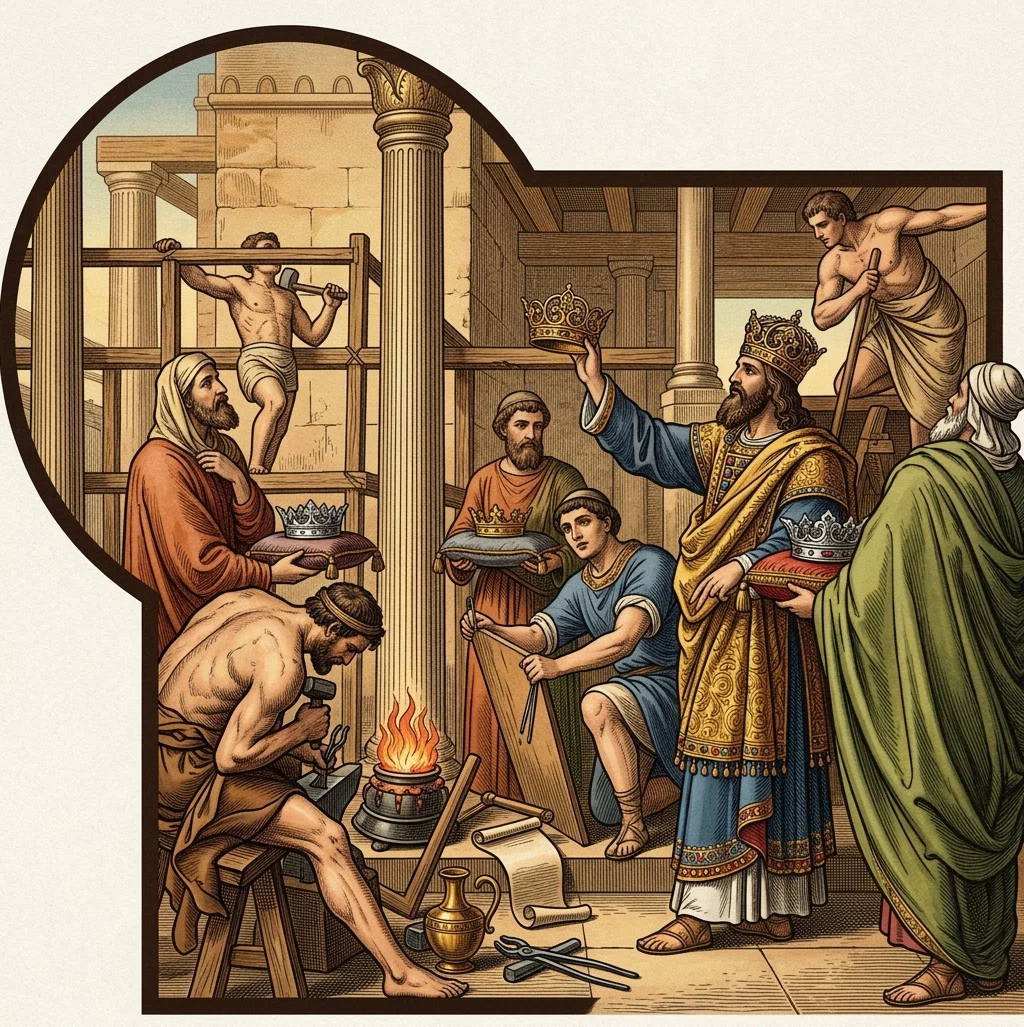
“And the word of the Lord came unto me, saying, Take of them of the captivity, even of Heldai, of Tobijah, and of Jedaiah, which are come from Babylon, and come thou the same day, and go into the house of Josiah the son of Zephaniah; then take silver and gold, and make crowns, and set them upon the head of Joshua the son of Josedech, the high priest; and speak unto him, saying, Thus speaketh the Lord of hosts, saying, Behold the Man whose name is the BRANCH; and He shall grow up out of His place, and He shall build the temple of the Lord; even He shall build the temple of the Lord; and He shall bear the glory, and shall sit and rule upon His throne; and He shall be a Priest upon His throne; and the counsel of peace shall be between them both. And the crowns shall be to Helem, and to Tobijah, and to Jedaiah, and to Hen the son of Zephaniah, for a memorial in the temple of the Lord. And they that are far off shall come and build in the temple of the Lord, and ye shall know that the Lord of hosts hath sent me unto you. And this shall come to pass, if ye will diligently obey the voice of the Lord your God.”
In the above scripture Zechariah is told to take certain men of the captivity, and enter into the house of Josiah, and take gold and silver, and make crowns, and place them upon the head of Joshua the high priest, and then to say, “Behold the man whose name is the BRANCH; and He shall grow up out of His place, and He shall build the temple of the Lord; even He shall build the temple of the Lord; and He shall bear the glory, and shall sit and rule upon His throne; and He shall be a Priest upon His throne; and the counsel of peace shall be between them both.”
That Joshua is introduced as a type of Christ in these verses is apparent, when we consider the language used; for we find that some of the specifications here presented are applicable to Jesus, and to Him only. First, He is called the Branch, which is the term applied to Jesus in chapter 3:8; and also in Isa. 11:1, 2, where we read, “And there shall come forth a Rod out of the stem of Jesse, and a Branch shall grow out of his roots; and the Spirit of the Lord shall rest upon Him.”
“And He shall bear the glory;” for this Branch was to be beautiful and glorious; and “we beheld His glory, the glory as of the only-begotten of the Father, full of grace and truth.” The glory of God is His character; and His character was fully revealed in the life of Jesus. And He “shall sit and rule upon His throne; and He shall be a Priest upon His throne.” This language is not true of Joshua, who was priest, but not king. Jesus now sits upon His Father's throne as king of grace; while He is also our great High Priest; for we read in Heb. 8:1, 2: “Now of the things which we have spoken this is the sum: We have such an High Priest, who is set on the right hand of the throne of the Majesty in the heavens; a Minister of the sanctuary, and of the true tabernacle, which the Lord pitched, and not man.” This one is the antitype of Joshua; and to us, the people, He says, “To him that overcometh will I grant to sit with Me in My throne, even as I also overcame, and am set down with My Father in His throne.” Between these two, that is, between the Father and His Son, Jesus, is the counsel of peace—that counsel in which all the wisdom of heaven is involved, even infinite wisdom, in carrying out the plan for the redemption of man.
“And He shall build the temple of the Lord; even He shall build the temple of the Lord.” That is the spiritual temple, of which the temple at Jerusalem was but a feeble type. It is that temple which is built upon the foundation of the apostles and prophets, Jesus Christ Himself being the chief Corner-stone; that spiritual house in which we are to be lively stones, if we will but be hewed and squared for the heavenly building.
Jesus is now preparing the stones for that house; and in the dawning of eternity's morn, it will be laid up, as it were, without the sound of a hammer; so perfect will be the preparation of each stone for its place. It shall tower aloft, radiant and glorious in the light of the eternal day, to be beheld with wonder and delight by a sinless universe, as the sunlight of the face of God shall gild it with glory. O to be a stone in that building, to be prepared for a place, perhaps by the Headstone of the corner! O wondrous thought!
There are crowns to be made; and these crowns are to be placed, first upon the head of the High Priest, and then to be for the men of captivity who made them. Paul, in speaking to those whom he had been instrumental in bringing to Christ, says, “For what is our hope, or joy, or crown of rejoicing? Are not even ye in the presence of our Lord Jesus Christ at His coming? For ye are our glory and joy.” Thus each soul we bring as a sheaf to the heavenly garner becomes a star or gem in our crown of glory. Since every soul is one for whom Christ died, the crowns are glory first to our great High Priest; but He will share them with us; for He speaks by the apostle Peter to us who are under shepherds, saying, if faithful, “When the chief Shepherd shall appear, ye shall receive a crown of glory that fadeth not away.”
When we take our places in the beautiful, spiritual temple, these crowns shall adorn our brows; and so they will be laid up in the temple as a memorial of the work of Jesus, and also of our work as co-laborers together with Him. The sharing with Him of these crowns is the entering into His joy; and the sweetest, deepest joy known in the universe of God is the joy of saving others. This joy placed before Jesus led Him to bear the cross and despise the shame. O what a crowned rejoicing to the Saviour will be that great company which no man can number, out of every tribe, kindred, and nation, when they cast their crowns at Jesus' feet, and crown Him Lord of all!
But, my reader, we, the men of the captivity are now working upon our crowns. If we do faithful work, and make them of gold, silver, and precious stones, they will abide; but if of hay, wood, and stubble, they shall be burned, and we shall suffer loss. If we are not faithful in dealing with souls, God will give our work to another, and he may wear our crown. “Hold that fast which thou hast, that no man take thy crown.”
God is inviting even those who are afar off to come and build in the temple of the Lord. Then let us all build, and build for eternity.
[The next article is “Ritualism and Righteousness.”]
Continue reading: CONSIDER HIM