Your ShelfYour Projects

Review and Herald, Vol. 87, No. 35.

A Psalm of the Helpers

Review and Herald

Sep 1, 1910

Review and Herald Publishing Association · Tacoma Park Station, Washington, D. C. · Sep 1, 1910

A Psalm of the Helpers

He that turneth from the road to rescue another, Turneth toward his goal: He shall arrive in due time by the footpath of mercy, God will be his guide.
He that taketh up the burden of the fainting, Lighteneth his own load: The Almighty will put his arms underneath him, He shall lean upon the Lord.
He that speaketh comfortable words to mourners, Healeth his own heart: In his time of grief they will return to remembrance, God will use them for balm.
He that careth for the sick and wounded, Watcheth not alone: There are three in the darkness together, And the third is the Lord.
— Henry van Dyke.

Issue for the Third Quarter of 1910 Is Now Ready

The following brief announcement of leading features in this number of the Protestant Magazine, will serve to give a clear idea of the value of this fall issue. Facts with which every Protestant in America should be thoroughly familiar are here brought to light.

EUROPEAN ANTICLERICALISM

Mainly a clear and unbiased statement of the present crisis in Spain, and other complications threatening the Vatican.

SURRENDERING TO THE PAPACY

A review of a significant article by Dr. G. A. Gordon of Boston, in the Atlantic Monthly.

THE CHANGE IN THE KING'S OATH

POPE PIUS X AND THE REFORMATION

ON THE PROPHECIES RESPECTING THE CHURCH OF ROME

Concluding article of a most profitable series.

MARY THE HOPE OF SINNERS

This article, being an extract from a Catholic book of the same title, shows conclusively the extent to which the Virgin Mary has been put in the place of Christ by the Roman Catholic system of religion.

THE POPE'S ENCYCLICAL IN PROTESTANT GERMANY. By L. R. Conradi.

One of Germany's most active Protestant workers writes regarding the way in which Germany has received the Pope's latest dictum. German leaders have characterized it “a declaration of war against Protestantism,” “a gross falsification of history,” “a blow of the fist in the face of truth.”

THE DEITY OF CHRIST. By Prof. Benj. B. Warfield, D. D., LL. D., Princeton Theological Seminary.

“Every word that is spoken of him, every word which he is reported to have spoken of himself, is spoken on the assumption that he is God.” A forceful treatment of an all-important subject.

THE PRIMITIVE CHURCH AND THE PRIMACY OF ROME. By Percy T. Magan.

Review of an essay by Prof. Giorgio Bartoli, former Jesuit. The writer of the essay forsook the Jesuit society and the Roman Church, after twenty-seven years' membership, during which time he held many positions of responsibility.

SOME PRINCIPLES ESTABLISHED BY THE VATICAN COUNCIL
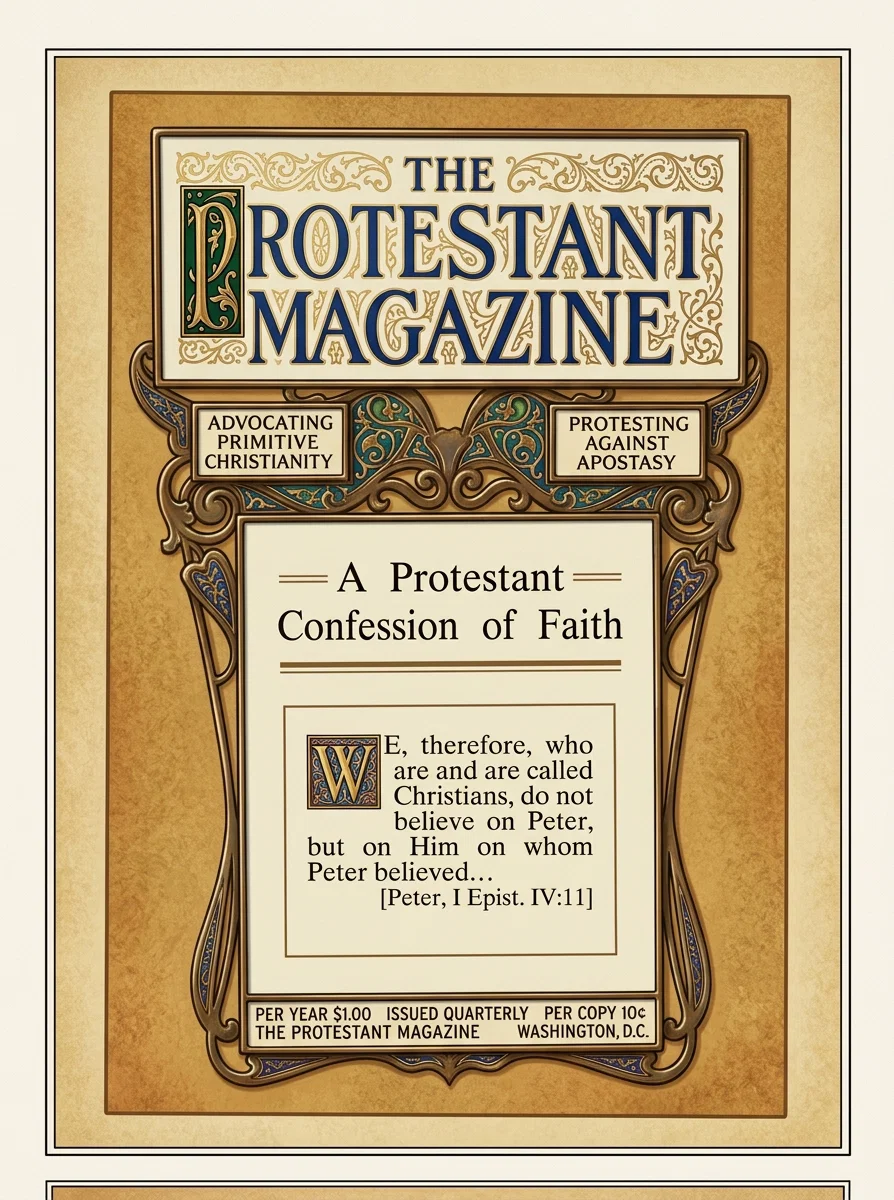
An excerpt from “The Pope and the Council,” by Janus, published in 1870. The writer was, until the time of the publication, highly esteemed by the Church as a Roman Catholic scholar.
Every Seventh-day Adventist should read this number of the Protestant Magazine carefully, and assist in giving it a wide circulation. It sounds a clear note of the third angel's message, striking a telling blow for great underlying principles of truth. Agents will find it no difficult matter to place this number in the hands of the people.
Single Copy - - - $ .10 Yearly Subscription - - $ .25
Special rates to agents in quantities. Write direct to your tract society.
SEE THAT THIS NUMBER IS PLACED IN THE HANDS OF YOUR LAWMAKERS, AND MEMBERS OF ALL ANTI-CATHOLIC ORGANIZATIONS.

A Call to Prayer

G. B. THOMPSON
IN view of the tremendous work before us to carry the message quickly to the cities, a day of fasting and prayer has been appointed, and as a people we are asked to especially seek the Lord upon this day in behalf of this work.
The work itself is a call to consecration. We need to pray. We ought to pray much more than we do. We are often so busy that we neglect to pray. And a prayerless Christian is like a body without breath.
We need to fast also; not as a penance to afflict the body, but in order that our minds may more clearly sense our need, and take hold of divine help.
This call to work the cities is from God. The Lord is directing our attention to a neglected work. The people live in the cities. This is a trumpet call from the Holy Spirit to carry the message to the people. Hitherto we have worked the places of least resistance. Now the call is to storm the strongholds of sin; to carry the battle to the very gates of the enemy, and plant the flag of the message on the ramparts of the foe. When this is done, the work will be finished in the earth.
The cities are the strongholds of the devil. Walls of sin and pleasure surround the people. Antichrist has his seat in the cities. Millions who are unwarned live in these great centers. In some sections thousands live in a single block. Now the call is to carry the message to these congested centers of population, not to one language only, but to all the languages under heaven. This will take hard, persevering effort, tens of thousands of dollars, and hundreds of consecrated workers. In view of this great work, we may well fast and pray, not for a day only, but often.
When the call to work these populous cities, where sin and crime have their seat, is fully responded to, it will result in a great evangelical awakening among us. It is a call to this very thing,—a call to old-time methods of hunting for souls in a personal, heart-to-heart way. It is a call, not to a few persons simply, but to the whole denomination, to wake up and labor for souls. It means a house-to-house search, by preachers, Bible workers, evangelical workers, sellers of literature, physicians, and nurses, for lost souls, to tell them how to give their hearts to God, and prepare for the return of his Son from heaven.
In the writer’s opinion we need a spiritual, evangelical awakening. We have needed it for years. In our struggle with institutions and debts we have drifted somewhat from this line of work. There is much activity, much mechanical effort, much expenditure of money, but there is not that ingathering of souls that should be seen. The art of soul-winning has in a measure been lost sight of. In this call to carry the message to our cities, the Lord is calling us back to this work. To do the work, we shall have to study the art of winning souls. The call is not for more machinery, but for the vitalizing energy of the Holy Spirit, that workers may be trained and endowed with power to do personal work in behalf of the perishing.
Humanly speaking, the task is beyond our power to accomplish in this generation or any other. But the God who captured Jericho, and in a short time sent a terrible warning to Nineveh, is still able to speedily warn cities, demolish the citadels of sin, and plant the banner of the truth everywhere,—and then the work will be done.
Surely we need to pray. If ever men needed to “weep between the porch and the altar,” it is now. We face a work which should lead the children of God to seek meekness. Prayers and supplications, with strong crying and tears, should go forth from all hearts. All great movements in God’s work begin with prayer. Once the people are on their knees in earnest prayer, something will happen. The arm of Jehovah will be stretched out in behalf of his people. The armies which are in heaven will be sent to assist those who pray, and the fortifications of the enemy, which seem impregnable, will be taken.
Takoma Park, D. C.

The Treasure and the Heart

MRS. E. G. WHITE
“LAY not up for yourselves treasures upon earth, where moth and rust doth corrupt, and where thieves break through and steal: but lay up for yourselves treasures in heaven, where neither moth nor rust doth corrupt, and where thieves do not break through nor steal: for where your treasure is, there will your heart be also.”
Mark these words of the Great Teacher, who spake as never man spake. He sets before you the course to pursue if you would serve your best interests in this life, and lay up for yourselves an eternal treasure,—“Lay not up for yourselves treasures upon earth.” There is danger of losing all in the pursuit of worldly gain; for in the feverish eagerness for earthly treasure, higher interests are forgotten. The care and perplexity that are involved in laying up treasures upon the earth, leave no time nor desire to estimate the value of eternal riches. The glory of the world to come is eclipsed by the corruptible things of earth. “For where your treasure is, there will your heart be also.” Your thoughts, your plans, your motives, will have an earthly mold, and your soul will be defiled with covetousness and selfishness. “What shall it profit a man, if he gain the whole world, and lose his own soul?” The day is coming when the idols of silver and gold will be cast to the moles and to the bats, and the rich men will weep and howl for the miseries that shall come upon them.
Christ entreats, “Lay up for yourselves treasures in heaven.” This work of transferring your possessions to the world above, is worthy of your best energies. It is of the highest importance, and involves your eternal interests. That which you bestow in the cause of God is not lost. All that is given for the salvation of souls and the glory of God, is invested in the most successful enterprise in this life and in the life to come. Your talents of gold and silver, if given to the exchangers, are gaining continually in value, which will be registered to your account in the kingdom of heaven. You are to be the recipients of the eternal wealth that has increased in the hands of the exchangers. In giving to the work of God, you are laying up for yourselves treasures in heaven. All that you lay up above is secure from disaster and loss, and is increasing to an eternal, an enduring substance.
It should be your determined purpose to bring every power of your being into the service of Christ. His service is profitable for the life that now is, and for that which is to come. If your thoughts, your plans, your purposes, are all directed toward the accumulation ofthe things of earth, your anxiety, your study, your interests, will all be centered upon the world. The heavenly attractions will lose their beauty. The glories of the eternal world will cease to have the force of reality to you. Your heart will be with your treasure, and every faculty of your mind will be so concentrated on the work you have chosen, that you will not heed the warnings and entreaties of the Word and Spirit of God. You will have no time to devote to the study of the Scriptures and to earnest prayer that you may escape the snares of Satan, and render intelligent obedience to your Heavenly Father.
Satan has nets and snares, like the snares of the fowler, all prepared to entrap souls. It is his studied purpose that men shall employ their God-given powers for selfish ends rather than yield them to glorify God. God would have men engage in a work that will bring them peace and joy, and will render them eternal profit; but Satan wants us to concentrate our efforts for that which profiteth not, for the things that perish with the using. The service of Satan is one of care, perplexity, anxiety, and wearing labor, and the treasure men toil to accumulate on earth is only for a season. The greatest caution is exercised in the worldly investment of means, that the expenditure may yield a good profit; but in things of eternal concern the utmost indifference is displayed. O that the great interests of the world to come were appreciated! Why is it that men are so unconcerned about the salvation of the soul when it was purchased at such cost by the Son of God?
The heart of man may be the abode of the Holy Spirit. The peace of Christ, which passeth understanding, may rest in your soul; and the transforming power of his grace may work in your life, and fit you for the courts of glory. But if brain and nerve and muscle are all employed in the service of self, you are not making God and heaven the first consideration of your life. It is impossible to be weaving the graces of Christ into your character while you are putting all your energies on the side of the world. You may be successful in heaping up treasure on the earth, for the glory of self; but “where your treasure is, there will your heart be also.” Eternal considerations will be made of secondary importance. You may take part in the outward forms of worship; but your service will be an abomination to the God of heaven. You can not serve God and mammon. You will either yield your heart and put your will on the side of God, or you will give your energies to the service of the world. God will accept no half-hearted service.
(Concluded next week)

The Individuality of the Life in the Flesh

L. A. HANSEN
There is a most emphatic personal and individual tone to Gal. 2:20. This is so in both the positive and the negative of its application in Christian experience. Read the verse again, and note the “I’s” and “me’s” in it: “I am crucified with Christ: nevertheless I live; yet not I, but Christ liveth in me: and the life which I now live in the flesh I live by the faith of the Son of God, who loved me, and gave himself for me.”
Christian experience must be personal; its requirements must be met by individual response. Nothing could be more indicative of this than its demands upon “self.” The gospel call is to “any man” and “every man.” The reward is to “every man according as his work shall be.”
All repentance and contrition for sin, all self-denial and self-sacrifice, find their full expression in “I am crucified with Christ.” All yielding and surrender of the will, all submission and resignation, are found in “not I, but Christ.”
So it is that all realization and enjoyment of spiritual blessings lie in self-appropriation. The exercise of faith must be an individual one. John 3:16 must not be read to mean that “God so loved the world” in general that no one in particular is meant, but rather, that it includes every one in the world, and to the reader, that means “me.” It is a relationship of two.
The demand for a personal experience in the Christian life does not ignore the peculiarities of one’s situation. On the contrary, it especially takes account of them, and makes particular provision for them.
We may possess dispositions that are peculiar; our environment may be unlike that of another, our lot may be harder than his. We may have trials that seem strange and temptations that look uncommon. None of our friends may know what struggles we have, and how hard it is for us to live right.
We may feel that if we could only have been born thus and so; if we could just get out of our own particular surroundings, and be in a more favorable place; or if we could have more congenial people around us, we could live better lives.
But God has taken note of all these things, and has made provision accordingly. Yea, more than this. The very circumstances of our lives will be the means in his hands of perfecting our characters. He has placed us just where we are, because that is the best place for us. And of each one of us is it required that our life be lived just as Jesus would live it were he situated just as we are. It is the privilege of each one of us to say, “The life I now live in the flesh, I live by the faith of the Son of God.”
“True faith is that which receives Christ as a personal Saviour. God gave his only begotten Son, that I, by believing in him, ‘should not perish, but have everlasting life.’ When I come to Christ, according to his Word, I am to believe that I receive his saving grace. The life that I now live, I am to ‘live by the faith of the Son of God, who loved me, and gave himself for me.’”
“The relations between God and each soul are as distinct and full as though there were not another soul for whom he gave his beloved Son.”
Takoma Park, D. C.

What the People Say

G. B. STARR
“We like the preacher, and are interested in the subjects presented; but he wears us out with his long preaching. We really want to hear the next subject; but when we contemplate starting in to listen for an hour or an hour and a half, the strain looks too great for our tired nerves; and so, in self-defense, we plan to remain at home at least part of the time.”
“We wouldn’t mind a half-hour, or even forty minutes, of bright, earnest talk, but longer than that seems more than we are equal to.”
“The way it affects me,” says another, “is this: When I am enjoying a good thing, I want the speaker to stop while I am really enjoying it; but if he keeps on until I become weary, and my mind is overcrowded, I lose the sense of pleasure, and instead carry away with me a dread of another such experience, and so feel disinclined to attend again.”
Now the minds of the majority of people are not at leisure, as are the minds of speakers, to devote hours of earnest thought every day to Bible themes. Home cares, business, and many other things fill the mind, until it can not retain a long list of even very important facts.
Ought we not, therefore, to be admonished to pack and boil down and concentrate, and make sure of a few clear, clean-cut points, and nail them to stay? And ought we not to keep “the terminal apparatus” in good working order, and use it constantly by stopping on time, as well as to urge the people to “come on time”?
If we are to gather and hold largeaudiences in the great cities, we shall have to listen to their friendly admonitions and warnings against the “sin which doth so easily beset” the public speaker.
Everybody likes to hear a bright, short speaker, and to hear him often.
Melrose, Mass.

Difficulty

WHAT is difficulty? — Only a word indicating the degree of strength requisite for accomplishing particular objects; a mere notice of the necessity for exertion; a bugbear to children and fools; only a mere stimulus to men. — Samuel Warren.

Thanks for All

How can I count Thy mercies up? What boisterous seas thou hast made calm, What sad sights changed to joyous psalm, And what rich wine has filled my cup! My day and night, my work and rest, Even my sorrows, thou hast blessed.
Thou gavest, and I took my share Of pain and trouble, grief and tears; But ever through the stormiest years My peace was greater than my care. Unworthy I! and yet I pray, O Lord, accept my thanks to-day.
— Marianne Farningham.

Reporting

Writing for the Press—No. 5

Reporting

W. S. CHAPMAN
It does not follow, because I advise you to acquire a practical knowledge of reporting, that I am suggesting that you enter the employ of some newspaper editor as a paid reporter. A Sabbath-keeper could not consistently do this.
A salaried newspaper reporter must ever stand ready to do the bidding of his employer, unquestioningly, at all times, under all circumstances; to accept each and every assignment given him; to go anywhere, and investigate anything that comes under the heading of news. He is not supposed to have likes or dislikes, preferences or compunctions, conscience or religion. He is to spare none. The old, the young, the innocent, the guilty, the man of wealth or fame, or the poor and outcast,—the facts must ever be told, regardless of consequences; the details of the happenings, however hideous and humiliating they may be to the parties concerned, and no matter where or on whom the blow falls, are to be laid bare. In such work a Sabbath-keeper can have no part.
Neither am I suggesting a too close attention to this work of reporting. It is not best to make a hobby of it, or to seek news items continuously, daily. A paid reporter is supposed to pick up every available item coming within his reach. A corresponding reporter is expected to send in only the more important and more interesting items. This latter is the only kind of reporting it will be well to engage in.
Be careful, therefore, not to degenerate into a 'gossip.' Gossip may or may not be news; but it is in a class not worthy, generally, of the attention of a Sabbath-keeper.
To chronicle the fact that Miss Green gave a reception to Miss Plum from Centerville: that the time was delightfully passed playing forfeits; and refreshments were —, etc.; the following young ladies being present —, etc.—such a report is gossip. Utterly refuse to touch that sort of thing.
But when Mrs. Townsend is called, suddenly, by telegraph, to Centerville, her father having been taken dangerously ill, and leaves on the early train, all good citizens will be anxious to learn about the matter, as the old man, the former county treasurer, has always been a prominent character. Be certain to send in such an item: it's news, locally, of the very best kind.
If you send in items but once a week to your home paper, it will seldom be necessary for you to go from home to obtain them. When it becomes known that you are 'correspondent for the paper,' your neighbors and friends will be certain to think of you when anything of interest occurs, and to furnish you with the particulars.
Keep a tablet, with pencil attached, in some convenient place; and when any item comes to hand, let some member of the family make a note of it. You will be surprised to see how fast they will accumulate. When leisure moments come, study these jottings, and write them out for the paper on separate sheets. Occasionally pick them up and reconsider the matter, querying whether the composition can not be improved in arrangement, diction, or condensation. This work will be your 'school work,' and if faithfully followed up, will insure proficiency.
This field—not an overworked one, either—can be entered by our people with great benefit to themselves and to the cause. By doing this work they become what may be termed 'corresponding reporters;' i. e., those sending in items of news, occasionally, or regularly by appointment, but not under a salary, to their local paper, or as opportunity offers, to newspapers at a distance.
A newspaper correspondent usually confines himself to the sending in of a chatty letter once a week, or on stated occasions, as agreed upon, such a letter generally containing items of interest from the home of the writer only, which are inserted as such, headed with the name of the town or village from which the news is sent.
A corresponding reporter deals more in isolated items of news, and happenings of interest, gathered from any point, preferably, however, from within the county, describing each on a separate sheet of paper. These items the editor has set up singly; and the 'compo,' in 'making up' the paper, inserts them where each is most appropriate, or else uses them as 'fillers' to close small vacancies in the columns. Items of sufficient importance might receive distinctive headings, and be assigned a more or less important position, according to the estimate the editor might put upon them, and according to the congested or vacant condition of some of his columns.
If the newspaper is published in the correspondent's own town, it will be best to consult the editor before writing out any item of particular interest. It is customary to present an outline of the facts to him, and he will name the number of words which, in his judgment, the article can be granted, to fill a certain amount of space. Sometimes this may be but a stickful, or about one hundred sixty words; or it may be half a column, or, to your surprise, possibly a whole column, or about fourteen hundred words.
The space assigned to an article is not always a safe criterion as to its value. In estimating the number of words to be accorded it, the editor takes into consideration the condition of the columns of his paper, and the available matter on hand. Often an item may be extended to-day to a column which to-morrow would be reduced to a stickful or two.
An item, filling a goodly proportion of half a column or of a full column, is called a 'space' story. When such a story is of peculiar interest, it can be remodeled and written out, after you have gained sufficient experience at reporting and story writing, and sent to some large daily in a big city, on 'space rates.' If accepted and printed, a check for from one dollar to ten dollars may be sent to you. Often quite an addition to your income will come from watching for such openings. Do not feel disappointed, however, if many of your efforts prove failures. Many times good material has to be sacrificed, even after acceptance.
The pay of a corresponding reporter varies according to circumstances. Items sent to your local paper may perhaps bring you in no money. The editor may put your name on the free list for a copy of the paper regularly, and furnish you with paper, envelopes, and postage. Still, the experience you will obtain, particularly because of the editor's advice and criticism of your work, will be of far greater value to you than the cash remuneration from outside papers.
Most of the contributions from a corresponding reporter can be classed as 'space' writing. When the items are sent to a paper paying cash for them, they must be carefully preserved; and once a month, with their headings, if they have any, pasted in long sheets, or strips, then sent in for payment. The office will measure them into column lengths, and you will be paid so much a column for them. This, generally, is ten cents an inch, sometimes as high as five dollars to ten dollars a column, varying according to the character of the matter, and payment being made only for that which appears in print.
It is important that you get your matter into the hands of the editor early. There is very little show, in daily papers, for items coming into the office late, unless of exceptional value. You should ascertain the hour of going to press, and aim to get your contributions in on ample time.
Should you get hold of a particularly interesting item of sufficient importance to be valuable to some distant daily, and it comes to you too late to mail and reach the office before the paper goes to press, you should telegraph a 'query,' describing the story, and asking if the editors wish to have it. If it is desired, they will reply, naming the number of words that you are permitted to use in telegraphing. This style of story business with newspapers I will describe more fully farther along. If your telegraph matter is used, you will be paid 'space rates.' Remember, however, that all large daily papers receive from two to five times as much telegraph matter daily as they can use. Yours, therefore, may be 'turned down' simply because it came late, and there was no room, or because more important mattercame after it was accepted. No two papers treat this kind of matter alike. Some send checks without the asking; others require correspondents to send in their bill and copy of 'stuff.'
The 'art' in newspaper writing is to put the climax into the opening sentence. Proficiency here goes far toward insuring success everywhere.
Reporting, especially studying to make bright, sharp, breezy items out of commonplace occurrences,—items that will 'make folks sit up and take notice,'—is 'art' in journalism, and can be mastered in no other way than by practise as a reporter. Once mastered, the art banishes forevermore all dulness from your writings. When you write, your stories will 'tell something;' you will tell it interestingly; you will cull it of all superfluity; you will tell it so the hurried business man can catch the idea quickly, getting the gist of the matter even in skimming your story; and your 'stuff' will linger in the minds of the readers as a pleasant memory.
How important all this becomes when associated with the presentation of truth to the carnal mind, which is enmity to it! 'Study to show thyself approved unto God, a workman that needeth not to be ashamed,' surely applies in this work.

Personal Experience in Accepting Present Truth

DANIEL NETTLETON
“Thou shalt remember all the way which the Lord thy God led thee,” says Moses; and Paul exhorts us to “call to remembrance the former days.” The Lord said he had somewhat against the church of Ephesus, because they had left their first love. A good way to keep from losing our first love for this message and work is frequently to review the steps we took in coming into the truth, and then to “remember all the way” in which the Lord has led us.
I accepted present truth in 1875, entered the ministry in 1877, and have been in the work ever since. God called me to do the work of an evangelist,—to preach the word,—and I have endeavored to be about my “Father’s business.” “As we were allowed of God to be put in trust with the gospel, even so we speak.”
The Sabbath truth came to me while I was yet at home, working on father’s farm in Nebraska. A Seventh-day Adventist home missionary worker sent father the ADVENT REVIEW AND SABBATH HERALD. Being strict Methodists, and being warned not to read those “advent papers,” mother pasted them on the wall to keep out the wind and cold. Well, they did help keep the cold out, and they brought the truth in, though we did not invite it to come. Though they came uninvited, the papers were a great blessing. “Some have entertained angels unawares.” Pasted in a conspicuous place near the wood-box was one of those papers, with the title-page plainly to be seen. When I brought in the wood, I would stop and read: “ADVENT REVIEW AND SABBATH HERALD.” “Here is the patience of the saints: here are they that keep the commandments of God, and the faith of Jesus.”
When I went out to work, I would say to myself: “Do not we Methodists keep the commandments of God and the faith of Jesus?” I had learned the ten commandments at Sunday-school, and I knew the fourth one said, “Remember the Sabbath day, to keep it holy. . . . The seventh day is the Sabbath of the Lord thy God.” I knew the calendar put Sunday as the first day of the week, and Mark said, “When the Sabbath was past, . . . very early in the morning the first day of the week,” and Matthew said, “In the end of the Sabbath, as it began to dawn toward the first day of the week.” Our Methodist minister said, “We keep the first day of the week to commemorate the resurrection of our Saviour,” but I had not read that in the Bible. I did read, however, “Do we then make void the law through faith? God forbid: yea, we establish the law;” and I knew the law to say, “The seventh day is the Sabbath.” In the epistle of James I read: “And whosoever shall keep the whole law, and yet offend in one point, he is guilty of all;” and in I John 3 : 4, “Whosoever committeth sin transgresseth also the law: for sin is the transgression of the law.”
I was made a little uneasy by these scriptures, so I began to study and think about this matter. Some said we could not tell which day is the Sabbath. But I read in my Bible (Luke 23 : 54-56) that the day on which Jesus was crucified “was the preparation, and the Sabbath drew on. . . . And they returned, and prepared spices and ointments; and rested the Sabbath day according to the commandment.” Then “upon the first day of the week, very early in the morning, they came unto the sepulcher.” So I knew that the day just before the first day of the week was the Sabbath day, according to the commandment.
Another incident also helped to make this truth plain. One morning after family worship (my father always had family prayer, morning and evening, and it was this that led me to give my heart to God) my brother said to me, “You are not keeping the true Sabbath day. The seventh day is the Sabbath, and our family Bible says Saturday is the seventh day, or Sabbath.” I went to the family Bible, and found the time-table to which he referred, and sure enough, it said, “The first day of the week, Sunday; the second day, Monday; . . . the seventh day, or Sabbath, Saturday.” It was made so plain that Saturday is the true Sabbath day that I could not deny it and be a Christian. God fixed that truth so firmly in my mind that it has not yet been removed. Divine truth took hold of me, and claimed me as its own. I praise the Lord that I am still his, and by his grace have been able to call hundreds to the same truth, who have been led to keep “the commandments of God, and the faith of Jesus.”
I am so glad now that my father was poor, and we did not live in a fine, comfortable house; for if we had, those “advent papers” might never have been pasted on the wall, and I might never have read them, and been led to the present truth. I am also thankful that God put it into some one’s heart to send us the REVIEW. God knows who it was, and I expect to know in the new earth. O brethren! let us continue to send our good papers to our friends. “Blessed are ye that sow beside all waters.” “In due season we shall reap, if we faint not.” As I continued to read the REVIEW and study my Bible, there came into my heart a strong desire to be a Sabbath-keeper. I would go out into the grove on father’s old homestead, and pray that God would open the way so I could be baptized and keep his Sabbath. In my next article I will tell how God answered my prayer.
Port Townsend, Wash.

The Law of God

M. E. STEWARD
An essential element of every kingdom is the law. “The Lord . . . is a great king over all the earth;” hence the law of God is binding on all mankind.
There are three periods in this world's history:—
1. From Adam to Moses, called the patriarchal age.
2. From Moses to Christ, or the Mosaic dispensation.
3. From Christ to the end of the world, or the Christian dispensation.
The law of God was in existence during these three periods:—
1. Paul argues, in Rom. 5:14, that death from Adam to Moses is proof that the law was in force during that time; because death is the wages of sin, and sin is the transgression of the law. Rom. 6:23; 1 John 3:4. “Where no law is, there is no transgression,” in that case there could be no death, which is the penalty of transgression. Rom. 4:15.
2. The law was “written and engraven in stones,” for the people of the second period.
3. Paul's argument in Romans 5, providing that the law was in force from Adam to Moses, is equally applicable to the third period; for “death” still “reigns.” Hence God's law is in full force now.
If the law could have been abolished or changed, Christ need not have died. “Do we then make void the law through faith? God forbid: yea, we establish the law.” An intelligent “faith” in Christ acknowledges the necessity of the atonement for sin; and the fact that “sin is imputed,” “establishes” the claims of the law to-day. Further, the “faith which worketh by love,” purifying the heart, establishes the law in the Christian life; for Jesus saves his people from transgressing it. “He shall save his people from their sins.” Matt. 1:21.
The last benediction and promise in the Bible, given in the Christian dispensation, are made to those who keep God's commandments. Rev. 22:14.
Three points on the nature and perpetuity of the law of God:—
1. This law is perfect; it comprises the principle of right. Psalms 19. Being perfect, it can not be changed without becoming imperfect or wrong.
2. “The law is holy, and the commandment holy, and just, and good.” Rom. 7: 12. “This is the love of God, that we keep his commandments, and his commandments are not grievous.” 1 John 5: 2.
3. “Whosoever shall keep the whole law, and yet offend in one point, he is guilty of all.” James 2: 10. He violates the principle of obedience, which underlies every commandment. Moreover, the transgressor of one command is “guilty of all,” because each offense weakens his moral character, so that he has less ability to keep the rest of the law inviolate.
Do we not well, when we see the terrible results of Adam's failure, and comprehend in some measure the infinite importance of perfect obedience to God, to resolve, by his grace, to “make no compromise with evil”?
Sanitarium, Cal.

A Touch of Green

A touch of green in the city street, A touch of green where the fences meet; A touch of green by the wayside there In city alley or thoroughfare; A touch of green—it will help so much, That yard of bloom, with its country touch!
A touch of green, and the roaring street Fades off in a garden cool and sweet, Where the blossoms bend and the bright day beams Till the touch of green brings a touch of dreams; A touch of green—it will go so far Where the dead brick walls and the fences are!
A touch of green, and the heart will know The childhood spell of the long ago, Brought through the dust of the steam-baked town Like visions of fairyland drifting down; A touch of green—it will make you leap Like a sudden call in a dreamless sleep!
A touch of green in the old back yard, And life grows easy that seemed so hard; And other eyes than your own are there Its bloom and beauty and joy to share; A touch of green—it will pay so much, That yard of bloom, with its country touch!
— Baltimore Sun.
Continue reading: The Way to Health