It has been almost if not quite a score of years since we visited the commodious and pleasant home of Bar-jona the fisherman.
Capernaum, whither he had removed with his family, from Bethsaida, was, in the days of which I write, a large city; it was situated on the northwestern shores of the Sea of Galilee. The country thereabout was rich and populous,—the center of the manufacturing interests of all Palestine. Hundreds, even thousands, of ships and vessels, large and small, plied in every direction, north, south, east, west, over the Sea of Galilee; the war-ships of the Romans, and the brilliantly decorated pleasure crafts of Herod, the busy boats of the hardy and industrious fishermen, and the white sails of the merchantmen,—all combined in presenting a scene of busy activity and joyous life.
Here it was that Matthew, one of the twelve disciples of our Lord, had been chosen, even while he was acting as customs officer in the employ of the Romans; and here the Master latterly made His home, evidently that He might be nearer the great, throbbing heart of humanity,—humanity, for whom He paid such a price.
It was the evening of a day in late December. The winter rains had swollen the river Jordan, which tumultuously enters the Sea of Galilee about five miles to the eastward.
We have fortunately chosen a time for our visit, upon one of those rare occasions when the family of Bar-jona are all present; for Bar-jona the fisherman is now so closely identified with the interests and business of his beloved Master, that he, with others, has become His almost constant companion during those wonderful journeys which meant life and healing and salvation to multitudes along His route.
But on this evening the fisherman is at home. It is also the occasion of the first visit of Matthias since his adventure with the thieves on the highway between Jerusalem and Jericho,—which thrilling adventure, with every particular, including the remarkable tale of Varro, has already been related by him.
The passing years have wrought many changes in this as in other families. Sylvanus, an old man now, is sitting in the shadow, by the side of a white-haired woman, Esther, his wife. Bar-jona himself, now no longer a young man, is engaged in an animated conversation with Matthias. Affectionate, large-hearted, quick of speech, impulsive, and generous to a fault, bold and aggressive in the use of the sword, yet abnormally sensitive to ridicule, is this Bar-jona—the "fiery Galilean."
There is one more whom we especially notice,—an intelligent appearing man with broad and noble brow, whom Esther often addresses as "my son Heber."
"Come, Bar-jona, my husband," exclaims Perpetua, at last seating herself, "the work of the evening is done, now thou shalt tell Matthias, my brother, of thy journey to Gadara, with the Master, and of the storm which came down on the sea."
"But first," interrupts Esther, "speak thou, Heber, my son, speak thou of thy healing; for we would hear the tale once again from thy lips;" and the woman laid her hand tenderly upon the broad brow of the man Heber.
"The Master hath indeed healed me, but how He hath healed me I know not, my mother, even as I before said unto thee. I but remember His touch and the shining of His gracious eyes, as He said unto me, 'Go show thyself unto the people of Decapolis, that they may know what great things the Lord hath done for thee, and hath had compassion upon thee.' And so even to-morrow I do return unto the country of the Gadarenes, where of a truth I dwelt many years in mine infirmity, that I may preach Jesus of Nazareth, the Shiloh of Israel, the Son of the Highest."
Deep and reverent silence reigned for a little time, and Bar-jona began his recital:
"The day had been very pleasant for the season, and a multitude of people had thronged our Master, to hear the words of His mouth, and to be healed of whatsoever diseases they had. Finally, as the sun was about sinking, He asked me to make ready the large boat that we might go even unto the other side of the sea. The Man was very weary, for He had healed many throughout the day; and His face was white and wan, as He at last sent the multitude away, and entered with us into the ship."
"The Master careth not for Himself, if so be He may but teach the people and heal their diseases," interrupted Esther impulsively. "Thou shouldest look to thy Master more carefully, Bar-jona."
Bar-jona only smiled as he continued:
"When the night began to settle down, John the son of Zebedee saith unto me, 'Behold, our Master sleepeth upon a pillow,' and he smiled, for this man John loveth the Master well."
"The night was beautiful and calm, save for a light breeze, and we sailed smoothly along. There were also a number of other, smaller boats which followed us. The calmness of the night seemed to beget a calmness in mine own heart also, which, as thou well knowest, Brother Matthias, possesseth not my soul at all times. My brother Andrew sat gazing thoughtfully at the starry sky."
"'What thinkest thou, Andrew,' I said, 'when will the Master set up His kingdom at Jerusalem?'"
"'Surely it must be very soon,' he replied."
"'I know not,' interrupted John the son of Zebedee, sadly, 'I know not; neither understand I the words of our Master.'"
"While we thus talked, the one to the other, there fell upon us a dead calm; for the space of a moment the white sails were empty and the ship lay motionless, while the moon and the stars were suddenly cut off from our sight. Then the boat trembled and shuddered as if shaken by the hand of a giant."
"A gale from the north had struck us furiously. At once every man sprang to the rescue of the ship; some to lower the sails which already threatened to be torn to shreds, while others seized the oars. I have seen many a storm, Matthias, but never even upon stormy Galilee did I experience so sudden, so terrible, so appalling a tempest."
"Suddenly I remembered that the Master was on board."
"'O thou son of Zebedee!' I cried loudly; 'go thou and waken the Master, that we perish not!' At once he hastened toward the hinder part of the ship, while my brother Andrew and I rushed blindly after him; and I saw with a feeling of astonishment, that even John had forgotten the Master in his wild terror. The boat seemed ablaze with an unearthly flame, which revealed the calm face of the Miracle-Worker. He was still asleep, the pillow upon which He slept was already dampened by the spray of the salt waves."
"I could wait no longer; for it seemed that the tongue of the son of Zebedee was paralyzed."
"'Master! Master!' I shouted, bending close to His ear, 'save us, that we perish not!' Then the man John, casting upon Him a look of deepest anguish, cried aloud, 'O Master! carest Thou not that we perish?' In an instant the Master was upon His feet, and preceded us along the flame-lit passageway to the open deck."
"The ship was now tossing and dashing about so furiously that I could scarcely keep my feet; and Andrew, my brother, fell heavily as we advanced. When we reached the center of the ship, the Man paused, and lifting His right hand toward the lurid and blazing sky, said, 'Peace, be still!'"
"With one quick shudder, the sinking vessel righted herself; the dashing waters became calm, as had the sky above, and I saw again the reflection of the moon and the bright stars in the quiet sea."
"Until now I had forgotten that there were other, smaller boats in our company. Now I perceived that they were very near us. The bright light of the moon revealed the faces of the men on board, and their faces expressed astonishment and awe, as they put their boats about and returned to Capernaum."
"But I heard the loud voice of the man Marcus the centurion, of Capernaum, he whose servant was healed by the Master, and he cried out saying, 'What manner of Man is this, that even the winds and the sea obey Him?'"
Chapter XXXIX. Deciding His Fate
Three leagues or more to the southward from Hebron, in Judea, lay the little village of Kerioth. It was late in winter, the third year after the baptism of Jesus of Nazareth. "The midst of the week"—the time appointed by the unerring decree of the Spirit of prophecy for the "cutting off" of the Messiah—was drawing near.
We would love to remain in the society of those whose hearts are true to the Master,—those who follow Him not for the loaves and fishes; but we shall for a time cast our personal preferences to the winds, that we may the better understand the dark and mysterious workings of the mind of that man whom the Scriptures of Truth name "the son of perdition."
The man Judas, of Kerioth, the son of Simon, had for a little while left the company of Him whom he was pleased to call "Master," with the little band of eleven, up at Jerusalem, while he took his journey southward toward his home in Kerioth of Judea. Occasionally he made this journey, if there was any question of moment to decide, that he might discuss it pro and con with the members of his family. These seem to have been, at least for the most part, possessed with the same spirit as Judas.
"Ho, Judas, whence comest thou? Thou art travel-stained and weary, and thy countenance seemeth sad. Speak! I would know; for are not thy joys my joys, and thy sorrows mine also? Hath not thy Master, this Son of a carpenter, dealt well with thee, my son?"
The speaker was Simon of Kerioth. Grizzled and bent with the weight of years, his eyes were keen, and showed the same uneasy, fiery restlessness as did those of his son.
As the old man spoke, he glanced uneasily up at the tall figure standing in the doorway of the outer court.
"Come hither, my mother, and Claudia, my wife!" exclaimed the traveler, almost ignoring the old man, and hastily entering and throwing himself upon a divan.
"See! I have come down from Hebron, whither I was sent upon business, and where I remained but last night. I have come that I might make known unto you somewhat of the workings of mine own mind. Come, Claudia, call our sons, that I may greet them, and that we may converse together upon matters of grave importance."
"Ah, David, my son; and Solomon, my youngest born!" he exclaimed a moment thereafter, as two young men entered at the call of their mother. "David and Solomon!" he repeated reminiscently, taking a hand of each. "True sons of your father are ye!"
"Welcome, my son!" exclaimed an aged woman who just then entered the room. "Hath thy Master yet set up His kingdom?"
"Not yet, not yet, my mother; verily this Nazarene seemeth to be slow to act; and of a truth, did He not so many miracles, my heart would incline to doubt Him even now."13"Miracles, indeed!" exclaimed the woman impatiently. "How shall the healing of a few sick folk dispossess the Roman heathen of the inheritance of our fathers? Ah, much I fear mine eyes will be dimmer and mine head whiter—if indeed the grave receive me not—before thou, my son, art appointed chief treasurer of the new kingdom. And as the Lord liveth, thou art far above thy fellows, in understanding, my son." And the woman sighed.
"Thinkest thou, mine husband," interrupted Claudia, "that these low-born fishermen, John, or Andrew, or Bar-jona, or other of thy companions, seek for themselves so great honor as should be accorded to thee, Judas, the scribe, the son of Simon of Kerioth?"
"I perceive that thou considerest not the effrontery of these men, my Claudia."
"Thou rememberest the ruler Jairus, of Capernaum," continued the speaker, addressing the old man; "he hath a daughter—a little maiden twelve years old. Now she fell sick and died; so said Jairus unto me,—and indeed, I myself heard the hired mourners wailing and making ado, as I stood in the outer court of the house. And when Jairus brought the Master into his house, behold, I thought to go into the chamber with the Master where the child lay. For I said, 'Who better can write concerning this miracle than I, Judas, the scribe?' for I perceived that the Nazarene would do a miracle. But Bar-jona, of Galilee, an uncultured fisherman, and James and John, the sons of one Zebedee, entered before me!" and the speaker's face grew dark with passion and jealousy.
"But dost thou declare that this dead child was restored again to life?" said the old man.
"So said Jairus, and—and the others. And indeed, for that matter, I myself saw her many days thereafter in her father's garden. In very deed, it was like unto the raising of the dead man of Nain. And I verily thought to go unto the chief priests and rulers of our nation, and I might peradventure have turned the attention of Annas and Caiaphas favorably toward the Nazarene. But of a truth this Miracle-Worker aspireth not to the kingdom; for even as they entered the court where we stood awaiting them after the child lived again, the Nazarene said earnestly, fixing His strange, sad eyes upon me as He spake, 'Tell the miracle to no man!'"
"Preposterous!" exclaimed Claudia. "Thou art no babbler; why should thy lips be sealed as if thou hadst no understanding?"
"Scant honor indeed He giveth me; and yet I, the scribe of Kerioth, remain in His company, when many a man with but half my endowments hath already parted company with Him,—being convinced, as I suppose, that His companionship profiteth little. Know ye that but few months ago this Man by His strange discourse turned a whole multitude away from Him? Indeed I was verily astonished when He declared Himself to be the Bread from heaven."
"It was not long after He had freely fed a multitude with but two fishes and a few small loaves of barley bread,—freely,—when we should have made many a shekel for the bag that day. Then, verily, the time was ripe for Him to have gone up to Jerusalem and taken the kingdom, and to this very end did I labor until set of sun. But not long thereafter He exclaimed, 'Have not I chosen you twelve, and one of you is a devil?' As the Nazarene said this, He fixed His great sad eyes upon me. I can not soon forget the look He gave me! At the first, a feeling of horror and amazement crept over me, for it seemed that the Man had power to read the secrets of my soul; but now as I think upon it, a feeling of anger possesseth me!" and the speaker rose and began pacing the floor of the room with quick, nervous strides.
"If He hath already called thee a devil, my son," exclaimed the white-haired woman, "thou shalt never receive the honor thou cravest at His hands," and the woman frowned darkly.
"Thou but sayest the same as did Jazer, the scribe of the temple," replied Judas; "for this man stood by, and when he had heard the words of the Nazarene, he said: 'Scant honor thy Master accordeth unto thee, Judas of Kerioth, thou son of Simon; and now, wherefore dost thou follow Him?' and the scribe laughed mockingly."
"Wherefore dost thou follow Him, indeed?" repeated Claudia and the young men, David and Solomon, together.
"I will answer; and indeed it is for this that I am come. There seem to be but three men whom the Master continually calleth to be near Him,—Peter, James, John,—until, of a truth, my soul sickeneth and riseth in indignation!"
"Thy Master seemeth not to consider that thou art of Judea, a scribe of an honorable house, and that thou art not an ignorant Galilean fisherman!" exclaimed Simon indignantly.
"And yet," continued Judas, a note of sadness and indecision in his voice, "how can I give up the company of this Man? for as the Lord liveth, I know not but He be the Messiah. Besides,—and of this I told thee not until now,—but a few days ago, while at Capernaum, I was stricken with deadly fever, until my parched tongue clave to the roof of my mouth, and my swollen veins seemed bursting with fire. Of a truth I would even have given all the gold of Cæsar, could I have bought therewith one moment's peace. At last, on the evening of the third day, the Man stood by the side of my cot; for He had been in Chorazin and Bethsaida. I can not easily forget the love, the tenderness, and the all mighty power that sounded in His voice as He bade me rise; neither can I forget the cool touch of His hand, when the pain and the fever left me;" and the narrator sighed, while the look of indecision upon his brow deepened.
The family of Judas of Kerioth listened to this recital until it was ended,—listened in astonishment,—from Simon, the gray-haired sire, to Solomon, the young lad. Then the old man replied querulously:
"It may hap that the fever was about to leave thee before thy Master came, my son; I also have been sick unto death, and rallied suddenly, as well as thou!"
"Of a truth," interrupted the white-haired woman, turning toward her son, "thou hast been sick unto death many times, in thy childhood, my Judas."
"Verily; but the Man healed me, O my mother," replied the narrator, with a ring of conviction in his voice which forbade further discussion. "But now," he continued, dropping his voice to a harsh whisper, "now I am minded to deliver this Man up to the chief priests—to Annas and Caiaphas, the rulers of our nation; for indeed they have covenanted to give me money. What think ye?" For a few moments the silence of death fell upon the guilty household of Judas of Kerioth.
At last a trembling voice broke the silence. It was that of the young man Solomon:
"Wilt thou deliver Him—thy Master—the Nazarene, to death, O my father?"
"To death—to death!" the words were repeated almost sadly. "I know not. It dependeth somewhat upon the Man Himself. He is fully able to deliver Himself if He will. Indeed, how can it be to death, my son? Thou forgettest His mighty power,—for surely this Nazarene is able to save Himself if He willeth it. And now verily all men shall one day acknowledge my wisdom. For of a truth there is a price upon His head; and if I give Him up to the priests, it will but hasten the day when, if He be the true Messiah, He will go up to Jerusalem and reign gloriously, and I shall be next unto Him. But if He be not the Messiah, if He be unable to deliver Himself, or too obstinate to do so, let not the blame rest with me—Judas of Kerioth!"
The gray-haired woman rose, and stepping quickly to the side of the dark-browed speaker, as he sat, she bent over him until the black locks were mingled with the gray, as she whispered huskily:
"List! thou shalt sell Him, my son, for the silver of Caiaphas!"
(To be continued)
Bibles
By Editor
Bibles.—Remember that we are headquarters for anything in the Bible line. We shall be pleased to send you our catalog of Bible selections on application. Pacific Press, Mountain View, Cal.
APPROXIMATE CHRONOLOGY, OR THE TIME OF THE CRUCIFIXION
Places in condensed form a few facts, from Scripture, history, and astronomy, that will enable the reader to understand the exact time of the crucifixion and resurrection of Jesus, giving the year, the month, the day of the month, the time of the moon, the day of the week, and the day of the Jewish month. Price 25 cents. Address H. H. Perry, 67 19th St., San Diego, California.
Having read the "Time of the Crucifixion and Resurrection of Christ," we testify that to our minds it contains a clear and interesting statement of the facts in the case, fortified with good evidence for the positions taken.
John Norton Loughborough, John O. Corliss, E. J. Hibbard.
Large Ripe Olives for Sale
5 gallon lots, 60 cents per gallon; 25 gallon lots, 55 cents per gallon; 50 gallon lots, 45 cents per gallon. Satisfaction guaranteed. Order at once of A. E. Crist, Chico, California.
Wanted
A middle-aged or elderly man without family, a Sabbath keeper, for general ranch work, one who has had experience in milking cows. Steady work. E. F. Horning, R. F. D. No. 1, Box 127, San Jose, California.
Life and Health
By Editor
A PRACTICAL health journal, published with a view of meeting hygienic needs in every home; teaching how to care for the health and how to preserve life; prescribing simple home treatments to assist nature in throwing off diseases rather than adding more poison by using drugs or unnatural stimulants as remedies: teaching how to avoid disease as far as possible, how to manage in the home when sickness does come, and how to combat the disease by simple remedies which nature provides.
Send for sample copy and special rates to agents. Price 10 cents per copy or $1.00 per year.
Address, LIFE & HEALTH, Takoma Park, D.C.
IN THREE DAYS
SAN FRANCISCO
Overland Limited
TAKES YOU
To Chicago
ACROSS GREAT SALT LAKE
AND
HIGH SIERRA BY DAYLIGHT
Luxurious High-class Equipment
Electric Lighted Throughout
Pullman Drawing-room
Stateroom
Vestibuled Sleeping-cars
Careful and Attentive Dining Service
Parlor Observation-car with
Library and Cafe
Ladies' Reading-room
Gentlemen's Smoking-room
Daily News Bulletins
Latest Papers and Magazines
Southern Pacific
Portugal
By C. E. Rentfro
The Beginning of the Republic
We have watched with interest the turn of affairs in the new republic. Certainly the nations may applaud the determination of the republicans to form a good government.
For many years the people have felt the oppressive hand of the clerical party. The powerful Jesuits and other orders robbed the state as well as people.
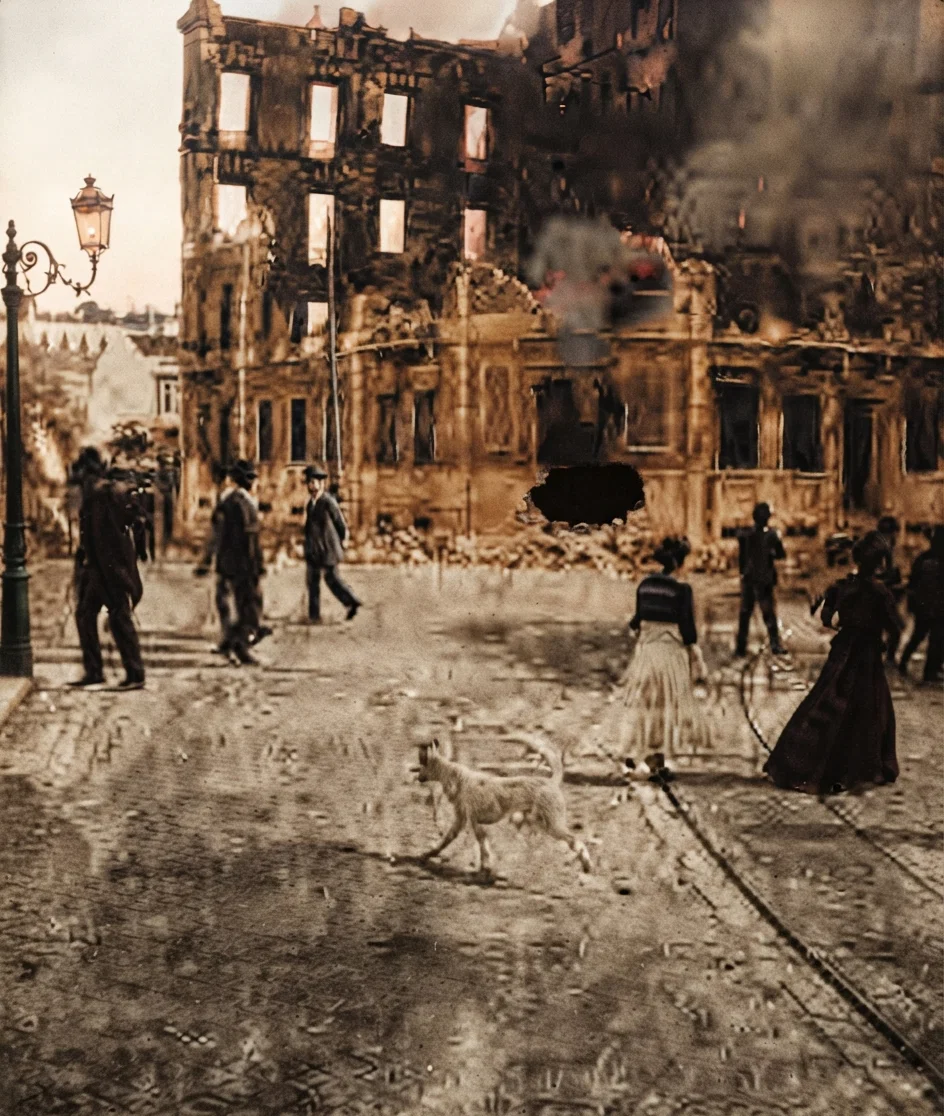
A Building Set on Fire by a Shell
Large inheritances were captured by them. At birth, in the christening, marriage, death, burial, and even after death, many tell me, it was the continual grasping and greed for money.
Since 1759 the presence of Jesuits in Portugal has been contrary to law. Since 1834 all other orders of monks and nuns had no right to operate. While these laws were never repealed, yet arbitrational decrees permitted them to enter and remain. Colleges were conducted for girls and boys, but the teaching was of such a nature that good citizens were not produced. For these reasons the monarchial government already had begun to inquire into these things, thus obeying the clamors of the people.
Since the proclamation of the republic the people have demanded the enforcement of the old laws for the banishment of these orders, and the provisionary government adopted this same program. All foreign monks and nuns and Jesuits were to be immediately sent from the country; while the Portuguese were to separate at once, and never-more to congregate more than three in a place. This was done.
In a fort near us about 150 priests or monks were placed for safe-keeping. In Lisbon over 300 nuns of various nationalities were taken to the marine arsenal to await the disposition of the minister of justice and ecclesiastical business. Among these were said to be two Chinese women. All of them are questioned by the minister, who has been working almost continually night and day. Some of the testimonies given by fanatical persons moved him to exclaim, "This is the reason why these Jesuits shall no more enter Portugal!"
A Barricade and Cannon of the Republican Forces
The condition of some nuns, and other things which came to light, moved the people to great indignation, yet were a cause of sport to many.
Spain is making preparations to order all foreign monks and nuns to move on. Italy talks of prohibiting the Portuguese Jesuits and other orders. So to the countries where they are not known they will carry their baleful influence.
On October 14 a committee of brethren delivered to the president a message and a declaration of some of our principles, written on parchment; and on Sabbath was published a telegram from the minister of the interior to the civil governors about the respect for each one's religion as follows:
"I beg your excellency to give instructions to all administrators and the respective governors of your district so that the worship be respected in all the churches and other places to it destined, prohibiting any manifestation against exercise of that worship of whatever worship it may be. The government of the republic respects the religion of each citizen, as a mere case of conscience, against which no one may attempt, and only proceeds against the clericalism and the reaction for being contrary to human liberty, peace, and social order."
We had the news as a great cause of rejoicing in our first Sabbath meeting after the revolution. We are sure of what God says in His Word, "The Most High ruleth in the kingdom of men." We felt no fear, but confiding in the sure word of prophecy, simply awaited the turn of affairs to a bettered condition of liberty. To our God be praise, honor, and glory forever and ever.
C. E. RENTFRO.
School Building at Gland, Switzerland
"Ye Know"
IN His discourse concerning His second advent our Lord gave this parable:
"Now learn a parable of the fig-tree; When his branch is yet tender, and putteth forth leaves, ye know that summer is nigh: so likewise ye, when ye shall see all these things, know that it is near, even at the doors." Matt. 24:32, 33.
Upon this George M. Mackie, M.A., D.D., of Beyrout, Syria, writes in the Sunday School Times:
"The latter or spring rains cease about the end of April or the beginning of May. Before that time, in March or even in February, the almond and apricot trees put forth their blossoms, and these sometimes suffer from cold winds and thunder showers. The fig-tree comes on rather later in April, when the showers are about over and the power of the sun is increasing toward summer heat. The stem of the tree whitens to silver and lilac, and the leaflets and young figs appear simultaneously. Some of the latter have a freakish way of rushing ahead of the former, and form the early figs about which much has been written. In the Song of Solomon the budding fig-tree is grouped with other signs that tell that the winter rains are over for three months, and that the summer of changeless blue sky has returned for good. There is no precariousness about the Syrian summer, and it is this value of certainty15and sameness that here qualifies it for parable use. When the summer thus announced by the fig-tree has come, it has come, and nothing can stop or alter it. Even so would come to pass the things of which Christ spoke."
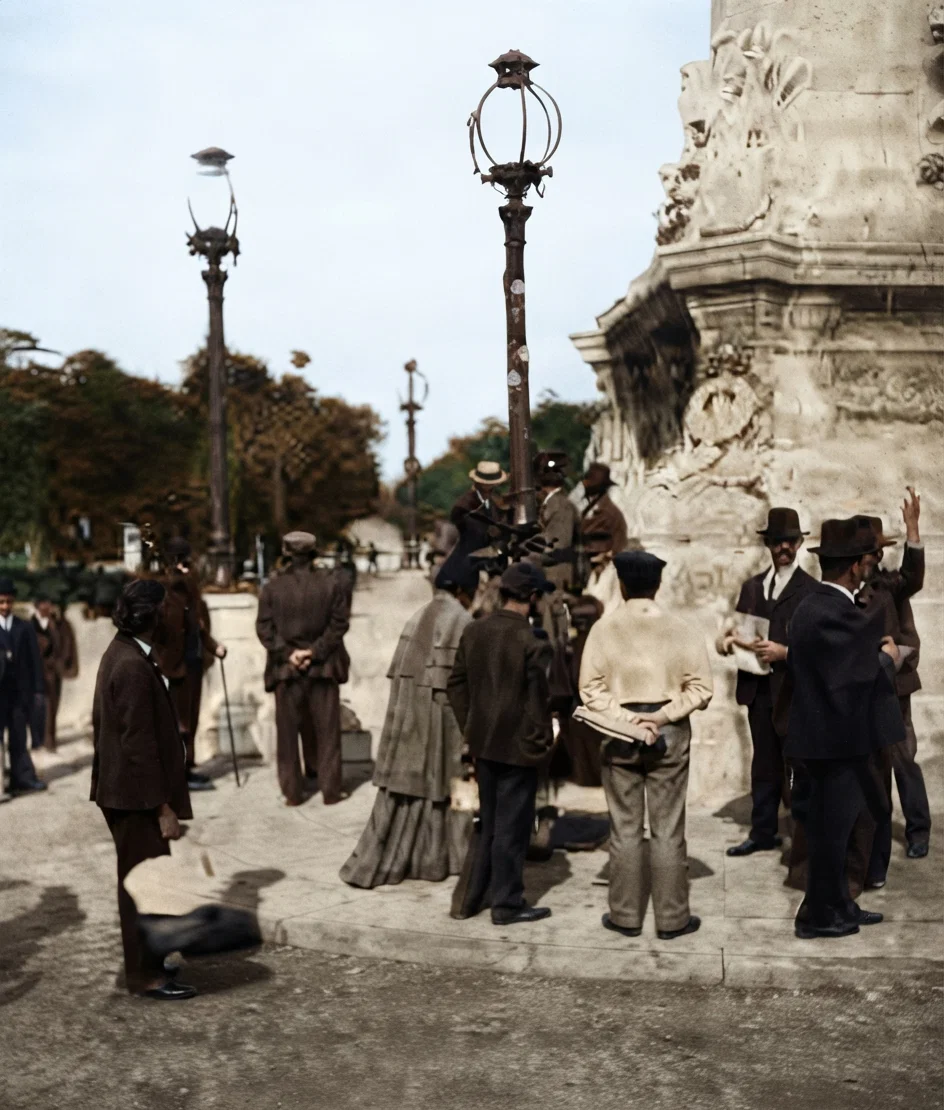
The Effect of Shells on a Lamp-Post
Prof. James Stalker, D.D., says in the same issue:
"The second advent is sure to come, but none can tell when it will come; hence the necessity for unwearying vigilance on the part of all who hope to see it with joy and not grief."
But of what use the parable if we may not know, when we see certain signs, that Christ's coming is near, "even at the doors"? Why should we be uncertain when our Lord's instruction is certain?
The Effect of Shot on a Building
The Trinity
By Laura Kellogg
By Laura Kellogg
SHALL I tell you something, dear,
Just to make the way less drear —
Something that will cast out fear!
God is Love.
Shall I tell you who is here,
Never far and alway near,
Who will hold you very dear?
Christ, His Son.
And who will that comfort bring
That will cause your heart to sing,
Jesus Christ, the Lord, is King!
The Comforter.
To these blessed Three in One,
God and Comforter and Son,
Let us pray, when day is done,
For more grace.
Mrs. Stuttle's
HOME
SERIES
These three books by Mrs. L. D. Avery-Stuttle furnish to the parent a much-needed help in the instruction and entertainment of their children
A Need Supplied
By Editor
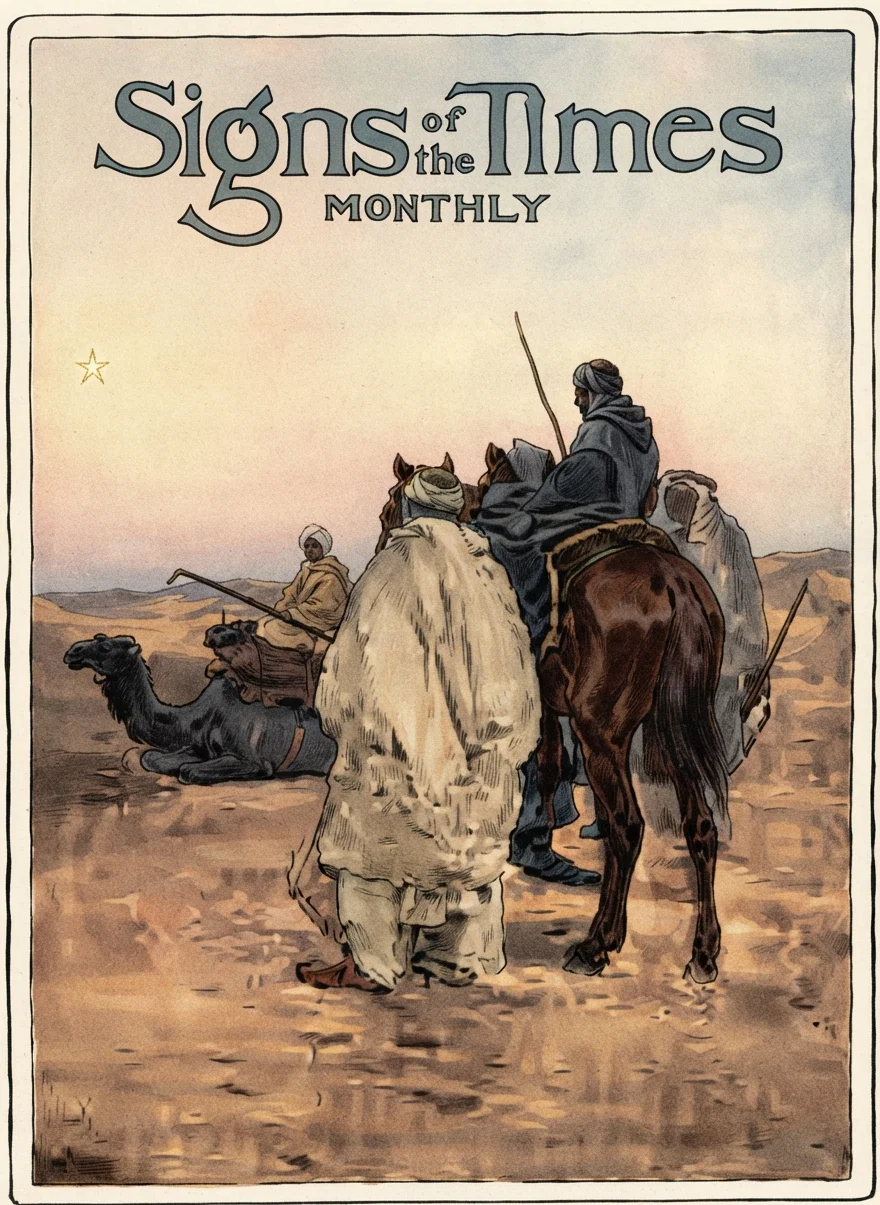
December Cover in Three Colors
It was a little more than two years ago that the publishers of the Signs of the Times, acting upon insistent demands for a religious magazine that would prove more salable than the weekly journal, began publishing the Signs of the Times Monthly. Its magazine form, variety of subjects treated, well-illustrated pages, and beautiful covers in colors, caused it to meet with instant favor.
An agent residing in Portland, Oregon, has sold over 38,000 copies during these past two years. She has earned a net weekly wage of about $25. Others are regularly selling from 50 to 1,000 and even more each month.
These faithful workers have a purpose in doing this work which is higher than the mere earning of money. They are endeavoring to win souls to God and His truth. This is the secret of their staying with the Signs Monthly, even if they sell but a few copies a month.
Here is what one of our agents has to say about the Signs Monthly:
"Enclosed please find $16.00 for which send me 400 of the October Signs Monthly. I have sold half of my last order of 400 already. They sell well. I will be sorry when my strength fails so I can't sell the Signs. I love the work, and am so glad I can earn my living in service for the Master."
Other agents are wanted who can devote even a small portion of their time to this work. Write to-day direct to us or to your tract society for further information.
SIGNS OF THE TIMES, Mountain View, Cal.
Our Work and Workers
By Editor
SEVEN have been baptized recently at Portland, Oregon.
FOUR have received baptism at Littlebirch, West Virginia.
SEVEN or eight new Sabbath-keepers are reported at Petrolia, Texas.
TEN souls are rejoicing in their newly found faith at Memphis, Tennessee.
FOURTEEN members have been added to the Pittsburg, Pennsylvania, church No. 1.
As the results of the effort of a tent company, four have been baptized at Keeler, Michigan.
FOUR persons have accepted the message to obey God's commandments at Grey Eagle, Minnesota.