Signs of the Times, Vol. 42, No. 45.

Interesting Islands of Sumatra and Java

Signs of the Times

Nov 16, 1915

Pacific Press Publishing Association · Mountain View, California · Nov 16, 1915

Interesting Islands of Sumatra and Java

Their Populations, Climate, and Soil — Mountain Chains and Volcanoes — Marvels of Earlier Civilization and Greatness — Ruins That Rival Egypt and India
Progress of Our Work in Those Fields
By ARTHUR G. DANIELS
THE work in the East Indian section of our Malaysian mission field is carried on in three separate divisions,—Sumatra, Java, and Borneo.
The first of these islands to be entered was Sumatra. In the year 1900, Pastor R. W. Munson and family located in the city of Padang, on the west coast of Sumatra, and began active missionary work. A mission school was opened, Bible studies were conducted for inquirers, and literature was translated into Malay for the people speaking that language.

MIXED POPULATION

Pastor Yates, superintendent of our Sumatra Mission, and Mrs. Yates
The population of Sumatra is a mixture of Malay and Chinese. Mohammedanism has a strong hold on its people, and the Dutch government exercises a restraining control over missionary endeavors throughout the East Indies. This combination of conditions makes Sumatra a difficult field for gospel work. But though the results seem small, yet victories have been won as the workers have pressed on with their efforts.
Among the few who took their stand for the message of truth was a young man named Timothy. As he felt a great desire to become an evangelist, and gave evidence of possessing the ability to do that kind of work, he was encouraged by Pastor Munson to make suitable preparation.

TIMOTHY GOES TO COLLEGE

In 1904, young Timothy entered a theological school in Amoy, China. His conscientious observance of the seventh day as the Sabbath of the Lord according to the fourth commandment, led one of the leading teachers in the school to investigate the Sabbath question. As the result of his study, this teacher, Pastor N. P. Keh, began the observance of the seventh day. After further study, he embraced all the truths of the Scriptures which we as a people hold.
As Pastor Keh was a preacher of experience and ability, he soon began to proclaim publicly the message he had come to believe and love. His labors in China have been greatly blessed by the Master. Many have been led to the light of God's truth. About two years ago, he was asked by our committee in China to open our work in Fuchau, the capital of Fukien. He now has a church of sixty or seventy members, and a company of twenty or thirty receiving instruction for baptism. He has also opened a school, which has an attendance of one hundred. This is an outgrowth of the work begun by Pastor Munson in Sumatra.

HURRIED TO HIS PEOPLE WITH THE NEWS

Finding it necessary to spend some time in a cooler climate, Brother Munson and family removed to Australia, where they continued the work of translating for the Malay language.
Pastor and Mrs. G. A. Wantzlick were sent from Australia to take charge of the work in Sumatra. In 1907, a young man named Immanuel, from the Battak country in the interior of the island, embraced the message. In the joy and enthusiasm of his new-found light, Immanuel hurried to his people, to tell them the good news; and in a short time, he reported that twenty or more had taken a stand with him. Thus the cause made headway at different points in the field.
Steadily failing health made it necessary for Pastor Wantzlick to return to Australia. As it took considerable time to secure a permanent superintendent for the field, the work suffered. At the present time, Pastor and Mrs. Yates are at Padang laboring earnestly to build the work up in the different parts of the island.

ITS EXTENT, ITS SOIL, AND WILD ANIMALS

Sumatra lies along the west side of the Straits of Malakka. It is 1,115 miles long, and 275 miles across its greatest width. Its area in square miles is nearly equal to that of Spain, but its population is only about 4,000,000.
A lofty mountain range skirts the western coast, while on the east of this range there are large tracts of alluvial soil. Indrapura, the highest mountain of the island, is 11,800 feet. It is an active volcano, and there are seven others on the island.
MALAY VILLAGE IN SUMATRA
PEARLING BOATS, JAVA
The rainfall is abundant, and the soil is productive. The principal agricultural products are rice, sugar, coffee, coconuts, and tobacco. In one section there are rich petroleum wells. In this island are found the orang-utan, the tiger, the bear, the rhinoceros, and even the elephant. Crocodiles swarm in the rivers. There is a great variety of insect life. Naturalists report having found 250 species of the spider.

RULED BY THE DUTCH

The government of the island is administered by the Dutch, the capital being located at the city of Medan. The inhabitants in the southern part of the island accepted Dutch rule without much opposition; but the Achinese, in the northern part, warred against the Dutch for thirty years, causing great loss of life and expense to Holland. The Achinese are an intelligent, industrious people.

THE ISLAND OF JAVA

Missionary work under the auspices of the Seventh-day Adventist Foreign Mission Board was begun in Java in 1906. In that year, the Australasian section of the Mission Board sent three workers to Surabaya, Java. As is usually the case on entering new mission fields, these workers experienced many perplexities and hardships while learning a new country and climate, and an altogether new environment. The climate was especially trying at Surabaya; and within a year after entering upon their work, they had all suffered serious illness, and Pastor and Mrs. Teasdale had lost by death a bright, promising son.
The island of Java lies close to the equator, extending along its southern side a distance of 666 miles. Its width varies from 15 to 135 miles, giving an area of 49,197 square miles — about the size of the state of New York. On this island are living 30,000,000 people, 459 to the square mile. This exceeds the population of all the rest of the Indian Ocean combined. The island belongs to Holland, and is the richest and most important in Malaysia.

MOUNTAIN CHAIN CLEAR THROUGH IT

Java has a mountain chain extending through the entire length of the island. In this chain there are forty-five volcanoes, twenty of which are active at the present time. The lowlands are very fertile, producing rice, sugar, bananas, tea, coffee, tobacco, and spices in great abundance. The principal mineral products are tin and petroleum.

REFINEMENT OF MANNERS

The native inhabitants, called Javanese, belong to the Malay race. The Javanese are an attractive, winsome people to most foreigners who visit the island. One who has recently spent some time among them describes them as the “finer flowers of the Malay race — a people possessed of a civilization, arts, and literature in that golden period before the Mohammedan and European conquests. They have gentle voices, gentle manners, fine and expressive features. . . . They are a little people; and one feels the same indulgent, protective sense as toward the Japanese. Their language is soft and musical—‘the Italian of the tropics’; their ideas are poetic; and their love of flowers and perfumes, of music and the dance, of heroic plays and of every emotional form of art, proves them as innately aesthetic as their distant cousins, the Japanese, in whom there is so large an admixture of Malay stock. Their reverence for rank and age, and their elaborate etiquette and punctilious courtesy to one another, are as marked even in the common people, as among the Japanese.”

MARVEL OF CIVILIZATION AND GREATNESS

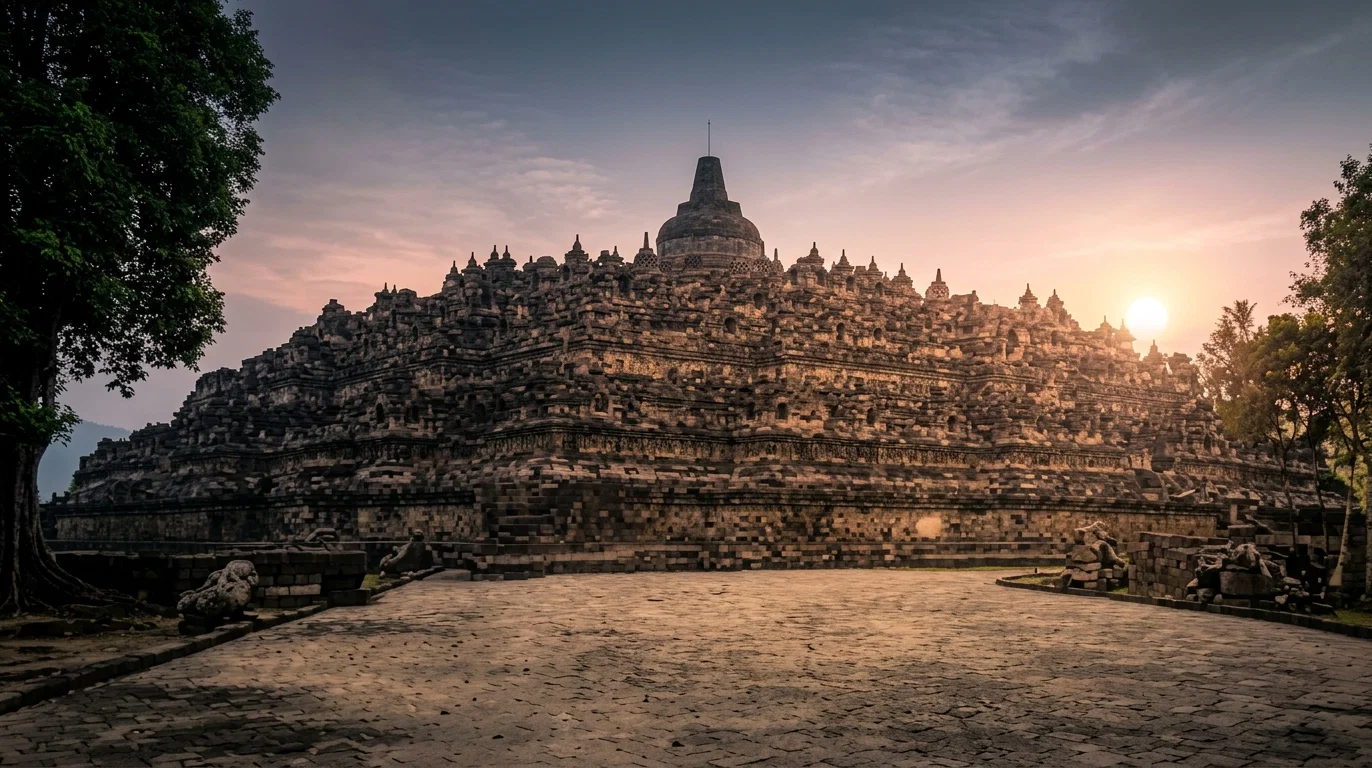
During the last century, discoveries have been made in Java which show that between the seventh and tenth centuries, this island enjoyed a degree of civilization and greatness that is now a marvel to all who visit the country.
After an extended examination of the ruins of some of the great buildings of Java, Alfred Russell Wallace wrote, “The number and beauty of the architectural remains of Java . . . far surpass those of Central America, and perhaps even those of India.” Of one of the temples, called Boro Budur, he said, “The amount of human labor and skill expended on the great pyramid of Egypt sinks into insignificance when compared with that required to complete this sculptured hill temple in the interior of Java.”
BORO BUDUR, JAVA
BORO BUDUR, JAVA

RUINS THAT RIVAL EGYPT OR INDIA

Another writer who has recently returned from Java says: “The fact is not generally appreciated that there are ruins of Buddhist and Brahmanic temples in middle Java surpassing in extent and magnificence anything to be seen in Egypt or India. There remains nearly intact the temple of Boro Budur, covering almost the same area as the great pyramid of Gizeh. It is ornamented with hundreds of life-size statues and miles of bas-reliefs, presenting the highest examples of Greco-Buddhist art—a sculptured record of all the arts and industries, the culture and civilization, of the golden age of Java, of the life of the seventh, eighth, and ninth centuries in all the farther East—a record that is not written in hieroglyphs, but in plainest pictures carved by sculptor’s chisel. That solid pyramidal temple, rising in magnificent sculptured terraces, that was built without mortar or cement, without column or pillar or arch, is one of the surviving wonders of the world. On the spot, it seems a veritable miracle.”

WEALTH OF ORNAMENT

It is claimed that this terraced pyramid is covered with a wealth of ornament such as “no other one structure in the world presents.” It is five hundred feet square at the base, and the dome is one hundred feet high. No cement was used to hold the stones of this great structure together. They were closely fitted together by the expert stone-cutter.
The bas-reliefs of the terraces present the everyday life of the seventh and eighth centuries. “Temples, palaces, thrones and tombs, ships and houses, all of man's constructions, are portrayed. The life in courts and palaces, in fields and villages, is all seen there. Royal folk in wonderful jewels sit enthroned, with minions offering gifts and burning incense before them, warriors kneeling, and maidens dancing. The peasant plows the rice fields with the same wooden stick and ungainly buffalo, and carries the rice sheaves from the harvest field with the same shoulder poles, used in all the farther East to-day. Women fill their water vessels at the tanks, and bear them away on their heads, as in India now; and scores of bas-reliefs show the unchanging customs of the East that offer sculptors the same models in this century. Half the wonders of that great three-mile-long gallery of sculptures cannot be recalled.”

BUDDHA WAS THEIR GOD

The five hundred images of Buddha occupying places carefully planned for them, show that the builders were Buddhists. There are proofs of various kinds to show that in the tenth century, Buddhism began to decline in Java; and that in the fifteenth century, Mohammedanism took its place. Mohammedanism is still the nominal religion of the Javanese.
In the hands of the Dutch, the cultivation of the soil has been developed to the highest state of efficiency; the whole island being “cultivated from edge to edge like a tulip garden. . . . All the valleys, plains, andhillsides are planted in formal rows, hedged, terraced, banked, drained, and carefully weeded as a flower bed.”
(Continued on page 13)

“FINEST TROPICAL ISLAND OF THE WORLD”
It is this thorough cultivation of rich soil, which receives a good, well-regulated supply of water, that gives Java the distinction of being the “finest tropical island in the world.” It is claimed that Java produces about one tenth of the world's supply of sugar, the value of the output amounting to about $75,000,000 a year.
Our mission workers in Java find their work both interesting and encouraging. They have established churches in the cities of Batavia and Surabaya. Batavia is situated at the western end of the island, while Surabaya is located at the extreme eastern end. Believers are scattered through the island.
We print a Javanese paper, which is well received in the island. Our converts are faithful and liberal in supporting the cause, and earnest in their activities to lead others to the light. Thus jewels are gathered for the kingdom of the Prince of peace.
BROTHER TIMOTHY AND FAMILY, PADANG, SUMATRA

Reply of Archaeology to the Higher Critics

What Is the Higher Criticism Movement? — Its Principles and Its Characteristics

Some of Its Leading Characters
By A. EARL HALL, B. A.
This is the first of some eight articles by Professor Hall on the reply of archaeology to present-day Biblical criticism.
His article this week states the principles on which the “higher critic” works. Next week, he will tell of the startling inroads made by the critics among the theological seminaries, and consequently with the ministers of this day and generation. The remaining articles tell of discoveries in Babylon, Egypt, and elsewhere that completely overthrow the theories of the critics.
The mass of evidence that has been unearthed to establish the absolute accuracy and reliability of God’s word, is marvelous. The inference is irresistible that divine Providence caused the inscriptions on tablets and monuments to be preserved. And it is furthermore impressive that the strong hand of Divinity has brought them forth in this generation, to comfort and encourage the believer in its inspired Book, and to confound the destructive critic and caviler. EDITOR.
The term “higher criticism,” since the days of Eichorn, the noted German philosopher, has had a definite meaning and place in theological discussions. That this article may set forth clearly the object of higher criticism, and time and space be conserved, a few questions will be answered that will place the matter before us.

WHAT IS HIGHER CRITICISM?

First, what is “higher criticism”? The term is really devised as a contrast to “lower” or “textual criticism.” The latter terms are used commonly, and their field of study is recognized as a proper and legitimate one. They are applied to facts relating to the Scripture text itself, an examination of manuscripts, and readings in various versions and codices. The former term, “higher,” embraces a study of historic origins, dates, and authorships. In a word, it is the literary study of the Bible. This is also a proper field of research. If that is so, then why this discussion, for so many decades and even centuries? And why is the term associated with unbelief in the Bible? We will endeavor to answer these very important questions.

REQUISITES FOR HIGHER CRITICS

It can readily be seen that marked ability and diligent study are requisite for a successful career in the line of work known as “higher criticism.” But we must not stop here. At the same time, it demands the simple, childlike faith of which Christ once spoke. And here is the root of the whole difficulty. Here is where the destructive element in this movement has entered—stealthily at first; but during the past century, its boasted “assured results” are heralded everywhere. Thousands have believed the doctrines advanced; but it may be noted here that some of the more radical positions have been given up by the critics in late years. Yet the general principles and policies are still adhered to.
But a word further in reference to the qualifications necessary for those who engage in the work of critically examining the Scriptures. The statement of Luther concerning one who undertakes a translation to the point: “It demands a right pious, free, reverent, Christian, scholarly, and well trained mind.” Notice the words “pious,” “reverent,” and “Christian,” and remember them as we mention some of the leaders in this work.
A statement from Prof. W. G. Jordan will greatly aid in recognizing one great fundamental error of the whole fabric: “The nineteenth century has applied to the history of the documents of the Hebrew people its own magic word evolution.”—“Biblical Criticism and Modern Thought,” quoted in “Fundamentals,” volume 2, page 54.

MUST ASSUME THE HYPOTHESIS OF EVOLUTION

Dr. Franklin Johnson, who quotes this, adds: “Thus were there no hypothesis of evolution, there would be no higher criticism. The ‘assured results’ of higher criticism have been gained, after all, not by an inductive study. . . . They have been attained by assuming that the hypothesis of evolution is true, and that the religion of Israel must have unfolded itself by a process of natural evolution.”—Id., page 54.
It is further stated, on sufficient grounds, (1) that the leaders in this propaganda base their theories largely on their own subjective conclusions, (2) that the Germans—the most radical—are especially given to the framing of hypotheses; and (3) that they are strongly biased against the supernatural.

DENY MIRACLES, PROPHECY, AND REVELATION

Again Dr. Johnson says, in speaking of the continental critics: “They deny the validity of miracle, or any miraculous narrative, all being legendary exaggerations of events that are entirely explicable from natural causes; they deny the reality of prophecy; all such prophecies are merely conjectures or coincidences; and last, that there is no revelation in the sense in which it is held by the universal Christian church.”—“Fundamentals,” volume 1, pages 89, 91, 97.
That there may be no misunderstanding of these charges, we quote from another authoritative work, which gives statements from the writings of the critics themselves. This particular school—a late German one—believes that Babylonia was the home and center of culture, that Israel borrowed generously from that source, and that ancient history is to be tested by astrology.

THEY WOULD INTERPRET BY ASTROLOGY

Professor Winckler may be regarded as the real founder of the school. In 1900, he published his views of the universe. After speaking of the divisions of the world and heaven, the zodiac and the planets, he says that the heavens reveal the past, the present, and the future, for those who can read them; and that astrology, therefore, was the all-important test and interpreter of ancient history, and that even Israel practiced it or were influenced by it.
There is some truth in the last statement, but only so when Israel had apostatized.
Further, according to Professor Winckler, the patriarchs and leaders of Israel were solar or lunar mythological personages. Abraham and Lot are identical with theGemini—Castor and Pollux—of the Romans. Jacob was a moon deity, and his twelve sons are the twelve months; the stories of Moses, Joseph, and others are sun myths; even David and Solomon do not escape classification in this category.
This scholar’s views are given somewhat lengthily, as they are typical of the whole school, as well as giving an idea of how the Old Testament is viewed by the critics in general.

WOULD MAKE BABYLON THE SOURCE

Professor Zimmern devotes his time to working out analogies, and looks for Babylonian originals for all of the Jewish history. He even says that in Israel the writer considered Yahweh—Jehovah—to be identical with Marduk—Merodach—a Babylonian deity. Christ weeping over Jerusalem, His agony in the garden, His death and resurrection, have their origin in the traditions of Marduk; all are simply repetitions of Marduk and Tammuz myths.
Photo by Underwood and Underwood, N. Y.
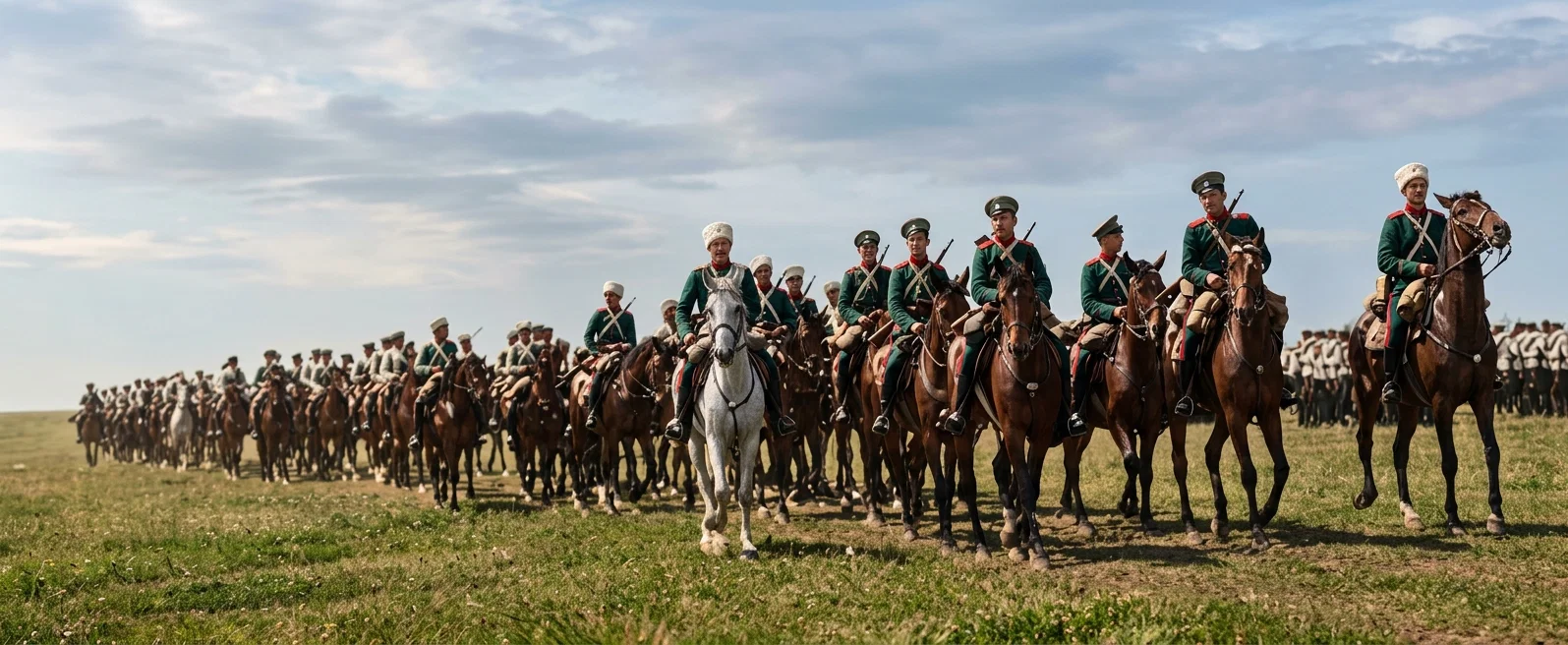
BULGARIAN CAVALRY ON THE MARCH
Photo by Underwood and Underwood, N. Y. BULGARIAN CAVALRY ON THE MARCH
Dr. Jeremias admits the possibility of the patriarchs’ being historical personages. Professor Jensen finds the originals of Biblical characters from Abraham to Christ, including John the Baptist, in the Babylonian collection of sun myths. He calls the Gospels “mythographs,” and says further that “the old Israelitish history, the history of Jesus of Nazareth, has collapsed, and the apostolic history has been exploded.”—A. T. Clay, “Amurru, the Home of the Northern Semites,” pages 14–19.

THREE SCHOOLS OF THE CRITICS

Let the reader now follow as a brief sketch is given of the rise and development of the movement under consideration. It may be divided into schools of three periods,—the French-Dutch, the German, and the British-American.
The remainder of this article will be devoted to a sketch of a few representatives of these schools.
Spinosa (1632–1677), born in Amsterdam, is called the “fountainhead” of the movement. It is of interest to note that his parents were Jews, and were driven from Portugal on that account. He boldly repudiated the Mosaic authorship and the traditional date of the Pentateuch, placing its origin as late as Ezra.
Astruc (1684–1766), born in France, is called the “father of the documentary theories.” He finds ten or twelve memoirs in Genesis. He says, “Genesis is disfigured by useless repetitions, disorders, and contradictions.”—Hirschfelder, page 66, quoted in “Fundamentals,” volume 1, page 94.
With Eichorn, the German critic (1752–1827), we come to one whose formative influence was very marked. Most of the later writers do homage to the “new sun.” He profited by the works of Astruc, especially putting in shape his documentary hypothesis. It is through him that the term “higher criticism” has become identified with the movement.

THE SCHOOL OF COMPROMISE

The British-American is called the school of compromise, because none of the scholars have been so radical as those on the continent of Europe. In England, Drs. Davidson and Driver, both of world-wide reputation in theological circles, and in America, the late Dr. Briggs, may be mentioned among those who have been lured by the “rational interpretation” of the Scriptures.
Since this “religious war” rages to a large extent around the Pentateuch, it may be proper to set before the reader just what the critics say about it. First, they say it contains material of three values,—“the probably true, the certainly doubtful, and the positively spurious; that it consists of four completely diverse documents, composed at various periods between 800 and 425 B. C. They represent traditions of the Hebrews; were not, as is evident, written by Moses; are inconsistent, incomplete, and contain misleading statements.”—Quoted in “Fundamentals,” volume 1, pages 102, 103.
From the foregoing, it can be readily seen that there is no final authority, and that the day of proof texts and harmony is gone. As the New Testament does not escape, as stated before, Christ’s authority is valueless.
When such men, occupying prominent positions in the educational and theological world, have been so completely deceived by this “vain philosophy,” and have now, through their works and by almost unlimited influence, a large following in the Christian world, it is not difficult to answer the question of Christ, “When the Son of man cometh, shall He find faith on the earth?”

“INFIDEL” IS THE PROPER TERM.

A few brief statements may be helpful in fixing the essential facts of the above in mind: “Higher criticism” is the term applied to a movement in the literary study of the Bible, which is proper in itself; but after a consideration of some of the qualifications necessary for those who would do such work, it is apparent that a class of men are active in this capacity who lack almost wholly some of the very necessary ones. The term “infidel” is a proper one to apply to many of the leaders, at least, as they place little or no confidence in a plain “Thus saith the Lord.” When we realize the tremendous influence of these teachings, it is incumbent that we know for ourselves about the book that is a complete guide to life eternal.
Absolute fairness and impartiality is the rule followed in all these discussions. Nothing like a full presentation is here possible. The important facts are given here, so the reader will get an idea at least of the movement which in the end will leave only the body of the Bible, the Book itself being swept away by the critics.
Continue reading: Spiritism in the Final Conflict