A missionary who was working on an "industrial" field in Central Africa, met with a curious experience. Leaving his station for a while that he might push his Gospel work into the interior, he arrived at a native village where he hoped to get a good hearing, but found the tribe exceedingly obstinate. The chief, who was a tall, well-built, powerful man, met the missionary and told him plainly that they did not want any white man's interference there, but he would give him an escort to take him on his way.
The missionary tried to argue that as they believed in a God, they should hear the message he had from the God who made the heavens and the earth. He tried to address the group that had gathered around, but the chief immediately ordered his people to bring out their drums, and they made such a noise that further conversation was impossible.
Still having a strong desire to deliver his message, and being therefore unwilling to proceed on his journey, he quietly walked to a shady tree, trying to think what course he should follow. Partly to relieve his feelings and partly not knowing what else to do, he began to sing one of three hymns he had learned in their language. His eyes were closed, but he noticed that the drums were getting fainter, as, apparently, the tribe was dispersing, leaving him to sing to himself. Without opening his eyes he started his second hymn. All was silent now, but he still sang on till he finished the third hymn, when, on opening his eyes, he was astonished to find that a vast crowd had crept around him and had been intently listening to the hymns.
The chief, whose head was above the rest, then called out, "Tell us your message, we want to hear you." "But I thought you had all gone away, as you said you would not hear me." "Well, we do want to hear you now. Tell us your message."
Thereupon he gave them a Gospel address, pointing out how Jesus came to save sinners, and that all may be saved—the blacks as well as the whites. They listened with evident attention, but when he had finished, the chief surprised him by saying, "You told us you had a 'message from God,' and we have carefully listened for it. You have only told us what men say. Now, if you really have a message from God, tell us what He said; that's what we want to hear."
He tried to think of some passage that gives the words spoken by God. He took his Bible out of his pocket. The only words God had spoken, that he could then call to mind, were the Ten Commandments, and he was sick of learning them as a child. "How stupid," thought he, "there are plenty of other passages."
The chief began to press him, "You said you had a message from God, where is it?" So he reluctantly commenced the Commandments. "God 'spake all these words, saying _______".
"Ah!" said the chief, "that's what we want. Go on."
All went smoothly till he came to the fourth, "The seventh day is the Sabbath _______".
"Stop," said the chief, "which day is that? You white folk would teach us not to work to-day. Is to-day the seventh day?"
Here the missionary found himself in an awkward fix. He dared not tell a lie, and yet it would be very difficult to make them understand that the first day was the Christian Sabbath, when he had just told them that God said the seventh day was the Sabbath. However, he tried to explain that the apostles had changed the day. "Yesterday was the seventh day, but the first day is the Christian Sabbath."
"But those apostles were men," said the chief; "we have had enough of men's words, if we become Christians we must do what God says."
This incident worried the missionary considerably, and he could not help thinking how inconsistent his position appeared. He turned it over and over in his mind, but still thought Sunday-keeping must be right. When he returned to his station, those troublesome commandments came up again, and some eleven or so of his native converts persisted that as God had said the seventh day was His Sabbath they would keep it. The missionary left them free to follow their consciences, and he decided that he would look into the Sabbath question the first opportunity he had of meeting any Seventh-day Baptists.
When, however, the other natives working on the farm, or plantation, found that the eleven did not work on Saturdays, because they "sang hymns," that is, had divine service on that day, they complained about it, and said they would rather "sing hymns" than work. So it came about that a first-day missionary formed a Sabbath-keeping mission.
Later on, he was visiting the United States and sought out the Seventh-day Baptists. Thus he was soon convinced that Saturday was the true Christian Sabbath, and that Sunday-keeping was dishonoring to God. He therefore followed the example of his native converts and himself became a Seventh-day Baptist, and accepted the "message from God."
That Blessed Hope.
By T. Godfrey
"Looking for that blessed hope, and the glorious appearing of the great God and our Saviour Jesus Christ." Titus 2:13.
THE greatest event to transpire in the history of all the world is the second appearing of our Lord. It has been the hope of the ages past, and is the hope of the present generation. It is the time when the reign of sin and death shall come to an end. Patriarchs, prophets, and holy men of old looked forward to that great day when sin and death would come to an end, and that eternal reign of grace would be ushered in that would span eternity. It is the time when the millions of righteous dead shall be awakened from their dusty beds, and the gift of eternal life bestowed upon them—that life which will measure with the life of God. It is the time when this mortal shall put on immortality. It is the time of the restoration of all things foretold by the prophets of old. It is the time of the meeting of loved ones who have long been parted. It is the glad day of all days to the child of God. "Behold, I come quickly; and My reward is with Me, to give every man according as his work shall be." Rev. 22:12.
It shall be said in that day, "Lo, this is our God; we have waited for Him, and He will save us: this is the Lord; we have waited for Him, we will be glad and rejoice in His salvation." Isa. 25:9. "And the ransomed of the Lord shall return, and come to Zion with songs and everlasting joy upon their heads: they shall obtain joy and gladness, and sorrow and sighing shall flee away." Isa. 35:10.7
"God shall wipe away all tears from their eyes; and there shall be no more death, neither sorrow, nor crying, neither shall there be any more pain: for the former things are passed away. And He that sat upon the throne said, Behold, I make all things new. And He said unto me, Write: for these words are true and faithful. And He said unto me, It is done." Rev. 21:4-6.
"He which testifieth these things saith, Surely I come quickly. Amen. Even so, come, Lord Jesus." Rev. 22:20.
T. GODFREY.
Come, Lord Jesus, Come Quickly.
By Mrs. L. D. Avery-Stuttle
By Mrs. L. D. Avery-Stuttle.
WE are waiting for Thy coming,
And the weary days seem long;
For the earth is filled with darkness,
With violence and wrong;
And the scoffer's cry grows bolder
As the slow years pass away;
But the saints of God are waiting
For the dawning of the day.
O we're weary, weary longing
For the sign within the sky
That heralds our beloved King,
That tells us He is nigh.
Around the stanch old lighthouse
How the white-lipped breakers roar,
But the old ship's dropped her anchor,
And we know she nears the shore.
We can see the lamps of heaven
Gleaming, gleaming bright afar,
And we know the land is nearing
Where the many mansions are.
And our hearts beat high with longing,
Tho our trembling lips are dumb;
Still we cry with soul and spirit:
"Come, Lord Jesus, quickly come!"
Simplicity of Faith.
By I. S. Spencer, D.D.
THE simplicity of faith was once illustrated to me in the following manner:
I was preaching my ordinary weekly lecture in the evening, when I was sent for in great haste, to visit a woman who was said to be dying, and who very much desired to see me. I closed the service, as soon as I could, and went immediately to her house. She was a member of my church, whom I had known very well for years; with whom I had been acquainted ever since her first serious impressions, before she became a communicant. As I entered the room where she lay, I found it filled with her friends, who had gathered around her to see her die. Making my way through the midst of them, I reached the side of her bed, and found her apparently in the last agonies of death. She was bolstered up in her bed, gasping for breath, almost suffocated by the asthma; and the whole bed shook, by a palpitation of her heart, which seemed to be shaking her to pieces. It appeared to me, that she could not live a quarter of an hour. I said to her,—
"Mrs. M., you seem to be very sick?"
"Yes," said she, "I am dying."
"And are you ready to die?"
She lifted her eyes upon me with a solemn and fixed gaze, and speaking with great difficulty, she replied,—
"Sir, God knows—I have taken Him—at His word—and—I am not afraid—to die."
It was a new definition of faith. "I have taken Him at His word." It struck me in an instant as a triumph of faith. "God knows I have taken Him at His word and I am not afraid to die." It was just the thing for her to say. I have often tried to think what else she could have said that would have expressed so much in such few words.
I prayed some four minutes by her bedside, recited to her some passages of God's word, and was about to leave her for a moment to her friends, whom she seemed anxious to address. She held me by the hand, and uttering a word at a time, as she gasped for breath, she said to me, "I wanted to tell you—that I can—trust—in God—while—I am dying.—You have—often told me—He would not—forsake me.—And now—I find—it true.—I am—at peace.—I die—willingly—and happy."
In a few minutes I left her, uttering to her such promises of the Saviour as I deemed most appropriate.—However, she did not die. She still lives. But that expression of her faith has been of great benefit to me. It has aided me in preaching and in conversation with inquiring sinners very often. It gave me a more simple idea of faith than ever I had before. It put aside all the mist of metaphysics, speculation, and philosophizing. It made the whole nature of faith plain. Everybody could understand it:—"God knows I have taken Him at His word."
Many of the published dissertations on the nature and philosophy of the atonement may be deep, but they are dark. We can not afford to travel along such weary distances and through such twilight paths in order to get at the fact—at what it is, that we are to believe and trust in. The Bible puts it directly before us—"slain for us,—the just for the unjust, that He might bring us to God." We are asked to receive it, just on God's testimony; not by the aid of philosophy; but on the declaration of the fact. We "make God a liar" if we do not "believe the testimony which He hath given us of His Son." We must take it on God's declaration. That is faith. The speculations may be useful to silence skepticism; but they never soften hearts. They may make us scholars; but they never make us children, or lead us home. The atonement satisfies God. He says so. That is enough. Leave it there. Men may try; but they will try in vain when they attempt to convert the weapons for defending against infidelity into bread to feed God's hungry children. We must "take God at His word." The philosophy of religion is just faith; nothing more.—I. S. Spencer, D.D.
Our Bible Reading
By H.
The Second Advent and the Incorrigibly Wicked.
1. What is the object of Christ's second coming?
"He cometh to judge the earth;
He will JUDGE THE WORLD with righteousness,
And the people with His truth." Ps. 96:13.
"He shall come to be GLORIFIED IN HIS SAINTS." 2 Thess. 1:10.
"Rendering vengeance to them that know not God, and to them that obey not the Gospel of our Lord Jesus." 2 Thess. 1: 8
2. How will each case be decided?
"Behold, I come quickly; and My reward ["wages," margin] is with Me, to render to each man according as his work is." Rev. 22:12.
3. How will the righteous meet Christ at His coming?
"It shall be said in that day, Lo, this is our God; WE HAVE WAITED FOR HIM, AND HE WILL SAVE US: this is Jehovah; we have waited for Him, we will be glad and rejoice in His salvation." Isa. 25: 9.
4. How will the wicked be affected?
"Then shall appear the sign of the Son of Man in heaven: and then shall ALL THE TRIBES OF THE EARTH MOURN, and they shall see the Son of Man coming on the clouds of heaven with power and great glory." Matt. 24: 30.
"The kings of the earth, and the princes, and the chief captains, and the rich, and the strong, and every bondman and freeman, hid themselves in the caves and in the rocks of the mountains; and they say to the mountains and to the rocks, FALL ON US, AND HIDE US FROM THE FACE OF HIM THAT SITTETH ON THE THRONE, AND FROM THE WRATH OF THE LAMB: for the great day of their wrath is come; and who is able to stand?" Rev. 6:15-17.
5. How long will the wicked remain dead?
"The rest of the dead lived not UNTIL THE THOUSAND YEARS should be finished." Rev. 20:5.
NOTE.—Rev. 20:1-3 shows that at the coming of the Lord, Satan, the author of sin, is placed in bonds in the earth, with no power to deceive men — they being all dead — for one thousand years, at the end of which period he will be "loosed for a little time." The wicked dead are also raised at this time. "The sea gave up the dead that were in it; and death and Hades gave up the dead that were in them." Rev. 20:13.
6. What will Satan then do?
"When the thousand years are finished, Satan shall be loosed out of his prison, and shall come forth to deceive the nations which are in the four corners of the earth, Gog and Magog, to gather them together to the war: the number of whom is as the sand of the sea. And they went up over the breadth of the earth, and compassed the camp of the saints about, and the beloved city." Rev. 20: 7-9.
7. How is this attack met?
"Fire came down out of heaven, and DEVOURED THEM." Rev. 20: 9.
8. What is the final disposition of sin and sinners?
"Death and Hades were cast into the lake of fire. This is the second death, even the lake of fire. And if any was not found written in the Book of Life, he was cast into the lake of fire." "And the devil that deceived them was cast into the lake of fire and brimstone." Rev. 20:13-15, 10.
"Behold, the day cometh, it burneth as a furnace; and all the proud, and all that work wickedness, shall be stubble; and the day that cometh shall burn them up, saith Jehovah of hosts, that IT SHALL LEAVE THEM NEITHER ROOT NOR BRANCH." Mal. 4: 1.
H.
The Pilot of the Deep.
By Delwin Rees Buckner
By Delwin Rees Buckner.
Sometimes the Rudder will not steer aright,
And then my boat doth wander all about
Far from Fair Havens on the Sea of Doubt
Surrounded by the mist, and by the night.
The frail boat rolls, as by the tempest tossed;
No lighthouse warns me where the dangers lie;
The sea-bird mocks me with his hoarse, shrill
cry;
Hope fails me, and I feel that I am lost.
But lo, when shadows compass me around,
When I am in the very vale of death,
I think to call the Pilot of the Sea,
Who vigil keeps where perils most abound;
Who hears the sinking one's despairing cry,
Just as He heard that one on Galilee.
The Mind’s Mastery Through Action
By William Mountford
I do not say the mind gets informed by action,—bodily action; but it does get earnestness and strength by it, and that nameless something that gives a man the mastership of his faculties.—Wm. Mountford.
The True Ends of Existence
By E. H. Chapin
CONSIDER and act with reference to the true ends of existence. This world is but the vestibule of an immortal life. Every action of our lives touches on some chord that will vibrate in eternity.—E. H. Chapin.
"For Lack of Knowledge."
HISTORY repeats itself. Humanity swings in cycles. The same great waves of temptations and iniquity sweep away thousands to destruction as they were swept away centuries agone. The same general conditions which exist now existed in lesser degree ages ago. The same antidote of God for the evil then is practical and effective now. The same solemn warnings then given, the same sad truths then told, are true now. An instance of this is given in the word of the Lord by the son of Beeri to ancient Israel:
"My people are destroyed for lack of knowledge: because thou hast rejected knowledge, I will also reject thee, that thou shalt be no priest to Me: seeing thou hast forgotten the law of thy God, I also will forget thy children. As they were multiplied, so they sinned against Me: I will change their glory into shame." Hosea 4: 6, 7.
The words are as true to-day as they were seven centuries before Christ. God's people!—those who profess His name,—God's people "destroyed," when all the powers of the universe are enlisted on their behalf!
Infinitely sad, isn't it? Yet God will not compel salvation nor the conditions requisite. He will do infinite things to save men, but He can not save against the human desire, the human choice, the human will.
God's people are destroyed because they will not know the loving God's will, the wise God's power, the mighty God's love. "My people are destroyed for lack of knowledge." They might have known; for He has "made known" His will. The simple may know it; for the simple have learned it in all the ages of the past. The meek may know it; for "the meek will He teach His way." The wise may know it; for "the wise shall understand;" and "the fear of Jehovah is the beginning of wisdom." How deplorably, infinitely sad, "My people are destroyed for lack of knowledge."
That knowledge pertains to His law. "Thou hast forgotten the law of thy God." His law in Christ Jesus is the law of life. Living from God, yet forgetting His law! He spoke it from heaven. He wrote it on two tables of stone. It has been recorded in the Scriptures, and multiplied millions of times. It was written in His Son Jesus Christ. He has written it in the lives of some of His children. Yet have His people forgotten it. And the more they are multiplied and builded up by blessings from God, the more they sin against Him. They are separating God from them. They are hiding Him from their children, they are turning His blessings to curses. He has made the great Christian church His priest to those who know Him not; and "the priest's lips should keep knowledge; and they should seek the law at his mouth; for he is the messenger of Jehovah of hosts. But ye are turned aside out of the way; ye have caused many to stumble in the law." Mal. 2: 7, 8.
How true it is! Take the world-wide agitated Sabbath question. The day is commanded of God. Christ Jesus our perfect Example observed it. A knowledge of His will would lead us to the truth of precept and example. How easy would it be for the great Protestant churches to lead the people.
But the churches have forgotten the law, have refused to receive it at God's mouth, and "have caused many to stumble in His law." If God would preserve His truth, what else can He do than to turn aside from such a priest, and ask others to give His message—His last great threefold message of reform. Rev. 14: 6-14.
Yet, brother, sister, Christian soldier, it is so easy if we desire to do God's will as well as know. The willingness to do precedes the knowing. "If any man willeth to do His [the Father's] will, he shall know." Salvation, full, complete, glorious, is ours if we choose.
Not a Question of Days.
THE Sabbath question is not a mere question of days. Behind the Sabbath is God, the great Creator and Redeemer through our Lord Jesus Christ. It is the memorial of His creation, the sign of His redeeming, sanctifying, upholding, keeping power. Behind the Sunday—hidden tho they be by sacred memories and hallowed traditions of honest hearts—are a hoary pagan sun-worship and an apostate ecclesiasticism, the Papacy, which claims it as its mark or badge of authority. Honest men have passed the base, well-worn counterfeit in the past, but now the true light from God's word shines upon it and reveals the imposture. Will they cherish it longer?
The Sunday-Rest Bill of California.
By Editor
The Law of God.
WHILE such papers as the San Jose Mercury, and such persons as Dr. G. L. Tufts, declare that the proposed Sunday-rest law is in no sense a religious law, the Rev. James Whitaker, Ph.D., writes in the California Christian Advocate, a strong Sunday-law paper, as follows:
"The question of Sabbath observance is of vital importance to the individual, the state, and to the nation. . . . California is in great need of a Sabbath law. . . . A nation that sets aside the Sabbath as a day of worship and uses it as a day of pleasure, recreation, and sport can not expect to hold a place of influence and power among the nations very long. The European Sabbath must be destroyed by the American people and the Christian Sabbath restored if we are to save our nation from corruption and ultimate death. We see with alarm the growth of Sabbath desecration. Picnics, excursions, baseball games, horse racing, automobile racing, and pleasure-seeking on the Sabbath appear to be growing." (Boldface ours.)
Now there can be no doubt as to what Dr. Whitaker wants; he wants a religious Sabbath, and a law to enforce the at-least outward observance of the religious Sabbath, to prevent its "desecration" by "pleasure-seeking," "recreation," "picnics," etc. Some men take their recreation in fishing, some in picnics with a few friends, some in physical labor of various kinds, but all this would "desecrate" the Sunday of Dr. Whitaker, and violate his ideal law. When the San Jose Mercury secured its "benevolent," "reasonable" non-religious Sunday-rest law, Dr. Whitaker would see to it that it was made the religious Sabbath he desires.
Not to leave in doubt, Dr. Whitaker further says:
"Some people are not in favor of a Sabbath law, because it will violate the conscience of those who do not believe in the Lord's day. But what is conscience? Is it a sovereign, is it a law, is it that which applies a law to the actions of men? It is not a sovereign, neither is it a law, unless it be in accord with the law of God. God's law is supreme, for He is the Sovereign of the universe. . . . I have a right, and am bound, to restrain men from wrong-doing, no matter how conscientious he may be in it.9"The laws of the state or nation must conform to the law of God, so as to restrain the actions of men whenever they are detrimental to the public good. It is the duty of the state to enact laws for Sabbath observance, and enforce them, because it is in accord with God's law and for the good of the people and the nation. Men may cry bigotry and intolerance, and say that this is contrary to civil liberty; but liberty to sin always involves injury to others. . . . The Christian Sabbath is enshrined in the tenderest memories and holiest associations of our national life."
Surely we can not misunderstand this. It is to make the state God's vicar, the judge to religious controversy, and the one who speaks for God. It is fearful assumption.
All sin is of the heart and motive. All sin is detrimental to the one who commits it, and injurious many times to one's neighbor. It is sin to hate one's neighbor. It is sin to lust after the other sex. Inspiration says of the one that it is murder, and Jesus says of the other that it is adultery. It is sin to covet. It is sin to take God's name in vain, not alone in profane swearing, but in hypocritical prayers and professions. And so with scores of other things. All those things which affect the individual's life for evil affect the public good, affect the state; but it is utter folly to say the state should correct them, because the state can not, in the nature of the case, correct them. It would renew the Inquisition, and rightly determine nothing.
So with the Sabbath. God commands that the Sabbath shall be kept "holy," "not doing thine own ways, nor finding thine own pleasure, nor speaking thine own words;" but to truly keep the day is to "call the Sabbath a delight, the holy of the Lord, honorable." Ex. 20:8-11; Isa. 58:13. God's "law is spiritual." Rom. 7:14. The Sabbath precept is a part of that law; therefore the Sabbath is spiritual. But no civil law, no state, no coercion, can enforce a spiritual law. Men can only enforce its empty shell and compel men to be hypocrites. They can do no more. When man can assume to act for God in civil law, in matters of conscience, it is not difficult to assume the authority to do, as did Saul of Tarsus, "persecute unto the death," thinking one is doing God service. And the one justification of it all is, "We are enforcing the law of God for the public good." Well did the United States Senate say in 1829 over the very question of Sunday legislation:
"Among all the religious persecutions with which almost every page of modern history is stained, no victim ever suffered but for the violation of what government denominated the law of God." ("American State Papers," page 93.)
One party may call it civil or police regulation to deceive itself, and to deceive the people in order to secure it; but when it is secured its religious proponents will exalt it as the law of God, and the state as God's executive. But God's government neither asks nor permits such interference, nor does His Sabbath need such protection or support. He who would thus put his hand to the ark of God would do well to take warning from the rash Uzzah and the entire history of such legislation.
What Does God's Law Teach?
Of that Law Dr. Whitaker says:
"God's law is supreme, for He is the Sovereign of the universe."
Again, concerning that part pertaining to the Sabbath, he declares:
"The manner of its observance has been determined by God, and His directions can not be disannulled nor modified by man. It has been stated by some that Christ has Himself modified the Sabbath law and allowed greater liberty both as to labor and recreation."
Dr. Whitaker does not believe this, and cites in proof of the fact that Christ did not change the law Matt. 5:17, 18: "Think not that I am come to destroy the law, or the prophets; I am not come to destroy, but to fulfil. For verily I say unto you, Till heaven and earth pass, one jot or one tittle shall in no wise pass from the law, till all be fulfilled."
Now God's law of the Sabbath reads as follows:
"Remember the Sabbath day, to keep it holy. Six days shalt thou labor, and do all thy work; but the seventh day is the Sabbath of the Lord thy God; in it thou shalt not do any work, thou, nor thy son, nor thy daughter, thy man servant, nor thy maid servant, nor thy cattle, nor thy stranger that is within thy gates: for in six days the Lord made heaven and earth, the sea and all that in them is: and rested the seventh day; wherefore the Lord blessed the Sabbath day, and hallowed it." Ex. 20:8-11.
That is "the supreme law." That is "the supreme law" as regards the particular day as truly as it is regarding the proportion of time. It is the day, the particular day, which is emphasized. Upon it God rested. Sabbath means rest, and Sabbath day, means rest day; and God rested only upon the seventh day of the cycle, the day which came just before the first day of the week. Mark 16:1, 2. That seventh day He blessed; that seventh day He sanctified. Gen. 2:2, 3. That seventh day of the cycle He pointed out by a threefold weekly miracle for forty years. Exodus 16. That same seventh day — rest day — He calls "My holy day." Isa. 58:13. That same seventh day Jesus, our blessed Lord and perfect Example, observed. No other day is named a weekly holy day or Sabbath day in the Scripture. It is an unwarrantable liberty; it is a perversion of truth; it is heaven-daring presumption, to presume to change the law of the Most High. That power which would demand and enforce such substitute under penalty places itself contrary to God's law and God's plan of the Gospel in Jesus Christ.
The Law of Love.
GOD'S law presents no arbitrary requirements to show His authority. Infinite Wisdom, Infinite Justice, Infinite Love, could not give any other law. The commandments of God are the expression of His own character, and He can not deny Himself.
Moreover God's law is the law of His life. It is the law of the perpetual life of all humanity. Through that channel eternal life flows. To pervert that law is sin; to pervert that life is death. God could not, therefore, teach or require any change or perversion of His law. He wishes man to live; how could He give him a law of death? God's law is the law of righteousness. Well does the psalmist sing: "All Thy commandments are righteousness." Ps. 119: 172. And a complement of that is: "In the way of righteousness is life; and in the pathway thereof there is no death." Prov. 12: 28.
The sinner can not get that righteousness and life in the law, but he can secure it by faith in Jesus Christ. But to the righteousness he obtains from Christ, God's law bears witness. Rom. 3: 20-22. And Jesus bestows upon us the righteousness of God and within us the life of God, in order "that the righteousness of the law might be fulfilled in us, who walk not after the flesh, but after the Spirit." Rom. 8: 4. "Do we then make void the law through faith? God forbid, yea, we establish the law." Rom. 3: 31. "For this is the love of God, that we keep His commandments; and His commandments are not grievous." 1 John 5: 3.
Suggestive Notes
By Editor
We begin a new book in our Old Testament readings, that of Numbers, so named because of the two numberings of Israel; one in the early part of the book and the other near its close. The first four chapters deal exclusively with the numbering of the people, the numbering of the tribe of Levi, and the office of the various families of Levi.
Chapters 5 and 6 include, among other instructions, the laws concerning jealousy and the Nazarites, closing with the blessing which the priests were instructed to place upon the children of Israel. Chapter 7 is the oblation which the princes brought for the services of the sanctuary. Chapters 8 and 9 give the laws for the purification of the Levites, and instructions concerning the passovers. Chapters 10 to 16 give instructions concerning marching, the murmuring of the children of Israel, the appointment of the seventy elders, the quails and the plague sent, God's approval of Moses, sending out of the spies into Canaan, the rebellion of the people, the wonderful instruction of Moses, showing laws concerning meal offerings, drink offerings, offerings for sins of ignorance, etc., closing the week's lesson with chapter 16, Korah's fearful rebellion and God's punishment upon the rebels.
Our New Testament lessons begin with Mark 3 and close with the 29th verse of Mark 6. It is needless to recount the many miracles recorded in these chapters, the wonderful teaching of our Lord, choosing of the disciples, the sad account of the death of John the Baptist. All these are told with marvelous simplicity and wonderful interest. They are the revelation of our Lord Jesus Christ and His work for the children of men.
The Teaching of Christ.
By H.
"WHOSOEVER goeth onward and abideth not in the teaching of Christ, hath not God: he that abideth in the teaching, the same hath both the Father and the Son." 2 John 9. "I and My Father are one," the Saviour expressly declares, — one in power, in love, in purpose; Their law and will are one. That which is of the Father is also of the Son. The creation of the world was through the Son, the Word. The work of redemption was the work of the Father through the Son; He gave His only-begotten Son. God's will is expressed in His law, the words of which were spoken by the Son, fulfilled by the Son, commanded by the Son for His followers.
There is only one way by which man may have the Father in his life — by obedience to Him. There is only one standard of obedience — God's law. The "teaching of Christ" brings God into man's life. Therefore, the law of God and the teaching of Christ are identical. "He that abideth in the teaching, the same hath both the Father and the Son."
Here is the testimony of the beloved disciple. He who told only "that which we have heard, that which we have seen with our eyes, that which we beheld, and our hands handled, concerning the Word of life," — makes not so much as a mention of a change in the law of God. Instead, he says: "Whatsoever we ask we receive of Him [of God], because we keep His commandments and do the things that are pleasing in His sight."
The Church-and-State Disease Germ
By Editor
THERE ARE SOME DISEASE GERMS which are found almost everywhere in civilized lands, like the bacteria of tuberculosis, for instance. They are quite harmless so long as people where the germs circulate are normally well. But let the people live below a health standard, with life force non-resistant, and they become a prey to the deadly bacteria. The church-and-state disease germ has been prevalent in this world since sin entered. At various times when spiritual life is at low ebb, the disease has become epidemic, thousands have died in consequence, and both church and state have been ruined. There are remedies for prevention and cure of most diseases; there are also for the church-and-state phobia. But the remedy must be applied early, thoroly, repeatedly, emphatically, drasticly, let the consequences be what they may. The most effectual remedy in California just now for the Sunday-law fever is to let it and its zealous promoters entirely alone. Let it die of inanition. It does not belong to the sphere of the legislator or statesman. Let him not seek to warm into life such a serpent.
Triumph of a Modern Invention.
By H.
ALMOST blindly groping her way through dense fog in the darkness of early morning of January 23, the floating palace, the steamer "Republic," steamed off the coast of Massachusetts by Nantucket Island, bound for the Mediterranean. More than seven hundred passengers were aboard, all eagerly looking forward to the sunny land of Italy where many of them hoped to find relief from the rigors of northern winter. Besides her passengers, she carried four hundred tons of food and supplies for the home-coming fleet off Gibraltar.
Suddenly, in the darkness, without warning, a ship appeared at the side of the "Republic." So close were they together before they could be seen that the course of neither could be changed, and in a moment there was a frightful crash as the strange ship from the darkness struck the "Republic" amidships, crashing into her engine-rooms, which instantly filled with water, rendering the great vessel helpless by disabling her powerful engines. Then out again into the darkness the strange craft glided.
Wildest confusion followed. Men, women, and children rushed from their berths to the decks. Half-clad, trembling and weeping with fear and pain and cold, the passengers crowded the decks. The electric-lighting system being disabled, orders were given prohibiting their return below, for in the darkness there was greater danger than on deck. Even with some semblance of order restored, hopeless fear was upon every face.
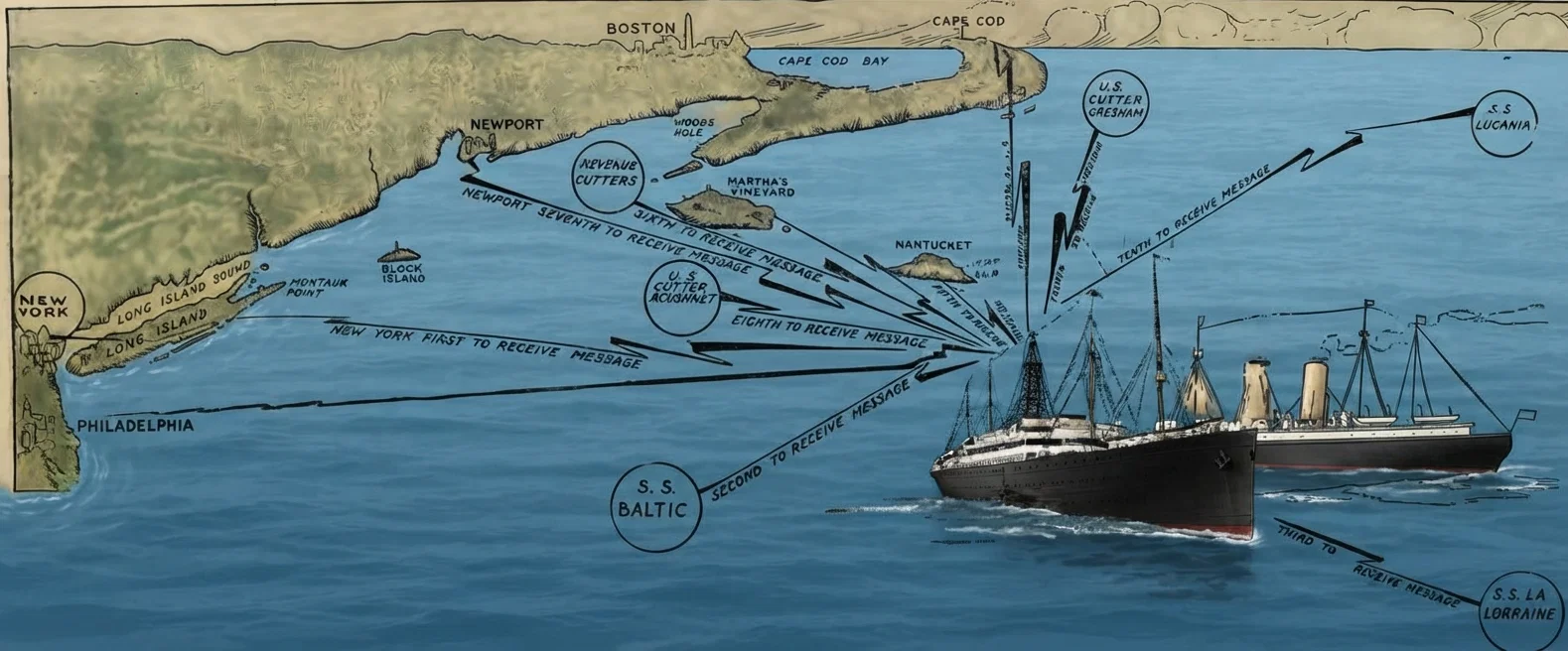
But a means of rescue was at hand. On board ship was the apparatus of the Marconi wireless system. Quickly the operator sent messages for help. Unseen, unheard, the word shot over the waves through the fog, telling of the dire distress of the ill-fated vessel. In every direction the messages sped, seeking the sensitive receivers on ships and at life-saving stations. The "La Lorraine" and the "Baltic" heard, and turned about in their course to help. The Cunarder "Lucania" heard from the open sea to the east, and put on speed to reach the scene quickly. Out of the skies the ticking instruments of the revenue cutter "Gresham," at Provincetown Harbor, near Boston, read the message: "Steamer 'Republic' in distress and sinking. Latitude 40.17, longitude 70, twenty-six miles southwest of Nantucket." And out around Cape Cod she steamed to carry assistance.
Soon the news was picked up at many points, the messages of cheer were flashed back to the helpless ship. Out of the very air came encouragement and cheer, promising speedy assistance from many sources. Every ship within two hundred miles which heard the call hastened to assist.
Then out of the gloom of the misty dawn came unexpected help, a ship appeared. It was the "Florida," with broken and twisted bow and well-nigh helpless machinery. She it was which had rammed the "Republic," coming now to her rescue. Seeing that the "Republic" was doomed, the passengers were transferred to the "Florida," which already carried nine hundred passengers, many of them refugees who had escaped from the Italian earthquake. Two thousand souls were thus crowded on the "Florida."
By noon the liners "Baltic" and "La Lorraine" had, after a weary search in the fog, by the help of wireless signals and submarine bells, located the wreck and stood by ready to give needed assistance, tho the dense fog rendered every movement perilous. By night it was seen that it would be best to transfer the passengers of both injured vessels to the "Baltic," which was done, ten small boats toiling in the darkness of the night until all were safe on the stanch liner, which carried them immediately to New York, there to be greeted by thousands of wildly enthusiastic friends of the passengers and interested spectators.
From the Philadelphia Press. Notice how in every direction the silent cry for help was heard. The first to receive the message was the most distant station, New York. If all modern inventions were but put to such a use.
It is another signal victory for modern science and discovery. Without the aid of the wireless system, the great steamer "Republic" might now be the grave of hundreds. Without those sensitive instruments, the "Baltic" would have steamed on her way, as would the other ships which arrived on the scene of the disaster in time to rescue the passengers, and to-day where there is rejoicing in a thousand homes of America, there would have been deepest mourning.
Through the air the call for help was flashed, caught up by receivers far away, and answered with promises of speedy help from many willing sympathizers. Hope rose in the hearts of erstwhile hopeless and helpless men and women; immediate danger past, they waited the coming rescuers, and welcomed them with inexpressible joy when through the gloom of fog and mist the far-reaching bells were heard and the lights were seen. And all this was the result of silent, unseen, little-understood air vibrations set in motion by the cunning power of electricity.