Your ShelfYour Projects

Signs of the Times, Vol. 28, No. 16.

NERO'S TOWER

Signs of the Times

Apr 16, 1902

Pacific Press Publishing Company · Oakland, California · Apr 16, 1902

NERO'S TOWER.
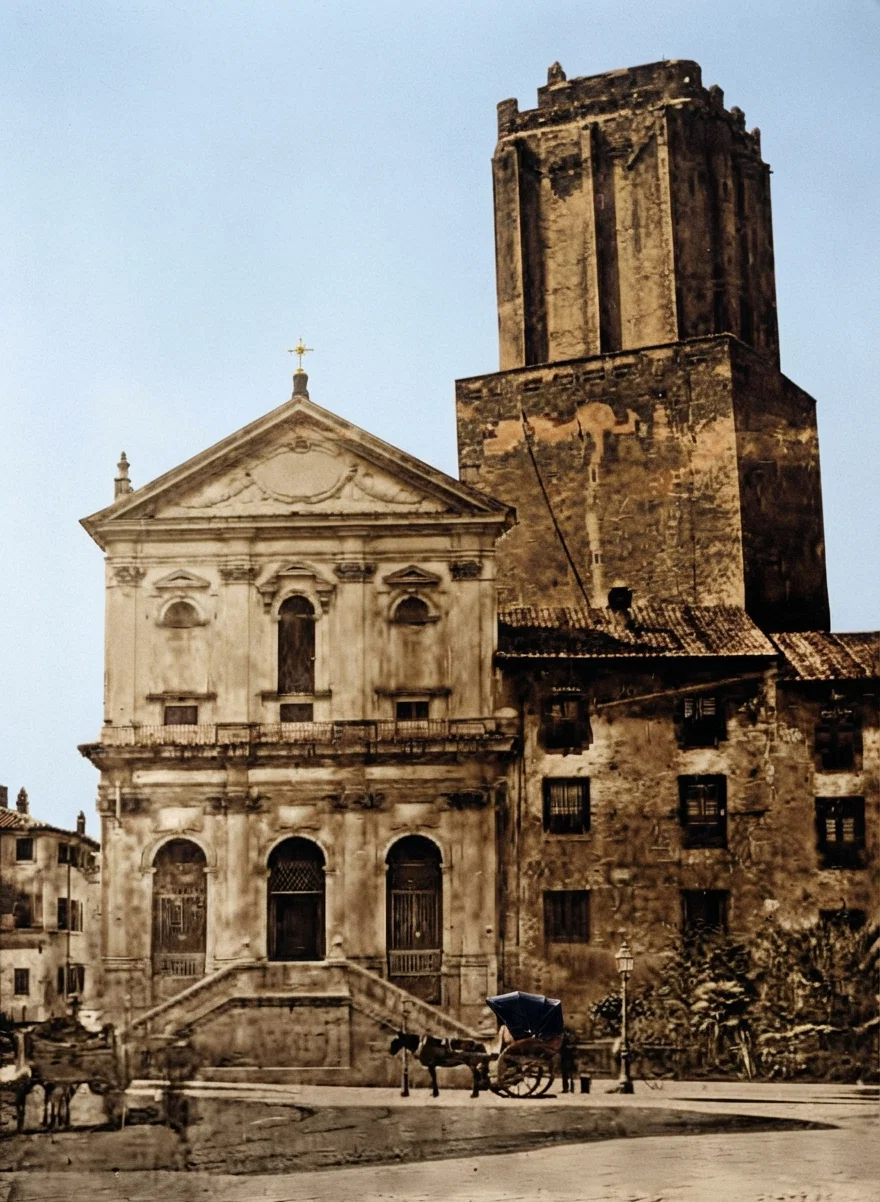
AN important text-book in the school of life is the history of the past. "Whatsoever things were written aforetime were written for our learning." At least some of the things written aforetime were experiences from which we may learn lessons. So it is sometimes important to be put in contact with the past, that we may learn from the experience of those who lived in days of old. The long past may sometimes be brought vividly near through the presentation of ancient structures in picture.
HOWEVER, were there no other purpose than the commemoration of a heartless tyrant and his wicked deeds, the tower still known by the name of Nero, emperor of Rome, would be a topic too academic for the general purpose of this journal. But the name and tower of the first Roman emperor who inaugurated a systematic persecution of Christians, may also be a memorial of a period of Christian faith and fortitude well worthy of frequent contemplation. Indeed, the Sacred Record itself gives testimony to these things; therefore they are worthy of consideration. The Word tells us of those who "had trial of cruel mockings and scourgings, yea, moreover of bonds and imprisonment; they were stoned, they were sawn asunder, were tempted, were slain with the sword; they wandered about in sheepskins and goatskins; being destitute, afflicted, tormented (of whom the world was not worthy); they wandered in deserts, and in mountains, and in dens and caves of the earth." Heb. 11:36-38.
NERO'S TOWER.
NERO'S TOWER.
NERO was born in A.D. 37, his mother, Agrippina, being a niece of the Emperor Claudius. At his birth the diviners, or fortune-tellers, said that some day he would be emperor. So his mother determined that the prediction should be verified. She became a
widow in course of time, and set about winning the affections of the emperor. In this she succeeded so well that he had his wife put to death and married his niece. Then she induced him to adopt her son Nero, and give him preference over his own son, Britannicus. After this she succeeded in having the emperor murdered, and then Nero was proclaimed emperor in A.D. 54, at the age of seventeen.
For five years, under the counsel of Seneca and other wise advisers, he did fairly well; but at last his natural instincts prevailed. He murdered his step-brother, Britannicus, divorced and then murdered his wife, murdered several leading men, among them Seneca and Lucan. Then he murdered his mother, who had so wickedly intrigued to promote him.
SUCH a man was ready for any Satanic act. In A.D. 64 a great fire broke out in the city, and burned for nine days. While the fire raged, Nero indulged in the most hilarious acts, playing on musical instruments, singing songs, and reciting verses on the burning of Troy. He was suspected of having been the instigator of the fire, and so strong did this impression become that he was obliged to devise some scheme to turn public suspicion in some other direction. So he accused the Christians of the crime, and began to persecute them in the most cruel manner. Thus the people of God were made the scapegoat to bear what would have been most outrageous punishments for even guilty parties. This persecution lasted during the remainder of Nero's life, about four years.
THE apostle Paul was one of the victims of Nero's vindictiveness, altho his death was not as atrocious as that of some others. Nero was the Caesar to whose court Paul was taken from Cesarea. The reference to "Caesar's household" in Phil. 4:22, is the household of Nero. It was to one of Nero's soldiers that Paul was continually chained during his two years of imprisonment in Rome. Thus we can account for some of those who were immediatelyconnected with the palace, becoming converted to Christ. During this first term of imprisonment, it seems there was no general persecution by the Romans. So far it had been at the instigation of the Jews.
THE tower represented in our illustration was built after the great fire to which we have alluded, the building in the foreground being a more modern structure. In the rebuilding of the city, the emperor did not neglect to build for himself a magnificent palace, highly ornamented with gold and precious stones. Of course a tower was a necessary accompaniment, and would be constructed in the most substantial and durable form.
IT is a notable fact that under such a corrupt and oppressive government, the church remained pure and experienced unparalleled prosperity. We have no record of any attempt on the part of the ambassadors of Christ to reform the government. It was not until the apostasy set in, and the church became corrupt through pride and ambition, that any union with the State or any part in political affairs was deemed advantageous. The doctrine of the apostles was: "Be ye not unequally yoked together with unbelievers; for what fellowship hath righteousness with unrighteousness? and what communion hath light with darkness? and what concord hath Christ with Belial? or what part hath he that believeth with an infidel?" 2 Cor. 6:14, 15.
AS WE look upon the monuments of those trying times, let us beware of the allurements to luxury and the temptations to carnal indulgence that beset our otherwise most favorable season. Let us remember that "when the south wind blew softly" it was "not long after" that there arose a "tempestuous wind." Acts 27:13, 14. May the tower of Nero be to us rather a memorial of the grace and faith in store for God's people under the most trying circumstances. G.

THE LOVE OF CHRIST FOR HIS CHILDREN.

THE love of Christ is a golden chain binding finite human beings to the infinite God. This love passes our knowledge. Human science can not explain it. Human wisdom can not fathom it. The more we feel the influence of this love, the more Christlike we shall be. Paul's prayer for the Ephesians was: "That Christ may dwell in your hearts by faith; that ye, being rooted and grounded in love, may be able to comprehend with all saints what is the breadth, and length, and depth, and height; and to know the love of Christ, which passeth knowledge, that ye might be filled with all the fulness of God."
Writing to the church at Rome, Paul declares: "I am persuaded that neither death, nor life, nor angels, nor principalities, nor powers, nor things present, nor things to come, nor height, nor depth, nor any other creature, shall be able to separate us from the love of God, which is in Christ Jesus our Lord."
The Lord's children are never absent from His mind. Even the birds are the objects of His tender solicitude. "Behold the fowls of the air," Christ said; "for they sow not, neither do they reap nor gather into barns; yet your Heavenly Father feedeth them. Are ye not much better than they?" If the Lord cares for the birds, has He not a special care for those who believe in Him? His love and care flow earthward to His children. He knows us by name. He knows the very house in which we live, the name of each occupant. He has at times given directions to His servants to go to a certain street in a certain city, to such a house, to find one of His children.
Every soul is as fully known to Jesus as if he were the only one for whom the Saviour died. The distress of every one touches His heart. The cry for aid reaches His ear. He came to draw all to Himself. He says, "My sheep hear My voice, and I know them, and they follow Me." He cares for each one as if there were not another on the face of the earth. Each child is loved by Him with a peculiar love.
To the disciples, just before His crucifixion, Christ said, "He that loveth Me shall be loved of My Father, and I will love him, and will manifest Myself to Him." Jesus read the future of the disciples. He saw one brought to the scaffold, one to the cross, one to exile among the lonely rocks of the sea, others to persecution and death. He encouraged them with the promise that in every trial He would be with them. That promise has lost none of its force. The Lord knows all about His faithful servants who for His sake are lying in prison or who are banished to lonely islands. He comforts them with His own presence. When for the truth's sake the believer stands at the bar of unrighteous tribunals, Christ stands by his side. All the reproaches that fall on him, fall on Christ. Christ is condemned over again in the person of His disciple. When one is incarcerated in prison walls, Christ ravishes the heart with His love. When one suffers death for His sake, Christ says, "I am He that liveth and was dead; and, behold, I am alive forevermore, . . . and have the keys of hell and of death." The life that is sacrificed for Me is preserved unto eternal glory.
Circumstances may separate friends; the restless waters of the wide sea may roll between us and them. But no circumstance, no distance, can separate us from the Comforter. Wherever we may be, He is at our right hand, to support, sustain, uphold, and cheer. Greater than the love of a mother for her child, is the Saviour's love for His redeemed. It is our privilege to rest in this love; to say, "I will trust Him; for He gave His life for me."
Jesus is our strength and happiness. He is the great storehouse from which we may draw grace and power. How grieved He is when, after He has declared His willingness to help us, we withdraw our eyes from His sufficiency to behold and bemoan our weakness. We are to keep our eyes fixed upon Him. Has He not promised that His strength shall be made perfect in our weakness? Receiving and imparting His blessings, we grow in grace, increasing in strength and holiness.
For every service we perform, the Lord has pledged His word to reward us, not because it is a debt He owes us, but because His heart is full of love, full of mercy and tenderness. He promises to repay us a hundred-fold in this life, and in the world to come give us life everlasting. But how many there are who spend their days in gloom and discouragement, looking at the dark side of their experience, forgetting that angels of heaven are waiting to cooperate with them, waiting to make them channels of blessing to the world.
Listen to Christ's words of comfort, spoken to His sorrowing disciples, and to every sorrowing child of His: "Let not your heart be troubled: ye believe in God, believe also in Me. In My Father's house are many mansions: if it were not so, I would have told you. I go to prepare a place for you. And if I go and prepare a place for you, I will come again, and receive you unto Myself; that where I am, there ye may be also."
In words of tenderness Christ invites us: "Come unto Me, all ye that labor and are heavy laden, and I will give you rest. Take My yoke upon you, and learn of Me; for I am meek and lowly in heart: and ye shall find rest unto your souls. For My yoke is easy, and My burden is light." Lay all your cares upon Me, He says, "I will carry them for you."
In these words Christ is speaking to every human being. Whether they know it or not, all are weary and heavy laden. All are weighed down with burdens that only Christ can remove. The heaviest burden that we bear is the burden of sin. If we were left to bear this burden, it would crush us. But the sinless One has taken our place. "The Lord hath laid upon Him the iniquity of us all." He has borne the burden of our guilt. He will take the load from our weary shoulders. He will give us rest. The burden of our care and sorrow also He will bear. He invites us to cast our cares upon Him; for He carries us upon His heart. Not until we stand face to face with God, when we shall see as we are seen and know as we are known, shall we know how many burdens the Saviour has borne for us, and how many burdens He would have been glad to bear, had we brought them to Him.
The Elder Brother of our race is by the eternal throne. He looks upon every soul who is turning his face to Him as the Saviour. He knows by experience what are the weaknesses of humanity, what are our wants, and where lies the strength of our temptations; for "He was in all points tempted like as we are, yet without sin." "Come unto Me," is His invitation. The weaker and more helpless you know yourself to be, the stronger you will become in His strength. "In all things it behooved Him to be made like unto His brethren, that He might be a merciful and faithful high priest in things pertaining to God, to make reconciliation for the sins of the people. For in that He Himself hath suffered being tempted, He is able to succor them that are tempted."
Human love may change, but Christ's love knows no change. When we cry to Him for help, His hand is stretched out to save. "The mountains shall depart, and the hills be removed; but My kindness shall not depart from thee, neither shall the covenant of My peace be removed, saith the Lord, that hath mercy on thee."

RESURRECTION.

ON the resurrection of the Sufferer of Calvary hinged the fate of the world and the destiny of mankind. St. Paul was so fully alive to the importance and magnitude of this doctrine and the interest involved in it that he does not for a moment shrink from facing the tremendous issue squarely and bravely. "If Christ be not raised, your faith is vain; ye are yet in your sins." "We are of all men most miserable." "Yea, and we are found false witnesses of God; because we have testified of God that He raised up Christ," which is not true if the dead rise not. There is no mincing or shuffling here. No indirection to leave a loophole of escape. No subterfuge nor innuendo. The challenge is clear, the language unmistakable. He joins issue with the host of infidels and scoffers on the very scene of the crucifixion and its attendant incidents, while the facts are still clear and fresh in the minds of those who were witnesses of the dreadful tragedy.—Methodist Protestant.

Leaving Possessions for Christ

"CHRIST leaves all power with those who are willing to leave their possessions for Him."

A LAY DISCURSUS ON THE SOUL

BY PROF. J.A.L. DERBY

THE PHYSICAL PHENOMENA OF SPIRITISM

Scientific View.

(Concluded.)

IT may be argued that, since a large portion of the facts of Spiritism has already been admitted by us to be due to no fraud, so far as human instrumentality is concerned; and furthermore since many of these, such as "spirit" communications, are often of an exalted moral character, no blame from the character of false manifestations can logically attach to the true ones.
Truly so. But this does not establish the existence of the spirits of dead men; for as the more nearly a confidence man can simulate the character of a saint, the more likely he is to succeed in practising on the credulity of the people; so the more closely an evil spirit could transform himself into an angel of light, the more perfectly he would approach to a master stroke of diabolism. If these phenomena are the works of the spirits of devils, and if these malicious spirits, bent on the destruction of the souls of men, can palm themselves off as the souls of the dead, how could they better prepare mankind to fall into their snare than by leading them to believe no snare is possible? If souls are alive in another world, or sphere of being, and if there is no such thing as a devil bent on deceiving man to his ruin, who then will believe that any damage can accrue to the soul by any course of action in this world? It is a leading tenet of "spirit" teaching that the most nefarious life here results in nothing worse in the spirit world than a sort of temporary social ostracism, which is capable of being remedied by good behavior over there, if, indeed, progression there is not inevitable whether or no. All of which, and a thousand other things, show that the theory of the demon origin of both the teachings and manifestations of Spiritism, is perfectly adequate to explain them. Digressing for a moment, there is another trick of the devil which works admirably with many "scientific" minds. There is probably no other being in the universe whose excessive modesty prompts him to such painful straits to conceal his identity as does the devil's. He is anxious to be thought the soul of a dead man. But if this can not be done, he is willing to become an absolute nonentity. Hence it is that the supercilious rejection of the theory of "spirits" by the scientist is pushed on by his Satanic highness until our scientific friend, imagining himself emancipated from vulgar superstition, denies there is such a being as the devil. Poor man! dreaming himself to be—
"-owner of the sphere Of the Seven Stars and the solar year," he is, in truth, but the dupe of diabolic spiritual hypnosis, adopting unquestioningly the suggestions of his master.
There is likewise another attitude which the enemy of souls is doubtless pleased to have men adopt toward himself. If a man were informed that a Mafia, a High Binders' society, or a Clan Na Gael, in secret nocturnal conclaves, were plotting his murder, he would scarcely consider it a subject for mirth. And yet while fiends are lurking along the moral highways of every soul to lure it to perdition, they would fain have us caricature them with horns, hoofs, and a barbed tail, discuss them facetiously, and dismiss them either as merely cynical wags of the spirit world, good-natured jinn full of harmless practical jokes, or else as fictions of medieval imagination.
The terrible earnestness of the unseen realities, even as a possibility, seems to be fast passing from the conception of the human race; and the attitude of "scientific" thinkers is contributing not a little to this result.
Returning to our first question, "Are any of the manifestations supernatural?" the answer we have given is, "Not necessarily supernatural, but undeniably superhuman." And we have preferred to show this supernormal quality concerning the physical rather than the psychical, because it is especially in the physical that there is the most intentional fraud committed. We wished to prove that they are not all mere simulated wonders. The psychical laws involved are of such a mooted nature at present, that the ultimate character of particularly mental phenomena must be determined largely from their moral bearings; and since the word "moral" in a scientific discussion seems to give the earache to so many modern physicists, we preferred to speak least about this phase, and to say what we wish to concerning it under our second question; namely, If these manifestations are superhuman, what is their source?
As to this second query, we have already found that the answer lies between the demons and departed souls. The question is on the identification of the spirits. That this can be done only from the moral standpoint, we have already shown. But lest our humble name should carry no weight, we shall quote from one ignorance of whom bespeaks a very limited preparation on the part of any critic to pass judgment on our position.
Professor Hyslop admits in the following extract all we claim:—
"Personal identity after death is the problem whose solution conditions inquiry into all others. I do not say or imply that any adequate answer [from the purely scientific standpoint] can be given to this question; for with that secondary personality and its deceptive, half-fiendish simulation of spiritistic ideas, and the possibilities of telepathy, whose limits no one can define at present, to say nothing of the ease with which the necessary phenomena can be fraudulently imitated, the task of proving identity, even in presumably genuine phenomena, is a gigantic one; and until it is done, skepticism regarding both the existence and alleged conditions of a transcendental life and consciousness must be conceded its rights."
It will be seen from the latter part of the last sentence that the writer is speaking of the scientific proof of a future life and its conditions, entirely separate from moral or Scriptural considerations. He further says:—
"Nor do I say that there is any hope of attaining knowledge of those conditions, even if it be possible to determine the fact of survival. This is a separate problem. But it is certain that if we wish to obtain any position making it rational to inquire as to the mode of life in another state of existence, we must in some way establish the veracity of the spirits which claim to reveal themselves to us. The alleged spirits, however, must prove their veracity by first proving their identity, their present and previous existence, and we may then reckon with their statements relative to their mode of life. There can be no truce with the man who does not see the priority of personal identity to all other questions of psychical research."
It is therefore perfectly plain that we can make no truce with Spiritism, even scientifically, until the spirits can prove they are not lying, by demonstrating that their claim to be disembodied souls is true. But while this is the one unchanging element in all their communications, it is not proved, has not been, and can not be. Their assertion that they are spirits of the dead, is really worth no more than would my asseveration be that I am the reincarnated soul of Napoleon Bonaparte.
It is sometimes argued that a spirit might prove his identity with some one who had once lived, by his memory of events in the life of that person. The reasoning is like this: I go to a spirit medium. This person goes into a trance; a spirit takes possession of her, and uses her as a means of talking with me. Or it may be that the communications are made by table-rappings or slate-writings without the trance state. Now, it is said, if the alleged spirit can recall spontaneously things in the life of the person whose soul it purports to be, events whose occurrence is demonstrably unknown to the medium, it proves its identity.
But this is actually less proof that the intelligence speaking through the "sensitive," as mediums are frequently called, is not that of a devil, than my knowledge of circumstances in the life of Napoleon is proof that I am merely an ordinary man like any one else. For I, dependent upon books for my information, could not be so well informed of the past as a spirit that has lived through all historic time and has had a large controlling participation in the lives of men.
This brings us to a realization of the ghastly fact, that the world at large, discarding for one reason or another the Word of God, the only source of ultimate truth concerning this great question, not willing to retain God in its knowledge, not willing to depend upon Jesus Christ for life, ready to accept any fable as proof that immortality is independent of the atonement, is open to the reception of the "doctrine of devils,"—which Inspiration indicates as a sign of the last days,—and is rapidly passing under the sway of demons.
Spiritism is the religion of deception, as Romanism is the religion of perversion, and nominal Protestantism the religion of apostasy.
Spiritists are of two classes, the deceivers and the deceived; and not infrequently the former are themselves self-deceived.
"The heart is deceitful above all things, and desperately wicked: who can know it?" Answer: Not even the medium himself. (Compare this scripture with Professor Hyslop's "secondary personality and its deceptive, half-fiendish, etc., . . . whose limits no one can define.") Doubtless greed for gain and the equally natural desire for notoriety constitute two of the main motives of mediums. But, under Satan's control, deception becomes the normal expression of a deep-seated instinct—an impulse, since the fall of Adam, naturally present in the heart of mankind. So profound, indeed, is this organic inclination—"a deception for the love of imposing upon humanity" (Jastrow),—that it is often practised by children so young that "motives for it can not be accurately determined."
"You would make a first-class medium." Little compliment this to one who realizes that such commendation is but a proof of his more than ordinary deceitfulness of heart.
To the student of God's glorious Word, all these things are but—not the proof, for the Word itself is the proof; not the evidence, for the Word itself is the evidence; but—the answer to the statement found in His Word, that there is a "spirit that now worketh in the children of disobedience." Eph. 2:2.
No Christian can be a Spiritist. It is utterly impossible until darkness and light can occupy the same space at the same time,—till Christ and Belial can dwell together in holy concord.
Fearful indeed is the condition of those upon whom the control of this demon-spirit has become fixed and permanent; darkness becomes light, and light darkness; truth is error, and error truth. Their feet stumble on the dark mountain, and they fall to rise not again.
[The next article in this series is entitled "Scriptural Spiritism."]
A LAY DISCURSUS ON THE SOUL BY PROF. J.A.L. DERBY

“SPEAKING THE TRUTH IN LOVE.”

God is love, and His love is the great lever that moves the universe. “God so loved the world, that He gave His only-begotten Son, that whosoever believeth in Him should not perish, but have everlasting life.” John 3:16.
God has commissioned us to proclaim this Gospel of His love to sinful men, that they may be restored to life and happiness. But our Lord knew that it was necessary for those whom He has sent to preach the truth to tarry until they were endued with “power from on high,” and had the love of God shed abroad in their hearts by the Holy Spirit, without which we are unqualified to bear the message of His undying love to a perishing world. But that love will move us to pity and compassion for those who oppose their own good; it will spur us on in the work of trying to lift fallen humanity. Without this love it would be impossible to endure the scorn, the derision and spiteful opposition of a wicked world.
Peter says, “If any man speak, let him speak as the oracles of God.” 1 Peter 4:11. But speak in love, Paul says. Eph. 4:15. For “tho I speak with the tongues of men and of angels, and have not charity [love], I am become as sounding brass, or a tinkling cymbal.” 1 Cor. 13:1. If we speak the truth in love, then the Spirit of the Lord will be manifested to all men. The Word of God, which is “quick, and powerful, and sharper than any two-edged sword” (Heb. 4:12), will prick the conscience and pierce the hearts of men, tho spoken in the sweetest accents of love.
If we are devoid of the spirit of love, we will speak in harsh terms which will wound and anger all, but heal none. Many a man has been driven away from God by preaching that was more blighting than the desert wind, and more destructive than a blizzard in the time of harvest, because the words were a cold hail-storm of abuse. Harsh, grating words are sterile and unfruitful; but words spoken in love will bring forth fruit to the honor and glory of God. For “the fruit of the Spirit is love, joy, peace, long-suffering, gentleness, goodness, faith, meekness, temperance.” Gal. 5:22, 23.
We are not to fawn and caress the wicked, or to be men-pleasers, nor speak words to tickle the ear. Our mission is to imperatively and with unswerving fidelity speak the truth, but to speak it in love. Then, if the words of truth offend, we can safely leave the results with God. “Let your speech be alway with grace,” is the admonition of the apostle Paul; “speak thou the things which become sound doctrine, . . . sound speech, that can not be condemned, that he that is of the contrary part may be ashamed, having no evil thing to say of you.” Col. 4:6; Titus 2:1, 8. And the wise king of Israel says, “A word fitly spoken is like apples of gold in baskets of silver.” Prov. 25:11. In speaking the truth in love, “thou shalt both save thyself and them that hear thee.” 1 Tim. 4:16.
C. CASTBERG.

GENTILES RECEIVED INTO THE CHURCH.

SOON after Peter's experience with Cornelius at Cæsarea, he returned to Jerusalem. But news of his work at Cæsarea had preceded him, and so those at Jerusalem who still adhered to the old Jewish rites were ready, at his coming, to contend with him, which they did, charging him with associating and eating with persons uncircumcised. Acts 11:1-3. This made a defense necessary, and therefore Peter related his whole experience, dwelling especially on the vision given to him at Joppa.
In a clear and decisive way he described the sheet held by its four corners, which he saw descend from heaven. He told of its contents,—"four-footed beasts of the earth, and wild beasts, and creeping things, and fowls of the air;" he repeated the words of heavenly command to him, "Arise, Peter; slay and eat;" he pronounced again his protest of that occasion, "Not so, Lord; for nothing common or unclean hath at any time entered into my mouth." Then came the solemn statement of God's voice, commanding three times in succession, "What God hath cleansed, that call not thou common."
Had the apostle rested his defense at this point, it might have been thought he was laboring under the influence of a disordered brain. But there were yet coincident facts to relate which would suffice to show that the apostle's view of the matter was not a mere vagary. He said that immediately upon the vision being withdrawn, three men from Cæsarea were found in the house, waiting to speak with him. Then came another demonstration, aside from the vision itself, wherein an audible voice was heard. The Spirit spoke to Peter, telling him to go with these men without any doubting whatever. More than this, Peter said that he did not venture on the journey alone, but (pointing to some who stood with him) "these six brethren accompanied me, and we entered into the man's house."
What further evidence was needed to convince Peter's critics that God had led him to preach to, and eat with, the Gentiles? By his testimony he had shown how strongly he had resisted the thought, and how, even after the Spirit Himself had corroborated the vision, and added His command in harmony with it, he had refused to go without taking along six others as witnesses of his sincerity, and his faithfulness to the common cause of the church of Christ.
But there was yet more corroborative evidence to be added. Upon entering Cornelius' house, that officer revealed how an angel had visited him, and commanded to send men to Joppa to bring thence one Simon, surnamed Peter, who would tell him what to do to be saved. This was the strongest evidence yet. A Gentile stranger, having had no connection whatever with Jesus or Christian assemblies, had been miraculously informed, not only of the town where some one could be found to lay before him the way of life, but the very street of that town, and the man's name owning the house in that street in which help would be found, as well as the name of the man whom God would have come to his help. Yes, and more than this. Six men stood by Peter, ready to testify that they too had witnessed and heard the things related by the apostle.
What a singular chain of evidence was here woven to convince the Judaizing brethren that the Gospel call was to every nation, in harmony with the original promise to Abraham their father: "In thy seed shall all the nations of the earth be blessed." Gen. 22:18. Looking, as they ever had done, to the natural seed of Abraham as the sole inheritors of the promises, it required the strongest evidence possible to convince them that the Gentiles would ever come within the range of salvation, even by the Gospel.
But Peter had still another testimony, more convincing than all that had preceded, even tho these seemed uncontrovertible. He said: "As I began to speak, the Holy Ghost fell on them, as on us at the beginning. Then remembered I the word of the Lord, how that He said, John indeed baptized with water; but ye shall be baptized with the Holy Ghost." Acts 11:15, 16.
What more could be said? Only one thing, to be sure, and that Peter did say: "Forasmuch then as God gave them the like gift as He did unto us, who believed on the Lord Jesus Christ; what was I, that I could withstand God?" Peter had been as prejudiced as the most unyielding, but when, step by step, he had been led in the clearest manner to see God in all his late experience, his will was completely subdued, and he gladly accepted the call to go to the Gentiles with the good news. But he was not the only one whose prejudice was caused to yield. When his recital was closed, especially that part wherein it was revealed that God gave the Gentiles His Spirit as freely as He had the believing Jews, all present were satisfied, and glorified God, saying, "Then hath God also to the Gentiles granted repentance unto life."
This was the breaking down of the middle wall between Jews and Gentiles. From this time, those who knew of Peter's experience gladly accorded the Gentiles a part and place in the work of God, and all believers from among them were accounted good members of the church of Jesus Christ.
J. O. CORLISS.

THE LORD OF DEATH.

[Zitella Cocke, in the Independent.]
WITHIN the gardens all is still, As men at arms, in grim array, Fulfil the haughty high priest's will Where Joseph laid his Lord away; But see! the East bursts forth in bloom, And earth responsive throbs beneath; The soldiers reel, and from the tomb Jesus is risen—the Lord of Death!
The Roman guard kept watch below, Angelic legions watched above; And direst hate of fiend and foe Falls vanquished at the feet of Love. Death, who had all his arrows hurled, Now flees, a smitten, skulking wraith, While seraphs shout around the world, The Lord and Christ is Lord of Death!
. . . . . . . . . . . . . . . O mourning ones, lift up your heads! O breaking heart, awake to song! There is no darkness and no death, If ye but list th' exultant throng Whose endless hallelujahs ring. Hear what the Easter triumph saith, Hear Angel and Archangel sing: The Lord and Christ is Lord of Death!

Good Points and Good Cheer

If you have lots of good points about you, the world won’t sit on you very hard.—Good Cheer.
Continue reading: RESTORATION from BABYLON