Your ShelfYour Projects

Review and Herald, Vol. 90, No. 32.

Our High Calling

Review and Herald

Aug 7, 1913

Review and Herald Publishing Association · Takoma Park Station, Washington, D. C. · Aug 7, 1913

Our High Calling

WORTHIE HARRIS HOLDEN
Chisel not marble that wayfarers read, Speak thou today in some virtuous deed, Write in the living affections of men, Waken their hearts' noblest strivings again.
Rise to endeavor both valiant and true, Prove the commission vouchsafed unto you; Thou hast a message no angel may speak,— Lift up the fallen and strengthen the weak.
Haste, for Jehovah soon ushers the day; For His majestic tread prepare the way, Cast up a highway, make level each hill,— So thy Commander's instructions fulfil.
Thou art elected to serve by His throne, Claim now the might He bestows on His own,— All heaven waits God's best gifts to bestow,— Tarry no longer! He calleth thee. Go!
Portland, Oregon.

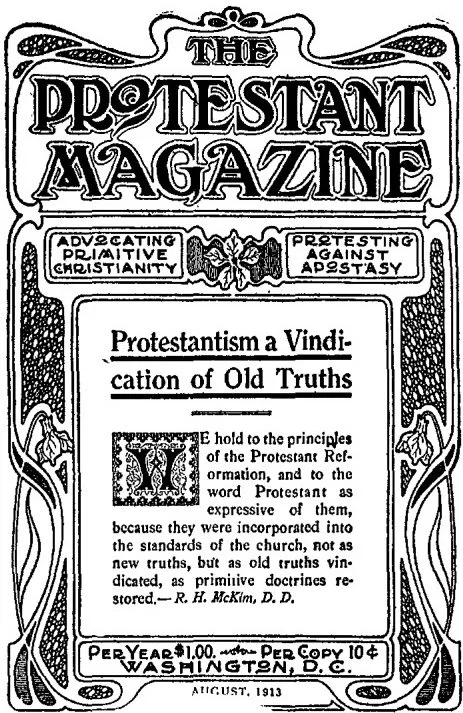
SHALL ROME THROTTLE FREE SPEECH IN AMERICA?

Do You Know That Within the Past Few Weeks Two Protestant Speakers Have Been Attacked by Roman Catholic Mobs, One in Oelwein, Iowa (June 12), and the Other in Pittsburgh, Pa. (June 17), for Daring to Lecture Upon "Rome's Attitude Toward the Public Schools," "Savonarola Sacrificed to Popish Greed and Lust," and "Martin Luther and the Reformation"?
Rome is again trying to carry out her old program, so well expressed in these three words penned in Rome by Prof. W. S. Tyler of Amherst, Mass., in 1870: "REPRESSION," "SUPPRESSION," "OPPRESSION."

PARTIAL AUGUST CONTENTS

Double Frontispiece: First Public Appearance of the Pope After His Recent Illness—Photograph of That Remarkable Bonzano Letter. Rome Proposes to Have Protestant Periodicals Excluded From the Mails Proposed Change in Name of "Protestant" Episcopal Church Primacy of the Roman Pontiff The Famous Bonzano Letter The Word of God Catholics and Religious Liberty "The Double Doctrine of the Church of Rome" Great Papal Persecutions Paganism and Popery A Murderous Attack Upon Jeremiah J. Crowley Church and State in Spain The Church in Politics
Ever since 1910 the American Federation of Catholic Societies has been doing all in its power to have the Postmaster-General of the United States exclude Protestant periodicals from the mails.

DO YOU WISH TO KNOW WHY ROME ALWAYS ATTEMPTS TO SUPPRESS PROTESTANT ARGUMENTS, ORAL OR WRITTEN, WHICH SHE CANNOT ANSWER?

Read and circulate this "Free Speech," "Bonzano Letter," and "Papal Persecutions" number.
TO TEN FRIENDS: You can send $3.00 for 10 six months' (or 5 yearly) subscriptions, in behalf of friends. These will be sent to different addresses. Send ten cents for sample copy. Liberal terms to agents.

ORDER THROUGH OUR NEAREST AGENCY

(If you do not know the address of our Agency, ask "Protestant Magazine," Washington, D. C.)
PRICES, POST-PAID
PRICES, POST-PAID

"What to Do First," and "Digestive Disorders" Number

The Magazine That Tells You How to PREVENT as Well as CURE Disease
June Edition Sold by May 28—Second Large Edition of July Number (10,000) Fast Disappearing!

SOME AUGUST FEATURES

Beautiful Cover Design (3 Colors) What to Do First for Burns, Drowning, etc. Digestive Disorders—How to Remedy Them Sunlight and the Body What is the "Staff of Life"? Is Alcohol Never a Food? What to Do for Hay Fever Friedmann Tuberculosis Treatment How to Make Wholesome Breads How to Loosen a Cough "U. S. Inspected and Passed" Questions and Answers, etc. Human Carriers of Disease
EARN A SCHOLARSHIP: Sell anywhere from 1,700 to 3,000 copies to earn a year's scholarship in the Academy or College you have picked out. Sell half the number for a half year's scholarship. Three to eight weeks of vigorous effort will suffice! All aboard!
Make All Arrangements for Territory and Supplies With Our Agency Nearest You. See List in Magazine
10 cents in stamps will bring you a sample copy
Send $1.00 for 20 copies; $2.00 for 50; $4.00 for 100; $8.00 for 200. Fifty or more, 4 cents each, post-paid.

ORDER THROUGH OUR NEAREST AGENCY

(If you do not know the address of our Agency, ask "Life and Health," Washington, D. C.)
Don't Forget to Take Subscriptions!

National Apostasy

MRS. E. G. WHITE
Two years before the death of Asa, Ahab began to rule in the kingdom of Israel. From the beginning, his reign was marked by terrible apostasy. His father, Omri, the founder of Samaria, "wrought evil in the eyes of the Lord, and did worse than all that were before him," but the sins of Ahab were even greater. He "did more to provoke the Lord God of Israel to anger than all the kings of Israel that were before him," acting "as if it had been a light thing for him to walk in the sins of Jeroboam the son of Nebat." Not content with encouraging strange forms of religious service, he boldly led the people into the grossest heathenism by setting aside the worship of Jehovah for Baal-worship.
Taking to wife "Jezebel the daughter of Ethbaal king of the Zidonians" and high priest of Baal, Ahab "served Baal, and worshiped him. And he reared up an altar for Baal in the house of Baal, which he had built in Samaria."
Not only did Ahab introduce Baal-worship at the capital city, but under the leadership of Jezebel he erected heathen altars in many high places, where in the shelter of surrounding groves the priests and others connected with this seductive form of idolatry exerted their baleful influence, until well-nigh all Israel were following after Baal. "There was none like unto Ahab," the record reads, who "did sell himself to work wickedness in the sight of the Lord, whom Jezebel his wife stirred up. And he did very abominably in following idols, according to all things as did the Amorites, whom the Lord cast out before the children of Israel."
Ahab was weak in moral power. His union by marriage with an idolatrous woman of decided character and positive temperament, resulted disastrously both to himself and to the nation. Unprincipled, and with no high standard of right-doing, his character was easily molded by the determined spirit of Jezebel. Because of his selfish nature, he was incapable of appreciating the mercies of God to Israel, and his own obligations as the guardian and leader of a chosen people.
Under the blighting influence of Ahab's rule, Israel wandered far from the living God, and corrupted their ways before him. For many years they had been losing their sense of reverence and godly fear; and now it seemed as if there were none who dared expose their lives by openly standing forth in opposition to the prevailing blasphemy of everything sacred. The dark shadow of apostasy covered the whole land, and images of Baal and Ashtoreth were everywhere to be seen. Idolatrous temples and consecrated groves, wherein the works of men's hands were placed to be worshiped, were multiplied. The air was polluted with the smoke of the sacrifices offered to false gods. Hill and vale resounded with the drunken cries of a heathen priesthood who sacrificed to the sun, and moon, and stars. Guided and urged on by king and priests, the people drank iniquity like water, and sported in shameful riot.
Through the influence of Jezebel and her impious priests, the people were taught that the idol gods that had been set up were deities, ruling the elements of earth, fire and water, by their mystic power. All the bounties of heaven,—the running brooks, the streams of living water, the gentle dew, the showers of rain which refreshed the earth and caused the fields to bring forth abundantly,—all these were ascribed to the favor of Baal and Ashtoreth. The people forgot that the hills and valleys, the streams and fountains, were in the hand of the living God; that he controlled the sun, the clouds of heaven, and all the elements of nature. They forgot that in the wilderness, in the day of Israel's need, he had listened to the prayers of Moses, and that in obedience to his word living waters gushed from the smitten rock. The benefits which God gave to his people called forth from them no gratitude to the Giver.
Through faithful messengers the Lord sent the apostate king and people repeated warnings; but in vain were these words of reproof uttered. In vain did the inspired messengers assert Jehovah's right to be the only God in Israel. In vain did they exalt the laws he had entrusted to them. Captivated by the gorgeous display and the fascinating rites of idol-worship, the people followed the example of the king and his court, and gave themselves up to the intoxicating, degrading pleasures of a sensual worship. In their blind folly they chose to reject God and his worship. The light so graciously given them, despised and rejected, had indeed become darkness. The fine gold had become dim.
Alas! how had the glory of Israel departed! Never before had the chosen people of God fallen so low in apostasy. Of the prophets of Baal there were "four hundred and fifty," besides four hundred "prophets of the groves," all of whom were supported by Jezebel. Nothing short of the miracle-working power of God could preserve the nation from utter destruction. Israel had voluntarily separated herself from Jehovah, yet the Lord in compassion still yearned after those who have been led into sin, and he was about to send to them one of the mightiest of his prophets, through whom many were to be led back to their allegiance to the God of their fathers.

Riches and Righteousness

Gospel Finance—No. 3

Riches and Righteousness

E. K. SLADE
By the fall, man was as much unfitted to possess true and lasting riches as he was for the society of heavenly beings or to occupy a place in the household of God. The Bible recognizes such a thing as wealth, or riches. It is made clear that it is possible for one to be rich and righteous at the same time. "Riches and honor are with me; yea, durable riches and righteousness." Prov. 8:18. We have no desire to dwell upon the way of the world as to its getting, holding, and using riches, only in the way of comparison. We believe that the rewarded righteous will be permitted to enjoy real, concrete, and material things in the new earth. The perverted nature that enjoys possessions here, will, after the complete transformation is accomplished, differ greatly from the selfish nature, yet there will be experienced the joy ofpossessing, not of the selfish sort known here, but the "fulness of joy" that can be known only in the perfect state.
The purpose of the gospel is to prepare mankind for true riches. "The blessing of the Lord, it maketh rich, and he addeth no sorrow with it." Prov. 10:22. The trouble with earthly riches is that there is added much sorrow with them. It is claimed that a great artist in the old country entered upon a search to find a face that would be a fitting expression of abject poverty and misery. He finally found the desired subject, and, much to his surprise, he learned that the possessor of the face that most fully revealed abject poverty and misery was the possessor of untold wealth. Paul speaks thus about the sorrow accompanying world wealth: "But they that will be rich fall into temptation and a snare, and into many foolish and hurtful lusts, which drown men in destruction and perdition. For the love of money is the root of all evil: which while some coveted after, they have erred from the faith, and pierced themselves through with many sorrows." 1 Tim. 6:9, 10. "Go to now, ye rich men, weep and howl for your miseries which shall come upon you." James 5:1. God is not pleased that any should suffer, and with his blessing riches will be possessed with no sorrow added.
To reach a more vital part of this question, we shall consider how true and lasting riches are to be acquired. The following text indicates that heavenly riches are not secured in the same way that earthly riches are: "There is that maketh himself rich, yet hath nothing: there is that maketh himself poor, yet hath great riches." Prov. 13:7. It would be hard to make a worldly financier believe that the proper way to acquire riches is to give to others all his wealth. The world's method is based upon love of self; the gospel way is based upon divine love. The former stands for individual and selfish ownership; the latter makes a commonwealth possible. The only way that a selfish man of the world can be safely admitted into a perfect commonwealth is to experience the gospel method of acquiring wealth, which is to give. There is a deep meaning to the words, "It is more blessed to give than to receive." The Saviour gives us this truth after having revealed to the world and the universe the truth he sought to teach by his own unselfish act. When he spoke those words, it was truthfully said of him, "The Son of man hath not where to lay his head." He gave up all. "Though he was rich, yet for your sakes he became poor, that ye through his poverty might be rich." This text should be correctly understood. We are not to become rich alone through his poverty in the sense that he has given all that he had to us and for us, but we are to become rich "through his poverty," through following his steps, the example which we are to follow.
The laying up of treasures in heaven, becoming joint heirs with Christ, inheriting the earth and all things, can become real to us only as we come into possession of the righteous nature that is in harmony with the heavenly commonwealth, where each rejoices that all others are possessors with him. It brings us again to this thought: God is not in need of our possessions, neither is it a question of possession so much, but it is our own need, our unfitness for true riches; and the Lord purposes to have us pass through the experience here in handling earthly belongings that will develop in us a fitness for true riches hereafter.
The servants of God who took joyfully the spoiling of their goods, knowing in themselves that they had in heaven a better and an enduring substance, understood God's purpose in these earthly burdens and disappointments. There is something that gives confidence and real comfort in knowing that God is giving us the very best opportunities here for being made fit for a place in his great commonwealth. Through the gospel our financial burdens are designed to prepare us for the better and enduring riches to which no sorrow is to be added.
Mount Vernon, Ohio.

The World's Armageddon Battle in Prophecy

(To be concluded)

Professedly Christian Nations Coming to Armageddon

THE fourth chapter of Micah is a remarkable prophecy which is to meet its fulfilment in the last days. In this prophecy it is stated that the professedly Christian nations will come to Jerusalem expecting the Lord to overthrow their enemies, remove all war forevermore, and from that time forward establish in this sin-cursed earth his kingdom of eternal peace. "And many nations shall come, and say, Come, let us go up to the mountain of the Lord." Verse 2. "Nation shall not lift up a sword against nation, neither shall they learn war any more." Verse 3. "For the law shall go forth of Zion, and the word of the Lord from Jerusalem." "And we will walk in the name of the Lord our God forever and ever." Verses 2, 5.
This is Satan's last effort to counterfeit the establishment of the kingdom of Christ before Christ's second advent. He here comes with armed nation professedly to establish Christ's kingdom of peace. Since the world's Armageddon is marshaled by the spirits of devils, doubtless it is at this time that Satan will transform himself into an angel of light and declare himself to be Christ come to establish the kingdom. 2 Cor. 11: 14.
In Micah 4:6-10 the Lord repudiates the whole procedure of these pretentious peace conferences of the nations at this time, and declares that his children over whom he will reign are the ones who at that time are driven out of the cities and dwell in the field, as Lot did in Zoar. But verse 8 makes the bold statement that this is the time when Christ will receive again the kingdom lost by Adam, and he himself will take the throne and reign in Jerusalem, the holy city,—not the earthly, but the heavenly Jerusalem. Rev. 21:1-3; Zech. 14:4.
Speaking of the disappointment of those nations which will attempt to establish the kingdom of Christ by the sword of civil power, the prophet Isaiah, in the second chapter, after giving a parallel statement to that given by the prophet Micah, says: "And the mean man boweth down, and the great man humbleth himself: therefore forgive them not." "And they shall go into the holes of the rocks, and into the caves of the earth, for fear of the Lord, and for the glory of his majesty, when he ariseth to shake terribly the earth." Verses 9, 19. Zephaniah says: "The mighty man shall cry there bitterly. That day is a day of wrath, . . . and their blood shall be poured out as dust, and their flesh as the dung." Zeph. 1:14-17.
This is the sequel to the world's Armageddon, as recorded in Rev. 16:12-16; 6:12-17; 19:11-21. Then will be fulfilled the utter destruction of earthly kingdoms and the setting up of the everlasting kingdom of God as predicted in Dan. 2:34, 35; Ps. 2:8, 9; Rev. 11:15.

The Heathen Shall Be Awakened

The prophet Joel says: "Let the heathen be awakened, and come up to the valley of Jehoshaphat" to this last-day battle. Joel 3:12. See Rev. 16:14. The heathen will, then, have to be reckoned with in this Armageddon conflict of the last days. They must first "awake" and "prepare war." Are the heathen awakening? Are they preparing war?
Chow Tsz'chi, chargé d'affaires of China at Washington, D. C., U. S. A., in Van Norden's Magazine for September, 1907, says:— "Progress has at last taken hold of China. Attempts to galvanize the giant out of his sleep of ages have been made many times, but until recently they have failed because the giant was not ready to awake. Now he has roused himself, stretched himself, and begun to put his house in order. It was time. Had he not awakened when he did, he would have found his house in possession of strangers. . . ."
"A few decades ago Japan was asleep, but she has awakened, and no people on earth has watched her progress in civilization with deeper interest than the Chinese. Her methods of war, her shipbuilding, her scholarship, have been studied by the Chinese, and when her little army conquered the legions of the most-feared nation on earth, Chinamen accepted it as proof that the yellow race had in it potentialities that were at least equal to those of the Caucasians."
Major-General Wilson, in the "Annals of the American Academy of Political and Social Science," discussing the probable terms of peace with Russia, says of the Japanese:— "They will probably stay on the Continent this time, come what may. And this makes a permanent disturbance of the balance of power in eastern Asia.It brings about a state of 'unstable equilibrium.' It inaugurates a new epoch in the history of mankind. It becomes an encouragement to every Asiatic people. It means Asia for the Asiatics. It means that the white man is no longer to dominate the yellow man. It means that the period of spoliation has come to an end. It means that Japan is awake. Finally, it means that China must also awake, and that the two will awaken all Asiatic mankind. It makes Japan the hegemony,—the ruling people of the Asiatic races,—and will surely turn every element of discontent in Asia toward her for instruction and guidance."
In the Literary Digest, under date of March 5, 1910, are to be found the following significant words showing that another part of the above remarkable prediction by Major-General Wilson is being fulfilled:— "A league of influential Japanese and Hindus to consolidate the Asiatic people against the domination of Europe is attracting notice and concern. High officials at the court of the mikado and chiefs of the Japanese aristocracy are at the head of it, and the constitution is from the pen of Count Okuma. On the other side there are very many of the most influential people of India enrolled among its members."
Mr. William T. Ellis in the Independent, in the year 1910, said: "When it comes to China, with her four hundred millions of people, one is tempted to abandon any attempt to convey even the most superficial impressions of the seriousness of her present crisis. China's awakening is portentous. It is marvelous. It is indescribable. It is incredible. It is limitless in its influence. For the sake of the world today, for the sake of the next generation, for the sake of China herself, some new prophet watchman should ascend the housetops of civilization and cry aloud with megaphonic voice: 'China is awake! China is awake!! CHINA IS AWAKE!!!' The biggest of all nations,—the people with the greatest latent powers,—the heirs of tomorrow,—have started to school to learn all the ways, and weapons, and wisdom of the West. This is the news of the day that most deserves 'scareheads' in the newspapers. Here is the subject upon which every wise man will inform himself and instruct his children."
China's sending her young men to the military schools of Europe and America as Japan did before her conflict with Russia, as well as her change of government to a republic from her staid customs of forty centuries, is an alarming evidence of an awakening to war.

The East Against the West

The Armageddon battle will doubtless be a religious war. The different religious bodies of the world are becoming very jealous for the triumphs of their religious creed. The talk about a holy war is not confined to the Mohammedans. It may be traced also to Catholicism, Protestantism, and heathenism. The world is divided religiously approximately as follows: Jews, 9,000,000; Greek and Eastern Churches, 115,000,000; Protestants, 175,000,000; Mohammedans, 210,000,000; Roman Catholics, 240,000,000; heathen, 845,000,000.
From the scriptures already cited it is evident that the final conflict will be between professedly Christian and heathen nations. On this point, as quoted in the New York World, Mohammed Barakatullah, speaking for China, says:— "Yes, it is we who do not accept it that practise the gospel of peace; it is you who accept it that trample it underfoot, and—irony of ironies!—it is the nations of Christendom who have come to us to teach us by sword and fire that the right in this world is powerless unless it is supported by might." "O, do not doubt that we shall learn the lesson! And woe to Europe when we have acquired it! You are arming a nation of four hundred million,—a nation which, until you came, had no better wish than to live at peace with itself and all the world." "In the name of Christ you have sounded the call to arms; in the name of Confucius we respond." "In not many years a power will arise in China that will make the entire world listen."
The late Oscar II, of Sweden, was a man of great diplomacy and far-seeing political sagacity. Prince Adam Wiszniewski publishes part of a letter written by King Oscar to him, dated March 22, 1896, in which the king expresses himself thus:— "I hope to die in peace. My military and warlike inclinations, which were rather strong in my younger years, have gradually died down, and have now all but disappeared. But I believe that in the bloody conflict, sure to take place somewhere, and on the outcome of which the fate of Europe will probably depend, the Occident will be conquered by the Orient."
The greatest of English scholars of the Far Eastern question, Weale, on the first page of his history, entitled "The Reshaping of the Far East," quotes from the sixteenth chapter of Revelation a description of the battle of Armageddon as the probable result of present conditions in the East.
Again Weale, in a late work entitled "The Truce in the East and Its Aftermath," says:— "Instead of the flames of war lighting Manchuria's hills and plains as they do now, they may soon leap sky high once again along an immense land frontier extending from Asia Minor to the sea of Okhotsk, involving the whole world in the bloodiest conflict ever known."
In an article in the "Daily Mail Year Book," 1908, by Archibald R. Colquhoun, F. R. G. S., entitled "A Great World Color Problem, How It Challenges the White Man's Supremacy," appears the following paragraph:— "There is no question that the victory of Japan over Russia, and the Anglo-Japanese alliance, raised the question of relations between white and yellow in an entirely new form, and moreover that a spirit of renaissance is at work throughout Asia, which is destined to challenge the vaunted supremacy of the white man. This spirit is as strong, in its way, as the spirit of democracy now rising in Europe is in another. Japan has demonstrated the efficiency and energy of a yellow race. China is awakening, and no one can predict what that amorphous giant will do when thoroughly aroused. India, where one fifth of the world's population is living, is stirred unceasingly to her depths by all sorts of new doctrines and ideas. The Mohammedan countries of the world are enjoying a spiritual revival. Africa is a seething mass of unrest; and the black man is seeking an outlet for that long-suppressed energy which he used to work off in intertribal wars."
The following is a statement by the German emperor, as reported in the London Daily Telegraph of Oct. 28, 1909:— "Look at the accomplished rise of Japan, think of the possible national awakening of China, and then judge of the vast problems of the Pacific. Only those powers which have great navies will be listened to with respect when the future of the Pacific comes to be solved; and for that reason only, Germany must have a powerful fleet. It may be that even England herself will be glad that Germany has a fleet when they speak together on the same side in the great debates of the future."
These utterances of the greatest statesmen and scholars, taken with those from leaders of the heathen world, are too significant to be passed by indifferently. They confirm the prophetic word.

A Short Sermon

The Teacher

H. A. ST. JOHN
"Master, we know that thou sayest and teachest rightly, neither acceptest thou the person of any, but teachest the way of God truly." Luke 20:21.
WITHOUT question or hesitancy, we pronounce Jesus the greatest teacher the world has known. In a preeminent sense he was a teacher sent from God, and the words he spoke and the doctrines he taught were not his own, but the words and doctrines of his Father, who sent him. He never attended the school of the learned of earth, but was ever taught of God in all things necessary for his work and mission. And it will be observed that his teaching was almost exclusively devoted to one great science, the science of salvation, the kingdom of heaven.
Jesus was constantly using the simple objects and transactions around him to impress his hearers with the great truths of his gospel. He would sometimes stop in his discourse and ask, "Whereto shall we liken the kingdom of God? or with what comparison shall we compare it?" Then he would begin, "Hear ye therefore the parable of the sower;" the parable of the mustard seed; theparable of the leaven; the treasure hid in a field; the man seeking goodly pearls; the parable of the net, gathering both good and bad, but in the end the bad were thrown away and only the good were saved. Thus he would go on illustrating his great subject by parables, and hanging his important lessons of the kingdom of heaven on objects and transactions familiar and everywhere visible, that the truths taught might the more easily be remembered.
Frequently on the Sabbath day he taught in the synagogue, sometimes in the temple courts, but more frequently by the wayside, the mountainside, and the seaside. His school was ever open and free to all.
Praise God, the school of Christ is open to us all now. Without money and without price, we may even now sit at the feet of Jesus, and learn of him, though we cannot see his face. What a blessed thought that we may walk and talk with Jesus, and by our words and lives we may teach that we have been with Jesus and learned of him.
Sanitarium, Cal.

Avoiding Debt

(Concluded)

The Exercise of Faith and Energy in Providing Means Beforehand

THE instruction that has been given in previous articles to provide beforehand the money that will be needed for any enterprise that is to be begun, does not preclude faith in God, perseverance, and effort. Rather, on the other hand, much of these are often avoided by the easier method at the outset of borrowing the money from some source and beginning before God's providence indicates by his having provided the means.

Pointed Example From Life of George Muller

To emphasize the fact that a struggle of faith is sometimes necessary through much prayer, to keep from debt by first providing the means to build institutions for carrying on God's work, I cannot forbear quoting a little of George Müller's experience, that man of such great faith who was so remarkably used of God in building orphans' homes at Bristol, England, and providing at the last for about two thousand orphans, in securing for them food, clothing, and shelter. The work had grown to such proportions, and the demands to provide for more orphans became so urgent, that Mr. Müller decided to erect two more houses. Of this experience we read:—
"In March, 1866, the plans for two new houses were ready, and in April tenders were received from contractors to build them. Mr. Müller supposed that the building fund accumulated, £34,002 2s., was of ample amount to meet all expenses. But the prices of building material and wages had so increased since the previous houses were built that it appeared from the estimates of contractors that £7,000 more would be needed.

The Sharp Line Between Faith and Presumption

"Now, what was to be done under these circumstances? My decision was made instantly. My heart longed to build two more houses to the honor of the Lord for the benefit of poor children, bereaved of both parents by death; I had brought before the Lord many thousands of prayers during the past five years [during the time this money was being secured]; there were many hundreds of orphans waiting for admission, and their number daily increasing (for during the past year alone, as stated before, six hundred and eleven were applied for to be admitted); but I could not contract debt.

'I Would Not Sign Contracts

which I had not money in hand to meet. Should it be said: 'But your work is so manifestly the Lord's work, it is surely according to his mind that destitute children, who have lost by death both parents, should be cared for, so that you need not be afraid to build though you have not yet all the money in hand, for God will surely help you,' my reply is this: Just because it is the Lord's work, and manifestly his, therefore I can wait, patiently wait his time. When his time is come, he will give to the last shilling all I need; but if I commence BEFORE his time, which I should do were I to begin that for which I have not the means, it would be like saying, 'God has not money enough to pay for his own work;' and, instead of acting in faith, I should act presumptuously. I therefore did this. As I had ample means to meet the contract for [house] No. 4 (for separate tenders were given in for the two houses), I accepted it, and a written agreement was made between the contractor and me that on Jan. 1, 1867, or at any time previously, I might accept his tender for [house] No. 5 also, but should not be bound to do so. If it will, therefore, please the Lord, by the first of January, 1867, to give me about £7,000 more than I have now in hand, the contract for No. 5 will be signed; but I cannot go in debt."—Müller's Life of Trust, pages 457, 458.

God Had His Money Ready on Time

How did it come out with the belated contract for orphan house No. 5? Mr. Müller tells us:—
"On the twenty-sixth of May, 1866, I needed about £7,000 more than I had in hand, to be able to accept the contract for No. 5 without going in debt; but by the thirty-first of December, 1866, the Lord had so graciously helped that a little more than £7,000 had come in by donations and interest, so that a day before the first of January, 1867, I was able to accept and sign the contract for No. 5, the contracts for both houses being £41,147. I had now the desire of my heart given to me, regarding this point also, and had the precious recompense from the Lord, in having received all the money from him for this object without going in debt. Thousands of times I had asked the Lord for the means needed for building these two houses, and now I had, to the full, received the answer."—Id., page 459.
And who dare say that in all this experience God was not the more glorified, and in the end more honor bestowed upon this good work of caring for the orphans, than had Mr. Müller in the crisis gone ahead of the providences of the Lord by beginning building before sufficient money was in hand to complete the work? Instead of paying out interest upon borrowed money, he immediately placed that which he had in hand over and above what was needed for his house No. 4, upon interest, and that came in as an asset to help provide enough by December 31 to build house No. 5.

No Debts on Our Foreign Missions

In carrying on foreign mission work, the denomination has steadily pursued the policy of advancing only as the providence of God has indicated by the gifts from the believers and that obtained in going to those outside the church. Appeals which come from the fields touch tender places, but often the word must be sent back that, while the brethren fully appreciate the appeal for help, on account of a lack of funds it will be impossible to go on with the enterprise now, all the time there being no slackening of the effort to provide mission funds.
With George Müller, the settled policy governing our foreign mission work has been that this world-wide message being manifestly God's work, he is able to provide the means to carry it forward through a willing and liberal people as fast as his providences in distant lands open the way. Earnest efforts have been made to provide the money by keeping the need of missions before the brethren and sisters, and God has provided for the growing cause by increased gifts from year to year.
For his own work he will surely provide, and that, too, without involving his cause in debt, when his servants and people exercise faith in him and follow the counsel he has given in his Word. His sure promise is, "My God shall supply all your need according to his riches in glory by Christ Jesus."

Finger Religion

"I SUPPOSE that John Atkins is one of your best weavers," said a clergyman who was being shown by the foreman through a great mill.
"Not much, he isn't," replied the foreman. "The trouble with John is that he stands around talking about his religion when he ought to be attending to his loom. He is a good enough fellow, and has the making of a fine weaver in him, but he has not yet learned that while he is in his weaving shed his religion ought to come out of his fingers and not out of his mouth."
A great deal of living must accompany a very little talking. And this is true zeal.—Record of Christian Work.
Continue reading: Editorial