Your ShelfYour Projects

Signs of the Times, Vol. 25, No. 40.

DESPISED AND REJECTED OF MEN

Signs of the Times

Oct 4, 1899

Pacific Press Publishing Company · Oakland, California · Oct 4, 1899

"DESPISED AND REJECTED OF MEN."

A Result of Prejudice.
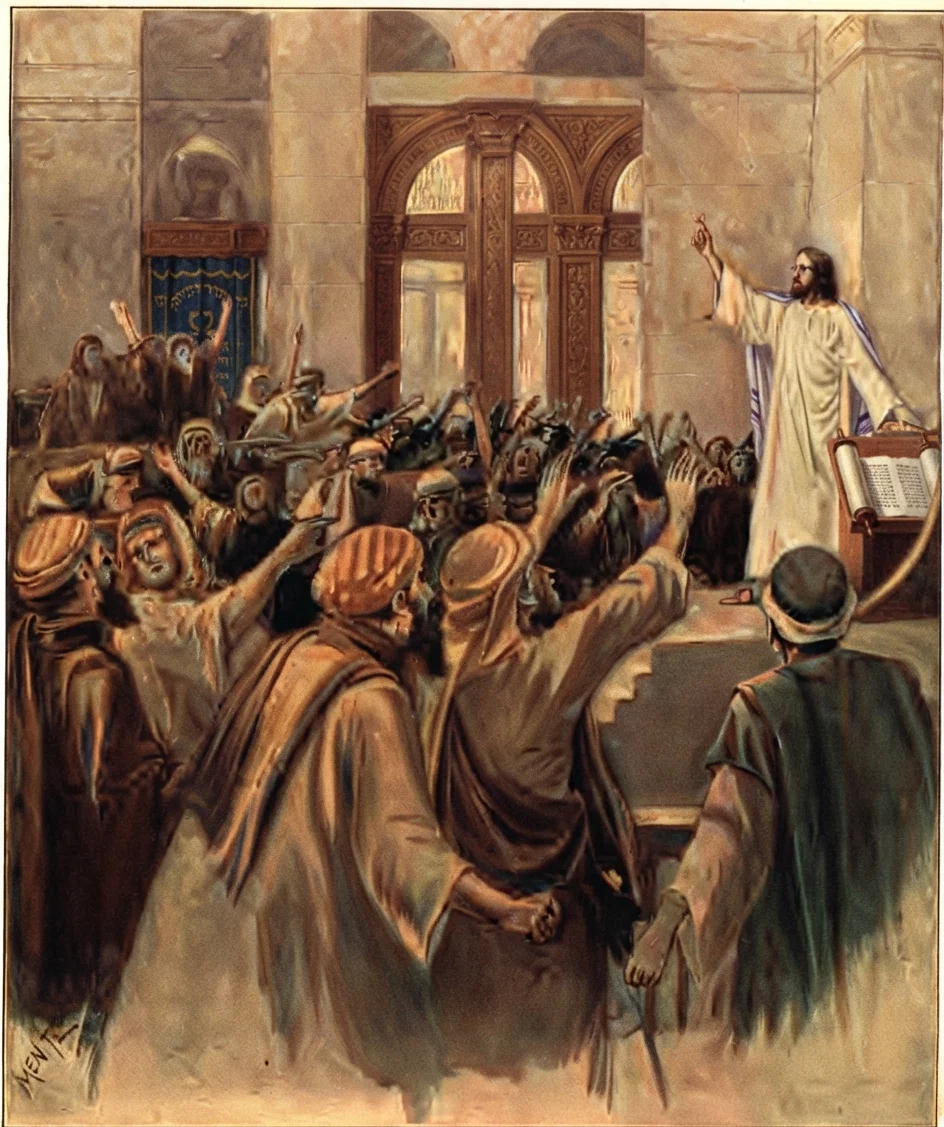
OUR Lord had well begun His ministry. He had called His first disciples. He had wrought His first miracle at Cana of Galilee. He had, with divine authority, driven out from the temple courts those who profaned its hallowed precincts by their unholy barter. He had stirred Samaria with His mission. He had preached in Galilee, and had "taught in their synagogs, being glorified of all." He had at Capernaum healed the son of the nobleman. His ministry everywhere bore witness that He was the Anointed of God.
"AND He came to Nazareth, where He had been brought up; and He entered, as His custom was, into the synagog on the Sabbath day, and stood up to read. And there was delivered unto Him the book of the prophet Isaiah. And He opened the book, and found the place where it was written:— "The Spirit of the Lord is upon Me, Because He anointed Me to preach good tidings to the poor; He hath sent Me to heal the broken-hearted; To proclaim release to the captives, And recovering of sight to the blind, To set at liberty them that are bruised, To proclaim the acceptable year of the Lord.
"And He closed the book, and gave it back to the attendant, and sat down; and the eyes of all in the synagog were fastened on Him. And He began to say unto them, To-day hath this scripture been fulfilled in your ears. And all bare Him witness, and wondered at the words of grace which proceeded out of His mouth."
JESUS did not ask the people of Nazareth to accept Him the first of any. He went out to unknown fields, to strange faces; but wherever He went, God witnessed to His work. With this record behind Him, Jesus came to His own city. Faithful in His life to all God's precepts, an attendant at divine service on the Sabbath, no fault could be found as respects His character.
Jesus in the Synagog at Nazareth.
THE message He bore to Nazareth was not one of condemnation. A more blessed message could not be given. For over seven centuries the gracious words had remained a dim mystery in the roll of the wonderful prophet; here was their unfolding. If He had said, "The Spirit of the Lord is upon Me to condemn you, to punish you, to govern, rule, or direct you," they might well have questioned. But Jesus came not to force Himself upon a single soul. He would oppress none. He would not quench the smoking flax nor break the bruised reed.
BUT what a gracious message He brought! God has sent "Me to preach good tidings to the poor." Surely they needed it. Oppressed by despotic Rome, despised by their wealthy Pharisaical brethren, the way to life hedged and clouded by the traditions of their ecclesiastical teachers, why should not good tidings be gladly received?
"To HEAL the broken-hearted,"—hearts broken by sin and wo and misery and disappointment—Jesus came to heal them all. He has balm for every bruise, healing for every hurt.
"RELEASE to the captives" of sin. In that synagog at Nazareth there were many bound ones, those held for long years in the fetters of sin, the bondage of Satan.
"SIGHT to the blind," not alone physically blind, but, more than this, the spiritually blind; for better a thousand times is blindness of physical eyes to him who sees and knows God, than the clearest of physical vision and blindness of soul. When the mission of the Anointed of God is finished, there will be blindness in neither; for all shall see. The heart that knew God in the flesh shall see Him through undimmed eyes. "Thine eyes shall see the King in His beauty."
"LIBERTY to them that are bruised." There is no more glorious word. Slavery and bondage are the cruelest of words. Liberty and freedom are blessed. Men and governments may secure to man a desirable and comparative degree of freedom; yet, possessing this, souls may be in worse bondage than the galley-slaves of ancient Rome,—in the spiritual bondage of sin, bruised by the enemy, helpless from the bruises, hopeless in the misery. But Jesus proclaims liberty from sin. He gives freedom from Satan's bondage. If the Son "make you free, ye shall be free indeed." He gives power to "stand fast in the liberty" wherein He has made us free." Read His miracles, and know that just as He set free the men whose souls were bound by demons, womenbound by incurable disease, so will He set you free, sinner, if you will but yield your sins and your ways to Him. "If we confess our sins, He is faithful and just to forgive us our sins, and to cleanse us from all unrighteousness."
"THE acceptable year of the Lord." It was then; it is now. What a glorious opportunity opened before the people of Nazareth on that blessed Sabbath morning! It was the acceptable time for them to receive the Lord Jesus Christ; it was the acceptable time for them to join with Jesus in giving the blessed message to others. It is even so now to us. "Behold, now is the acceptable time; behold, now is the day of salvation."
STUDY the whole message, reader; it is all good tidings; and we need not marvel that as the people listened to that wonderful Teacher, filled with the Spirit, as He read in tones of infinite tenderness the words He had inspired the prophet to speak, the eyes of all were fastened upon Him, and that all bore witness in their hearts to the graciousness of His words. At this we need not wonder. How could they do otherwise?
BUT they did. Satan came in to close the opening hearts, to shut their souls against the truth. They were turned from the message to the Messenger. The message was gracious, sweet, and powerful; and every longing of their heart witnessed to its truth, as Jesus told them that it then and there applied. But this Man Jesus! "Why," says Satan, "who is He?" Ah! their selfish, envious hearts respond, "Is not this Joseph's son?" He is only one of us. We know His father and mother. He came up with us, in our presence. What has He told that we have not? And prejudice, always selfish prejudice, closed the door. The gracious Gospel was forgotten; they saw only one of themselves whom they were judging by their own selfish motives.
AND then He showed them, in reading aloud the thoughts of their hearts, that He knew them. He showed them from the Scriptures, which they professed to believe, that the messengers of God, of which Elijah and Elisha were examples, had been rejected by their own, till God was forced to send His message to the poor and lame and bound and blind without, who were longing to receive it. Of course He would send it anyway, but He wanted that His professed people should share the labor and the blessing.
HEARTS shut against the truth of God grow hard, critical, and then revengeful. So at Nazareth. And finally they were filled with wrath, and rose up and thrust Him out of the city, and led Him unto the brow of the hill, whereon their city was built, that they might cast Him down headlong. But God interposed, sent His angels to the rescue, and Jesus passed through their midst, unseen by their wrath-blinded eyes, and went His way, leaving them to their choice,—blindness, bondage, and death. Did He ever return to Nazareth?
THE lesson to us is obvious. God sends His wonderfully gracious message to us, full of life and light and liberty and healing and salvation. It comes by an uncultured acquaintance, maybe, one not educated in our schools. We supposed we had known him all our lives, and we question. We lose sight of the message for our need in our criticism of the feeble instrument God has honored. Sometimes the message comes by a person who does not bear the certificate of the schools. He does not come heralded with sound of trumpet or flattering newspaper notice,—only a humble messenger of God. He is not known to fame, and prejudice closes our heart's door to life. Sometimes it is a humble tract, sometimes a humbling duty, a cross for crucifixion. Our souls acknowledge the reasonableness and truth of all, but pride closes the door; hardness of heart follows; Christ is rejected, in His truth, and we drive home ourselves the hand-piercing nails of His crucifixion.
O READER, ponder the lesson! Receive every message of God that is according to His Word. Let the messenger be lost sight of in the message. Honor him only for the message's sake, receiving him in Christ's name. But do not shut your heart against the Gospel of Jesus Christ. X.

SIGNS OF CHRIST'S COMING.

(Continued.)
IN our Lord's great prophetic discourse, to which reference has already been made, as another notable sign in the heavens of the coming of the Lord, which was to follow the darkening of the sun and moon, is noted—

The Falling of the Stars

from heaven. The scripture reads, “Immediately after the tribulation of those days shall the sun be darkened, and the moon shall not give her light, and the stars shall fall from heaven, and the powers of the heavens shall be shaken.” Matt. 24:29.
“And the stars of heaven fell unto the earth, even as a fig tree casteth her untimely figs, when she is shaken of a mighty wind.” Rev. 6:13.
We are not to understand by the term “stars” that the fixed stars, or planets, are meant. Some of the fixed stars are many times larger than this earth, or even our sun; hence, it would be impossible for them to fall to the earth. Christ evidently had reference to the shooting stars, or meteors, adapting His language to the language of the people. We now oftentimes on a starry night see a meteor shoot through the skies, and we exclaim, “See that star!” making no reference to the stars or planets, which do not thus carelessly shoot out of their orbits.
From the description given of this event by Professor Olmstead, of Yale University, one of the world-renowned meteorologists of his day, we may obtain a fair idea of the extent and brilliancy of the display:—
Those who were so fortunate as to witness the exhibition of shooting stars on the morning of Nov. 13, 1833, probably saw the greatest display of celestial fireworks that has ever been since the creation of the world, or at least within the annals covered by the pages of history. In nearly all places the meteors began to attract notice by their unusual frequency as early as 11 o'clock, and increased in splendor and numbers until about 4 o'clock, from which time they gradually declined, but were visible until lost in the light of day. The meteors did not fly at random over all parts of the sky, but appeared to emanate from a point in the constellation Leo, near a star called Gamma Leonis, in the bend of the sickle. The extent of the shower of 1833 was such as to cover no inconsiderable part of the earth's surface, from the middle of the Atlantic on the east to the Pacific on the west; and from the northern coast of South America to undefined regions among the British possessions on the north, the exhibition was visible, and everywhere presented nearly the same appearance.
The Connecticut Observer of Nov. 25, 1833, copied from the Old Countryman as follows:—
We pronounce the raining of fire which we saw on Wednesday morning last, an awful type, a sure forerunner, a merciful sign of that great and dreadful day which the inhabitants of the earth will witness when the sixth seal shall be opened. The time is just at hand, described not only in the New Testament, but in the Old. A more correct picture of a fig tree casting its leaves when blown by a mighty wind, it is not possible to behold.
Many other testimonies might be adduced in further demonstration of the fulfilment of the prophecy in this event, but these will be sufficient to the mind of any candid reader.

The Shaking of the Powers of Heaven,

spoken of by Matthew, we understand takes place in immediate connection with the coming of the Lord. The powers of the heavens are the sun, moon, and stars. Their shaking will be by the voice of God when He comes at the last great day. Upon this point Isaiah thus testifies: “Therefore I will shake the heavens, and the earth shall remove out of her place, in the wrath of the Lord of hosts, and in the day of His fierce anger.” Isa. 13:13. Of this same exhibition of divine power the prophet Joel says: “The Lord also shall roar out of Zion, and utter His voice from Jerusalem; and the heavens and the earth shall shake; but the Lord will be the hope of His people, and the strength of the children of Israel.” Joel 3:16; see also Heb. 12:26, 27; Rev. 16:17-21. Hence the shaking of the powers of heaven can not be considered so much in the light of a sign of Christ's coming, as an event in connection with that coming.
When the Son of man, with all the heavenly train, descends from His celestial abiding-place through the universe of God to this earth, the multitude of worlds will move for Him. Never before has His universe witnessed such an exhibition. Never again, perhaps, will such glory be manifested as when the Lord comes as King of kings and Lord of lords, to take to Himself a kingdom and to reign.
And that coming hastens on apace. The footsteps of the approaching God are heard in the portentous signs which He has given. May we heed the warning and so relate ourselves to Him that “the covenant of peace” shall be between us in that day. FRANCIS M. WILCOX.

"UNTIL THE DAY BREAK AND THE SHADOWS FLEE AWAY."

I WALKED along a weary way; All day it rougher grew; The clouds hung low, the rain-drops fell, The winds in fierceness blew; And when night's somber curtain dropped, And blacker was the storm, I sank beside the thorny road, And waited for the morn. I prayed that God would shed His light, His hand would guard my way, And keep me safely through the night, And bless the coming day. I rested in the arms of faith, Until with music rang The woods aglow with morning's light, While birds of promise sang. I saw the hard and stony way My feet had pressed so long Was all behind, before me lay The land of light and song; For God is love, and God is wise, He leads in vales of sorrow, Until shall come the glad surprise— The golden, bright to-morrow.
—Rev. O. D. Sherman.

Life and Healing Power

THERE can be no disease where there is no life; and where there is life, there is the healing power always, and charged with the potency of God.—J. H. Dewey, M.D.

CHRIST THE EXAMPLE.

JESUS CHRIST came into the world to bring to men the true knowledge of God; for "God was in Christ reconciling the world unto Himself." He came to reveal to men the kingdom of God,—to enunciate its principles, to manifest its spirit, to reveal its character. Of it He said: "My kingdom is not of this world." "Except a man be born again he can not see the kingdom of God." And His apostles declared: "The kingdom of God is righteousness and praise and joy in the Holy Ghost."
"My kingdom is not of this world." Every kingdom, every State, every government of men, is altogether of this world and of this world alone. How then can anybody be of any earthly kingdom or State and of the kingdom of God at the same time?—Those who are of the church are of the kingdom of God, because the church is the church of God, and not of this world,—it is composed of those who are chosen out of the world. Those who are of the State are of this world, because the State is altogether and only of this world. Thus in the Word of Christ, in the very principles of the cause of Christ, there is taught the separation of Church and State as complete and as wide as is the separation between the kingdom of God and the kingdoms of this world, and that is as complete and as wide as is the separation between God and this world.
Accordingly, Christ says in another place, "Render therefore unto Cæsar the things which are Cæsar's; and unto God the things that are God's." In that time the head of the Roman Empire, the personification of the world's power, was Cæsar. And in that Roman world system whatsoever was Cæsar's was God's; because to all the people of that world system Cæsar was God; he was set before the people as God; the people were required to worship him as God; incense was offered to his image as to God. In that system the State was divine, and Cæsar was the State. Therefore that system was essentially a union of religion and the State.
In view of this, when Jesus said, "Render therefore unto Cæsar the things which are Cæsar's; and unto God the things that are God's," He denied to Cæsar, and so to the State, every attribute, or even claim, of divinity. He showed that another than Cæsar is God. Thus He entirely separated Cæsar and God. He entirely separated between the things which are due to Cæsar and those which are due to God. The things that are due to Cæsar are not to be rendered to God. The things due to God are not to be rendered to Cæsar. These are two distinct realms, two distinct personages, and two distinct fields of duty. Therefore, in these words Jesus taught as plainly as it is possible to do, the complete separation of religion and the State, that no State can ever rightly require anything that is due to God; and that when it is required by the State, it is not to be rendered.

Christ Our Example.

Again: Jesus is the Example whom God has set to be the Guide to every person in this world in every step that can be taken in the right way. Any step taken by anybody in a way in which the Lord Jesus did not go is taken in the wrong way. He hath left us "an example, that ye should follow His steps." Whosoever saith that he "abideth in Him ought himself also so to walk even as He walked." And Jesus never, in any manner nor to any degree, took any part in political matters nor in any affairs of the State. Jesus was then, and is forever, the embodiment of true religion. Therefore, in His whole life's conduct of absolute separation from everything political, from all affairs of the State, there is taught to all the world, and especially to all believers in Him, the complete separation of the religion of Christ, and of all who hold it, from everything political and from all affairs of the State.
So faithfully did He hold to that principle that when a man asked Him only, "Speak to my brother, that he divide the inheritance with me," He refused, with the words, "Man, who made Me a judge or a divider over you?" and then said to them all, "Take heed, and beware of covetousness; for a man's life consisteth not in the abundance of the things which he possesseth." O, if only all who have professed to be His followers had held aloof from all affairs of politics and the State, how vastly different would have been the history of the Christian era! What a blessing it would have been to the world! What floods of misery and wo mankind would have been spared!
And why was it that Jesus thus persistently kept aloof from all affairs of politics and the State? Was it because all things political, judicial, and governmental, were conducted with such perfect propriety, and with such evident justice, that there was no place for anything better, no room for improvement such as even He might suggest?—Not by any means. Never was there more political corruption—greater perversion of justice—and essential all-pervasive evil of administration, than at that time. Why, then, did not Jesus call for "municipal reform"? Why did He not organize a "Law and Order League"? Why did He not disguise Himself and make tours of the dives and the gambling-dens, and entrap victims into violation of the law, and employ other spies to do the same, in order to get against the representatives of the law evidence of maladministration by which to arraign them and to compel them to enforce the law, and thus reform the city, regenerate society, and save the State, and so establish the kingdom of God? Why? The people were ready to do anything of that kind that might be suggested. They were ready to co-operate with Him in any such work of reform. Indeed, the people were so forward and so earnest in the matter that they would have actually taken Him by force and made Him King, had He not withdrawn Himself from them. Why then did He refuse?
The answer to all this is, Because He was Christ, the Saviour of the world, and had come to help men, not to oppress them, had come to save men, not to destroy them. The government under which Jesus lived was corrupt and oppressive; on every hand were crying abuses—extortion, intolerance, and grinding cruelty. Yet the Saviour attempted no civil reform. He attacked no national abuses, nor condemned the national enemies. He did not interfere with the authority or administration of those in power. He who was our Example kept aloof from earthly governments—not because He was indifferent to the woes of men, but because the remedy did not lie in merely human and external measures. To be efficient, the cure must reach men individually and must regenerate the heart.
"Not by the decisions of court, or councils, or legislative assemblies, not by the patronage of worldly great men, is the kingdom of Christ established, but by the implanting of Christ's nature in humanity through the work of the Holy Spirit. 'As many as received Him, to them gave He power to become the sons of God, even to them that believe on His name; which were born, not of blood, nor of the will of the flesh, nor of the will of man; but of God.' Here is the only power that can work the uplifting of mankind. And the human agency for the accomplishment of this work is the teaching and practising of the Word of God."
Now Christ is the true Example set by God for every soul in this world to follow. The conduct of Christ is Christianity. Conformity to that example in the conduct of the individual believer—this and this alone is Christianity in the world. The conduct of Christ, the Example, was totally separate in all things from politics and the affairs of the State. Christianity, therefore, is the total separation of the believer in Christ from politics and all the affairs of the State, the total separation of religion and the State in the individual believer.
Accordingly, Jesus said to His disciples forever, "Ye are not of the world, but I have chosen you out of the world." And to His Father He said of His disciples forever, "They are not of the world, even as I am not of the world." Every Christian in this world, then, must be in the world as Christ was in the world. "As He is so are we in this world." "It is enough for the disciple that he be as his Master." The Master was always, and in all things, and by fixed design, completely separated from all affairs of politics and the State. And it is forever enough "that the disciple be as his Master."
This is the Christianity of Jesus Christ, as respects the great question of religion and the State. And, as in all the instruction from God from the beginning of creation down, it calls always for the complete separation of religion and the State in all things and in all people.
ALONZO T. JONES.

CONCERNING PROPERTY.

What the Bible Teaches.

MR. EDWIN MARKHAM, author of the much-discussed poem, “The Man with the Hoe,” among other things, has this to say:—
Jesus everywhere takes the ground that God is the Owner and the Giver of all, and that men are but the stewards of the gifts—that all property is held in trust for the common good.
In fact, the whole Bible declares against the selfish holding of property. It is to be held in trust for God’s service. Let us turn to the Word for the testimony: “Behold, the heaven and the heaven of heavens is the Lord’s thy God, the earth also, with all that therein is.” Deut. 10:14. “The silver is Mine, and the gold is Mine, saith the Lord.” Hag. 2:8. No man belongs even to himself, for we are told, “Ye are not your own; for ye are bought with a price.” 1 Cor. 6:19.
This is the whole spirit of the great Book. These words are as clear and open as the sun. There is no dodging their immense significance. They carry judgment and finality. Unless we accept their vast import, let us not mock God by calling ourselves Christians. For be it known that the application of these words to life, to personal and public life, wouldchange the whole face of the world. They would destroy the social conflicts of the time, and upbuild on earth the fraternal commonwealth.
If any of our riches belong to God, all of them do. God is the sole Proprietor, and He wishes His goods distributed to His children as they have need, even as He sends His rain upon the parched and hungry lands. So it comes to this—that we are trustees of God’s gifts, and that they should be used in a way to honor Him. And how can He be honored? In only one way—by serving humanity. God in Christ identifies Himself with humanity. “Even as ye did it unto the least of these My brethren, ye did it unto Me.”
This is well stated; and we can supplement it no better than to add the words of the great apostle to the Gentiles:—
“Charge them that are rich in this world, that they be not high-minded, nor trust in uncertain riches, but in the living God, who giveth us richly all things to enjoy; that they do good, that they be rich in good works, ready to distribute, willing to communicate; laying up in store for themselves a good foundation against the time to come, that they may lay hold on eternal life.” 1 Tim. 6:17-19.

OUR PRIVILEGES IN CHRIST JESUS.

FULL and free the invitation comes to us: "Come unto Me, all ye that labor and are heavy-laden, and I will give you rest. Take My yoke upon you, and learn of Me; for I am meek and lowly in heart; and ye shall find rest unto your souls. For My yoke is easy, and My burden is light." What an invitation! It was this invitation that Christ gave to Enoch before the world was destroyed by a flood. That time was no more favorable to the development of Christian character than is the present time, yet we read that Enoch walked with God. Christ was as verily Enoch's Saviour as He is our Saviour, and in His power, notwithstanding the corruption of that degenerate age, Enoch perfected a Christian character. The voice saying to us, "He that followeth Me shall not walk in darkness," said the same words to Enoch, assuring him that if he followed the Saviour, he would not walk in the darkness of ignorance. The Lord instructed Enoch, and made him His watchman. He was a faithful witness for God, warning the inhabitants of the old world not to follow the example of the Cain-worshippers, but to serve the living God. "Enoch also, the seventh from Adam, prophesied of these, saying, Behold, the Lord cometh with ten thousands of His saints, to execute judgment upon all, and to convince all that are ungodly among them of all their ungodly deeds which they have ungodly committed, and of all the hard speeches which ungodly sinners have spoken against Him."
It is our privilege to walk as did Enoch. Christ has assured us that those who walk in His steps are His disciples, His true representatives. He says, "I am the Light of the world; he that followeth Me shall not walk in darkness, but shall have the Light of life." Is not this sufficient assurance? Should not these words fill us with holy peace and joy?
"Herein is My Father glorified," Christ said, "that ye bear much fruit; so shall ye be My disciples. As the Father hath loved Me, so have I loved you; continue ye in My love. If ye keep My commandments, ye shall abide in My love; even as I have kept My Father's commandments, and abide in His love. These things have I spoken unto you, that My joy might remain in you, and that your joy might be full." The greatest sin we can cherish is the sin of unbelief. Many say, I do not know how to be a Bible Christian. It is because you do not receive Christ as a sin-pardoning Saviour. Therefore your experience is full of inconsistency and unbelief. No one can have joy and peace who does not receive and obey Christ's words.
We need the riches of faith and love. But we can obtain these only by surrendering the will to Christ. When we take the Saviour at His word, and do those things that are pleasing in His sight, complete unity will prevail. We shall constantly grow more like our Leader. His character has been clearly revealed, and we have been plainly told that we are to be like Him. Our watchword is, "Go forward." Pressing onward to the Light of life means victory. We see in our hearts much that is dark and forbidding, and there is much we do not see at all, but God is greater than our hearts, and He knows all things. Do not deplore the crookedness of your past life; for this does not bring strength, but weakness. All unbelief is moral deformity. In bemoaning our past, there is no healing balm, but only sorrow and sin, that makes the heart sick and faint. Thus we become more and more discouraged. Might we not better look to the Lamb of God, which taketh away the sin of the world?
Unbelief greatly dishonors God. Our lack of faith is withholding from us precious blessings which are hanging over us, and which God would have us receive and appreciate. When we practise the Word, we shall be perfect in Him who is our righteousness. If the Word is believed by us, soberly, meekly, if it is received and appropriated, it will give us a precious experience, that will make us wise unto salvation. But, like the children of Israel, we are in danger of indulging a spirit of unbelief and murmuring.
The fruit of righteousness is quietness and assurance forever. If we had exercised more faith, if we had trusted less to our own wisdom, God would have manifested His power on human hearts. "These signs shall follow them that believe: In My name shall they cast out devils; they shall speak with new tongues. They shall take up serpents; and if they drink any deadly thing, it shall not hurt them; they shall lay hands on the sick, and they shall recover." It is faith, an active faith, that makes the gracious promise of any avail. We have been losing faith, in the place of increasing it. Our lack of faith is the reason why we have not seen more of the power of God. We exercise more faith in our own working than in God's working for us.
A great Teacher from heaven visited our world. Jesus Christ is His name. He is the Lord our Righteousness. He was visited by the prince of darkness, and was tempted in all points like as we are. He reached to the very depths of human wo, and all who carry their sorrows to Him, as to One who can be touched with the feelings of their infirmities, will receive the oil and wine of consolation. They will know from experience that Christ is their personal Saviour, one who comforteth those who are cast down, who bindeth up the broken-hearted. This experience grows as they in turn impart that which they have received. Christ is formed within, the hope of glory. He is made unto them wisdom, and righteousness, and sanctification, and redemption. They can say, "I know in whom I have believed."
"What think ye of Christ?" What is He to you personally? Is your faith centered in Him as your Redeemer? Do you believe that He saves you from sin, that He imputes to you His righteousness?
"Faith is the substance of things hoped for, the evidence of things not seen." Faith results in spiritual knowledge. By faith we are encouraged to grasp still more; for we behold God in the promise, and are armed with stability. The true Christian knows in whom he believes. He has the evidence of things unseen; and a knowledge that is regenerating, overpowering, follows this. This may not be believed by skeptics, but it is to the receiver no speculation, no mere theory. The Gospel offers to him a remedy for the moral disorders which sin has caused. He does not merely read the Bible, but experiences the Bible. He has not merely heard of the righteousness of Christ; by faith he has opened the windows of his soul to the Sun of Righteousness. Skeptics may stand back and argue the impossibility of the remedy he has taken, but their words are nothing to him against experience. It is a matter of knowledge with him. The believing man, even tho he be unlearned, has a knowledge that can not be wrested from him. The one who trusts his Saviour implicitly finds the gate of heaven ajar, and flooded with glory from the throne of God.
MRS. E. G. WHITE.
Continue reading: MAN'S PRIMITIVE AND BEST DIET