Your ShelfYour Projects

Review and Herald, Vol. 89, No. 40.

LET US BE KIND

Review and Herald

Oct 3, 1912

Review and Herald Publishing Association · Takoma Park Station, Washington, D. C. · Oct 3, 1912

LET US BE KIND

Let us be kind; The way is long and lonely, And human hearts are asking for this blessing only— That we be kind. We can not know the grief that men may borrow, We can not see the souls storm-swept by sorrow, But love can shine upon the way to-day, to-morrow; Let us be kind.
Let us be kind; This is a wealth that has no measure; This is of heaven and earth the highest treasure; Let us be kind. A tender word, a smile of love in meeting, A song of hope and victory to those retreating, A glimpse of God and brotherhood while life is fleeting,— Let us be kind.
Let us be kind; Around the world the tears of time are falling, And for the loved and lost these human hearts are calling; Let us be kind. To age and youth let gracious words be spoken; Upon the wheel of pain so many weary lives are broken; They live in vain who give no tender token; Let us be kind.
Let us be kind; The sunset tints will soon be in the west; Too late the flowers are laid then on the quiet breast; Let us be kind. And when the angel guides have sought and found us, Their hands will link the broken ties of earth that bound us, And heaven and home will brighten all around us; Let us be kind.
— Selected.

"Catholic Federation" and "Sunday Mails" Number

Beginning with Jan. 1, 1913, the subscription price will be 35 cents a year, or $2.00 for 10 copies, one year, to one or more addresses.
COVER: "ENTRANCE TO WHITE HOUSE"
Two Editions Exhausted by August 31

PARTIAL CONTENTS

Frontispiece: Photograph of Senate Sunday Mail Report, printed upon silk and displayed in office of Postmaster-General Rome and the Prohibition Party Platform Establishing God's Kingdom by Law God's Example of Religious Liberty Putting the Church Over the State in Ecuador American Principles in the Balance—a history of the famous Senate Sunday Mail Reports Religious Liberty in Puritan Times Absurdity of Proposed California Sunday Law Proposed California Sunday Law Un-American A World Survey of Religious Freedom Religious Liberty by Divine Authority Report of Convention of American Federation of Catholic Societies Temperance the Question of the Century

SPECIAL OFFER ON TEN, ONE YEAR

Good only until Jan. 1, 1913. Ten copies, one year, to one address or to ten separate addresses, only $1.50, or 15 cents each. Sender may include his name as one of the ten. This number should be placed in the hands of every editor, attorney, clergyman, city and county official, and public-school teacher in your county. We can furnish the names and addresses.

ORDER THROUGH OUR NEAREST AGENCY

If you don't know the address of our Agency, ask "Liberty Magazine," Washington, D. C.
Cover Design in Two Colors

A GOOD PROPOSITION FOR AGENTS

Prices: 25 cents a year (35 cents after Dec. 31, 1912), 10 cents a copy; 5 to 40 copies, 5 cents each; 50 or more copies, 4 cents each.
Send 10 cents for sample copy. Better still, send $1.00 for 20, or $2.00 for 50. Discount to agents on yearly subscriptions.

"Get Well," "Questions," and "Mothers'" Number

OTHER FEATURES: "Nerves," "Healthful Cookery," "Theaters," "Cancer," "Liquor," and "Infant Feeding."
BEAUTIFUL "DUTCH WINDMILL" COVER
September Edition Exhausted by August 31

PARTIAL OCTOBER CONTENTS

Aids to Health Restoration What to do for Exhausted Nerves Milk as a Health Food Simple Methods of Infant Feeding Are Theaters Innocent? Federal Children's Bureau Mothers' Congress Poison in Soda-Water Why I Am Against Liquor Stimulants and Narcotics Alcohol and Efficiency Is Cancer Preventable? There Shall Be No Grade Crossings Treatment of Intestinal Disorders Newspapers and Patent Medicines City Christian Help Work Many Other Important Articles and Items
Questions and Answers (11 questions answered). — In this new and popular department the editor replies to questions asked by subscribers. Subscribe now. Send $3.00 for five years; $2.00 for 3 years; $1.00 for one year. Single bound volumes, 1908-11, half leather, each, post-paid, $1.75.

ORDER THROUGH OUR NEAREST AGENCY

If you don't know the address of our Agency, ask "Life and Health," Washington, D. C.
Cover Design in Three Colors

EARN YOUR OWN SUBSCRIPTION

By sending two subscriptions at $1.00 each, you may earn your own yearly subscription.
Send $2.00 for 50 copies; sell 20 to get your money back; then sell or give away the others.

PRICES

$1.00 a year, 10 cents a copy; 5 to 40 copies, 5 cents each; 50 or more copies, 4 cents each.

Before the Storm

THE fervent heat of summer's blistering ray Has quaffed the dewdrops that anoint the day; Its subtle spirit hovers o'er the lea In quivering waves of hushed expectancy; The whispering zephyrs drop their drowsy tale, And scarce a leaflet stirs through all the vale; The stifling air has banished labor's zest, And weary toilers seek the shade for rest.
A cloud appears, and with no bugle-cry Anon its marshaled hosts besiege the sky; In dark array the scouts are hurrying round; Aerial cannon in the distance sound; A rifle flash announces drops of rain, Which thicken fast; and soon the ripened grain, For which the laborers aweary toiled, Is flayed by hail, and by the storm despoiled.
So, swift by princely powers of darkness hurled, The final storm will burst upon the world. Look! in the distance see the clouds arise; Erelong the pall of blackness veils the skies. O weary reapers, haste to garner all; For soon the devastating rain will fall. The Master sounds his clarion call today; Arise, and reap for heaven while you may!
Portland, Oregon.

The Dignity of Labor

MRS. E. G. WHITE
NOTWITHSTANDING all that has been said and written regarding the dignity of manual labor, the feeling prevails that it is degrading. The opinion of men has, in many minds, changed the order of things, and men have come to think that it is not fitting for a man who works with his hands to take his place among gentlemen. Men work hard to obtain money; and having gained wealth, they suppose that their money will make their sons gentlemen. But many such men fail to train their sons, as they themselves were trained, to hard, useful labor. Their sons spend the money earned by the labor of others, without understanding its value. Thus they misuse a talent that the Lord designed should be used to accomplish much good.
The Lord's purposes are not the purposes of men. He did not design that men should live in idleness. In the beginning, he created man a gentleman; but though rich in all that the Owner of the universe could supply, Adam was not to be idle. No sooner was he created than his work was given him. He was to find employment and happiness in tending the things that God had created; and in response to his labor, his wants were to be abundantly supplied from the fruits of the garden of Eden.
While our first parents obeyed God, their labor in the garden was a pleasure; and the earth yielded of its abundance for their wants. But when man departed from obedience, he was doomed to wrestle with the seeds of Satan's sowing, and to earn his bread by the sweat of his brow. Henceforth he must battle in toil and hardship against the power to which he had yielded his will.
It was God's purpose to alleviate by toil the evil that was brought into the world by man's disobedience. By toil the temptations of Satan might be made ineffectual, and the tide of evil stayed. And though attended with anxiety, weariness, and pain, labor is still a source of happiness and development, and a safeguard against temptation. Its discipline places a check on self-indulgence, and promotes industry, purity, and firmness. Thus it becomes a part of God's great plan for our recovery from the fall.
The public feeling is that manual labor is degrading; yet men may exert themselves as much as they choose at cricket, baseball, or in pugilistic contests without being regarded as degraded. Satan is delighted when he sees human beings using their physical and mental powers in that which does not educate, which is not useful, which does not help them to be a blessing to those who need their help. While the youth are becoming expert in games that are of no real value to themselves or to others, Satan is playing the game of life for their souls, taking from them the talents that God has given them, and placing in their stead his own evil attributes. It is his effort to lead men to ignore God. He seeks to engross and absorb the mind so completely that God will find no place in the thoughts. He does not wish people to have a knowledge of their Maker, and he is well pleased if he can set in operation games and theatrical performances that will so confuse the senses of the youth that God and heaven will be forgotten.
One of the surest safeguards against evil is useful occupation, while idleness is one of the greatest curses; for vice, crime, and poverty follow in its wake. Those who are always busy, who go cheerfully about their daily tasks, are the useful members of society. In the faithful discharge of the various duties that lie in their pathway, they make their lives a blessing to themselves and to others. Diligent labor keeps them from many of the snares of him who "finds some mischief still for idle hands to do."
A stagnant pool soon becomes offensive; but a flowing brook spreads health and gladness over the land. The one is a symbol of the idle, the other of the industrious.
In God's plan for Israel, every family had a home on the land, with sufficient ground for tilling. Thus were provided both the means and the incentive for a useful, industrious, and self-supporting life. And no devising of man has ever improved upon that plan. To the world's departure from it is owing, to a large degree, the poverty and wretchedness that exist to-day.
In Israel, industrial training was regarded as a duty. Every father was required to see that his sons learned some useful trade. The greatest men of Israel were trained to industrial pursuits. A knowledge of the duties pertaining to housewifery was regarded as essential for every woman. And skill in useful duties was looked upon as an honor to women of all stations in life.
In the schools of the prophets, various industries were taught, and many of the students supported themselves by manual labor.
The path of toil appointed to the dwellers on earth may be hard and wearisome; but it is honored by the footprints of the Redeemer, and he is safe who follows in this sacred way. By precept and example Christ has dignified useful labor. From his earliest years, he lived a life of toil. The greater part of his earthly life was spent in patient work in the carpenter's shop at Nazareth. In the garb of a common laborer the Lord of life trod the streets of the little town in which he lived, going to and returning from his humble toil; and ministering angels attended him as he walked side by side with peasants and laborers, unrecognized and unhonored.
When he went forth to contribute to the support of the family by his daily toil, he possessed the same power as when on the shores of Galilee he fed five thousand hungry souls with five loaves and two fishes. But he did not employ his divine power to lessen his burdens or lighten his toil. He had taken upon himself the form of humanity, with all its attendant ills, and he did not flinch from its severest trials. He lived in a peasant's home; he was clothed with coarse garments; he mingled with the lowly; he toiled daily with patient hands. His example shows us that it is man's duty to be industrious, and that labor is honorable.
The things of earth are more closely connected with heaven, and are more directly under the supervision of Christ, than many realize. All right inventions and improvements have their source in him who is wonderful in counsel and excellent in working. The skilful touch of the physician's hand, his power over nerve and muscle, his knowledge of the delicate mechanism of the body, is the wisdom of divine power to be used in behalf of the suffering. The skill with which the carpenter uses his tools, the strength with which the blacksmith makes the anvil ring, come from God. Whatever we do, wherever we are placed, he desires to control our minds, that we may do perfect work. Christianity and business, rightly understood, are not two separate things; they are one. Bible religion is to be brought into all that we do and say. Human and divine agencies are to combine in temporal as well as in spiritual achievements. They are to be united in all human pursuits, in mechanical and agricultural labors, in mercantile and scientific enterprises.
There is but one remedy for indolence, and that is to throw off sluggishness as a sin that leads to perdition, and go to work, using the physical ability that God has given. The only cure for a useless, inefficient life is determined, persevering effort. Life is not given us to be spent in idleness or self-pleasing; before us are placed great possibilities. In the capital of strength a precious talent has been entrusted to men. This is of more value than any bank deposit, and should be more highly prized; for through the possibilities that it affords for enabling men to lead a useful, happy life, it may be made to yield interest and compound interest. It is a blessing that can not be purchased with gold or silver, houses or land; and God requires it to be used wisely. No man has a right to sacrifice this talent to the corroding influence of inaction. All are as accountable for the capital of physical strength as for their capital of means.
The race is not always to the swift, nor the battle to the strong, and those who are diligent in business may not always be prospered. But it is "the hand of the diligent" that "maketh rich." And while indolence and drowsiness grieve the Holy Spirit and destroy true godliness, they also tend to poverty and want. "He becometh poor that dealeth with a slack hand."
Judicious labor is a healthful tonic for the human race. It makes the feeble strong, the poor rich, and the wretched happy. Satan lies in ambush, ready to destroy those whose leisure gives him opportunity to insinuate himself under some attractive disguise. He is never more successful than when he comes to men in their idle hours.
Among the evils resulting from wealth, one of the greatest is the fashionable idea that work is degrading. The prophet Ezekiel declares: "Behold, this was the iniquity of thy sister Sodom, pride, fulness of bread, and abundance of idleness was in her and in her daughters, neither did she strengthen the hand of the poor and needy." Here are presented before us the terrible results of idleness, which enfeebles the mind, debases the soul, and perverts the understanding, making a curse of that which was given as a blessing. It is the working man or woman who sees something great and good in life, and who is willing to bear its responsibilities with faith and hope.
The essential lesson of contented industry in the necessary duties of life, is yet to be learned by the larger number of Christ's followers. It requires more grace, more stern discipline of character, to work for God in the capacity of mechanic, merchant, lawyer, or farmer, carrying the precepts of Christianity into the ordinary business of life, than to labor as an acknowledged missionary in the open field. It requires a strong spiritual nerve to bring religion into the workshop and the business office, sanctifying the details of every-day life, and ordering every transaction according to the standard of God's Word. But this is what the Lord requires.
The apostle Paul regarded idleness as a sin. He learned the trade of tent-making in its higher and lower branches, and during his ministry he often worked at this trade to support himself and others. Paul did not regard as lost the time thus spent. As he worked at his trade, the apostle had access to a class of people that he could not otherwise have reached. He showed his associates that skill in the common arts is a gift from God. He taught that even in every-day toil God is to be honored. His toil-hardened hands detracted nothing from the force of his pathetic appeals as a Christian minister.
God designs that all shall be workers. The toiling beast of burden answers the purpose of its creation better than does the indolent man. God is a constant worker. The angels are workers; they are ministers of God to the children of men. Those who look forward to a heaven of inactivity will be disappointed; for the economy of heaven provides no place for the gratification of indolence. But to the weary and heavy-laden rest is promised. It is the faithful servant who will be welcomed from his labors to the joy of his Lord. He will lay off his armor with rejoicing, and will forget the noise of battle in the glorious rest prepared for those who conquer through the cross of Calvary.

A Wonderful Prophecy

IN the former dispensation the daily round of service during the year typified the work of confessing sins and leaving them with Christ, our great sin-bearer, in the heavenly sanctuary; but Christ will not always bear the sins of the world. There comes a time when he will wipe the last trace of sin from the books of heaven, and lay the sins of the righteous upon Satan, the originator of sin, and will consume sin, sinners, and Satan in the lake of fire. God is a God of justice, and before either the sins of the faithful or the names of the unfaithful are blotted from the books of heaven (Rev. 3:5), there will be an examination of the records, an investigative judgment. The service in the second apartment of the sanctuary was a type of this work. It was called the day of atonement, or the cleansing of the sanctuary. The record states: "On that day shall the priest make an atonement for you, to cleanse you, that ye may be clean from all your sins before the Lord." Lev. 16:30.
When men and angels were placed on probation, a time was appointed when they should be judged. The resurrection of Christ is a pledge, or assurance, of the judgment. God "hath appointed a day, in the which he will judge the world in righteousness by that man whom he hath ordained; whereof he hath given assurance unto all men, in that he hath raised him from the dead." Acts 17:31. The day of judgment is a definite time set apart in which to perform a definite work; it is a period of time. "God shall judge the righteous and the wicked: for there is a time there for every purpose and for every work." Eccl. 3:17.
God did not leave the world in darkness in regard to the time of the antitype of the cleansing of the sanctuary, or the day of atonement, but through the prophet Daniel foretold when that event would take place. In the eighthchapter of the book of Daniel, in the last days of the Babylonian kingdom, the prophet was given a view of the history of the world from that time until the end of all earthly kingdoms. He saw a ram having two horns; and then a rough goat with a notable horn between his eyes came from the west and overcame the ram and trampled him underfoot. Then the goat grew very strong; and when he was strong, the great horn was broken, and in its place came up four notable horns. "Out of one of them came forth a little horn, which waxed exceeding great," until "he magnified himself even to the Prince of the host;" that is, claimed to be equal to the Prince of the host.
While the prophet was watching this little horn persecute the people of God on the earth, his attention was arrested by a conversation between two heavenly beings, which he records as follows: "Then I heard one saint speaking, and another saint said unto that certain saint ["the Wonderful Numberer," margin] which spake, How long shall be the vision concerning the daily sacrifice, and the transgression of desolation, to give both the sanctuary and the host to be trodden underfoot? And he [the Wonderful Numberer, the Prince of hosts] said unto me, Unto two thousand and three hundred days; then shall the sanctuary be cleansed." Dan. 8:1-14.
As Daniel did not understand the vision, One in command of the heavenly forces commissioned the angel Gabriel to make him understand the vision, and Gabriel gave the following brief explanation: "The ram which thou sawest having two horns are the kings of Media and Persia. And the rough goat is the king of Grecia: and the great horn that is between his eyes is the first king [Alexander the Great]." He then said that the four kingdoms into which Grecia would be divided, represented by the four horns, would not be so strong as Grecia, but that the kingdom represented by the little horn,—the Roman kingdom,—which grew out of one of the four horns, would destroy the people of God, and would even stand up against the Prince of princes himself when he came to the earth. This last view was more than Daniel could endure. When he saw that this power would even take the life of the Prince of princes, he fainted; and when Gabriel said, "The vision of the evening and the morning which was told is true," he found it was useless to proceed, as Daniel was not able to comprehend. Dan. 8:20-27.
Daniel was sick for some days, but soon began to pray for a full explanation of the vision. We have his prayer recorded. It is not long. When he began to pray, God in heaven commissioned Gabriel to go and answer the prophet's prayer; and before Daniel had finished praying, the angel touched him. Heaven and earth are brought very near each other by the prayer of faith. The one who holds on by simple faith until an answer is sent from heaven, is beloved of the Lord.
Gabriel assured Daniel that he was come to give him "skill and understanding," and told him to "consider the vision." All had been made plain except the question asked the Wonderful Numberer, and his reply. When Daniel was told to consider the vision, no doubt the words addressed directly to him came into his mind: "Unto two thousand and three hundred days; then shall the sanctuary be cleansed." Dan. 8:14. As Daniel's mind reviewed these words, Gabriel began the explanation of the portion of the vision he was unable to explain during his previous visit.
The two thousand three hundred days of Dan. 8:14 constitutes one of the grandest prophecies in the entire Bible. There are other lines of prophecy that foretell the rise and fall of nations, but the two thousand three hundred days definitely locates two of the greatest events in the history of all mankind; namely, the time when Christ would come to the earth and offer himself as a ransom for the lost race, and the opening of the great tribunal in heaven when the Judge of all the earth will decide the eternal destiny of every soul that has ever lived upon the earth.
During Gabriel's first visit to Daniel, he explained the symbols of the ram, the rough goat, the four horns, and gave an account of the work of the little horn; but Daniel fainted before he had explained the two thousand three hundred days; therefore when he returns to give Daniel skill and understanding and asks him to consider the vision, he immediately introduces the subject of time. His first words are, "Seventy weeks are determined upon thy people and upon thy holy city." The word determined signifies cut off, as from some longer period of time. The only period of time under consideration is the two thousand three hundred days. Therefore seventy weeks are cut off from that period for the Jews and their holy city.
In prophetic time a day represents a year of real time. Num. 14:34; Eze. 4:6. Seven years make a week of years. Gen. 29:27. Seventy weeks would make four hundred ninety prophetic days, or literal years. Four hundred ninety years were determined, or cut off, upon theJewish people to accomplish six things: (1) "To finish the transgression," commit the crowning act of all transgression,—take the life of the sinless Son of God; (2) "to make an end of sins." Christ partook of death "that through death he might destroy him that had the power of death, that is, the devil" (Heb. 2:14), and thus forever end all sin; (3) "to make reconciliation for iniquity." Christ "made peace through the blood of his cross," and reconciled "all things unto himself." Col. 1:20; (4) "to bring in everlasting righteousness." The death of Christ opened the way by which every son and daughter of Adam could obtain everlasting righteousness; (5) "to seal up the vision." Events took place within those four hundred ninety years that sealed, or established, the entire vision of the two thousand three hundred years; (6) "to anoint the most holy." When the time came to begin the service in the earthly sanctuary, the sanctuary was anointed (Ex. 40:9); and when Christ entered the heavenly sanctuary to perform the work of which the earthly service was a type, the heavenly sanctuary was anointed.
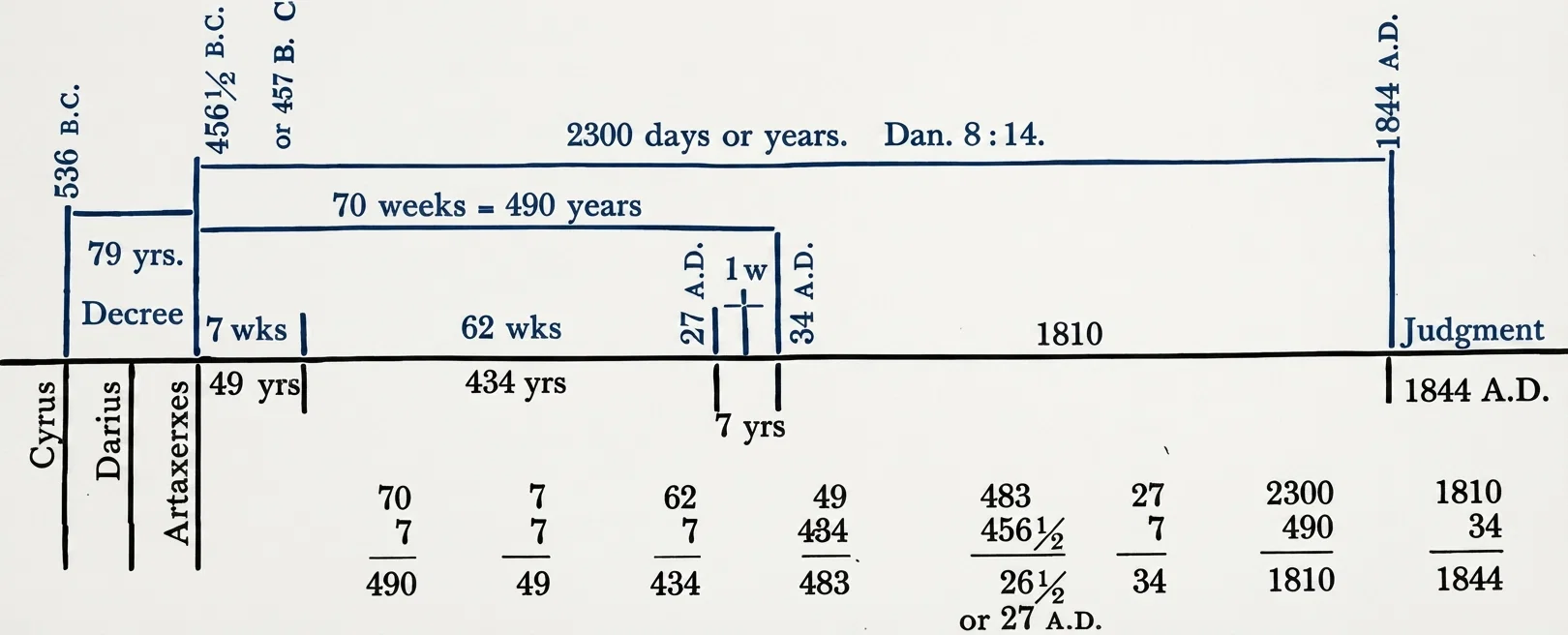
Wonderful changes were wrought in the history of the church during that four hundred ninety years. After the angel enumerated the events to take place during that period, he tells Daniel where to locate it in the history of the world, by announcing the date of the beginning of the period: "Know therefore and understand, that from the going forth of the commandment to restore and to build Jerusalem unto the Messiah the Prince shall be seven weeks, and threescore and two weeks: the street shall be built again, and the wall, even in troublous times." Dan. 9:24, 25. The long period of two thousand three hundred days, from which the seventy weeks, or four hundred ninety years, are taken, began with the going forth of the great threefold commandment (Ezra 6:14) to restore and build Jerusalem, which went forth in 457 B. C. This decree did not go into effect until about the middle of the year (Ezra 7:9), which would make the exact date for the going forth of the decree 456½ B. C.
Gabriel divides the seventy weeks into three divisions,—seven weeks, sixty-two weeks, and one week. Dan. 9:25-27. The prophet Nehemiah gives an account of the rebuilding of the walls during troublous times. The seven weeks and the sixty-two weeks, or sixty-nine weeks, were to extend to Messiah the Prince. Sixty-nine weeks equal (69×7) four hundred eighty-three days, or years. Four hundred eighty-three years from 456½ B. C. bring us to 26½ A. D., that is, to the spring of A. D. 27. Jesus at his baptism was anointed with the Holy Ghost, and henceforth was the Christ, the Messiah, the Anointed One. John 1:41 (margin); Luke 3:21, 22; Acts 10:38.
After the seven weeks and the threescore and two weeks passed, Messiah was to "be cut off, but not for himself." He died to atone for the sins of the world. After stating that the Messiah would be cut off, he adds, "He shall confirm the covenant with many for one week: and in the midst of the week he shall cause the sacrifice and the oblation to cease." Dan. 9:27. Christ's ministry after his baptism continued three and one-half years, or half a week, prophetic time. He was cut off in the midst of the seventieth week, but the entire seventy weeks were determined upon the Jews. Christ directed his disciples to begin their work at Jerusalem, and it was not until the stoning of Stephen, in A. D. 34, or three and one-half years after the crucifixion, that the gospel went to the Gentiles. The covenant was confirmed by the disciples (Heb. 2:3), who confined their labors to the Jews until A. D. 34, the close of the period cut off for that people. Acts 8:1-4.
The seventy weeks, or four hundred ninety years, ended in A. D. 34. Four hundred ninety years taken from the entire period of two thousand three hundred years leaves eighteen hundred ten years of the period remaining in A. D. 34 (2300—490=1810). This, added to A. D. 34, brings us to A. D. 1844 (34+1810=1844).
"Unto two thousand and three hundred days [years]; then shall the sanctuary be cleansed." Dan. 8:14. The earthly sanctuary had ceased to exist long before this date; but the time had come for the antitype of the cleansing of the sanctuary (the work performed on the day of atonement in the earthly sanctuary) to take place in the heavenly sanctuary. In 1844 the great court from which there is no appeal convened in the most holy place of the heavenly sanctuary.
This wonderful prophecy of two thousand three hundred years begins with the restoration of God's people to their earthly possessions and with the rebuilding of the holy city Jerusalem; but the Jews proved unfaithful to the trust, and the land of promise and the holy city passed from them into the hands of others. The coming of Christ and his death on Calvary, like a great seal, fixes definitely the entire prophecy, and insures the inheritance of the earth to the faithful; and the judgment, which opened at the close of that wonderful period of two thousand three hundred years, will give to the faithful a "court title" to the eternal inheritance and the city of God, the New Jerusalem.
Portland, Maine.

A Beautiful Type of Christ

H. A. ST. JOHN
THE pool of Bethesda (John 5:1-9) — what a wonderful sanitarium or water-cure! Was there ever another like it on earth? Continually open, wide and free, for all hopeless invalids from all kindreds, tongues, and peoples.
But after all, was not that a wonderful and beautiful type of Christ? It was located in the city of Jerusalem, a typical city, where existed and were enacted many services and ceremonies that were types of Christ and his work, all of which ceased when he, as the great antitype, came to earth, took man's nature, lived his example, and died his sacrifice. The devil, ignorantly no doubt, performed a very significant act, when he took Jesus and set him "on the pinnacle of the temple." Had we been there, and looked up at that particular time, we should have seen the Lamb of God, to whom all the services of that magnificent temple pointed, having come down from heaven, and sitting on that dizzy height, the pinnacle of the temple. Soon after, we should have seen the same great antitype, Jesus, hung between heaven and earth, on Calvary's cross; and hung there, too, by the same devil and his agents. At the crucifixion, Jesus caused the law of ordinances and oblations to cease. Type had met antitype.
The healing work accomplished at the pool of Bethesda was manifestly a miraculous healing by the Holy Spirit, through the ministration of Christ or his angel. When Christ came, he became a walking pool of Bethesda, and all who came to him were made whole of whatever disease they had. To Jesus, all diseases were alike; he made no inquiries as to the cause or nature of the disease; and no disease could resist his power. All his miracles were performed by the Holy Spirit through the ministration of holy angels. And in the personal, marvelous, instantaneous, and complete healing at the pool of Bethesda, we have a beautiful type of this prominent and important phase of the work of Christ among men.
At the pool multitudes waited and watched for the opportunity to have the healing virtue applied. Thus multitudes watched and waited for the troubling of the waters by the presence of Jesus, the Great Healer, in their neighborhoods or villages.
The antitype of Bethesda was met that Sabbath morning when Jesus quietly entered the enclosure, and without noisy ostentation, selected one of the most pitiable cases in the whole multitude, one of thirty-eight years' standing, just at the point of death, and made him every whit whole, without troubling the waters of the pool. Nor have we any proof that the waters were ever troubled again thereafter. The astounding miracle of healing the dying man in their midst was the signal for the multitude to find Jesus; and for ought we know, many did, and were healed; for he never turned any away.
Sanitarium, Cal.

The Supremacy of the Soul

“We are so constituted that the more our animal nature is curbed and restrained, the greater becomes the soul's supremacy over it; but, on the other hand, the more we indulge it and yield to its demands, the more we lose our power of self-control, until, at length, the will is utterly dethroned, and we are carried headlong down the path to hopeless disaster.”
Continue reading: Editorial