Your ShelfYour Projects

Signs of the Times, Vol. 23, No. 34.

A LESSON IN RULING

Signs of the Times

Sep 2, 1897

Pacific Press Publishing Company · Oakland, California · Sep 2, 1897

A LESSON IN RULING.
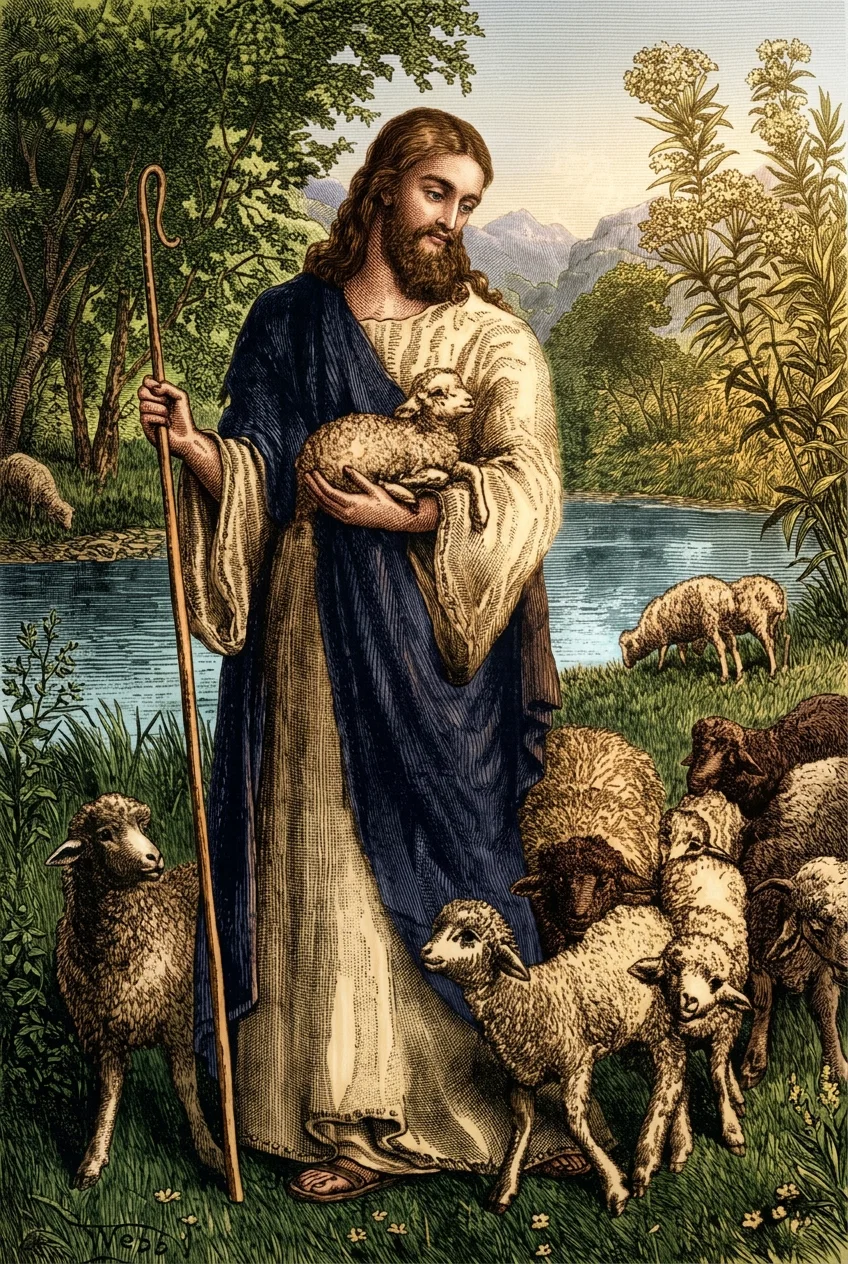
“THOU, Bethlehem Ephratah, tho thou be little among the thousands of Judah, yet out of thee shall He come forth unto Me that is to be Ruler in Israel.” Micah 5:2.
COMPARE this with Matt. 2:6, where it is quoted, and note the margin, which is closer to the original: “Thou Bethlehem, in the land of Judah, art not the least among the princes of Judah; for out of thee shall come a Governor, that shall feed my people Israel.”
THIS is the Holy Spirit’s own definition of the work of a true ruler or governor. We find it not in the nations of earth, nor in the apostate church, where the princes of the people “exercise dominion over them, and they that are great exercise authority over them,” but we do find it amongst the real followers of Christ, where greatness is according to the amount of service.
THE Danish Version, following the original Matt. 2:6 more closely than the English, has it: “Out of thee shall go a Prince who shall be My people Israel’s Shepherd.” This agrees with the marginal reading of our common version, for the duty of a shepherd is to feed the flock. But mark this, that the Ruler of Israel is the Shepherd of Israel; His work as Ruler of the people is to feed them.
SEE how beautifully this thought of a Shepherd-King is expressed in Isa. 40:10, 11: “Behold, the Lord God will come with strong hand, and his arm shall rule for him; behold, his reward is with him, and his work before him. He shall feed his flock like a shepherd; he shall gather the lambs with his arm, and carry them in his bosom, and shall gently lead those that are with young.”
THIS is the only kind of ruling that the Lord sanctions in his church. In Heb. 13:17 we read the exhortation, “Obey them that have the rule over you,” but here again we may learn from the margin that these “rulers” are guides—those who direct the people in the right way, as a shepherd. Christ is “the Prince of princes,” the Ruler over all; he leads his people, however, and does not drive them. He leads them where they will find food and safety.
THIS thought is emphasized by the fact that Christ as Ruler comes out of Bethlehem. Bethlehem, literally, is the “House of Bread.” Out of the house of bread comes the Ruler, whose work is to feed the people. How significant! More than this, he himself is the bread of life. In the house of God there is always an abundance of “the hidden manna,” enough and to spare. Here is a lesson for all who are in positions of authority in the church. Their work is to take the bread of life from the house of bread, to feed upon it themselves, and then feed the people with it. When they do this, their authority will be recognized by the people, even if questioned by the scribes and Pharisees.
E. J. W.

THE MOB SPIRIT.

The real strength of manhood is not manifested in fierce, strong passion, but in self-control. He is the strong man that remains calm and thoughtful when others go wild with frenzy. Yielding to uncontrollable impulse is a sign of weakness. When Rome became weak and degenerate, the passions of her people ran highest in her gladiatorial contests. In the closing years of the Jewish nation the weak, degenerate, impulsive people one day honored Christ, hailed him as king, and strewed his way with their garments; the next, led by demagogs, they became a mad mob and cried, “Crucify him, crucify him.” Thus it was in France prior to the revolution and the “reign of Reason.”
It may be easily seen by the thoughtful student that America is living Rome’s life over again. The same excitable mob spirit is seen in the great gladiatorial contests—prize-fights—of to-day, and among what are considered the coolest, hardest-headed, most self-controlled men, in the stock rings, wheat pits, corn exchanges, etc., in our great cities. Here is the description of a scene in San Francisco, Friday, August 20, in the wheat speculation:—
The most ignorant and apathetic spectator felt the contagious thrill course the length of his back and set his hair on end. No one could stop to reason about motives or meanings in such a place. The atmosphere was surcharged with electricity that put the nerves on edge and set the pulses pounding like hammer blows. No man in that room could truthfully say that he was absolute master of himself. . . . . There is but one means of physical relief in such a moment—to shout with all the power of one’s lungs. . . . It was unreasoning craziness born of a calculated purpose. The inspiration was carefully considered, but the frenzy was uncontrollable. It knew neither origin nor bounds. It was senseless, absurd, ridiculous, from a business man’s viewpoint, but not a soul in the hall could boast that he had not felt the sensation of helpless self-surrender to the contagion of the hour. It was useless to attempt to fight it off. It communicated itself insidiously and suddenly, and in a flash the victim was carried out of and beyond himself. Such is the spirit of gambling. . . .
Young men committed open and unprovoked assault upon their elders in that wheat pit. They mashed each other’s hats, tore each other’s coats.The strong pushed and pulled and bullied the weak in the struggle for the foremost place. It was no place for the timid or the coward. There was no money for him in that game. What was earned, was earned by unflinching nerve, backed by physical courage. Tall men overreached short men, and short men dodged under the arms of the tall men. What thin men lacked in momentum in the rush with their stouter brothers they supplied in their ability to scrooge through narrow places. But stout lungs were the weapon that wrought the greatest havoc and struck home with greatest sureness. The capacity to project one’s fractions hurtling through that hurly-burly was what secured deals and placed commissions of the operators.
Only sheer physical exhaustion could terminate such a scene. Brokers who went into that pit vigorous, sound of mind and limb and fearing nothing, emerged from the fray physical wrecks, trembling, weak with excitement, and worn in face and frame.”
—Examiner of August 21.
It is the “calculated purpose” of Satan and his agents to bring men to just such a condition as that. The arch-enemy desires to control them in that way, not only commercially, but religiously. And every yielding to his power increases the susceptibility. It has been said that this country will never persecute the honest, the humble, the conscientious, the God-fearing; but let a few magnetic leaders, inspired of Satan, in some popular, excitable assembly, lead out, and the crowds become mobs, enthusiasm becomes frenzy, and the shout of worship of yesterday becomes the cry of execration of to-day. If there is any man who ought to look at things calmly, it is the Christian. “Be sober” is an oft-repeated injunction. “Let your moderation be known unto all. The Lord is at hand.”

THE BEGINNING OF THE DAY.

Did the Bible Days Begin in the Evening, or the Morning?
I notice your statement that the Bible days begin and end with sunset, and you quote the passage, “The evening and the morning were the first day,” as your authority. I submit that it does not substantiate that statement. We might truthfully say that “the afternoon and the forenoon together make up the working day,” but it would not follow that the afternoon was the first part of the day, or the forenoon the latter part. Nor does it follow from the passage you quote, that the evening was the first, and the morning the latter part of the day in Bible times. Indeed, we have scriptural evidence that it was not so.
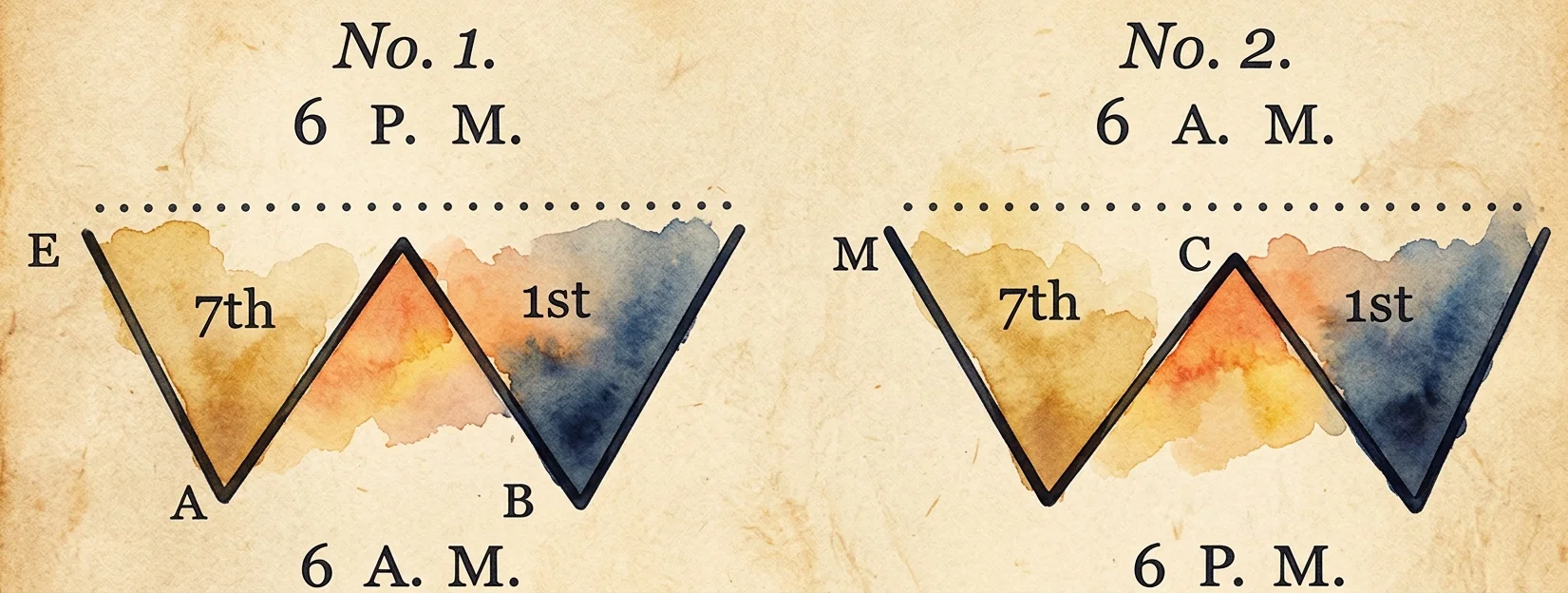
We are told in the account of the resurrection of Jesus (Matt. 28:1) that certain persons went to the tomb and found that the body was gone; and the time was stated to be, “In the end of the Sabbath, as it began to dawn toward the first day of the week.” I send a sketch to illustrate that passage, which will show it to be impossible that the days could begin with the morning. It consists of straight lines, each representing twelve hours of time, arranged in the form of a letter V, to represent the twenty-four hours of a day.
Supposing their upper ends, in No. 1, to represent sunset, at 6 P.M., their lower ends would be 6 A.M., and the two lines beginning at A would represent the seventh day, beginning at 6 P.M. and ending at 6 P.M. on the next day. The two similar lines joined on would represent the first day of the week.
Then the time when it began to dawn would be at the points marked A and B, on the two days. It is evident that the time referred to could not have been at A, because the Sabbath was not half gone then, and that would not be “in the end of the Sabbath.” Besides, it was still twenty-four hours from A to B, before it would begin to dawn towards the first day. So that a day beginning with sunset could not harmonize with that passage, either as to the end of the Sabbath or the dawn of the first day of the week.
Now let us look at sketch No. 2, in which the upper ends of the lines come at 6 A.M. and their lower ends at 6 P.M. In this case, the day begins at M, in the morning, and near the end of the Sabbath would come about at the point marked C; it would also be dawning towards the first day of the week at that same time. Does not that represent the times stated in that passage more correctly than sketch No. 1? It shows that the Bible days must have begun and ended in the morning not in the evening.
Moreover, the very words of that passage, rightly construed, say that the end of the Sabbath coincided with the dawning or morning of the first day of the week. Could language express it more positively or clearly? And does it not agree better with all notions of propriety and necessity? It also renders it certain that the Saviour did not rise on the first day of the week, as many have believed (and as might have occurred, if sketch No. 1 had truly represented the times), because the body was gone before the first day began. He rose on the Sabbath or seventh day of the week. Does not this clear up some of the points which have been discussed so long? I will not dwell upon them now, but leave them for you to bring before your readers as you think proper.
C. E. F.

Comments.

1. The expression, “The evening and the morning were the first day,” is not the only evidence God has given as to the beginning of the days; yet to an absolutely unprejudiced reader the obvious meaning of Gen. 1:5, 8, 13, 19, etc., is that the evening of the day came first. “And there was evening and there was morning, one day,” is the way the Revised Version reads. “And it was evening and it was morning, the first day.”—Rabbi Leeser’s version. “And the evening with the morning were the first day.”—Spurrell. And similarly all others we have consulted. The order in each and all places is the evening, the night, the dark part, first.
2. Ex. 12:14–18, where the feast of unleavened bread is enjoined, shows that the days began “at even.” See also Lev. 23:5, 32. “From even unto even, shall ye celebrate your Sabbath.” Compare also Judges 14:12, 17, 18. The seven days of the feast ended when “the sun went down” on the seventh day. Neh. 13:15–22 shows that the Sabbath—the day in respect to which all the other days were numbered—began with the sunset. “And it came to pass, that when the gates of Jerusalem began to be dark before the Sabbath, I commanded that the gates should be shut, and charged that they should not be opened till after the Sabbath,” etc.
3. In the Gospels the same thing is taught. Jesus healed on the Sabbath day, because it was lawful—according to the Sabbath law—to do good on that day. But the people, bound by tradition and fearing the priests, would not bring their sick on that day. They waited till evening, when the Sabbath was over, and then brought their sick. Thus the evangelists express it: “When the even was come” (Matt. 8:16), “And at even, when the sun did set” (Mark 1:32), “Now when the sun was setting, all they that had any sick with divers diseases brought them unto him” (Luke 4:40).
4. These texts are so plain, the custom among the Jews is so positive, that there is no question, so far as we are aware, among the best authorities. “The Jewish day was reckoned from evening to evening, probably because of a lunar calendar. The Sabbath was the only day with a name; the others were simply numbered.” See Schaff-Herzog Encyclopedia, Schaff’s Bible Dictionary, Smith’s Bible Dictionary, et al. Says Hales (Analysis of Chronology, vol. I, pp. 11, 12):—
It is remarkable that the evening, or natural night, precedes the morning, or natural day, in the Mosaic account. Hence the Hebrew compound evening-morning is used by the prophet Daniel to denote a civil day, in his famous chronological prophecy of the 2,300 days. Dan. 8:14. And also the Greek compound nuchthēmeron to denote the same. And hence Hesiod, the eldest of the Greek poets that have reached us, represents the occultation of the Pleiades as lasting nuktas te kai hēmata tessarakonta, forty nights and days, i. e., calendar days. [He also cites the ancient Gauls and Germans, and concludes] Thus is sacred history verified by primitive tradition, handed down to the present times, “the night seeming to usher in the day.”
The Egyptians, the Babylonians, and other sun-worshiping nations, began the day at sunrise, and worshiped toward the east. As the natural order of time, and as against this idolatry, the Lord placed the beginning of the day at sunset.
5. But what of Matt. 28:1? The text reads in our common version, “In the end of the Sabbath, as it began to dawn toward the first day of the week.” The expression, Opse de Sabbatōn, rendered “in the end of the Sabbath” (common version), may be translated “after the Sabbath.” Liddell and Scott’s Standard Lexicon defines opse as “after a long time, at length, late.” So Hales declares (“Analysis of Chronology,” vol. I, p. 16). Opse sabbaton is a phrase signifying “a good while after the Sabbath-day had expired, at the evening twilight on our Saturday, i. e., when the natural night was now far advanced.” So Philostratus uses Opse Trōikōn to denote “long after the Trojan [times].” Rotherham renders, “And late in the week, when it was on the point of dawning into the first of the week.” “The rendering ‘after the Sabbath,’ or ‘at a late hour after the Sabbath,’ is fully justified by quotations from Hellenistic writers, and is adopted by Fritzsche, Ewald, and De Wette.”—Bible Commentary. “In the end of the Sabbath,” or “after that the Sabbath was ended.”—Scott’s Bible. “In the end of the Sabbath. Opse de Sabbatōn. After the end of the week; this is the translation given by several eminent critics; and in this way the word opse is used by the most eminent Greek writers.”—Clarke on Matt. 28:1.
6. The above is sufficient to show that the Bible day began at sunset, and that Matt. 28:1 is not out of harmony with the uniform testimony of Scripture. But what of the claim that Jesus did not arise on the first day of the week? Well, it seems to us he did arise on that day. “Now when he was risen early on the first day of the week.” Mark 16:9, R. V. “And in the morning of the first day of the week, he arose.”—Syriac. “And, arising early on a first day of a week.”—Rotherham. “And having risen early on the first day of the week.”—Diaglott. “Now when Jesus had risen early on the first day of the week.”—Anderson. See also Mark 16:1, 2.
7. The resurrection on a first day or on a seventh day gives no foundation for a Sabbath or holy day whatever. God gives no ground for such a conclusion. Nowhere is first-day observance commanded, while on the other hand the Sabbath of the Lord is backed up by God’s eternal and immutable law and the example of Jesus Christ. The truth of God is not a matter of “notions of propriety and necessity” as men look upon it. To us there is no inharmon[y?] nor any necessity of discussion, unless men desire to establish a theory rather than to ascertain facts. This we trust our correspondent does not desire. May God lead him and all our readers into the simple truth as in Jesus.

Accepting Reproof Brings Understanding

The man who is too proud to acknowledge that he has been in error, is simply ashamed to declare that he knows more to-day than he did yesterday. Therefore the one who rejects the reproof which shows him his error, despises wisdom; but “he that heareth reproof getteth understanding,” and “abideth among the wise.” Prov. 15:31, 32.

Mary Presented as Christians’ Only Hope

“THERE is none other name,” the Word says, than that of Jesus, by which salvation comes. How effectually Mary has been placed by Roman Catholics in the stead of Christ is seen by the statement in the Roman Breviary, “Mary, thou art the only hope of Christians.”

A LESSON FROM THE THREE HEBREW CHILDREN.

“Nebuchadnezzar the king made an image of gold, whose height was three score cubits, and the breadth thereof six cubits; he set it up in the plain of Dura, in the province of Babylon. Then Nebuchadnezzar the king sent to gather together the princes, the governors, and the captains, the judges, the treasurers, the counselors, the sheriffs, and all the rulers of the provinces, to come to the dedication of the image which Nebuchadnezzar the king had set up. Then the princes, the governors, and captains, the judges, the treasurers, the counselors, the sheriffs, and all the rulers of the provinces, were gathered together unto the dedication of the image that Nebuchadnezzar the king had set up; and they stood before the image that Nebuchadnezzar had set up. Then an herald cried aloud, To you it is commanded, O people, nations, and languages, That at what time ye hear the sound of the cornet, flute, harp, sackbut, psaltery, dulcimer, and all kinds of music, ye fall down and worship the golden image that Nebuchadnezzar the king hath set up; and whoso falleth not down and worshipeth shall the same hour be cast into the midst of a burning fiery furnace. Therefore at that time, when all the people heard the sound of the cornet, flute, harp, sackbut, psaltery, and all kinds of music, all the people, the nations, and the languages, fell down and worshiped the golden image that Nebuchadnezzar the king had set up.”

A Confederacy to Establish Religion.

This scheme, devised in the counsel of Satan, was made in order to compel the three Hebrew children to obey human laws in direct opposition to the laws of Jehovah. The most learned of the nation, men who were noted for their aptness and educational advantages, thus worked to form a confederacy that would exalt the king of Babylon and excite enmity against the Hebrew captives. They prevailed upon the king to enact certain laws which these youth could not consent to respect.
The worship of the image which the king had set up, was made the established religion of the country. But the Hebrew children were determined not to dishonor the God of heaven, who made the world, and all things that are therein. Their God was the King of kings and Lord of lords, and they would serve him, at whatever cost.
“Wherefore at that time certain Chaldeans came near, and accused the Jews. They spake and said to the king Nebuchadnezzar, O king, live forever. Thou, O king, hast made a decree, that every man that shall hear the sound of the cornet, flute, harp, sackbut, psaltery, and dulcimer, and all kinds of music, shall fall down and worship the golden image; and whoso falleth not down and worshipeth, that he should be cast into the midst of a burning fiery furnace. There are certain Jews whom thou hast set over the affairs of the province of Babylon, Shadrach, Meshach, and Abed-nego; these men, O king, have not regarded thee; they serve not thy gods, nor worship the golden image which thou hast set up.” Hitherto the king had shown great regard for these youth. Their faithfulness in all their duties could not but increase his confidence in them, and he had exalted them to positions of high honor. But he was filled with rage that his word had been disregarded, and commanded that they be brought into his presence.
“Nebuchadnezzar spake and said unto them, Is it true, O Shadrach, Meshach, and Abed-nego, do not ye serve my gods, nor worship the golden image which I have set up? Now if ye be ready that at what time ye hear the sound of the cornet, flute, harp, sackbut, psaltery, and dulcimer, and all kinds of music, ye fall down and worship the image which I have made; well; but if ye worship not, ye shall be cast the same hour into the midst of a burning fiery furnace; and who is that God that shall deliver you out of my hands? Shadrach, Meshach, and Abed-nego, answered and said to the king, O Nebuchadnezzar, we are not careful to answer thee in this matter. If it be so, our God whom we serve is able to deliver us from the burning fiery furnace, and he will deliver us out of thine hand, O king. But if not, be it known unto thee, O king, that we will not serve thy gods, nor worship the golden image which thou hast set up.” The sentence of death did not change their decision. The martyrs knew what would lessen the fierceness of the fire kindling upon nerve and muscle. In beholding Christ, in the manifestation of his presence, the most cruel death was made bearable.

The Last Resort of a False Religion.

The last resort of the king of Babylon was force, and he put his terrible threat into execution. Filled with fury against these men for thus defying him, he commanded that the furnace should be heated seven times more than it was wont to be heated. “And he commanded the most mighty men that were in his army to bind Shadrach, Meshach, and Abed-nego, and to cast them into the burning fiery furnace. Then these men were bound in their coats, their hosen, and their hats, and their other garments, and were cast into the midst of the burning fiery furnace.” “Then Nebuchadnezzar the king was astonied, and rose up in haste, and spake, and said unto his counselors, Did not we cast three men bound into the midst of the fire? They answered and said unto the king, True, O king. He answered and said, Lo, I see four men loose, walking in the midst of the fire, and they have no hurt; and the form of the fourth is like the Son of God. Then Nebuchadnezzar came near to the mouth of the burning fiery furnace, and spake, and said, Shadrach, Meshach, and Abed-nego, ye servants of the most high God, come forth, and come hither. Then Shadrach, Meshach, and Abed-nego, came forth of the midst of the fire. And the princes, governors, and captains, and the king’s counselors, being gathered together, saw these men, upon whose bodies the fire had no power, nor was an hair of their head singed, neither were their coats changed, nor the smell of fire had passed on them.”

A Lesson for To-day.

The children of God to-day must not expect to meet less of persecution and trial than did these ancient worthies. Just as long as we are followers of Christ we must be witnesses for him. Tribulation will assuredly come; for Satan knows that Christ has purchased salvation for the whole world, and he is determined to wrest every soul possible out of his hand.
Christ forewarned his disciples of this, saying: “These things have I spoken unto you, that ye should not be offended. They shall put you out of the synagogues; yea, the time cometh, that whosoever killeth you will think that he doeth God service. And these things will they do unto you, because they have not known the Father, nor me. But these things have I told you, that when the time shall come, ye may remember that I told you of them.” It is not the world, who make no profession, from whom the persecution comes. It is those who profess to be doing God service who manifest the most bitter hatred.
But the man may have power to harm the bodies of those who exalt the law of God above all human enactments, he can not harm their souls. God’s grace will be given in every way proportionate to the trial suffered to come upon us. Christ has promised, “I will manifest myself to him;” “I will not leave you comfortless; I will come to you.” And again he comforts us with the words: “These things I have spokenunto you, that in me ye might have peace. In the world ye shall have tribulation; but be of good cheer; I have overcome the world.”
Our victory as believers is obtained through the grace of Christ, which he can and will bestow upon all who will put their trust in him. This is the good news with which Christ would have us comforted. In all the tribulation which the child of God must receive, whatever his position in the world, he may be of good cheer in contemplation of the truth that Christ has overcome the world.
It is a great thing to be right with God, the soul in harmony with its Maker. Amid the contagion of evil example, which by its deceitful appearance would lure the soul from duty, angels will be sent to our rescue. But if we invite temptation, we can not have divine aid to keep us from being overcome. The three worthies endured the fiery furnace, for Jesus walked with them amid the flames. If they had, of themselves, walked into the fire, they would have been consumed. Thus it will be with us. If we do not deliberately go into temptation, God will sustain us when the temptation comes.

Meet the Future by Meeting the Present.

But let no one think that an entirely new set of energies are to be communicated when we are brought into trying circumstances. We are to seek daily for the converting power of God. We should daily seek to recover in ourselves the moral image of God. Every affection, every attribute that has been perverted, must be restored by the grace of Christ. Lesser trials nobly borne under the control of God, will purify, refine, and ennoble us for endurance when the time shall come for greater test and greater trials.
Then let us look the future decidedly in the face, and say, “I can do all things through Christ which strengtheneth me.” We must cherish the presence of Christ, for we need him in the less as well as the greater trials. By a willingness for his sake to endure shame and reproach, by learning the meekness and lowliness of Christ, we shall prove the sincerity of our Christianity. When we are called to imprisonment and shame, when degraded by our fellow-beings, who are inspired by the spirit of Satan, God will give his grace to sustain us. His promise is, “As thy days, so shall thy strength be.”
The righteous have ever obtained help from above. How often have the enemies of God combined to destroy the character and influence of a few simple persons who trusted in God! But because the Lord was for them, none could prevail against them. Only let the followers of Christ be united, and they will prevail. Let them be separated from their idols and from the world, and the world will not separate them from God. Christ is our present, all-sufficient Saviour. In him all fulness dwells. It is the privilege of Christians to know that Christ is in them of a truth. “This is the victory that overcometh the world, even our faith.” All things are possible to him that believeth; and whatsoever things we desire when we pray, if we believe that we receive them, we shall have them. This faith will penetrate the darkest cloud, and bring hope to the drooping, desponding soul. It is the absence of this faith and trust which brings perplexity, distressing fears, and surmisings of evil. God will do great things for his people when they will put their entire trust in him. Christ will prove a never-failing source of strength, a present help in every time of trouble.
MRS. E. G. WHITE.

THE TWO GUIDES.

ONE day as I walked in the shadows, And my heart made ceaseless moan, There came a dark-browed stranger, And offered a heart of stone.
Would I take, and thus receive him, As my daily guide? quoth he. I should walk no more in the shadows, But down by the sun-kissed sea.
I accepted his offer gladly, And ever from that sad day, This sinister, dark-browed stranger, Walked by my side alway.
And always his evil counsel I took as my daily guide; He taught me to hate my fellows, And treat them with haughty pride.
My heart, that was once so tender, So tender, loving, and true, And filled with love for my neighbor, Harder than adamant grew.
My burden grew heavier daily, Till, almost crushed by its weight, I turned from my guide, who was filling My soul with the venom of hate.
One day when the wind was sighing, And moaning as if in pain, While drearily against the window Beat the chilling autumn rain,
I turned to my guide so evil, And bade him from me begone, And leave me alone in the shadows; And I gave back the heart of stone.
I spurned the gift, and the giver; He fled, and left me alone, Alone I walked in the shadows, While my heart made ceaseless moan.
I heard a step at the doorway, My name soft breathed on the air; I turned, and, lo, before me, Stood a Being wondrously fair!
His eyes were gently smiling, And around the forehead white, And over the flowing tresses, There shone a halo of light.
“My child,” He said, “I love thee, And if thou wilt bid Me stay, I will undo the work of the stranger, Whom thou hast turned away.
“My mission, to make thee better, Thy heart more tender and kind, To take thy life with its burdens, And pattern it after Mine.
“See: blood from My wounds is flowing; ’Twas shed on the cross for thee. O, give Me thy heart, let Me enter, Thy guide evermore to be!”
I knelt at His feet in rapture, Looked up in His face divine, “Dear Lord, take my heart forever, The heart that is rightfully Thine.”
Lo! soon the shadows were lifted, My heart forgot its sad moan, And it beat with the joy of gladness, As I wandered no more alone.
And mine are the love and the meekness, And gone is the arrogant pride. All the way through sunshine or shadow, I am led by my heavenly Guide.
MRS. NANNIE BEAUCHAMP JONES.
Baxter Springs, Kan.

The Worth of Want

Through want of a thing does its worth redouble. Through hunger’s pangs does the feast content, And only the heart that has harbored trouble Can fully rejoice when joy is sent. —Ella Wheeler Wilcox.

THE SINNER’S FRIEND.

We have seen in past articles that the Lord Jesus is the great Physician and the divine Teacher; but there is yet a nearer and dearer relationship which he assumes toward sinful man. Christ said to his disciples, “Henceforth I call you not servants; for the servant knoweth not what his Lord doeth; but I have called you friends; for all things that I have heard of my Father I have made known unto you.” John 15:15. “As the Father hath loved me, so have I loved you; continue ye in my love.” John 15:9.
Nor was the divine love confined to the inner circle of the chosen twelve. When the proud Pharisees reproached our Lord, calling him the friend of publicans and sinners, he did not deny the charge, but said, “I am not come to call the righteous, but sinners to repentance.” Matt. 9:13.
The love of Jesus reaches out to the vilest sinner; it embraces the whole human race. In the arms of infinite love our divine Friend desires to present each one faultless before his Father’s throne. This Friend is omniscient and omnipotent. He knows the grief we dare not breathe to mortal ear; he knows each trial and difficulty; he knows when we tremble and faint beneath the burden, and in tenderest compassion he says, “Come unto me, . . . and I will give you rest.” Matt. 11:28. He knows each feeble impulse toward the good and every secret inclination to sin; his power will help us to cherish the one and combat the other.
When the woman who was a sinner, accused by scribes and Pharisees, stood before Jesus, he read each heart, and as the conscience-stricken hypocrites went out one by one from his presence, he said to the woman, “Neither do I condemn thee; go, and sin no more.” John 8:11. And when, afterward, the sinful but repentant one came to Jesus as he sat at meat in the Pharisee’s house, “and stood at his feet behind him weeping, and began to wash his feet with tears, and did wipe them with the hairs of her head, and kissed his feet,” and anointed them with costly ointment, did he scorn the humble ministration?—No, but he said to the penitent woman, “Thy sins are forgiven.” “Thy faith hath saved thee; go in peace.” See Luke 7:38-50.
Is your life record marred and blotted? Have you sinned again and again? But are you repentant? Do you desire the Lord Jesus to be your Friend? He will not tell you nay.
“Not till earth, and not till heaven pass away.”
He has already laid down his life for you, and can he now refuse? “Greater love hath no man than this, that a man lay down his life for his friends.” John 15:13. “But God commendeth his love toward us, in that, while we were yet sinners, Christ died for us.” Rom. 5:8. Will we not respond to this
“Love divine, all excelling,”
by offering the heart’s best affections as a fitting acknowledgment? This is all we have to give; it is all he requires.
But how shall finite man show himself the friend of the infinite God? how show that the heart’s affections are consecrated to him? “Ye are my friends, if ye do whatsoever I command you.” John 15:14. “If ye keep my commandments, ye shall abide in my love; even as I have kept my Father’s commandments, and abide in his love.” John 15:10. “A new commandment I give unto you, That ye love one another; as I have loved you, that ye also love one another. By this shall all men know that ye are my disciples, if ye have love one to another.” John 13:34, 35. These words of our Lord are not generally heeded, and hence to acknowledge their claims involves a separation from the world. As said the apostle, “The friendship of the world is enmity with God.” James 4:4.
But said Jesus to his friends: “If the world hate you, ye know that it hated me before it hated you.” “The servant is not greater than his Lord. If they have persecuted me, they will also persecute you.” John 15:18, 20.
How the loving heart of the Saviour yearned over his chosen ones, as he was about to leave them to the persecutions of an ungodly world! How tenderly he pleads in their behalf: “Holy Father, keep through thine own name those whom thou hast given me, that they may be one, as we are.” “I pray not that thou shouldest take them out of the world, but that thou shouldest keep them from the evil.” “Sanctify them through thy truth.” John 17:11, 15, 17. Think not that this divine prayer was offered only for the chosen twelve: “Neither pray I for these alone, but for them also which shall believe on me through their word; that they all may be one; as thou, Father, art in me, and I in thee, that they also may be one in us.” John 17:20, 21.
And, O, most gracious petition of all: “Father, I will that they also, whom thou hast given me, be with me where I am; that they may behold my glory, which thou hast given me; for thou lovedst me before the foundation of the world.” John 17:24. Thus did the blessed Jesus declare himself the sinner’s Friend, and, “having loved his own which were in the world, he loved them unto the end.” John 13:1.
“O, for grace our hearts to soften! Teach us, Lord, at length to love; We, alas, forget too often What a Friend we have above.”
AUGUSTA W. HEALD.

ARE WE PREPARED FOR THE COMING OF CHRIST?

ARE our lamps trimmed and burning? Have we stored up plenty of oil with which to keep our lamps filled at his, our Bridegroom's, coming? Are we instant in duty, sowing beside all waters? Are we zealous in working for ourLord? Is self lost in Christ? Are we working with our whole heart, soul, and strength, keeping our eye single to God's glory? Are we dead to the world and alive to Christ? Are we made perfect in love? Are our hearts, our minds, our conversation in heaven?
“Out of the abundance of the heart, the mouth speaketh.” “Where our treasure is there will our hearts be also.” Are our treasures in heaven? Are we looking, waiting, for the return of our King as the bride waits in joyful, loving expectancy for the return of her lord, the happy bridegroom? Are we working with the faith that worketh by love? Do we love our neighbor as ourselves? Is every thought, every impulse, brought into subjection to the will of God? Are we obeying every command, keeping every precept, doing unto others as we would be done by? Is God all in all to us? Let each of our own hearts give answer under the all-seeing eye of Jehovah, who looketh upon the heart and judgeth not as man seeth.
MRS. MELISSA BARTON.
Denver, Colo.
Continue reading: RELIGION AND POLITICS UNITED