Your ShelfYour Projects

Review and Herald, Vol. 88, No. 46.

PREACHING THE LAST MESSAGE UPON MOUNT CARMEL

Review and Herald

Nov 16, 1911

Review and Herald Publishing Association · Takoma Park Station, Washington, D. C. · Nov 16, 1911
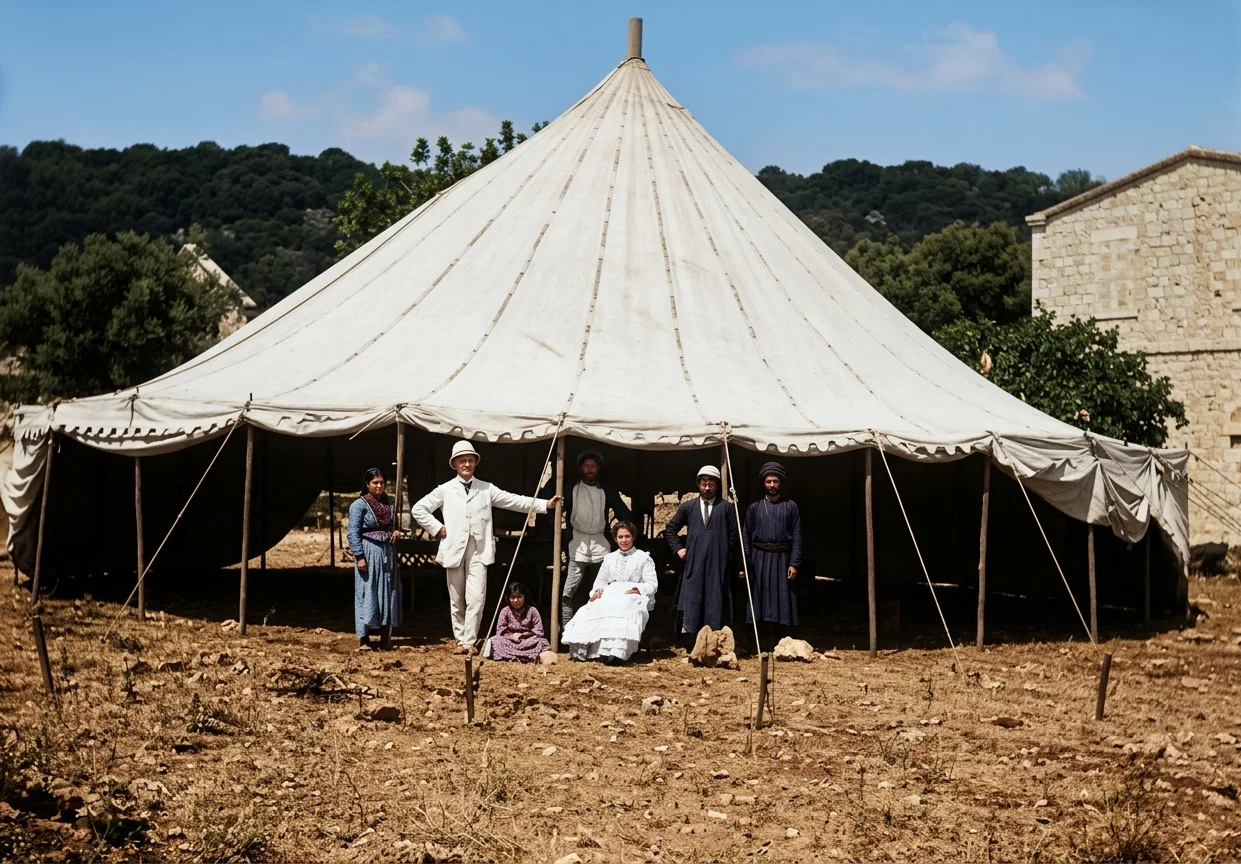
PREACHING THE LAST MESSAGE UPON MOUNT CARMEL

W. C. Ising
Within a few hundred yards from the place where this tent is pitched, Elijah of old gathered his pupils to train them for the cause of the Lord, that they might proclaim the worship of the living God. We, in these last days, for the first time are proclaiming the last gospel message to the colonists, who came here from Germany forty years ago. We invite the prayers of our people throughout the world that, as a result of this effort, some souls may be influenced to leave modern Baal, and take their stand with the only true God of Israel, in giving glory to Him in this solemn hour,

Here Is Just A Taste

Of the November-January Issue of

The Protestant Magazine

See pages 20, 21, of this number of the Review for the two striking pictures that appear as frontispieces in this issue of the Protestant Magazine.
On the cover pages appear the following artistic Protestant utterances, the titles of which are: “The True Apostolic Succession,” “Our Theses,” and “A Timely Warning.”
Here are the titles and the first few lines of some of the articles in this number, which will quicken the pulse of every true Protestant who reads them.
We print the first one in the same large, beautiful type that helps to make this magazine so popular with all classes:—

ROME AND DEMOCRACY

AUGUSTINE BAUMANN, FORMERLY FATHER AUGUSTINE, OF THE PASSIONIST MONASTERY, WEST HOBOKEN, N. J.
WHAT a scandal it is to many a sincere Roman Catholic in America to tell him that his church condemns democracy! The average Catholic is indig-

OUR AIM

WE believe that Roman Catholicism as a system of doctrine is a deception and a delusion, and that the Pope is the man of

PORTUGAL AND AMERICA

A FORMAL protest against the provisions of the law of separation recently enacted in Portugal has been signed by eleven bish-

ROME’S PLAN TO EXCLUDE AN- TICATHOLIC PUBLICATIONS FROM THE MAILS

THERE was organized ten years ago (Dec. 10, 1901) the American Federation of Catholic Societies. Commencing its exist-

THE “OUTLOOK’S” MISTAKEN VIEW OF ROMANISM

SOME one needs to be enlightened on a question of the utmost importance to the religious and political future of this coun-

AN INDICTMENT OF ROMANISM

ONE of the recent contributions to the controversy with Rome is in the form of a series of letters to Pope Pius X in which

THE PRIVILEGE OF PETER

THE next step in the inquiry is to ascertain what claims St. Peter himself, by his acts or writings, makes to supreme personal au-

AN INTERPRETATION OF THE MASS

AT the opening of the Eucharistic Congress at Cincinnati, Ohio, Sept. 29, 1911, Archbishop Ireland preached a sermon upon

ROME’S ORGANIZED FORCE

THERE are many organizations and societies of various sorts in the Roman Catholic Church. Each one may have some spe-

“NONE BUT CHRIST”

THIS declaration, as has been well said, constitutes “the center word of Protestantism.” It means the rejection of every

PROTESTS BY PRESBYTERIANS AND SEVENTH-DAY ADVENTISTS

IT was no uncommon thing a half century or more ago for vigorous protests to be made, both by individuals and by organiza-

SUBSCRIBE TO-DAY

Yearly subscription, 25 cents; Single copy, 10 cents. Send 50 cents and we will mail you all of the copies for 1911 and 1912. The back numbers are becoming scarcer every day.
Send $1.50 or $3.00 with your list of 10 or 20 names, and we will mail the magazine to each person for one year.

THE PROTESTANT MAGAZINE

WASHINGTON, D. C.
Send All Orders Through Your Conference Tract Society If you do not know the address of your tract society, ask the publishers of this paper

J. A. STRICKLAND

Vesper-Bells

J. A. STRICKLAND

Low sinks the sun, and evening shadows falling / O’er moor and plain, on mountainside and crest, / Night’s curtain drops, while voices soft are calling / To weary toilers, “Come to me and rest.”
Wafted on evening’s wings, so softly ringing, / I hear a sweet and solemn sound, that swells / In volume grand, like happy children singing: / It is the vesper-bells.
What mean those bells, so softly, sweetly tolling? / Is it a call to worshipers to come / And join the throng with voices loud extolling / Man’s will and mighty works that he has done?
No; ’tis the tramp of time’s events fulfilling / Things that God’s Word so certainly foretells. / Listen, O earth! with ready mind and willing: / It is time’s vesper-bells.
Hark! hear the sound of martial music swelling / O’er all the lands and ocean’s foamy wave: / Alarm is felt wherever man is dwelling; / Hearts filled with fear, men’s faces sad and grave; / Tempest and scourge through all the world are sweeping; / Sin, crime, and woe, earth’s long-loved peace expel; / Gladness is gone, and mirth gives place to weeping: / It is earth’s vesper-bell.
Ring on, ye bells, your solemn message giving, / Proclaim that time will soon have run its race; / Send forth the news of warning to all living, / That soon we’ll see our blessed Master’s face. Soon Armageddon’s hosts will rage in terror, / Soon break the bars of Satan’s prison cells, / Soon Christ will come and end the reign of error: / O hear the vesper-bells!
These things foretell the coming of our Saviour, / Sure omens that sin’s rule is soon to cease; / Darkness departs, and then eternal favor, / Home, home at last! Blest home of joy and peace! / List for the trump and for the chariot’s rumbling; / Look up, thank God for what the message tells. / E’en now I hear the sound of nations crumbling: / I hear the vesper-bells.
Harvey Station, New Brunswick.

Paul Before Agrippa

MRS. E. G. WHITE
PAUL had appealed to Cæsar, and Festus could not do otherwise than send him to Rome. But some time passed before a suitable ship could be found; and as other prisoners were to be sent with Paul, the consideration of their cases also occasioned delay. This gave Paul opportunity to present the reasons of his faith before the principal men of Cæsarea, and also before King Agrippa II, the last of the Herods.
“After certain days King Agrippa and Bernice came unto Cæsarea to salute Festus. And when they had been there many days, Festus declared Paul’s cause unto the king, saying, There is a certain man left in bonds by Felix: about whom, when I was at Jerusalem, the chief priests and the elders of the Jews informed me, desiring to have judgment against him.” He outlined the circumstances that led to the prisoner’s appeal to Cæsar, telling of Paul’s recent trial before him, and saying that the Jews had brought against Paul no accusation such as he had supposed they would bring, but “certain questions . . . of their own superstition, and of one Jesus, which was dead, whom Paul affirmed to be alive.”
As Festus told his story, Agrippa became interested, and said, “I would also hear the man myself.” In harmony with his wish, a meeting was arranged for the following day. “And on the morrow, when Agrippa was come, and Bernice, with great pomp, and was entered into the place of hearing, with the chief captains, and principal men of the city, at Festus’ commandment Paul was brought forth.”
In honor of his visitors, Festus had sought to make this an occasion of imposing display. The rich robes of the procurator and his guests, the swords of the soldiers, and the gleaming armor of their commanders, lent brilliancy to the scene.
And now Paul, still manacled, stood before the assembled company. What a contrast was here presented! Agrippa and Bernice possessed power and position, and because of this they were favored by the world. But they were destitute of the traits of character that God esteems. They were transgressors of his law, corrupt in heart and life. Their course of action was abhorred by heaven.
The aged prisoner, chained to his soldier guard, had in his appearance nothing that would lead the world to pay him homage. Yet in this man, apparently without friends or wealth or position, and held a prisoner for his faith in the Son of God, all heaven was interested. Angels were his attendants. Had the glory of one of those shining messengers flashed forth, the pomp and pride of royalty would have paled; king and courtiers would have been stricken to the earth, as were the Roman guards at the sepulcher of Christ.
Festus himself presented Paul to the assembly with the words: “King Agrippa, and all men which are here present with us, ye see this man, about whom all the multitude of the Jews have dealt with me, both at Jerusalem, and also here, crying that he ought not to live any longer. But when I found that he had committed nothing worthy of death, and that he himself hath appealed to Augustus, I have determined to send him. Of whom I have no certain thing to write unto my lord. Wherefore I have brought him forth before you, and specially before thee, O King Agrippa, that, after examination had, I might have somewhat to write. For it seemeth tome unreasonable to send a prisoner, and not withal to signify the crimes laid against him.”
King Agrippa now gave Paul liberty to speak for himself. The apostle was not disconcerted by the brilliant display or the high rank of his audience; for he knew of how little worth are worldly wealth and position. Earthly pomp and power could not for a moment daunt his courage nor rob him of his self-control.
‘I think myself happy, King Agrippa,’ he declared, ‘because I shall answer for myself this day before thee touching all the things whereof I am accused of the Jews: especially because I know thee to be expert in all customs and questions which are among the Jews; wherefore I beseech thee to hear me patiently.’
Paul related the story of his conversion from stubborn unbelief to faith in Jesus of Nazareth as the world’s Redeemer. He described the heavenly vision that at first had filled him with unspeakable terror, but afterward proved to be a source of the greatest consolation,—a revelation of divine glory, in the midst of which sat enthroned Him whom he had despised and hated, whose followers he was even then seeking to destroy. From that hour Paul had been a new man, a sincere and fervent believer in Jesus, made such by transforming mercy.
With clearness and power, Paul outlined before Agrippa the leading events connected with the life of Christ on the earth. He testified that the Messiah of prophecy had already appeared in the person of Jesus of Nazareth. He showed how the Old Testament Scriptures had declared that the Messiah was to appear as a man among men, and how in the life of Jesus had been fulfilled every specification outlined by Moses and the prophets. For the purpose of redeeming a lost world, the divine Son of God had endured the cross, despising the shame, and had ascended to heaven triumphant over death and the grave.
Why, Paul reasoned, should it seem incredible that Christ should rise from the dead? Once it had thus seemed to him; but how could he disbelieve that which he himself had seen and heard? At the gate of Damascus he had verily looked upon the crucified and risen Christ, the same who had walked the streets of Jerusalem, died on Calvary, broken the bands of death, and ascended to heaven. As verily as had Cephas, James, John, or any others of the disciples, he had seen and talked with Jesus. The voice had bidden him proclaim the gospel of a risen Saviour, and how could he disobey? In Damascus, in Jerusalem, throughout all Judea, and in the regions afar off, he had borne witness of Jesus the crucified, showing all classes ‘that they should repent and turn to God, and do works meet for repentance.’
‘For these causes,’ the apostle declared, ‘the Jews caught me in the temple, and went about to kill me. Having therefore obtained help of God, I continue unto this day, witnessing both to small and great, saying none other things than those which the prophets and Moses did say should come: that Christ should suffer, and that he should be the first that should rise from the dead, and should show light unto the people, and to the Gentiles.’
The whole company had listened spell-bound to Paul’s account of his wonderful experiences. The apostle was dwelling upon his favorite theme. None who heard him could doubt his sincerity. But in the full tide of his persuasive eloquence he was interrupted by Festus, who cried out, ‘Paul, thou art beside thyself; much learning doth make thee mad.’
The apostle replied, ‘I am not mad, most noble Festus; but speak forth the words of truth and soberness. For the king knoweth of these things, before whom also I speak freely: for I am persuaded that none of these things are hidden from him; for this thing was not done in a corner.’ Then, turning to Agrippa, he addressed him directly: ‘King Agrippa, believest thou the prophets? I know that thou believest.’
Deeply affected, Agrippa for the moment lost sight of his surroundings and the dignity of his position. Conscious only of the truths which he had heard, seeing only the humble prisoner standing before him as God’s ambassador, he answered involuntarily, ‘Almost thou persuadest me to be a Christian.’
Earnestly the apostle made answer, ‘I would to God, that not only thou, but also all that hear me this day, were both almost, and altogether such as I am,’ adding, as he raised his fettered hands, ‘except these bonds.’
Festus, Agrippa, and Bernice might in justice have worn the fetters that bound the apostle. All were guilty of grievous crimes. These offenders had that day heard the offer of salvation through the name of Christ. One, at least, had been almost persuaded to accept the grace and pardon offered. But Agrippa put aside the proffered mercy, refusing to accept the cross of a crucified Redeemer.
The king’s curiosity was satisfied, and rising from his seat, he signified that the interview was at an end. As the assembly dispersed, they talked among themselves, saying, ‘This man doeth nothing worthy of death or of bonds.’
Though Agrippa was a Jew, he did not share the bigoted zeal and blind prejudice of the Pharisees. ‘This man,’ he said to Festus, ‘might have been set at liberty, if he had not appealed unto Cæsar.’ But the case had been referred to that higher tribunal, and it was now beyond the jurisdiction of either Festus or Agrippa.

The Two Fires

OTTO M. HAYS
EARTHLY fire is of two kinds: that which awes us with the spectacle of a burning building, and that which cheers us from the wintry grate.
Such also is the great difference between the two flames of religion: the one burns steadily and cheerfully in the Christian heart, radiating everywhere its warmth and comfort; the other leaps into the air in mighty flames, sending out on all sides the sparks and cinders of fanaticism, and attacking in its fury the established beliefs and doctrines of centuries.
There is a vast, inconceivable difference between divine fervor and dangerous fanaticism. Let us consider the source of the true fire and its workings, and in doing so contrast the fallacy of the false fire.
The world to-day is full of religious fire, but it is principally the ephemeral enthusiasm of humanity, or the emotion stirred by eloquence, or zeal for some human cause, or some selfish motive. But the true, inspired flame of religion is lighted on the altar of self-renunciation.
We find that the source of the true fire is in Jesus Christ; for no religious emotion or experience that fails to recognize sin and the sacrifice of our Saviour is acceptable to God or safe for man. We find the false fire originating in mere human emotion, intellectual culture, heart-stirring eloquence, or selfish zeal. It may even come from a spirit of fear or a guilty conscience. Remorse often carries with it a deep conviction of sin, yet has no saving power. The Holy Spirit must be an abiding presence if we are to have true spiritual life or acceptable worship. The true fire depends for fuel on the Word of God, while the false fire burns on human reasoning or the revelation of the imagination. Nadab and Abihu wanted to magnify their importance, and show that they were just as good as Moses and Aaron.
The greatest blessing of the true fire is complete purification, which is everlasting. It can not be said of false fire that it gives any blessing, either general or particular. The fire emanating from the Holy Spirit seeks its way to and consumes everything sinful, revealing it in the most glaring and humbling light.
The true fire warms and blesses; the false criticizes and judges. The fire of God burns gentle and tender, is free from strife and harshness, easy to endure, and sweet, though strong and everlasting. God gives us as our birthright a spirit not only of power, but of love. If we sell this birthright for a mess of pottage, we desecrate the divine gift and sin against the Giver.
In every course of life we find the channels of true and false fire, each working its own destiny. The flames invade everywhere, leaving in their path conditions either better or worse. The fire of God working in men's hearts renews faith long grown cold; cheers the young, sanctifies the gray-headed, rebukes sin, encourages virtue; quickly sows the world broadcast with the seed of love, that man may reap a harvest for time everlasting.
The fire of God kindled in the heart of Paul turned the world upside down; the fire of God in the heart of Luther brought about the Reformation; the fire of God in the heart of Livingstone opened Africa to the civilized world;the fire of God in the heart of Hudson Taylor penetrated the closed walls of China, and turned that nation of heathenism into the pathway of Christianity. Men of all ages have bowed their heads, and thanked God for the flames that turned their lives and made Christianity possible.
O my brother, look to the flames of your heart and see what burns there! Pray for the baptism of that fire which endues with the Holy Spirit, that your soul may become a burning and shining light.
Lakeland, Fla.

Praying to God, and Forgiving Others

WILLIAM COVERT
We desire that God shall answer our prayers; and he does when conditions make it possible. But there should be an agreement in our souls with the Spirit of God when we pray. To come as a suppliant before God with a heart calloused by malice is but an attempt to reconcile God with our sins.
A lesson early to be learned, is that if we love God, we also love our fellow men. The love which the Holy Spirit puts in our hearts is God’s love, and that love makes us love as God loves.
That wonderful promise in Mark 11:24, regarding answer to prayer, closes with this admonition: “And when ye stand praying, forgive, if ye have aught against any: that your Father also which is in heaven may forgive you your trespasses.” Mark 11:25.
This same lesson follows the model on prayer given by Christ in the sixth chapter of Matthew. There he says: “If ye forgive men their trespasses, your Heavenly Father will also forgive you: but if ye forgive not men their trespasses, neither will your Father forgive your trespasses.” Matt. 6:14, 15.
Our Saviour and his apostles have safeguarded their lessons on prayer and its answers with admonitions relating to tenderness of heart and forgiveness of others on our part. Even the golden rule is set with many beautiful promises, and God’s goodness to us is assigned as a reason for this rule. Since God is so good in answering the prayers of men, men should certainly be good in helping men; “therefore all things whatsoever ye would that men should do to you, do ye even so to them: for this is the law and the prophets.” See Matt. 7:7-12.
This divine rule for human equity is the inevitable “therefore” for the man who would plead with God to bestow favors upon him. When God answers a man’s prayers, that man is logically classified in character with God, and he should consider himself as in honor bound to bless other men, as far as his ability and sphere will allow. The blessing he receives in answer to his prayers puts him in touch with the Spirit of heaven, and he is then expected to conduct himself as one whose citizenship is in heaven. It does not seem that a man can pray in faith until he lives in the atmosphere of God’s love; and when he does so live, he can exercise love for his fellow men as God exercises love for him.
Is not our daily course in life a manifestation of what our real heart prayers are? If in our prayers we get into the real heart and soul of heaven, then the character of heaven is manifest in us, and through us God is manifesting himself to others.
It is this divine life in us that draws others to God, and without this we can not be soul-winners for God. If deep down in our souls we feel a tender, forgiving spirit for those who do wrong toward us, we may then know that God in tender compassion is exercising forgiveness toward us. With this spirit in the soul, one feels at home with God, as a son feels at home in the presence of his father, and it is then we can truly in prayer call him our Father. These lessons we should learn so that we may understand how to pray.
Chicago, Ill.

Help From the Bible

You have a Bible; do you own it? You hold it in your hands; do you hold it in your heart? You read it; do you feed on it?
The Bible is the medicine-chest given us by the Great Physician. Are the labels on the sixty-six vials eloquent to you? Do you know for what each is a remedy? or do you take them at haphazard and in the dark?
There are two primary mistakes with regard to the Bible. One is not to read it at all; the other is not to read it with a purpose. And so there are two primary directions for the use of the Bible. One is, Read it. Read it regularly, read it perseveringly, read it in large measure, perhaps a book at a time. The other is, Always read it for power,—power over doubt, power over grief, power over temptation. Tempted souls have gone to the Bible, opened it at ignorant random, and hit upon a vein of the gold they sought; for the Bible is rich in precious ore. But others have blundered upon no discovery, and have scouted the Bible as a useless book.
Not thus does the wise gold-seeker go to work. He prospects the mountains, valley after valley, spur after spur, peak after peak. He learns the strata, what they are, how they lie, what each contains. To this he goes for lead, to that for zinc, to another for silver. He could guide you along any path in the dark, and when he strikes pick, it is not in vain.
So it is with this mountain range of the Bible. A friend may point out one rich outcropping or two, but it is only a shift for the time. You must know the Bible through and through for yourself. No one knows whether the Bible can help him or not until he has read it from cover to cover, in sections large enough to give comprehensive views, with aids sufficient to insure understanding, and with a definite purpose systematically pursued. In no inferior fashion would you survey a farm offered for sale; and surely the Bible has as much promise for you as a farm. Therefore, O tempted soul, book after book, from Genesis to Revelation, pursue the sacred journey! Tarry not with the beauties and delights that crowd upon you. ‘Keep an eye single for one discovery,’—help against temptation. And wherever you find this help, plainly mark it in the margin, returning to the spot over and over, and reviewing its wisdom till it has joined itself to your soul. If you read the Bible with this one aim, there are few pages you will not mark; just as there are few pages you will not mark if you read the Bible with any other aim.
From the fall of man in the opening chapters to the doom of the wicked and the reward of the righteous in the closing chapter, the entire Bible is a treatise on temptation and its conquest. The stories of Adam, Eve, Cain, and Noah; of Abraham, Lot, Esau, and Jacob; of Joseph, Moses, Miriam, and Aaron; of Balaam, Joshua, Samson, and Gideon; of Eli, Samuel, Saul, David, Absalom, and Solomon; of Rehoboam, Jeroboam, Ahab, and Elijah; of Esther, Ezra, Nehemiah, Jeremiah, and Daniel; of Amos and Micah; of John the Baptist and Jesus our Lord; of Mary Magdalene; of Judas, Peter, and Paul,—all the names I have mentioned, and scores of names I might add, are pictured in the Bible as conquerors or victims of temptation.
It was prophesied of John the Baptist that he should live in the spirit and power of Elijah; and he did. So may all who will read the Bible live in the spirit and power of both John and Elijah, and of all the other men and women of God, who have overcome themselves and the world. It is possible, reading and thinking long of a noble character, to incorporate his personality into our lives; it is not only possible, it is inevitable. You have read your Bible to little purpose unless you, too, become an Elijah, a John the Baptist.
You will never know what portion of the wonderful Book will aid you most or next. I remember that once I was greatly helped in temptation by reading the story of the woman who touched Christ’s robe in the crowd. To this day, though it was years ago, I can feel thethrill with which I realized that the slightest contact of faith with Christ would heal me of my sin.
Many another passage has come to me, at the time of need, with a message as fresh and startling as if God had spoken from the air above my head. Yet they might all be ineffective in your temptations, while your discoveries might be meaningless to me. For no man owns the whole Bible. It is too large for that, and our experience is too small. Every man makes his own Bible—a Bible constantly growing, if he grows, but always a smaller Bible than the Scriptures. It is a great thing to make a Bible—one of the greatest things any man ever does. For no one can make a Bible except through making his own, one by one, the experiences of the Bible heroes and saints. Did any one ever add all the psalms to his Bible? or all of the letter to the Romans?
The Bible you make is the only one you can really use. It is not using a passage to hunt it up with a concordance and dig out its meaning with a commentary, any more than it is using your house to prove title in a court of law. You use your house when you live in it, and so with a Bible passage. And what a lordly palace the Bible is! There are rooms we never enter. There are ranges of rooms that are as unfamiliar as a stranger’s house. How little of our Bibles we have really moved into! It was only the other day that I moved into First and Second Corinthians. Just now they are my favorite rooms. I am still in the new delight of discovery of those twelve connected galleries, the minor prophecies. And in every room I find surprises of usefulness and beauty all the time.
It is easy to think that you are making a Bible when you are not. No Bible is yours till you use it. You do not use it until it has become an instinct.
You do not use your Bible if, when you are tempted, you must say to yourself, “Now is there anything in Paul’s writing that fits this temptation? Let me see—Romans, Corinthians First, Second, Galatians, Ephesians, Philippians, Colossians; perhaps the armor chapter would fit; I will look it up.” Satan would deal his decisive stroke long before that. No; you are using Paul’s writings if, as soon as the temptation assails you, your thought leaps to its weapons: Keep the body under; mortify the flesh; crucified with Christ; with the temptation the way of escape; in all points tempted like as we are; stand, therefore; resist unto blood, striving against sin. This is to be a Paul and to own his writings, that is to say, his spirit and power.
A paper Bible will not answer; only a memory Bible will avail in the combat with the devil. He likes best to fight in the darkness, when you can not see to read; in your feebleness, when you are too weary to hunt up a book; in your despondency, when heart and will are broken. Sin flashes upon you through your instincts, the baser ones; therefore I say the Bible can not help you till it also has become an instinct, a holy one. How shall we exalt the Bible into an instinct?—Only by meditation and obedience.
By meditation. No hasty wooing wins a great truth. If you want the Bible, you must pay the price; and part of the price is time and patience. A lifetime of courageous living is in the six pages of Amos, and will you make them your own in half an hour? And by obedience. No one has a larger Bible than he obeys. No one can enlarge his Bible except by obeying more. That story of the woman who touched Christ’s garment is yours only as you also reach out the finger of faith. Paul’s armor is yours only as you engage in Paul’s battles.
To think about the Bible so much that we can not help thinking about it, and obey it so heartily that obedience becomes a habit,—this is the way to make the Bible a help in temptation.
It is a noble art—that of meditation. To start out in the day with some magnificent thought, like Paul’s “I buffet my body.” To recur to it, in the interstices of work and play. To reason with ourselves, “Now, what did Paul mean by that? What experiences led him to it? How did he illustrate it? What literal meaning has it for me? What spiritual significance? Have I done it? Am I doing it? If not, why not, and how can I do it?” To talk about it with one’s friends. To look for accidental side-lights upon it, such as are sure to come. To review it all at night, and ask God’s blessing upon it, and his Spirit to lead still farther into its truth,—all this is only a hint of the business of meditation.
And it is a still more noble art—that of obedience. The obedience that does not bandy arguments, nor palter, nor postpone. The obedience that listens eagerly and with poised powers. The obedience that exults in the authority back of the command, and is proud of a post under it. The obedience that leaps and laughs. Our age of silly independence knows little of this, as, in its silly bustle, it knows little of meditation. The more one obeys, the better he obeys he meditates and the more rejoicingly. The more one obeys, the better he obeys and the more happily. Make but a purposeful beginning, and you will soon make your Bible and your life.—Amos R. Wells, in ‘Help for the Tempted.’

The Latter Rain

WORTHIE HARRIS HOLDEN
Like the dew of early morning, And the rain upon the field, The crescendo of the dawning, And the power the wind doth yield, Is the Holy Spirit’s moving On the heart renewed by grace, While in tenderness reproving, All the sin-blight to efface.
’Tis a day of mighty blessing For the Israel of God That his glorious name confessing, We may walk the path he trod; ’Tis the hour of God’s appointing For a quick work to be wrought. Bare thy soul for his anointing, Gleaning sheaves the Master bought.
Portland, Ore.

“That Old Jewish Sabbath”

LESLIE LITTELL.
When we present the claims of the Sabbath, many say, “We do not have to keep that old Jewish Sabbath.” They reject the Sabbath because they think it is a Jewish Sabbath.
The Bible was written by the Jews. Why not reject it because it is a Jewish Bible?
Jesus was a Jew. Why not reject him because he is a Jewish Saviour?
Jesus says, “Salvation is of the Jews.” Why not reject it because it is a Jewish salvation?
The New Jerusalem will have twelve gates named after Jewish tribes. Why not refuse to go into that beautiful city because you have to go through Jewish gates?
None but true Israelites will ever inhabit the new earth. Why not refuse to become an inhabitant of that beautiful world because it necessitates your becoming a true Israelite?
Jesus is to be King of that world. Why not refuse to have him to be king over you because he will be a Jewish King?
May the Lord change us so that we shall be true Israelites indeed and in truth.
Bentonville, Ark.

Conditions of Effectual Prayer

N. W. VINCENT
If I my ear turn from God's Word, My prayer, though loud, will not be heard; And if one sin I dare to cherish, Unanswered prayer leaves me to perish.
I must forgive, to be forgiven; Spite, vengeful wrath, shut souls from heaven. Not vain nor selfish be my prayer; For fellow souls, God, give me care.
I ask alone in Christ's dear name, Who once for us the world o'ercame; God, fill my prayer with thankful praise For what he is, for all his ways.
Caney, Kan.

The Grace of God

H. E. SAWYER-HOPKINS
Have you ever noticed Paul's statement, “Most gladly therefore will I rather glory in my infirmities, that the power of Christ may rest upon me”? 2 Cor. 12:9. Why does he make this declaration? Let him answer (last part of verse 10): “For when I am weak, then am I strong.”
The manifestation of God's power is seen in behalf of the weakness of his people; and a realization of the Lord's presence was worth so much to Paul that for its sake he was willing to suffer all he might be called to pass through. When buffeted by Satan, Paul sought the Lord thrice for relief. In answer to his earnest entreaties, the Great Restorer said to him: “My grace is sufficient for thee: for my strength is made perfect in weakness.” Blessed assurance!
How many of modern Israel can take pleasure in infirmities, in reproaches, in necessities, in distresses for Christ's sake? What about the little vexations of life we have to contend with? How we try to escape these buffetings of the enemy! Is it not time we learned to trust the Almighty more fully? Then we could say from the depths of the heart, God's matchless grace is sufficient for all things.
Long Beach, Cal.

Do You Know the Lord ?

WE desire to address this question to every reader of our church paper: Do you know the Lord? The question is a pertinent one for every reader to consider, for the writer to consider as well. You may be a member of the church, doubtless you are; but there are some members of the church, some professed Christians, who really do not know the Lord.
We are all busy men and women, busy in our individual experiences of gaining a livelihood and caring for our families. We are a busy denomination. We have a great and important message to carry to the world. We are straining every energy to carry it forward. We are selling publications, giving to missions, educating our children for service, aiding our sanitariums, and in every possible way seeking to hasten the message to its culmination. But we may sell denominational books, and yet not know the Lord Jesus Christ. We may give liberally to missions, be faithful in the payment of tithes, strict observers of the Sabbath of the Lord so far as outward form is concerned, and yet not have reached in our own Christian experience a real knowledge of the Lord Jesus Christ. We may give all our goods to feed the poor, and our bodies for the burning, and still lack the essential quality of love. Are you one of this number? Have you a name to live, and yet after all is your experience a dead one? Is your name on the church book, and are you counted by your fellows as one of Israel, and yet are you really disconnected from the true vine?
What is it to know the Lord Jesus Christ?—It is to know him in all the blessed relationships which he sustains to the human family. It is to know him as a friend, the dearest friend in all the world. It is to know him as a loving father, a sin-pardoning Saviour. Do you know him in these relationships? Do you hold with him sweet communion? Do you confide in him? Can you feel, as it were, the touch of his hand, the beating of his great heart of love? Do you know what it is for him to walk with you and talk with you day by day?
To know the Lord is to know the power of his resurrection in a changed life; not as a Saviour alone in the great eternity beyond, but as a Saviour here and now; as one that cleanses from sin here, to-day. Do you know the Lord in this relationship? Has he given you the victory over your temper, over evil surmising, over envy and jealousy? Has he given you the victory over evil-speaking? He is able to do all this, and added to his great power is his willingness to do it. The joy of the Christian life is the joy of victory, of triumph over sin, in personal experience; and this personal triumph it is the privilege of every disciple of the Lord to have. Is this triumph yours?
To know the Lord Jesus Christ is to know the joy of service, and the fellowship of suffering. "It is a faithful saying: For if we be dead with him, we shall also live with him: if we suffer, we shall also reign with him: if we deny him, he also will deny us: if we believe not, yet he abideth faithful: he can not deny himself." When we come to know him as he is and to rejoice in his companionship, O, then we will love to live and labor for him! His service will not be a forced one. We will be able to say with the psalmist, "How love I thy law! it is my meditation all the day."
The path of duty may lead over mountain heights. The road may be rugged and rough and steep. Weariness, fatigue, and pain may afflict us; but even in the pain and sorrow, in the rough and rugged way, we may rejoice in Christ's presence and companionship. That communion will lend sweetness to all the journey. We shall know what it is to sing songs in the night of our experience. Love will prompt the labor and sweeten every bitter draft. The waters of Marah will be turned into fountains of blessing and rejoicing.
Dear reader, are you having in your life such an experience as this? It is your privilege. God does not want us to go on in a cold half-hearted experience. He does not want us to feel compelled to give a forced service. When we continually force ourselves to Christian duty, it makes of the service of God slavish drudgery. There is a better kind of service, and it is your privilege and mine to enter into it. "Acquaint now thyself with him, and be at peace: thereby good shall come unto thee."
F. M. W.
Continue reading: The Interpretation of a Controverted Text