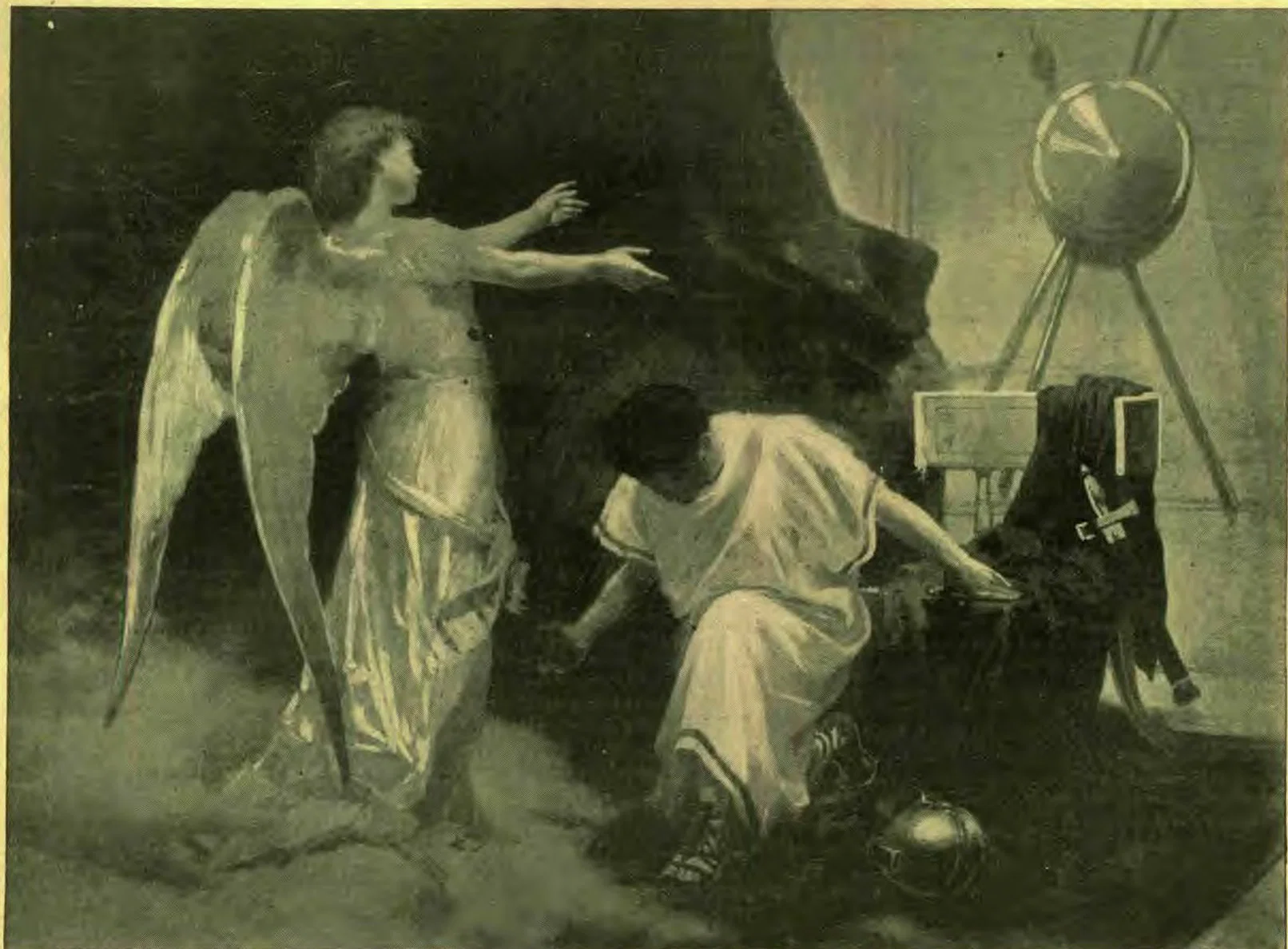
THERE was a certain man in Cæsarea called Cornelius, a centurion of the band called the Italian band, a devout man, and one that feared God with all his house, which gave much alms to the people, and prayed to God alway.”
Tho Cornelius was a Roman, he had become acquainted with the true God, and had renounced idolatry. He was obedient to the will of God, and worshiped Him with a true heart. He had not connected himself with the Jews, but was acquainted with the moral law, and was obedient to its precepts. He had not been circumcised, nor did he take part in the sacrificial service; he was therefore regarded by the Jews as unclean. However, he made liberal gifts to sustain the Jewish worship, and was known far and near for his charity and beneficence. His righteous life made him of good repute, among both Jews and Gentiles. Cornelius had not an understanding faith in Christ, tho he believed the prophecies, and was looking for the Messiah to come. Through his love and obedience to God, he was brought nigh unto Him, and was prepared to receive the Saviour when He should be revealed to him. It is rejection of the light given that brings condemnation.
The centurion was a man of noble family, and held a position of trust and honor. True goodness and greatness united to make him a man of moral worth. His influence was a blessing to all with whom he came in contact.
Believing in God as the Creator of heaven and earth, he revered Him, acknowledged His authority, and sought His counsel in all the affairs of life. He was faithful in his home duties, as well as in his official responsibilities, and had erected the altar of God in his family. He dared not attempt to carry out his plans or to bear the burden of his responsibilities, without the help of God; therefore for that help he prayed much and earnestly. Faith marked all his works, and God regarded the purity of his life and the liberality of his gift, and came near to him. He recognized his piety, and so ordered events that he might receive increased light.
While Cornelius was praying, God sent to him a heavenly messenger, who addressed him by name. The centurion was afraid, yet he knew that the angel was sent by God to instruct him, and he said, “What is it, Lord?” “And He said unto him, Thy prayers and thine alms are come up for a memorial before God. And now send men to Joppa, and call for one Simon, whose surname is Peter. He lodgeth with one Simon, a tanner, whose house is by the seaside.”
An Angel Appears to Cornelius.
The explicitness of these directions, in which was named even the occupation of the man with whom Peter was making his home, shows that Heaven is acquainted with the history and business of men in every grade of life. The very street on which we live is known to God. He is acquainted with the daily employment of the humble laborer, as well as that of the king2upon his throne. And the sins of men, as well as their good deeds, are all known to Him.
“Send men to Joppa, and call for one Simon, whose surname is Peter.” Thus God showed His regard for the Gospel ministry, and for His organized church. The angel was not commissioned to tell Cornelius the story of the cross. A man, subject, even as he himself, to human frailties and temptations, was to tell him of the crucified, risen, and ascended Saviour. In His wisdom the Lord brings those who are seeking for truth into touch with fellow beings who know the truth. His appointed way is to communicate truth through human beings. Those who have received light are to reveal it to those in darkness.
Speaking of the mystery “which from the beginning of the world hath been hid in God,” Paul says: “Unto me, who am less than the least of all saints, is this grace given, that I should preach among the Gentiles the unsearchable riches of Christ; and to make all men see what is the fellowship of the mystery; . . . to the intent that now unto the principalities and powers in heavenly places might be known by the church the manifold wisdom of God.”
To us, also, has been committed the sacred trust of making known “the unsearchable riches of Christ.” As His representatives among men, Christ does not choose angels who have never fallen, but human beings, men of like passions with those they seek to save. Christ took upon Himself humanity, that He might reach humanity. Divinity needed humanity, for it required both the divine and the human to bring salvation to the world. Divinity needed humanity, that humanity might afford a channel of communication between God and man. So with the servants and messengers of Christ. Man needs power outside of, and beyond, himself to restore him to the likeness of God, and to enable him to do the work of God; but this does not make the human agency unessential. Humanity lays hold upon divine power. Christ dwells in the heart by faith; and, through co-operation with the divine, the power of man becomes efficient for good.
We are to be laborers together with the angels in presenting Jesus to the world. With almost impatient eagerness the angels wait for our co-operation; for man must be the channel to co-operate with man. And when we give ourselves to Christ in whole-hearted devotion, angels rejoice that they may speak through our voices to reveal God’s love.
\"GIVE YE THEM TO EAT.\"
[Alexander McLaren, in S. S. Times.]
In the widest, deepest sense it is true that no hungry heart needs to go away from the bread which Christ's servants have put into their hands to dispense. All the needs of mind, heart, will, all the desires and wishes of all men, all social problems and diseases, may find what they crave and need there. The church has not sufficiently awakened to its resources, and has been too often willing that men should go away to satisfy their hunger at tables spread by social or political reformers, by philosophers, poets, and thinkers. If Christians had more confidence in Jesus Christ as being the all-sufficient, all-satisfying, all-sustaining bread of God, they would have more power to hold the multitudes from feeding on ashes, and there would be fewer complaints from famished men that the churches have nothing to give them. Capacity involves responsibility, so \"give ye them to eat\" follows. The task is laid on the twelve before the means of fulfilling it are visible. That was for the purpose of stimulating experience and faith. But we have the bread that we are to dispense, and whoever possesses Christ is thereby bound to impart Him. It is an obligation laid on every Christian. Alas, that it is so partially and poorly discharged! \"He that withholdeth grain, the people shall curse him;\" but what of him who withholds the bread of life?
TIME OF THE LATTER RAIN.
By H. A. St. John
BY H. A. ST. JOHN.
THE time for the latter rain has come. We have been in the time already, for a number of years. But if we are in the time of the latter rain, why is it delayed?
O, that this pertinent and important inquiry might enter like a barbed arrow into the heart of every inquirer! Then the answer would be forthcoming in a little while. What is it that delays the latter rain? Let this become a Bible-searching and heart-searching inquiry, and soon we will begin to hear of bright clouds, and refreshing showers, upon one here, and another there; a few here, and a few there; a church here, and a church there. These showers would grow more and more frequent and abundant, and would be the precursors of the latter rain. These showers will be the breathing of the Holy Ghost on the lukewarm church, as they begin to believe and heed the message of the faithful and true Witness by faith and zealous repentance. This will be the sowing to themselves in righteousness and reaping in mercy. It will be the breaking up of the fallow ground. It will be the smiting of the heart of stone with the rod of Jesus' love, and the springing forth from the cleft thus produced a perennial fountain of pure and fervent love for God and for one another.
Reader, are you asking for rain upon yourself, right where you are, upon your fellow pilgrims right where you live, in the time of the latter rain? "Ye have not, because ye ask not," saith the Lord. Ye find not, because ye seek not. When the latter rain comes, the refreshing from on high, you will receive not, unless you have asked and received the showers from the bright clouds that go before. These showers of blessing that precede the great refreshing are to fit the soul to receive that wonderful baptism of power. By the showers of blessing preceding, God's children will all be brought into one place, or position, before Him. They will all be clean, through the word He has spoken unto them. They will have obtained the victory over every besetment,—over pride, selfishness, love of the world, and over every wrong word and action. By so doing they will have come into one place before God, and into one accord with one another.
Then nothing can delay the latter rain longer. All of one accord, in one place, with one heart and one soul, will unite in one petition for one thing, namely, that the Lord will "rain righteousness upon them." And the windows of heaven will be opened, and our glorified Lord will pour out such a refreshing as there shall not be room enough to receive it. They will unitedly ask for the coming of that mighty angel, having great power, lightening the earth with his glory; and immediately the angel descends and joins the third angel, and at once there follows a tidal wave of Gospel truth, and light, and power, and glory, that will sweep over all the earth with lightning-like speed, causing the ears of all nations to tingle and exclaim, "Never saw we anything on this wise before." The very earth will tremble under the joyful tread of the pentecostal church of Christ, arrayed in spotless and beautiful wedding garments, with their banners of salvation unfurled to the Holy Ghost, bearing to all people the good tidings of the Gospel of the kingdom. Hallelujah! hosanna! our King cometh, seated on the right hand of power, accompanied by all the angel hosts, wearing a crown of glory! Get ready to go out to meet Him. Thus, with unwonted power, will the Gospel proclamation close up in the realms of sin and death.
The loud cry of the Third Angel's Message will be the last, the final triumphant march of the sacramental host, the church militant, in mortal guise, on the shores of mortality. When it is finished, the great controversy over the bodies, souls, and spirits of men will be forever past. The unrighteous must forever perish in their unrighteousness. The holy, their vile bodies changed in a moment to glorious Christ-like bodies, will enter upon their reign as kings and priests, unto God, in the realms of bliss eternal.
Reader, are you getting ready to join in the final triumphal march of the last Gospel message? Only those whose lamps are trimmed and brightly burning will be able to keep step with the army of Prince Immanuel in the last victorious conflict with the powers of darkness. Press in, press into the ranks while yet there is room.
WHAT WOULD HE SAY?
WHAT would He say,
If Christ should come on earth again,
After long centuries have rolled away,
Since last He judged the hearts of men?
What would He say,
To find unconquered, and the same
Wild passions have their fatal sway,
As when He bore the cross in shame?
What would He say,
To see the nations armed for war,
With battle-ships in stern array,
As in the blood-stained years of yore?
What would He say,
To know the maddening greed for gain,
And grasping hands that none can stay,
Still rule the human heart and brain?
What would He say,
To hear that gold can garnish crimes,
Where timid virtue fears to stay,
Like Sodom in her direful times?
What would He say,
To learn of stealthy bribes and fraud,
As in the time of Rome's decay,
Defying right and law and God?
What would He say
Of him who gains the poor man's mite
By lying lips—then dares to pray,
As tho his God were far from sight?
What would He say
Of those whose hidden guilt profanes
The altar where they deign to lay
Their hearts, where vengeance yet remains?
What would He say
Of those who think that money's power
Can drive the curse of sin away—
The coward creatures of an hour?
What would He say
Of men whose pilfered gold is given
With vulgar pride, from day to day,
In vain, to bribe the court of heaven?
What would He say
In judgment that His words sublime
By impious hands are thrown away,
Tho echoing down the aisles of Time?
—Presbyterian.
Shining as Stars Through God’s Spirit
With songs on our lips, prayers in our hearts, love in our souls, and God's Holy Spirit guiding us, we may shine as stars in the eyes of our blessed Lord.
THE BUILDER'S
By Roderick S. Owen
BY RODERICK S. OWEN.
(Continued.)
AND I heard a voice say, 'Let there be lights in the firmament of the heaven to divide the day from the night' (Gen. 1:14), 'and let them be for lights in the firmament of the heaven to give light upon the earth' (verse 15). I looked, and in the midst of the heavens there was passing a vast body. This was instantly clothed with the glory of God, and began to pour its radiance upon the earth, while opposite it, and nearer, was a smaller body, from which there streamed a flood of soft, silvery light, which fell upon the darker side of the earth. The first light was the king of day, to rule over it; the second was the queen of the night.
“Besprinkled throughout the canopy above, a great
host of lesser lights appeared, like unto sparkling gems of beauty, to grace the presence of the queen of night. The heavens, declaring the glory of God, and revealing His handiwork in the earth (Ps. 19:1), stood before me. The fourth picture was finished, 'and the evening and the morning were the fourth day.' Gen. 1:19.
“The voice spake again; saying, 'Let the waters bring forth abundantly the living creature that hath life, and fowl that may fly above the earth in the open firmament of the heaven' (verse 20). Immediately, in all the waters, appeared the finny tribes, in colors beautiful, in form diversified; while in the seas there swam the great whales and other denizens of the deep, leaving a trail of sparkling foam. High in the midst of heaven soared great birds, with leveled wings cleaving the air, and circling higher and still higher, while from tree to tree and from bush to bush upon the earth passed hither and thither birds of brilliant plumage, large and small, in happy flight, making the air resonant with their notes of joy. Another picture was complete, 'and the evening and the morning were the fifth day' (verse 23).
“When the voice spoke again, the cattle and the flocks upon a thousand hills appeared. The beasts of the forests were there, and the creeping things moved everywhere (verses 24-28; Ps. 50:10, 11).
“And God said, Let Us make man in Our image, after Our likeness; and let him have dominion over all these things (verse 26). At the command of Jehovah there stood forth man, formed of the dust of the ground, made a little lower than the angels, crowned with glory and honor (Heb. 1:6-8), and placed at the head of God's earthly creation. 'And the evening and the morning were the sixth day.' Gen. 1:31. The six pictures in the creation panel were now complete.
“And on the seventh day God ended all His work, and rested, and was refreshed (chapter 2:2; Ex. 31:17; Heb. 4:4). As He viewed the works of His hands, He saw that they were good, and 'the morning stars sang together, and all the sons of God shouted for joy' (Job 38:7), as they studied this new creation. The rest of Jehovah was entered into by all creatures, in all places of His dominion; and when the day was past, 'God blessed the seventh day, and sanctified it; because that in it He had rested from all His work which God created and made.' Gen. 2:3. The memorial panel was complete, and its blessing was to all, and its light rested upon all.
“I saw the earth in its Edenic beauty given to man for a possession. And God planted a garden eastward in Eden; and in it He put the man to dress and to keep it (verses 8, 15). This garden was a pattern by which man was to work in beautifying the whole earth. And man was to obey God, and to serve Him.
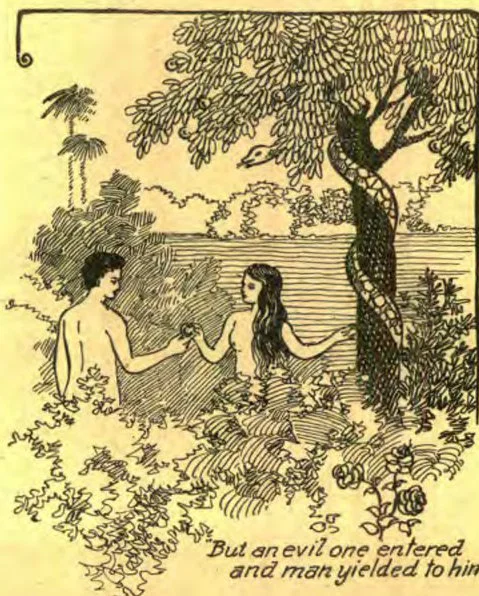
“But an evil one entered (chapter 3:1-5), and man yielded to him, and became his servant (verse 6). Then God said, 'Cursed is the ground for thy sake' (verse 17). Instantly a shadow began to fall upon the pictures in the creation panel, and they lost their brilliancy, and the shadow grew darker and darker. Only the memorial panel seemed to remain to cast a feeble but steady light upon the six pictures. Soon the beautiful garden was entirely lost to view, while throughout the earth the leaves began to wither and fall. The flowers began to fade and die. The cattle and beasts began to groan and cry. The whole creation was travailing in pain together (Rom. 8:22).
“In my sadness I shifted my pillow (Faith) to the prophetic arm of my chair, and, leaning upon it, I gazed at the redemption panel in the door. A light was there, and in it I read the words, 'Behold, I make all things new.' Rev. 21:5. I gazed in wonder, while the six pictures appeared in order upon the redemption panel; and then, by expanding and increasing in glory, they filled the entire door. Then the first six pictures, with the shadow, passed away, and there stood before me the re-creation. And 'I saw a new heaven and a new earth; for the first heaven and the first earth were passed away.' Rev. 21:1. The garden was there, and a city bright and fair, and the throne was in it, and the Lamb was the light of it, and the nations of the saved walked in the light of it (chapter 2:7; 21:2, 22-24). Peace and joy were also there, and 'the morning stars sang together, and all the sons of God shouted for joy,' at the new creation, as at the first.
'A city bright and fair.'
“The memorial was there, and the people kept it (Isa. 66:22, 23); and its light streamed over the earth, and called all to come up to the city and to the throne to worship before the Lord. And so, my friend, I love this room. I love that fourth door, for altho the pictures are dim, there is much of beauty in them yet. I love the memorial panel. Its steady light, week by week, shines into my soul, and while it points to the shadowed picture on the one side, no shade obscures its light on the other side. It stands as a pledge of the new creation, when the children of faith shall enter into the fulness of that rest which remains for the people of God (Heb. 4:9)—that rejoice in the new creation when redemption shall be complete, and when the shadow, with its sighing and crying, shall forever have fled away.”
(Concluded next week.)
'But an evil one entered and man yielded to him.'
THE EXPRESSION OF OUR LOVE.
By F. O. McCartney
My love to fellow men is dependent upon the extent to which I am willing to serve them. A willingness to sacrifice in service is the highest possible expression of love.
We are sometimes deeply moved at the recital of the need of our fellows. We feel tears coming to our eyes, and our throats choke up a little. That is the right kind of a feeling, but the test of the genuineness is this: Does this emotion express itself in service to our kind, even that service which counts life as naught in comparison to the true well-being of our fellow men? Religion is action, having service as its chief purpose and sacrifice as its method. And this is love.
And so with love to God. I believe that a man may feel the presence of the Infinite in his heart and life, in the universe, and in his fellows. But my love to God can express itself how?—By obedience to all the truth that He reveals to me; by service to His children, my brethren; by obedience and service; if needs be, by the sacrifice of all.
If you should to-day give body and mind and heart and will to this obedience, to this service, to this sacrifice, you would know then in actual experience what religion is in its essence. And no one can realize what religion is unless he puts into practise these three principles.
Devote your life to obedience, service, sacrifice, and through it there will breathe the spirit of a great helpfulness, and from your life there will flow love and light and life to your fellow men.—F. O. McCartney.
Losing Temper
Losing temper takes all the sweet, pure feeling out of life. You may get up in the morning with a clean heart, full of song, and start out as happy as a bird, and, the moment you are crossed, and you give way to your temper, the clean feeling vanishes, and a load as heavy as lead is rolled upon the heart, and you go through the rest of the day feeling like a culprit.
SEARCH THE SCRIPTURE
By F. D. Starr
Genesis.
BY F. D. STARR.
THE first book of the Bible covers the remarkable period of nearly twenty-four centuries, being considerable more than one-third of this earth's history since creation. Its fifty chapters would thus describe, on the average, the events of this world's history, at the rate of about two chapters for each hundred years. Brief indeed is the record. It is as if two or three such chapters should cover the history of the world since the American Revolutionary War.
But, short as this record is, it is far better than many large volumes of unfounded speculation would be, and we may be devoutly grateful to God that He has given us this truthful and accurate record of the origin of the race and its early history. During this long period, books were not known or needed. The antediluvians and patriarchs, living to be acquainted with their posterity for so many generations, could communicate from father to son the treasures of knowledge that had been committed to them. So there was a period of time, longer than from the days of Malachi, the last of the Old Testament prophets, to the present time, in which there was no written revelation. But what real need was there of such means of communication. Books and letters are but a substitute for something that is much better. To illustrate: When you are away from home, there is nothing that gives you or your family more pleasure than to receive letters one from the other. But when you are at home do you adopt this method of communication? Indeed not; you have a means of conveying your thoughts that is very much better. You may have a highly-prized book from a celebrated author, which you have perused with care and great delight; yet if you are greatly interested in the subject that is treated in the book, you will doubtless travel quite a distance to hear the author himself.
So when man had the opportunity of talking with his Maker, or with those who had conversed with Him, he had something that was much better than written or printed communication.
The word "Genesis" is of Greek origin, being taken from the word in the Septuagint, rendered in our version by the words, "let there be," in such expressions as "let there be light," "let there be a firmament," etc. This demonstrates the creative power of God, which is just as effective in bringing about spiritual changes as physical development. "For God, who commanded the light to shine out of darkness, hath shined in our hearts, to give the light of the knowledge of the glory of God in the face of Jesus Christ." 2 Cor. 4:6. "Let the peace of God rule in your hearts." Col. 3:15.
The question may, perhaps, arise, how we can know that the length of time from the creation to the death of Joseph, the last event mentioned in Genesis, was nearly 2400 years, as found in the chronology given in our Bibles. Is it all guesswork, or is there some foundation for this calculation? The inspired record itself furnishes us the necessary data from which this computation is made. For instance, the time from creation to the flood is given as 1656 years. An easy mathematical problem will show us how the result is reached. We find that Adam was 130 years old when his son Seth was born. See Genesis 5. Seth was 105 years old when Enos was born; Enos was 90 years old when Cainan was born; Cainan was 70 years old when Mahalaleel was born; Mahalaleel was 65 years old when Jared was born; Jared was 162 years old when Enoch was born; Enoch was 65 years old when Methuselah was born; Methuselah was 187 years old when Lamech was born; Lamech was 182 years old when Noah was born, and Noah was 600 years old when the flood came. Gen. 7:11.
All these periods of time added together amount to just 1656 years, so we see the process by which the chronological date of 1656 years from creation to the flood is reached, and that there is no question whatever about the correctness of the reckoning. By a similar process we find that the death of Joseph occurred over 2300 years after creation, or about the year B. C. 1635 as given in the marginal columns of our Bibles.
The plan of salvation is brought to view in the book of Genesis. The death of the innocent victim, the Son of God, is prefigured in the lamb provided for a sacrifice (Gen. 22:8) and in Abel's offering. His power of triumph over Satan's kingdom is shown in Gen. 3:15. The doctrine of the resurrection of the dead is brought out in the experience of Abraham in offering up his son Isaac; and the translation of the living righteous at the second coming of Christ is demonstrated in the experience of Enoch, who was taken to heaven without seeing death.
All the moral obligations are plainly taught, and sin in its various forms is condemned. The holy Sabbath is introduced on creation's morn, and so is seen to run parallel with human history.
The book of Genesis brings us over from the first world, as represented in 2 Peter 3, to a world broken up and disfigured by the curse, and the waters of the flood, and places us in the company of those who, through faith, are looking for new heavens and new earth, and for a city whose builder and maker is God. Wonderful indeed is the record. It is with regret, but yet with a bright hope, that we close the book that leaves the representative of God's work "in a coffin in Egypt" (Gen. 50:26), and look forward to the deliverance and redemption of Israel.
We append the following from the preface to "Great Controversy":—
God has been pleased to communicate His truth to the world by human agencies, and He Himself, by His Holy Spirit, qualified men and enabled them to do this work. He guided the mind in the selection of what to speak and what to write. The treasure was entrusted to earthen vessels, yet it is none the less from heaven. The testimony is conveyed through the imperfect expression of human language; yet it is the testimony of God; and the obedient, believing child of God beholds in it the glory of a divine power, full of grace and truth.
CRITICISM AND BIBLE FACTS
By Bryn Mawr
BY BRYN MAWR.
(Concluded.)
ADAM was 622 years old when Enoch, the "seventh from Adam," was born. He had an opportunity to converse with Adam face to face many times during their 300 years of contemporaneous existence, and learn directly from his lips the story of creation. Enoch "walked with God." Moreover, he was a prophet, and he prophesied of the judgment—yet future. He made a record of these things, and Jude—a relative of Christ according to the flesh—quotes from it in his epistle. Jude 14, 15.
Methuselah lived 243 years with Adam, and Lamech, his son, 56 years, and Noah himself was born only 126 years after Adam died. So Enoch, Methuselah, and Lamech were contemporary with Adam a period of from 50 to 300 years, and were also contemporary with Noah almost to the day of the flood, except Enoch, who was translated 69 years before Noah's birth.
Noah lived 350 years after the flood, and Abraham was about 40 years of age when Noah died, making a contemporaneous post-diluvian existence of nearly a half century with one who had an antediluvian existence of 600 years. Shem was antediluvian 98 years, and postdiluvian 502 years, which gave him opportunity to clasp hands and talk face to face with Isaac for 130 years. Jacob was with his father 120 years, and Joseph continued 54 years after Jacob's death, and 64 years later, or 145 years after the death of Isaac, Moses was born of the house of Levi. This gives one generation only from the active life of Joseph to the active life of Moses. And we know from the personal experience, that that is not a long time for the transmission of written records of fresh traditions.
Moses was learned in "all the wisdom of the Egyptians," who were the most highly-civilized people of the earth at that time; and there was an antediluvian written language transmitted by Noah and his family. There were written languages, also, immediately following the flood, to which Moses had access, besides being a "friend of God," with whom he talked face to face.
From Adam, the first man, to Isaac were only two living links, Methuselah and Shem; and from Isaac to Moses' active participation in the experiences of God's people, was about 200 years; not long enough for the world to consider itself very modern, dating from the last living ante-post-diluvian representative, nor for the anteflood period to appear very ancient. And, from the manner in which Moses handled the records, we would judge it all very fresh to him.
The attempts to brush aside the prophecies by affirming that they were written after the events transpired, are too weak for serious consideration; for the most marvelous prophecies have been, and are, fulfilling, many centuries after their utterance, some of them of the gravest import to us, now.
Altho God often uses the most ordinary agents for the manifestation of His wondrous power, He also often sets aside those forces that we call natural laws, and works wonders, "they" say, contrary to all laws. That is not the true conception of the fact, however, for He works in harmony with the greatest law of His being, and that is, the law of creation.
It is so strange that a puerile man will try to place a limit on the power of God, in the manipulation of the forces. He has already created.
The Scripture record is true in all that is contained therein, and the day is very near, and "hasteth greatly," when all the boastful pride and haughtiness of man will be laid low.
A "mighty," and a "beautiful," angel gazed upon himself until he fell. So will it be with the critics, who, forgetting Christ, denying His life and His Word, are puffed up almost to the point of bursting with self, the mightiness of self, believing not the sure destruction that hasteneth with the coming of the Lord.