Review and Herald, Vol. 92, No. 2.

The Inspiration of the Bible

Review and Herald

Jan 11, 1915

Review and Herald Publishing Association · Takoma Park Station, Washington, D. C. · Jan 11, 1915

The Inspiration of the Bible

By H. L. Hastings
The Bible is a book which has been refuted, demolished, overthrown, and exploded more times than any other book you ever heard of. Every little while somebody starts up and upsets this book; and it is like upsetting a solid cube of granite. It is just as big one way as the other; and when you have upset it, it is right side up; and when you overturn it again, it is right side up still. Every little while somebody blows up the Bible; but when it comes down it always lights on its feet, and runs faster than ever through the world.
They overthrew the Bible a century ago, in Voltaire's time,—entirely demolished the whole thing. “In less than a hundred years,” said Voltaire, “Christianity will have been swept from existence, and will have passed into history.” Infidelity ran riot through France, red-handed and impious. France still feels the curse and blight of its influence. That century has passed away. Voltaire has “passed into history,” and not very respectable history either. Few infidels would care to read publicly Voltaire's biography as written by a fellow infidel; but the Word of God “liveth and abideth forever.” Thomas Paine demolished the Bible; but after he had crawled despairingly into a drunkard's grave in 1800, the book took such a leap that since that time more than twenty times as many Bibles have been made and scattered throughout the world as ever were made before since the creation of man.

The Mistakes of Moses

For a book that has been exploded so many times, this book still shows signs of considerable life. I have heard of a man traveling round the country exploding this book, and showing up “the mistakes of Moses,” at about two hundred dollars a night. It is easy work to abuse Moses at two hundred dollars a night, especially as Moses is dead, and cannot talk back. It would be worth something after hearing the infidel on “the mistakes of Moses,” to hear Moses on “the mistakes of the infidel.” When Moses could talk back, he was rather a difficult man to deal with. Pharaoh tried it, and met with poor success. Jannes and Jambres withstood Moses, and, it is said, found a grave in the Red Sea. Korah, Dathan, and Abiram tried it, and went down so deep that they have not yet got back. But now Moses is dead, and it is easy to abuse him. It does not take a very brave beast to kick a dead lion.
*Published from a lecture delivered before the Sixteenth Annual Convention of the Massachusetts Young Men's Christian Association, at Spencer, Mass.

Interest in the Revised New Testament

But after all, this book seems to stand alone and to thrive upon refutation. A few months ago some learned men, after working for a number of years on the revision of the New Testament, finished their work. Having inserted a few modern words instead of others which had become obsolete, made some slight corrections of errors in translation, and rectified from ancient manuscripts some little errors that had been made by copyists in transcribing the New Testament, they at last announced the book as ready to be issued on a certain day. What was the result? Why, men offered five hundred dollars to get a copy of that book a little in advance of its publication; and the morning it was published, the streets of New York were blockaded with express wagons backed up and waiting for copies of a book which had been refuted, exploded, and dead and buried, for so many years. Millions of copies were sold as fast as they could be delivered. They telegraphed that book, from the first of Matthew to the end of Romans, from New York to Chicago, about 118,000 words,—the longest message ever wired,—for the sake of getting it there twenty-four hours sooner than steam could carry it, to print in the Sunday newspapers. A dead book is it? They would not pay for telegraphing the greatest infidel speech ever delivered in this country, from here to Tophet. This old book seems to show some signs of life yet. It is like Aaron's rod that budded and blossomed, and it is being scattered over all the world. And it is a curious fact that most of our skeptical friends contrive to keep very close to where its shadow falls.

The Bible Makes Things Safe

There was once a vessel wrecked on one of the South Sea islands. There was on board a sailor who had been there before, and who knew that the people were cannibals. And when the ship was wrecked, and its crew were cast away on this shore, they knew there was no hope for them; for they saw no way to escape. The sailor, however, climbed up on a hilltop to reconnoiter a little. Presently his shipmates saw him swinging his arms in great excitement, and inquired what was the matter. He had seen just over the hill the steeple of a meeting-house . That was what took all the fear of trouble out of his soul. He knew that church spire made his neck safe on that cannibal island.
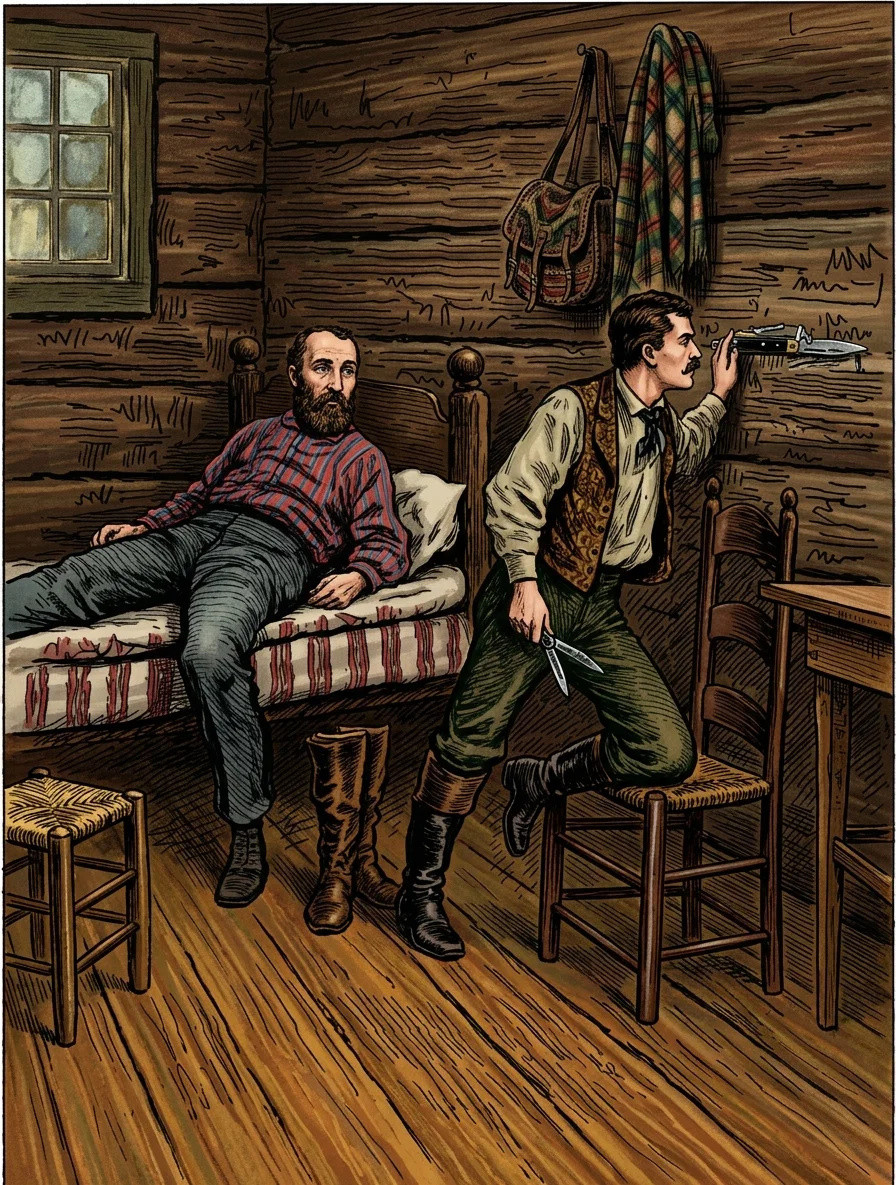
Now infidels know that fact just as well as he knew it. Years ago a young infidel was traveling in the West with his uncle, a banker, and they were not a little anxious for their safety when they were forced to stop for a night in a rough wayside cabin. There were two rooms in the house; and when they retired for the night, they agreed that the young man should sit with his pistols, and watch until midnight, and then awaken his uncle, who should watch until morning. Presently they peeped through the crack, and saw their host, a rough-looking old man, in his bearskin suit, reach up and take down a Bible; and after reading it awhile, he knelt and began to pray; and then the young infidel began to pull off his coat and get ready for bed. The uncle said, “I thought you were going to sit up and watch.” But the young man knew there was no need of sitting up, pistol in hand, to watch all night long in a cabin that was hallowed by the Word of God and consecrated by the voice of prayer. Would a pack of cards, a rum bottle, or a copy of the “Age of Reason” have thus quieted this young infidel's fears?

No Bibles in the Rogues' Museum

Every one knows that where this book has influence it makes things safe. Why is this? If it were a bad book, we should expect to find it in the hands of the worst men. In New York there was once a kind of rogues' museum—a place where they had all kinds of skeleton keys, and jimmies, and brass knuckles, and dirks, and pistols, and implements of mischief, which they had taken away from roughs and criminals. Do you suppose there was a single New Testament in the whole kit? Why not? If it were a bad book, you would expect a man to have a revolver in one pocket and a New Testament tucked away in the other. There was a row the other night, and a man broke his wife's head with—a Bible?—No! it was a bottle. Where the Bible bears sway, the rows and quarrels do not come.

Different From All Other Books

What makes this book so different from all other books? Whose book is it? Who made it? Infidels have the strangest ideas on that subject.
Said Tertullian, in A. D. 200, “If you are willing to exercise your curiosity profitably in the business of your salvation, visit the apostolic churches, in which their very authentic letters are recited, sounding forth the voice and representing the countenance of every one of them. Is Achaia near you? you have Corinth. If you are not far from Macedonia, you have Philippi and Thessalonica; if you can go to Asia, you have Ephesus; but if you are near to Italy, you have Rome.”
These apostolic churches received the Gospels at the hands of the men who wrote them; and the Epistles were written and signed by men whom they well knew. Paul wrote, “The salutation of Paul with mine own hand, which is the token in every epistle.”
Now, what did these writers testify? They testified things which they knew. The apostle John does not say, “That which we have dreamed, imagined, or guessed at, that thing do we declare unto you;” but, “That which was from the beginning, which we have heard, which we have seen with our eyes, which we have looked upon, and our hands have handled, of the Word of life.” 1 John 1:1. This was their testimony. They testified that they saw Christ in his life and in his death; that they saw him after his resurrection, felt his hands and feet, and saw the nail prints and the spear wound; and they knew these things and testified of them, and they preached Christ, who had died and risen again.

“Go and Be Crucified and Then Rise Again”

When Lepaux, a member of the French Directory, complained to Talleyrand that his new religion, “Theophilanthropy,” made little headway among the people, the shrewd old statesman replied: “I am not surprised at the difficulty you find in your effort. It is no easy matter to introduce a new religion. But there is one thing I would advise you to do, and then, perhaps, you might succeed.” “What is it? What is it?” eagerly asked Lepaux. “It is this,” said Talleyrand;“go and be crucified, and then be buried, and then rise again on the third day, and then go on working miracles, raising the dead, and healing all manner of diseases, and casting out devils; then it is possible that you may accomplish your end.”
The philosopher went away silent; and no infidel has succeeded in fulfilling these conditions. But Christ has died, and has risen again, and his apostles suffered the loss of all things, even of life itself, in proclaiming these facts; and they left their testimony in record in this book. Then the apostles quote from the prophets, and the prophets quote from the Psalms, and refer to the law which was given on Mt. Sinai; and so we go back from book to book, until we reach the book of Genesis, and that does not quote from anybody or anything. You have then reached the fountainhead.

The Story of the Quails

Now we have to discuss this subject from all points of view, but mainly from the direction of objections. Men love objections; and so they say there are difficulties, and absurdities, and errors, and contradictions in the Bible. You have all heard such assertions. After speaking once in the city of Boston, an ex-minister came to me and told me that the Bible was not true; for there was that story which Moses told about the quails. Israel lusted after flesh, and the Lord sent them quails to eat, and they fell by the camp a day's journey on each side, or over a territory forty miles across, and they were two cubits deep on the ground, and the Israelites ate them for a full month. I have in my possession an infidel paper that was published in Boston, in which there is about a column of arguments and figures on this “quail story,” giving an estimate of the number of bushels of quails that were piled up over the country, and showing that when they were divided among the people, each one would have 2,888,643 bushels of quails, which he was to eat during the month, giving each poor Israelite 60,000 bushels of quails to eat at each meal for thirty days; and therefore the Bible was not true! That is the meat on which these skeptical Cæsars grow so wondrous great. I said to this gentleman, “The Bible does not say any such thing.” He replied that it certainly did, but I answered that it did not say any such thing. He insisted that it did. “Well,” said I, “find it.” And when you ask an infidel to find anything in the Bible, you generally have him. He could not find the place; so I turned over to the eleventh chapter of Numbers, and then, instead of the birds being packed like cordwood on the ground, three feet deep, the account says that the Lord brought the quails from the sea, and let them fall by the camp, as it were “two cubits high,” or about three feet high upon, or above, the face of the earth. That is, instead of flying overhead and out of reach, they were brought in about three feet high, where any one could take as many of them as he chose. And this skeptical friend had got the birds packed solid, three feet deep, over a territory forty miles across. As if I should say that a flock of wild geese flew as high as a church spire, and some one would insist that they were packed solid from the ground up, a hundred feet high! This is a sample of the kind of arguments infidels bring to prove that the Bible is not true.

The Bible Foretells Things

The book, to my mind, bears the marks of inspiration in the foresight which it exhibits. This book foretells things: You cannot do that. You cannot tell what will be next year or next week. “The spirits” cannot tell who will be the next president, or governor, or emperor. They may tell a great many things which are past. They may tell you who your grandmother was, and may copy the inscription on your grandfather's gravestone, and may tell things which are written in the family record. They may reveal many things in the past,—for the devil knows about the past,—but they cannot foretell the future. I did hear of one spiritual medium who foretold her own death, and she died within a few hours; but when the stomach pump was brought, there was pumped out of her stomach poison enough to kill two or three. That kind of prophecy requires no omniscient foresight.
The revelations of prophecy are facts which exhibit the divine omniscience. So long as Babylon is in heaps; so long as Nineveh lies empty, void, and waste; so long as Egypt is the basest of kingdoms; so long as Tyre is a place for the spreading of nets in the midst of the sea; so long as Israel is scattered among all nations; so long as Jerusalem is trodden underfoot of the Gentiles; so long as the great empires of the world march on in their predicted course,—just so long we have proof that one Omniscient Mind dictated the predictions of that book, and “prophecy came not in old time by the will of man.”

A Wonderful Authorship

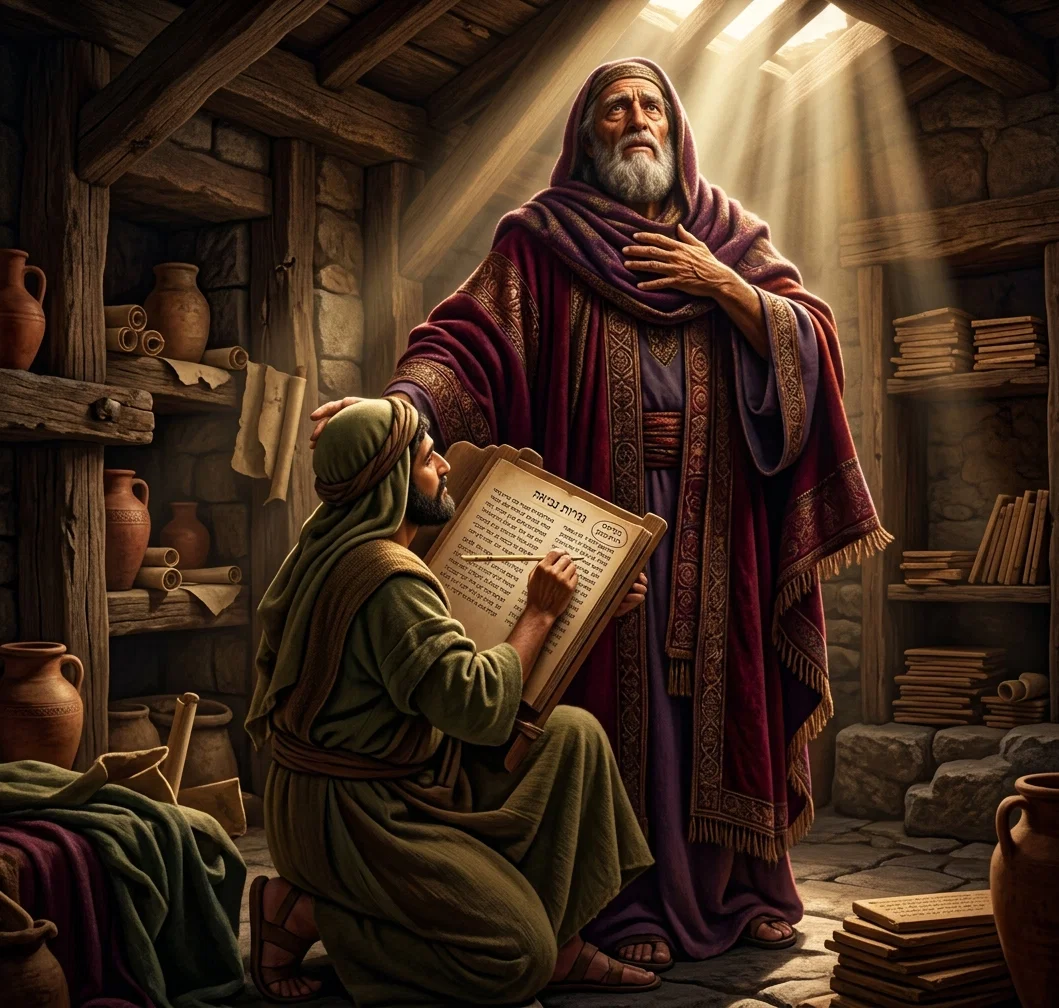
BARUCH WRITING THE PROPHECIES OF JEREMIAH
The authorship of this book is wonderful. Here are words written by kings, by emperors, by princes, by poets, by sages, by philosophers, by fishermen, by statesmen; by men learned in the wisdom of Egypt, educated in the schools of Babylon, trained at the feet of the rabbis in Jerusalem. It was written by men in exile, in the desert, in shepherds' tents, in “green pastures” and beside “still waters.” Among its authors we find the taxgatherer, the herdsman, the gatherer of sycamore fruit; we find poor men, rich men, statesmen, preachers, exiles, captains, legislators, judges; men of every grade and class are represented in this wonderful volume, which is in reality a library, filled with history, genealogy, ethnology, law, ethics, prophecy, poetry, eloquence, medicine, sanitary science, political economy, and perfect rules for the conduct of personal and social life. It contains all kinds of writing; but what a jumble it would be if sixty-six books were written in this way by ordinary men. Suppose, for instance, that we get sixty-six medical books written by thirty to forty different doctors of various schools, believers in allopathy, homœopathy, hydropathy, and all the other “pathies,” bind them all together, and then undertake to doctor a man according to that book!

One Mind, One Plan

But again, it required fifteen hundred years to write this book, and the man who wrote the closing pages of it had no communication with the man who began it. How did these men, writing independently, produce such a book? Other books get out of date when they are ten or twenty years old; but this book lives on through the ages, and keeps abreast of the mightiest thought and intellect of every age.
Suppose that thirty or forty men should walk in through that door. One man comes from Maine, another from New Hampshire, another from Massachusetts, and so on from each State, each bearing a block of marble of peculiar shape. Suppose I pile up these blocks in order, until I have the figure of a man, perfectly symmetrical and beautifully chiseled, and I say, “How did these men, who have never seen one another, chisel out that beautiful statue?” You say, “That is easily explained. One man planned the whole statue, made the pattern, gave the directions, and distributed them around; and so, each man working by the pattern, the work fits accurately when completed.”
Very well. Here is a book coming from all quarters, written by men of all classes, scattered through a period of fifteen hundred years; and yet this book is fitted together as a wondrous and harmonious whole. How was it done?—“Holy men of God spake as they were moved by the Holy Ghost.” One mind inspires the whole book, one voice speaks in it all, and it is the voice of God speaking with resurrection power.

The Very Breath of God

Again: I conclude that this book has in it the very breath of God, from the effect that it produces upon men. There are men who study philosophy, astronomy, geology, geography, and mathematics; but did you ever hear a man say, “I was an outcast, a wretched inebriate, a disgrace to my race, and a nuisance in the world, until I began to study mathematics, and learned the multiplication table, and then turned my attention to geology, got me a little hammer, and knocked off the corners of the rocks and studied the formation of the earth, and since that time I have been as happy as the day is long; I feel like singing all the time; my soul is full of triumph and peace; and health and blessing have come to my desolate home once more”? Did you ever hear a man ascribe his redemption and salvation from intemperance and sin and vice to the multiplication table or to the science of mathematics or geology? But I can bring you, not one man, nor two, nor ten, but men by the thousand who will tell you, “I was wretched; I was lost; I broke my poor old mother's heart; I beggared my family; my wife was heart-stricken and dejected; my children fled from the sound of their father's footsteps; I was ruined, reckless, helpless, homeless, hopeless, until I heard the words of that book.” And each one will tell you the very word that fastened on his soul. It may be it was, “Come unto me, all ye that labor and are heavy-laden, and I will give you rest;” perhaps it was, “Behold the Lamb of God, which taketh away the sin of the world.” It may have been, “God so loved the world, that he gave his only begotten Son, that whosoever believeth in him should not perish, but have everlasting life.” He can tell you the very word that saved his soul. And since that word entered his heart, he will tell you that hope has dawned upon his vision, that joy has inspired his heart, and that his mouth is filled with grateful song. He will tell you that the blush of health has come back to his poor wife's faded cheek; that the old habits have vanished from the windows of his desolate home; that his rags have been exchanged for good clothes; that his children run to meet him when he comes; that there is bread on his table, fire on his hearth, and comfort in his dwelling. He will tell you all that, and he will tell you that this book has wrought the change.
Now this book is working just such miracles, and is doing it every day. If you have any other book that will do such work as this, bring it along. The work needs to be done; if you have any other book that will do it, for Heaven's sake bring it out. But for the present, while we are waiting for you, as we know this book will do the work, we mean to use it until we can get something better.
What we most need is the book itself. It is its own best witness and defender. Christians sometimes try to defend the Word of God. It seems like half a dozen noodle heads trying to defend a lion in his cage. The best thing for us to do is to slip the bars and let the lion out; and he will defend himself. And the best thing for us to do is to bring out the Word of God, and let “the sword of the Spirit” prove its own power, as it pierces even to the dividing asunder of soul and spirit.

A Divine Harmony

God's Word declares the end from the beginning. It is not only the chart which guides each weary wanderer to his own eternal rest, but it is the record of the great plan and purpose of the Almighty concerning the world which he has made and the church which he has redeemed. It unfolds God's everlasting purpose, as manifested in Jesus Christ; and if one will read three chapters at the beginning of the Bible and three at the end, he will be struck with the correspondence which there exists. At the beginning of the Bible we find a new world: “In the beginning God created the heaven and the earth.” At the end of the Bible we find a new world: “I saw a new heaven and a new earth; for the first heaven and the first earth were passed away.” At the beginning, we find Satan waiting to deceive and destroy; at the end, we find Satan cast out, “that he should deceive nations no more.” At the beginning, sin and pain and sorrow and sighing and death find entrance to the world; at the end, there shall be no more pain nor sorrow nor sighing, and no more death. At the beginning, the earth, for man's transgression, is cursed with thorns and thistles; at the end, “there shall be no more curse; but the throne of God and of the Lamb shall be in it.” At the beginning, we find the tree of life in Paradise, from which the sinner is shut away by a flaming sword, lest he eat and live forever; at the end, we find the tree of life again “in the midst of the Paradise of God,” and the blessed and the blood-washed ones have a right to the tree of life, and “enter in through the gates into the city.” At the beginning, man was brought beneath the dominion of death and the grave; at the end, “the dead, small and great, stand before God,” the sea gives up its dead, and death and hell are cast into the lake of fire. At the beginning, the first Adam lost his dominion over earth, and was driven out of the garden of Eden in shame and sorrow; at the end, we find the second Adam, victorious over sin and death and hell, re-enthroned as King and Lord of all, and reigning in triumph and glory forever.

Unfolds the Divine Purpose

Now, when you get the plan of this book, you find that it is something more than a book of detached sentences, good maxims, and comforting words. It is a book which unfolds the divine purpose, and not only reveals the way of salvation, but marks the pathway of the people of God through this wilderness, and foreshows the destiny of the world which he has made and the church which he has redeemed.
When we look at these facts, we see that this is no man's book. When Columbus saw the river Orinoco, some one said he had discovered an island. He replied: “No such river as that flows from an island. That mighty torrent must drain the waters of a continent.” So this book comes, not from the empty hearts of impostors, liars, and deceivers; it springs from the eternal depths of divine wisdom, love, and grace. It is the transcript of the divine mind, the unfolding of the divine purpose, the revelation of the divine will. God help us to receive it, to believe it, and be saved through Christ our Lord.
THE BIBLE MAKES THINGS SAFE

The Bible

The Bible! hast thou ever heard Of such a book? the author, God himself; The subject, God and man, salvation, life And death—eternal life, eternal death. Dread words! whose meaning has no end, no bounds!
Most wondrous book; bright candle of the Lord!— Star of eternity! the only star By which the bark of man can navigate The sea of life, and gain the coast of bliss Securely.
This book,—this holy book, on every line Marked with the seal of high divinity, On every leaf bedewed with drops of love Divine; and with the eternal heraldry And signature of God Almighty stamped From first to last,—this ray of sacred light, This lamp, from off the everlasting throne, Mercy took down; and in the night of time Stood, casting on the dark her gracious bow, And evermore beseeching men, with tears And earnest sighs, to read, believe, and live. —R. Pollok.

The Standard of Christianity

The Bible, the whole Bible, nothing but the Bible, is the standard and the rule of Christianity. To know its meaning for ourselves, to receive its teaching, to rely on its promises, to trust in its Redeemer, to obey him from delight of love, and to refuse to follow other teaching, is Christianity itself. —T. W. Medhurst, in “The Fundamentals,” Vol. XI, page 103.

Chillingworth's Famous Statement

The Bible, I say, the Bible only, is the religion of Protestants. . . . I for my part, after a long and, as I verily, believe and hope, impartial search of ‘the true way to eternal happiness,’ do profess plainly that I cannot find any rest for the sole of my foot but upon this Rock only.
I see plainly and with mine own eyes that there are popes against popes, councils against councils, some fathers against others, the same fathers against themselves, a consent of fathers of one age against a consent of the fathers of another age. . . .
There is no sufficient certainty but of Scripture only for any considering man to build upon. This, therefore, and this only, I have reason to believe; this I will profess; according to this I will live; and for this, if there be occasion, I will not only willingly, but even gladly, lose my life; though I should be sorry that Christians should take it from me. Propose me anything out of this Book, and require whether I believe it or no, and seem it never so incomprehensible to human reason, I will subscribe it with heart and hand, as knowing no demonstration can be stronger than this: God hath said so, therefore it is true. — “Works of Wm. Chillingworth, M. A.,” Oxford University Press, 1838, Vol. II, pages 409-411.

The Living Word

COUNTLESS volumes have been written on this theme without exhausting it, and witnesses to the Bible still multiply. The mighty Past is speaking. God is bringing forth its testimony. Egypt, Assyria, Babylon, have broken the silence of the ages. The mouldering monuments, the buried cities, the sandy deserts, the sculptured rocks, have found a voice. Sinai and Petra, Horeb and Hermon, echo the sacred oracles. Memphis and Tyre, Tadmor and Nineveh, have risen from their graves. The painted papyrus, the pictured walls, the stony tablets, the rusted medals and coins bring forth their testimony. The ruins, the rivers, the mountains, and the seas cry out, “Thy word is truth.” And the living witness as well as the dead. The Samaritan still lingers at Sychar; the Jew still wanders in every land. The church of Christ still lives, and spreads throughout the world. The gospel still regenerates. The promised Spirit still sanctifies, and witnesses in Christian hearts. In a word, history and experience confirm the Scriptures, and assure us that through the prophets of the Old Testament and the apostles of the New, and above all through his Son, God himself has spoken to our race; and that the word which he has spoken liveth and abideth forever.
—H. Graham Guinness, D. D.

A Challenge to Atheism

By William J. Bryan
Atheists and materialists declare that the Bible is merely the work of man; that it was written under the limitations that apply to human wisdom. Taking this position, they must necessarily contend that, unless man has degenerated in ability and declined in wisdom, he can now produce a book equal to the Bible. Let them produce it.
Judged by human standards, man is far better prepared to write a Bible now than he was when our Bible was written. The characters whose words and deeds are recorded in the Bible were members of a single race. They lived among the hills of Palestine, in a territory scarcely larger than one of our counties. They did not have printing presses, and they lacked the learning of the schools. They had no great libraries to consult, no steamboats to carry them round the world and make them acquainted with the various centers of ancient civilization. They had no telegraph wires to bring them the news from the ends of the earth, and no newspapers to spread before them each morning the doings of the day before. Science had not unlocked nature's door and revealed the secrets of rocks below and stars above. From what a scantily supplied storehouse of knowledge they had to draw, compared with the unlimited wealth of information at man's command today!
And yet these Bible characters grapple with every problem that confronts mankind, from the creation of the world to eternal life beyond the tomb. They have given us a diagram of man's existence from the cradle to the grave, and they have set up signposts at every dangerous point along the path.
We turn back to the Bible for the ten commandments, which form the foundation of our statute law; and for the Sermon on the Mount, which lays down the rules for our spiritual growth. The Bible gives us the story of the birth, the words, the works, the crucifixion, the resurrection, and the ascension of him whose coming was foretold in prophecy, whose arrival was announced by the angel voices singing peace and good will; the story of him who gave to the world a code of morality superior to anything that the world had known before or has known since; the story of him who is the crowning figure of all time, whom the world is accepting as Saviour and as the perfect example.

Will They Attempt a Better One?

Let the atheists and the materialists produce a better Bible than ours, if they can. Let them collect the best of their school to be found among the graduates of universities, as many as they will, and from every land. Let the members of this selectedgroup travel where they will, consult such libraries as they please, and employ every modern means of swift communication. Let them roam at will wherever science has opened the way. Let them take advantage of all the progress in art and in literature, in science and in history. Let them use to the full every instrumentality that is employed in modern civilization. And when they have exhausted every source, let them embody the results of their best intelligence in a book, and offer it to the world as a substitute for this Bible of ours.
Have they the confidence that the prophets of Baal had in their god? Will they try? If not, what excuse will they give? Has man fallen from his high estate, so that we cannot rightfully expect as much from him now as nineteen centuries ago, or does the Bible come to us from a source that is higher than man—which?

No Refuge in Retrogression

But our case is even stronger. The opponents of the Bible cannot take refuge in the plea that man is retrograding. They loudly proclaim that man has grown and that he is growing still. They boast of a world-wide advance, and their claim is founded upon fact. In all matters except in the science of how to live man has made wonderful progress. The mastery of the mind over the forces of nature seems almost complete, so far do we surpass the ancients in harnessing the water, the wind, and the lightning.
For ages the rivers plunged down the mountain sides and exhausted their energies without any appreciable contribution to man's service; now they are estimated as so many units of horsepower, and we find that their fretting and foaming was merely a language which they employed to tell us of their strength and of their willingness to work for us. And while falling water is becoming each day a larger factor in burden bearing, water rising in the form of steam is revolutionizing the transportation methods of the world.
The wind that first whispered its secret of strength to the flapping sail is now turning the wheel at the well.
Lightning, the dread demon that, from the dawn of creation, has been raining down its zigzag path through the clouds as if intent only upon spreading death, has been metamorphosed into an errand boy, and brings us illumination from the sun, and carries our messages round the globe.

The Bible an Uplifting Power

Inventive genius has multiplied the power of a human arm, and supplied the masses with comforts of which the rich did not dare to dream a few centuries ago. Science is ferreting out the hidden causes of disease, and teaching us how to prolong life. In every line, except in the line of character building, the world seems to have been made over; but the marvelous changes by which old things have become new only emphasize the fact that man, too, must be born again; while they show how important are material things to touch the soul of man and transform him into a spiritual being.
Wherever the moral standard is being lifted up,—wherever life is becoming larger in the vision that directs it, and richer in its fruitage,—the improvement is traceable to the Bible, and to the influence of the God and Christ of whom the Bible tells.

They Must Confess It

The atheist and the materialist must confess that man ought to be able to produce a better book today than man, unaided, could have produced in any previous age. The fact that they have tried, time and again, only to fail each time more hopelessly, explains why they will not—why they cannot—accept the challenge thrown down by the Christian world to produce a book worthy to take the Bible's place.

Impress Is on the World

They have prayed to their god to answer with fire; prayed to inanimate matter with an earnestness that is pathetic. They have employed in the worship of blind force a zeal greater than religion requires, but their almighty is asleep. How long will they allow the search for the strata of stone and fragments of fossil and decaying skeletons that are strewn around the house to absorb their thoughts to the exclusion of the Architect who planned it all? How long will the agnostic, closing his eyes to the plainest truths, cry, 'Night, night,' when the sun in his meridian splendor announces that the noon is here?
The Bible has stamped its impress upon the map of the world. Its boundaries are clearly marked, and the light that emanates from the Christian nations is flowing outward toward those who sit in darkness. Back of the progress that marks the present day is the code of morals that Christ proclaimed, and back of the code of morals is the divine character of him who is both the Son of God and the Saviour of mankind.
Continue reading: The Unity of God's Word