Your ShelfYour Projects

Signs of the Times, Vol. 36, No. 4.

The Commanded Blessing

Signs of the Times

Jan 27, 1909

Pacific Press Publishing Association · Mountain View, California · Jan 27, 1909

The Commanded Blessing

“Jehovah bless thee, and keep thee; “Jehovah make his face to shine upon thee, and be gracious unto thee; “Jehovah lift up his countenance upon thee, and give thee peace.”

Question Corner

2709.— Woman’s Suffrage.

I would be interested to hear your views on the movement for woman’s suffrage. Would it help the temperance cause? Would it help to make politics purer, or does it conflict with the Scripture? E. H.
The woman’s suffrage movement is a political question, and the SIGNS OF THE TIMES is not a political paper. We do not know whether we would even dare to think of expressing our opinions concerning this movement. In communities where women are elevated and refined, it might help the temperance cause. In some of our large cities where women themselves are inclined to indulge in wine and excesses of various kinds, it is a serious question as to whether it would help at all or not. Take it in Utah. One would naturally think that woman’s suffrage would tend to abolish polygamy, but those who seem to be well-informed state that nearly all the Mormon women are in favor of polygamy; consequently if that question came to be a matter of state balloting, it would probably be carried contrary to every finer moral sense, it would seem to us. Really, the granting of suffrage to this or that class is not going to save this world or permanently help any community. The only true reform which will do this, is that reform which takes hold of hearts and regenerates mankind. That can come only through our Lord Jesus Christ; and in the meantime every Christian father and mother should work for the regeneration and salvation of the rising generation.

2710.— The Bride of Christ.

The New Jerusalem is referred to as the Bride of Christ, the Lamb’s wife. Why is not the description of the city also figurative, as Babylon is figurative, referring to God’s true church in the earth, that which we have learned constitutes Christ’s bride elsewhere? F. L. T.
We have noted in answer to another question as to the difference in the use of the two terms “Jerusalem” and “Babylon,” in the Revelation; the one coming in connection with literal prophecy and promise, the other in connection with highly figurative and symbolical presentations. There are three things referred to as the bride of Christ. First, the individual believer, as in Rom. 7:4; secondly, the church, as in Ephesians 5, and thirdly, the city of God, as in Revelation 21. Let us go back a little further. In Isaiah 62 we are carried beyond the city to the new earth itself. Jerusalem is merely called “Hephzi-bah,” “My delight is in her;” and the land, the new earth, “Beulah,” meaning “married.” You will note that in the beginning of the chapter the Lord is speaking of Jerusalem, or Zion. Verse 3: “Thou shalt also be a crown of beauty in the hand of Jehovah, and a royal diadem in the hand of thy God. Thou shalt no more be termed Forsaken; neither shall thy land any more be termed Desolate: but thou shalt be called Hephzi-bah, and thy land Beulah; for Jehovah delighteth in thee, and thy land shall be married.” By this scripture it is shown that the whole earth, the kingdom of our Lord Jesus Christ, is included in the bride Jerusalem. The capital city stands for that entire land. Therefore is she called the bride, but the most glorious thing in that city will be the saved men and women, the church of the Lord Jesus Christ; therefore, to comfort the hearts of His people during their sojourn here below, the Lord says that He is a husband unto them, and married unto them, because they are a part of that future glorious inheritance. He does more than that. He comes down to the believer Himself with the same wonderfully comforting thought, for that believer is to be a part of that time when the children of God shall all come home; when Jerusalem which is above shall be “the mother of us all;” Christ the “everlasting Father,” and the eternal home forever established. Then will it be true that “as a young man marrieth a virgin, so shall thy sons marry thee; and as the bridegroom rejoiceth over the bride, so shall thy God rejoice over thee.”

2711.— Three Unclean Spirits.

What is symbolized by the unclean spirits of Rev. 16:13? H. F.
The 14th verse clearly tells us they are “spirits of demons, working signs; which go forth unto the kings of the whole world to gather them together unto the war of the great day of God, the Almighty.” A.R.V. The devil has his angels and agents, and these he is sending out to all the world to arouse to war. Does it not seem strange that notwithstanding the fact that all the world wants peace, desires peace, yet they are preparing for war at a rate that was never even contemplated before? Evil spirits are stirring the world to war and preparing nations for the last great conflict.

2712.— The Sign of Jonah the Prophet.

Please explain Matt. 12:39, what the Saviour meant about the sign of the prophet Jonah. J. A. H.
It seems very clear in the text itself as to what He meant by it. In the next verse: “As Jonah was three days and three nights in the belly of the whale [margin, ‘sea monster’], so shall the Son of Man be three days and three nights in the heart of the earth.” The heart of the earth is sometimes interpreted to mean the grave, but this is a purely arbitrary interpretation. Nowhere else are we shown this. It would seem that it rather means in the hands of the powers of earth, and Christ came into the control of the powers of earth when He was arrested in the Garden of Gethsemane. The term “three days and three nights” would simply mean three days. Day and night was a common expression among the Jews, indicating simply day. It might not be the whole of a day, and yet the part of a day would be spoken of in the same way; so from the time that Jesus was arrested until He arose again from the dead, would be in general terms, three days; and so we read in the 24th chapter of Luke, His disciples saying unto Jesus toward the close of the day upon which Christ rose, “This is the third day since these things were done.”
Please give the reason why Rev. 20:5 is not spurious? M. W.
Why should reason be given that that is not spurious any more than any other text? It is there in the Bible, and the American Revised Version, the best probably that was ever translated, does not even raise a question concerning it. “The rest of the dead lived not again until the thousand years should be finished. This is the first resurrection.” There are one or two ancient copies that do not have it in; and on the other hand there are just as ancient copies which do have it. There is no reason whatever for considering it an interpolation. The only reason why it has been put forth as an interpolation is because it strikes against some cherished unscriptural doctrine.
The second question that is asked by M. W. will be answered later.

2714.— The Date of Christmas.

I would like to ask if we can be sure of the date of the birth of Christ, and how should the day be kept? E. H.
No, we can not be sure of the date of the birth of Christ. No one can be sure of it. We can conjecture that it probably came in the autumn of the year, but as to just the day of the month on which it came, it is impossible for us to tell, and all the best scholars recognize this. The keeping of the day is a question very easily settled. Inasmuch as God has not said anything in regard to the keeping of the day, inasmuch as we do not know the day, the only way to keep it is to keep it as we do all other days which He gives us—in doing faithful service and work for God wherever we are. A day concerning which the Bible says nothing, certainly can not be a sacred day to us. And inasmuch as we do not know what day it is, or where it falls, there is nothing required of us in the observance of it. Now, of course, we have a day which has been molded more or less by heathen custom through Christianity, kept generally in a jovial, fun-loving, and hilarious manner, and by doing as the ancient Romans did, in the heathen festival, sending gifts one to another. If we are to keep the day at all, it would be to keep it in recognition of God’s great mercy and goodness, and by giving to those who are needy, remembering the words of Christ, “It is more blessed to give than to receive.”

2715.— A Charity Fund.

Will you kindly inform me if Seventh-day Adventists have a fund for charity regardless of the religion of those helped? I think many would like to contribute, especially at Christmas. E. H.
Seventh-day Adventists have no general charity fund for this purpose. They endeavor usually to help those who may be in need. Any funds placed in their hands for that purpose they would endeavor to use wisely to help all who are needy, irrespective of belief. For instance, just recently an incident came under our own observation of a family that was in sore need. This family was helped almost solely by the young women of the Seventh-day Adventist Church, and this is true in many cases. We regret that we could not get to this question before Christmas was past.

2716.— Conscience.

Is the conscience always an infallible guide for the Christian? J. A. H.
No. It is almost never an infallible guide, and yet it is never safe to violate conscience. That may seem to be almost a contradiction of terms, but if we violate conscience we shall get to that place where conscience will not speak to us at all. What our duty is, is to have an enlightened conscience. We have God’s holy word, we have His great and infallible law. That law is God’s voice to us, and that voice is the test of all other voices. To illustrate: A forester might have a compass which was not absolutely accurate, and yet it would not be wise for him to throw that away when he was alone in the forest, would it? He would better depend upon that than the aberrations of his own mind, and then if it was not absolutely accurate, to either correct it or throw it away and get one that was. An engineer on a train whose watch was not absolutely correct would do better to follow his watch than to guess at the time. His business, however, is to see that that watch is regulated and kept in harmony with some standard timepiece. The Bible speaks of those who have an “evil conscience,” and those whose consciences are “seared as with a hot iron;” those are the ones who have constantly violated conscience until conscience becomes a voice to them no longer, and impulse leads wholly. An unenlightened conscience sometimes leads to fearful sins. It leads the Hindu mother to throw her babe into the Ganges, and she may be perfectly sincere in doing it. That very thing shows the world’s awful need of a revelation. And therefore, God has given us the revelation of His word to which we can come and bring our conscience, but when we set conscience against its clear precepts and its positive duties, that very thing should show us that our conscience is itself wrong and ought to be reformed.
In a land of Bibles we never should depend upon the conscience for a guide, unless our conscience is in harmony with the word. That is one of the daily duties; one of the great means of Christian advancement, to bring the conscience daily to God’s word and before His mercy-seat and plead that He will cleanse the conscience from everything that is out of harmony with His will, and bring mind and heart and conscience in harmony with His holy law. Then in the many, many things which will come to us in our daily life concerning which the word has not told us as to what duty is, the very first impulse of conscience will be the voice of God speaking to us. We do not believe that the Lord will ever suffer His children to go astray if their conscience is right toward Him, and their whole heart is to do His will and His alone.

The Impending World-Crisis

(From Our Own Correspondent, at Gland, Switzerland)
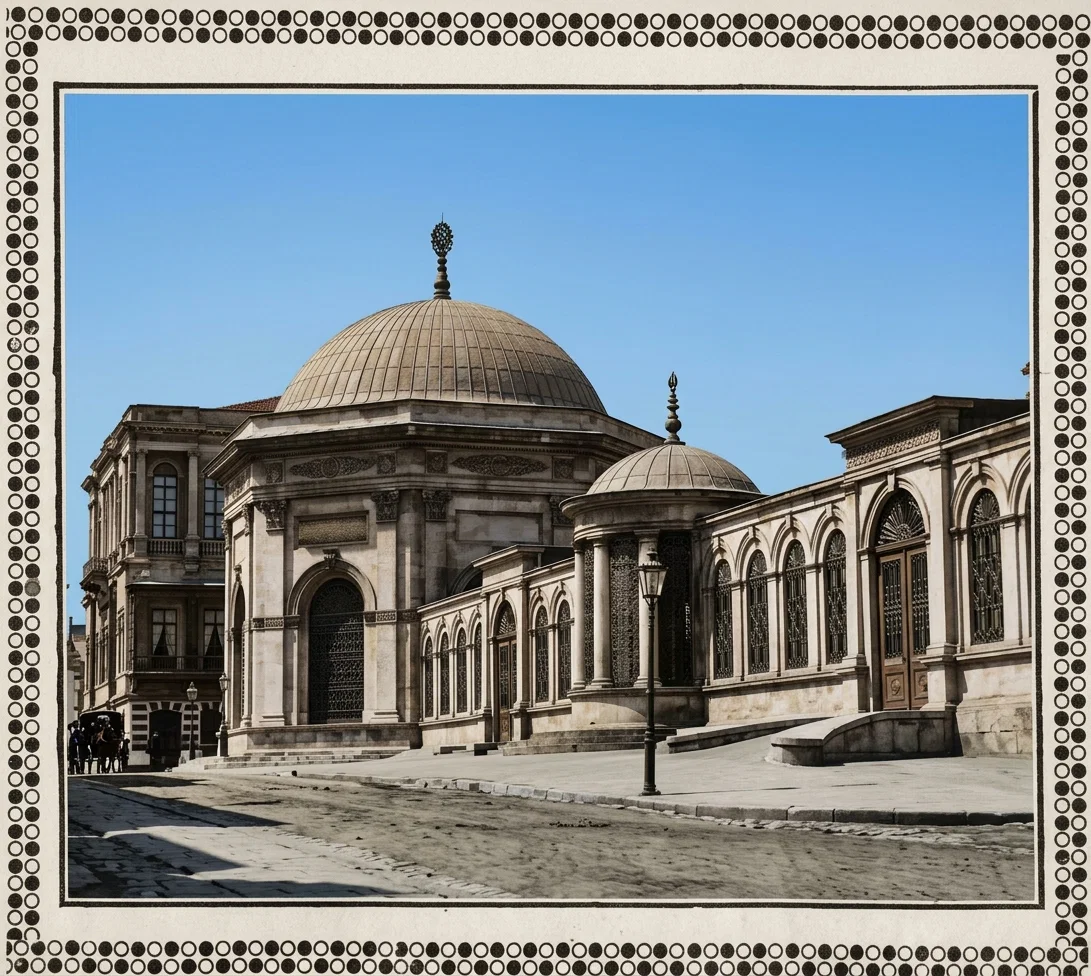
The Celebrated Cathedral of St. Sophia in Constantinople.
The remarkable statements of which I am giving below a translation, are from the pen of the editor-in-chief of a French magazine entitled Bibliotheque Universelle, published at Lausanne. It was founded in 1796. The present editor, Mr. Ed. Tallichet, is nearly eighty-two years old, and is recognized as one of the soberest and best informed political writers in Europe. He is now writing an important series on the Oriental question. The following is a digest of the series, as far as it bears on the future of the Levant crisis. The statements made are so clear and startling, that I purposely refrain from making any comments, except by way of italicizing. One of the articles begins as follows:

“FALL OR RESURRECTION OF THE OTTOMAN EMPIRE—WHICH?
“The above question applies, not only to Turks, but to the entire world; for the present crisis contains the winding up of all that has transpired since the beginning of the Christian era. . . .
“Constantinople has become again what it was for a long time, the center and pivot of the world. . . .
“During the larger part of the past century, the Ottoman empire—in a half-dying state—has been able to live only on account of the rivalries and the jealousies of the great European powers. . . . As a division of its territory or its conquest by one or two powers seemed impossible, the Turkish regime was accepted as the lesser evil. When this regime became decidedly too tyrannical, and when some of its people raised up in rebellion, they were helped in obtaining their freedom. Thus Greece, Roumania, Servia, and Bulgaria became autonomous, under the suzerainty of the Porte, and finally entirely free. . . .
“The Ottoman empire has thus been diminished, and every progress made in Europe has made it weaker. . . . Several times Russia tried its luck, but to see herself stopped just as she was preparing to seize her coveted prey. Ever since, her whole policy has consisted in letting Turkey sink under her own weight, while watching for her chance to materialize her dream—in which the whole Russian nation concurs—make her home in Turkey with Constantinople as her capital. . . .
“The recent Turkish revolution has entirely changed the political situation of the world, not only of the Mediterranean world, but of the universe. . . .
“We have already eulogized the admirable awakening of which Turkey has been the theater. . . .
“After a short period of calm—during which the interested parties in Europe took time to recover from their surprise—we have seen two parallel storms break out over Turkey, one in the interior of the Ottoman empire, the other on the exterior. . . .
“Let us look first to the Ottoman empire. Marvelous as the turn-about of young Turkey has been, one must still ask himself if it is not like a beautiful flower blooming suddenly upon a heap of corruption, but destined to loose its brilliant colors in a few days. Indeed, the most sober-minded observers consider the enterprise of the Ottoman revolutionists not only as a most extraordinary one, but also, from the human standpoint, as an impossible one.
“How can a bond of unity sufficiently strong and elastic be established between nationalities—Turks, Bulgarians, Roumanians, Servians, Albanians—who until recently hated each other with a hatred which could be satisfied with nothing less than murder, incendiarism, and torture? . . .
“The second storm which we must now give our careful attention to, is the attitude of Europe toward the Ottoman empire.”
Here the writer retraces the political events which followed each other in quick succession after the Turkish revolution—Bulgaria declaring its independence, Bosnia and Herzegovina annexed by Austria, Crete uniting itself to Greece—all of which were not only unexpected, but a direct violation of the treaty of Berlin, and were accomplished without a single protest on the part of Europe. The writer then goes on:
“If the new government of Constantinople had lost its balance, it would probably have opened one of the most formidable crises of which the world has been a witness. . . . Bulgaria thought itself strong enough to beat the Turks and take Constantinople. Europe would have opposed this move, and thus would have been unloosed the scramble that has long been hanging over the Ottoman empire, and will take place as soon as its neighbors see the approach of its final doom. . . .
“Whatever chances of success might be ontheir side, the directors of the Turkish movement knew also that a war with Bulgaria or Austria would be almost certain to open a most fearful crisis which has long been foreseen and warded off by all kinds of expedients, a crisis involved in the overthrow of the Ottoman empire, and which, to all appearances, would unloose a general war and bring about the complete transformation of the Old World. . . . The new Turkish government was not willing to take the responsibility of the most terrible conflict of which the modern world can conceive. . . .”
The writer then passes on to the new Congress or Conference among the great powers which it has been proposed to hold in order to readjust matters:
“Whatever care be taken to circumscribe its deliberations, we may be sure that claims and propositions will come up at the Conference, liable to provoke a general conflagration. . . .
“Europe should devoutly wish the success of the enterprise of the Young Turks, for it would keep off for a long time the dangers of a general liquidation, almost impossible to foresee without bloody encounters.
“The restoration of the Ottoman empire constitutes the only efficient means of solving the question of Constantinople and the Bosporus, a question which otherwise promises to bring about a general war, the most ruinous which has ever been witnessed. . . .
“Such is the peril before us, and it is an extremely great and pressing one. . . . It involves no less than a general liquidation in which the whole European polities will be thrown into the furnace, bringing about a new order of things from which all organizations based on injustice and despotism will have disappeared. . . .
“Whatever happens, it will come.
“Unquestionably, it will be accomplished, but how?
“In peace or through war? . . .
“This work can be accomplished peaceably if men will seek wisdom from above. Nothing will be done without the cooperation of a purified Christianity. . . .
“The nations are now called upon to choose their road; . . . a transformation of the world has become unavoidable; it has commenced and will follow its course; nothing can stop it now.
Tomb of the Sultan Mahmoud at Constantinople.
“In peace or through war? Such is the question now before the world, but more particularly before Europe.”
JEAN VUILLEUMIER.

Lay the Ax at the Root of the Tree.

“And now also the ax is laid unto the root of the trees: therefore every tree which bringeth not forth good fruit is hewn down, and cast into the fire.” Matt. 3:10.
THERE stands a stately tree. The owner sends his servant with an ax to lay at the root of that tree. The obedient servant leaves the ax in the place indicated in his master’s command, and goes away.
Now if that tree were a conscious, intelligent being, what would it think? With trembling I imagine I hear it soliloquizing thus: “Now that ax is the tool with which trees are cut down, and cut to pieces. I surmise and greatly fear that it means that I am soon to be cut down. A little time of reflection is given me. O, what can I do to avert the awful calamity? I have been growing here for many years, and now am a large tree with wide-spreading branches. I do so much enjoy this flourishing life.”
In this scripture statement, trees evidently mean people; the root of the trees, the hearts and consciences of the people; the ax, the Gospel of Christ that John preached and that all true Christians preach. John, the forerunner of the first coming of Christ, was a man sent from God with a sharp and shining ax, or Gospel message, to lay at the understanding and hearts of the people. Thus he prepared the way of the Lord and made His paths straight. He did his work faithfully and grandly. He laid the ax at the root of the trees and left it there to do its work. Many were made glad, others sad, and still others mad. But every person who reflected upon that message, received it, and obeyed it by bringing forth fruit meet for repentance, was saved from being cut down. Wo to all who heeded it not.
But the reader will observe that it was not John’s business to cut the trees down. Altho he was sent from God, and the ax was from God, he was only authorized to lay the ax at the root of the trees. The work of using the ax to cut the trees down, the Lord has not delegated to man. “Vengeance is Mine, I will repay, saith the Lord.”
It is not the work or duty of the servants of God in any age, to cut the trees down. Their duty ends with giving the Gospel message in all its clearness, brightness, and sharpness to every creature, and then leave them in the hands of God. They may not even decide that they should be cut down. Like Jesus they judge them not in this life.
Many dignitaries of the church in the past, bearing the name of Christians, have assumed the prerogatives of God, and have presumed to hew down those whom they judged to be unworthy or unfaithful. And what sad work they have made! Millions of faithful trees have thus been cut down by those who did not like their fruits. These wicked and disobedient servants have stained their garments with the blood of martyrs, and they will have a fearful account to meet in the day of God.
God’s remnant church in this day is sent from God to do a work similar to that of John the Baptist. John laid the ax—the first advent message—at the root of the trees when Jesus was about to come in mortalguise; now it is the announcement of the coming of Jesus in immortal glory.
The Gospel of the kingdom is now to be preached in all the world for a witness unto all nations. Then the work of the servants of God is finished. Then the end will come. They are to have no part in the work of hewing down any who are disobedient. Jesus will then appear in all His glory together with all the holy angels, and all who then know not God and obey not the Gospel will be hewn down by the brightness of His coming, and cast into the fire.
Reader, take the Gospel message for this generation into your heart and life, and then in that decisive day, you will hear the “Well done,” and enter into the joys of your Lord. H. A. ST. JOHN.

The Tenth Commandment

By J. O. Corliss

An “Exceeding Broad Commandment.”

The word “covet,” as used in the Bible, includes a wide field of operation. Its first appearance is in the last of the ten “words” of the Decalogue: “Thou shalt not covet” thy neighbor’s belongings. Its intent in this place is to control the mind against any desire for that which belongs to another. The reason for this uncompromising restraint may be readily and quite accurately conjectured. The mind being the seat of desire, and the latter the natural guide of outward actions, it became necessary for the commandment to touch the source of one’s conduct.
There is a feature of this subject that should be noticed at this stage, and that is the well-known fact that desires, like other living constituents, enlarge and strengthen with careful nursing. With certain encouragement these lead one to reach out after even dishonest gain, which must therefore be reckoned as an expanded form of covetousness. Indeed, when Jethro advised that Moses seek out men to assist him in the administration of Israel’s affairs, he designated that they should be men who “feared God,” and “hated covetousness.” Ex. 18:21.
The original word here used to express covetousness includes more than mere desire. It is a word which means greedily gotten gain by dishonest measures. The same word is used in later times to express the general character of the Jews,—a marked feature still very prominent with most of that people. Said the prophet: “From the least of them even unto the greatest of them every one is given to covetousness; and from the prophet even unto the priest every one dealeth falsely.” Jer. 6:13.

Covetousness Not Limited.

Could this condition of things now be limited to the Jews, the religious aspect of the world would be far more cheering than it is. But it has come to pass that religious scruples are not in all cases a sufficient barrier to prevent unholy desires from bearing bitter fruit. In many cases, the love of money is not the all-consuming process by which men’s prospect of heaven becomes clouded; but wrong desire, with some, is nurtured to such proportions that, while loudly proclaiming religious rights for all, they seem strongly led to trample down the rights of others, in order to win fame and power for themselves. Such is but the legitimate fruit of covetousness. It is not strange that the God of truth, who loves men’s souls, should warn against such a mortal form of error.
Coming to the New Testament we find the meaning of covetousness extending through several lines of thought. For instance: The apostle gave instruction to the brethren at Corinth not to keep company with certain individuals, among whom he mentions those who are covetous. In explanation of this exaction, the apostle makes a significant statement. As tho he feared the brethren might think his demand too sweeping, he says he did not have in mind people of the world; for in that case, to carry out instruction such as they had received, they would be obliged to go “out of the world.” 1 Cor. 5:9, 10.
Evidently Paul had in mind the separation of the good members from the bad in the church itself, since he had just reproved them so sharply for maintaining these evils among them. The particular case complained of here was a member of the assembly living in adultery with his father’s wife. Verse 1. But while guilty of openly violating the seventh commandment, he had first, and constantly, done violence to the one which forbade covetousness. The overt act could not have occurred without the desire of passion first getting control. In fact this principle obtains with every one of the other nine commandments.
This fact was tersely stated by the Saviour when He said that “out of the heart proceed evil thoughts, murders, adulteries, fornications, thefts, false witness, blasphemies; these are the things which defile a man.” Matt. 15:19, 20. In other words, while the issues of these evil thoughts, or reasonings, are the condemnation of the man, they are so only because these are but the plain index of what is graven on the heart, and so become the outgrowth of the natural “wish to have more,” as is indicated by the word rendered “covetous” in the text under consideration. 1 Cor. 5:10. So, then, it is emphatically true that out of the heart are “the issues of life.” Prov. 4:23.
But the mere passing “wish to have more,” is not the real object of censure. It is the cultivation of that wish, or desire. In his farewell address to the elders of the Ephesian church, the great apostle said: “I have coveted no man’s silver, or gold, or apparel.” Acts 20:33. He could not have meant by this, that he had not desired enough of these things, at least, to satisfy his common necessities; for in writing to the church at Corinth, he chided its members for not doing for him what he required in this direction. 2 Cor. 11:8, 9.
What, then, was the purpose of his statement to the Ephesian elders? The word employed on that occasion carries the sense of “fixing the mind” on their possessions, or lusting for them. This the apostle had not done, because he knew the sure result of such a line of thought, as expressed by him when writing to Timothy of his duties as a minister of the Gospel. In this connection he said: “The love of money is the root of all evil; which while some coveted after, they have erred from the faith.” 1 Tim. 6:10. The love of money is the root of all evil only because money is that which men covet, or, as the original of the word signifies, extend the arms for. When this is done, one “falls into temptation and a snare, and into many foolish and hurtful lusts, which drown men in destruction and perdition.”
It will be well to look at one other statement concerning this thing of covetousness. The apostle says it is idolatry, and that it is one of those things which bring upon men the wrath of God. Col. 3:5, 6. In this statement we have the last commandment of the ten identified with the first, and so binding the whole moral code solidly together, it is the fitting conclusion of a completely formed code of morals, because it is the underlying stratum upon which condemnation for violation of every other precept rests. Its provisions are ever the first ones to be violated in the downward path of evil. Its instruction properly heeded, no one can trample upon one of the commandments preceding it. It is the culminating point of all that was to be guarded by the other commandments,—the purity of the mind,—that God might be glorified.

The Tenth Commandment

“Thou shalt not covet thy neighbor’s house, thou shalt not covet thy neighbor’s wife, nor his man servant, nor his maid servant, nor his ox, nor his ass, nor anything that is thy neighbor’s.” Ex. 20:17.

Christian Life Is Action

CHRISTIAN life is action: not a speculating, not a debating, but a doing. One thing, and only one, in this world has eternity stamped upon it. Feelings pass; resolves and thoughts pass; opinions change. What you have done lasts — lasts in you. Through ages, through eternity, what you have done for Christ, that, and only that, you are.— F. W. Robertson.

Life for Action, Not Contemplation

EXISTENCE was given us for action, rather than indolent and aimless contemplation; our worth is determined by the good deeds we do, rather than by the fine emotions we feel. They greatly mistake, who suppose that God cares for no other pursuit than devotion.—E. L. Magoon.
Continue reading: The Importance of True Temperance