Australiasian Signs of the Times, Vol. 35, No. 27.

The Conflict Between Labour and Capital

Australiasian Signs of the Times

Jul 5, 1920

Signs Publishing Co. · Melbourne, Victoria · Jul 5, 1920

The Conflict Between Labour and Capital

THERE is a tremendous conflict in progress at the present time throughout the world. Practically every nation is feeling the throb of its propaganda and the thrust of its powerful impacts. It is the conflict between Labour and Capital, between employer and employee.
Capital clings to the age-old right of profiting from the earnings of all whom it employs.
Labour demands a larger share in the products of toil—demands, in fact, that all shall toil alike, and that the employer class shall cease to be.
Within the past few decades Capital has so gained control of the currency and the financial functions of the world that the amassing of wealth in the hands of the few has become a hundredfold easier than it was half a hundred years ago.
Labour sees the gigantic strides of the Colossus of wealth, and is determined to check his pace even though it be at the cost of a world tragedy that will shatter the very foundation pillars of civilisation itself.
Into that disastrous conflict this journal cannot go. It sees the forces of the embattled hosts marshalling for the fray, and knows by the very imminence of the impending struggle that we are nearing the consummation of the age.
For decades we have warned the world that this struggle was coming. We have based that warning upon the Word of God. It must come, or God’s Word would write itself a failure. It has come and is coming; and God’s Word in this prophecy, as in a multitude of others equally specific and literally fulfilled, proves itself the utterance of Divinity.
We have sometimes been criticised for not taking sides in this contest; and again when we have pointed out the disastrous nature and the hopelessness of the struggle, we have been accused of taking the capitalistic side and joining forces with the oppressors of Labour. This we have not done and shall not do.
The oppressor of Labour is the adversary of both God and man; for the principle of the Bible is, “The labourer is worthy of his hire.” The God who forbade man to “muzzle the ox that treadeth out the corn,” is not insensible to any of the wrongs which the human worker may suffer. But nowhere does the Bible encourage us to drive into this struggle of material forces. God’s admonition to all is, “Be patient, therefore, brethren, unto the coming of the Lord”; “for the coming of the Lord draweth nigh”; “behold the Judge standeth before the door.” James 5:7-9. How hollow will be the victory when Labour, having destroyed Capital throughout the world as it has in Russia, and with hands, mayhap, imbrued in its brother’s blood, stands face to face with the great Judge of the universe. It has won the struggle, but lost the victory. Equally disastrous would it be for the capitalists of the world to have won a crushing victory over Labour, and stand with greedy hearts and bursting coffers before the same great Judge.
To be patient under injustice, to wait for God’s solution of the difficulty, that we may stand approved of Him in the day of final awards, is the wiser course, the only really satisfying course, the only course worth while, and that is real victory—the victory that overcometh the world, the flesh, and the devil.

Millionaires Trebled

THE prophet Isaiah, speaking of the last days, says of the people, “Their land also is full of silver and gold, neither is there any end of their treasures.” Isa. 2:7. Likewise, the Apostle James declared: “Ye have heaped treasure together in the last days.” James 5:3, R.V.
A dissection of figures recently published concerning American millionaires shows the following proportions according to annual income (by which we mean not salary or wages, but money derived solely from personal property or capital):—
ANNUAL INCOME. NUMBER RECEIVING.
£7,000,000 1
£1,000,000 and over 4
£800,000 to £1,000,000 8
£600,000 to £800,000 5
£400,000 to £600,000 24
£300,000 to £400,000 33
£200,000 to £300,000 67
£150,000 90
£100,000 225
£80,000 170
£60,000 380
£50,000 342
£40,000 763
£30,000 1,302
£20,000 3,302
The total income tax paid to the United States Government by its millionaires during 1918 amounted to £72,297,236, an average of £155,852 per millionaire.
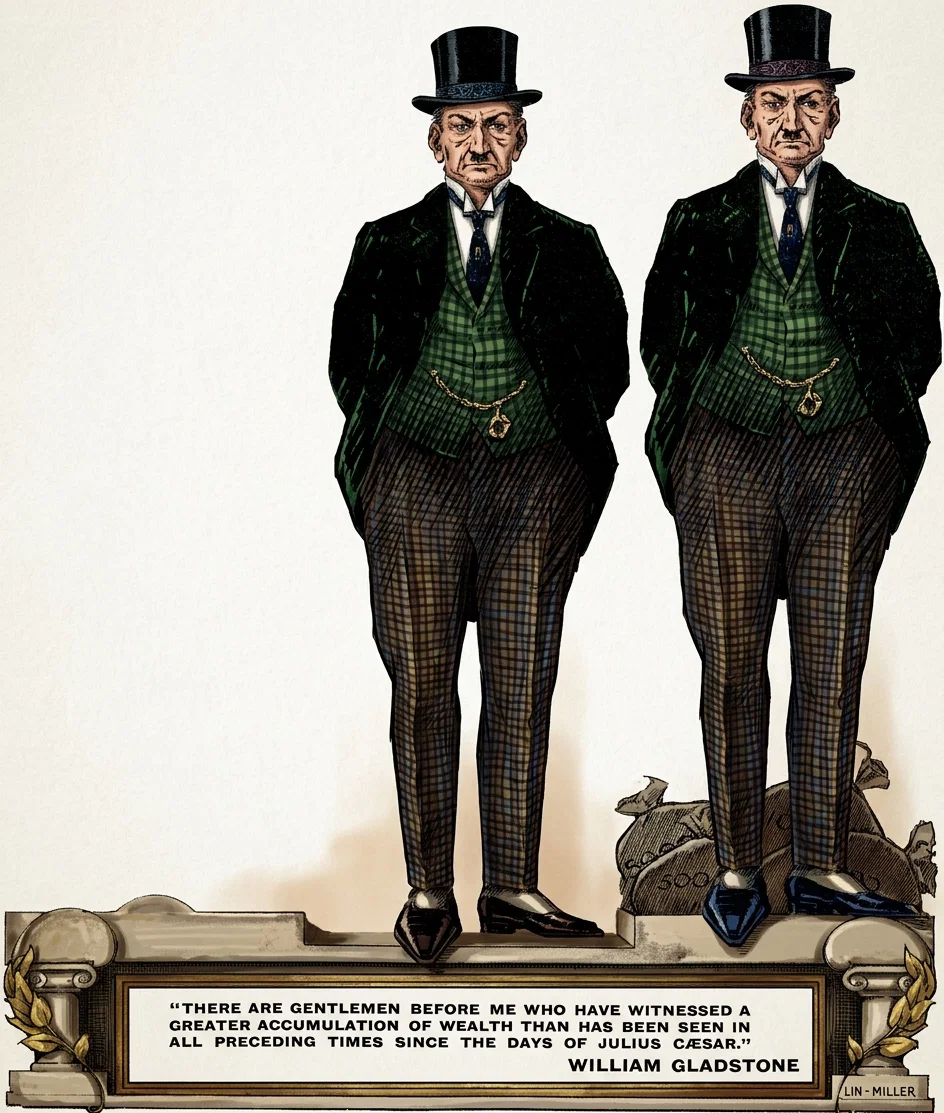
At the close of the nineteenth century, William E. Gladstone declared during one of his notable speeches: “There are gentlemen before me who have witnessed a greater accumulation of wealth than has been seen in all preceding times since the days of Julius Cæsar.” But since these words were spoken there has been almost as great an increase in the accumulation of wealth as the great statesman saw there had been from the days of the mighty Roman emperor. At the commencement of the nineteenth century there were but two millionaires in the civilised world, increasing to fifty by 1856. The rapid rise in numbers in America alone since then is shown by the accompanying chart.
Truly the passion for wealth has seized the world, for not only are “capitalists” seeking to hoard up much treasure, but youth and hoary age of every class are engaging in the same mad rush after gold. This seeking after the precious metal is fast becoming a great yellow peril to civilisation, for in the days that are just ahead the groaning coffers and bulging vaults will be witnesses against those who now take pleasure in gathering to themselvesthe wealth of the world. But soon the time will come when the prophecy will be fulfilled: “Go to now, ye rich men, weep and howl for your miseries that shall come upon you. Your riches are corrupted, and your garments are moth-eaten. Your gold and silver is cankered; and the rust of them shall be a witness against you, and shall eat your flesh as it were fire. Ye have heaped treasure together for the last days.” James 5:1-3.
When we add the industrial unrest consequent upon the “profiteering” of trade unions and capitalists alike to the picture of hoarded wealth, it is surely plain to the most casual reader that the condition of the world today perfectly fits the prophetic forecast. F.

The Problem of Drink

It is an old problem, many have tried to solve it, and many ways of solving it have been tried. The problem of “squaring the circle” may be more difficult, but it has not been tried by as many people.
America, Canada, and Sweden have tried the prohibition method, and are very well satisfied with the trial. They had tried other methods with ever more and more discouraging results. This method has gone to the root of the difficulty.
Nevertheless there are still many doubting Thomases. “Father” Joseph H. McMahon, of the Roman Church in America, expresses his doubts in these words:—
Prohibition is a religious error founded on the Protestant doctrine of the total depravity of man.
In Melbourne, Robert Heffron, a Socialist, lectures in the Socialist Hall on “A Socialist’s Case Against Prohibition,” and issues a challenge to prohibitionists.
Now the question of the prohibition of the liquor traffic is not a religious one, as the Catholic priest asserts; but it is a social problem, a civic problem, and an economic problem. Mr. Heffron, in considering it a social problem, is nearer right than the priest who considers it a religious one; but why he, if a true Socialist interested in the welfare of the proletariat, should want to challenge the prohibitionists instead of linking up with them, is difficult for us to understand; for nothing more unsocial and uncivil and uneconomic has ever come into the world to afflict the human race than the conscienceless and grasping liquor business.

A Move to Swing Backward

A strong effort is now being made in the United States to counteract and counterwork the sweeping victory of the prohibitionists. A few of the States, under the influence of reactionary governors, entered upon a campaign to have the Eighteenth Amendment (the prohibition amendment) declared unconstitutional. The effort has been nipped in the bud by the Supreme Court, which, after mature deliberation, has declared the Eighteenth Amendment constitutional. There the matter must end unless the liquor element can succeed in getting two-thirds of the States to vote for the return of the old conditions. This they can never do; and as the National Government has definitely decided to spend more than £10,000,000 this year in the work of enforcing the law, the liquor element may as well content themselves with the idea that the battle is finished.

Labour Leaders and Prohibition

Those who helped to win the victory are not the only ones who recognise that the battle has been won, and that it is a real victory. Labour leaders were not generally found advocating prohibition while the struggle was on. But here are a few testimonials from that class as to the beneficial results of prohibition, and we commend them to the consideration of Socialists and labour leaders in Australasia:—
I take great pleasure in advising you that the State Federation of Labour in Arizona is without reservation aligned with the temperance forces in demanding national prohibition. The workers as a class now realise that the industrial problem they are seeking to solve is of such great moment in the affairs of the human race that it is not safe or wise to divide their time with the saloon-keeper, and that in the oncoming fray which means industrial liberation and democratic control of the means of production and distribution for the proletariat and by the proletariat, our thoughts and actions must and will be sane and sober. When prohibition is realised we can then turn our thoughts to the complete emancipation of the toilers.—Thomas J. Croaff, President of the Arizona State Federation of Labour, in a letter to the Women’s Christian Temperance Union, dated March 20, 1919.
I cannot speak too highly of the results which I have seen from the enactment of prohibition laws throughout this country, and can safely say that the workers of Canada are socially and morally improved, and will reap a greater measure of success in their efforts to solve the great problems of the future than they have in the past, because of the abolition of the liquor traffic.—John W. Bruce, General Organiser for the United Association of Plumbers and Steam Fitters of the United States and Canada.
Canada is no whit behind the United States in the matter of temperance reform, and Canada’s labour leaders are outspoken in praise of the results of prohibition. Here are some of their testimonials:—
Let it be dry. I am satisfied with the way it is now. The carpenters’ organisation has had a clearer conception of industrial matters since prohibition. When I see the vast number of young people who will shortly take our place, I am not willing to vote the liquor traffic back to put a stumbling-block in their way.—Jack Cottam, Secretary of the Toronto Carpenters’ District Council and Financial Secretary of Toronto (Canada) Trades and Labour Council.
Words fail to express the wonderful benefits received by our members on account of prohibition and curtailment of the liquor traffic.—Mr. C. Lawrence, Chairman of the Dominion Legislative Board and Legislative Representative of the Brotherhood of Locomotive Engineers, Canada.
The prohibition legislation enacted by our provincial government and strengthened and confirmed later by our federal government has, in my judgment, greatly increased the efficiency of our Canadian workmen, as well as their sobriety, and has brought untold comfort and happiness to their wives and dependent children; the economical and safe operation of our public utilities has been greatly enhanced, and it is the experience of our business men that the commercial prosperity has greatly improved.—Hon. Gideon Robertson, Minister of Labour in the Dominion of Canada Cabinet.
Newspapers, which used to be the avowed enemies of prohibition, are also testifying now on its behalf. Note these:—
New York, December 25.—Christmas dinner went begging on the Bowery tonight. Roast turkey, with all its trimmings, candy and mince pie, failed to attract half as many hungry men as were served in former years. This was attributed to prosperity and prohibition. The famous Bowery Mission served only 400 persons, where in former years they have been called to provide for at least 1,500. At Hadley’s Rescue Hall fewer than 300 appeared for dinner. The usual Christmas noon hour dinner at the McAuley Water Street Mission was postponed until tonight on account of the lack of applicants.—San Francisco Chronicle.
Once upon a time in Portland the midnight cars to the suburbs on a Saturday were filled with drunken and quarrelling men; now any woman or a Roberts from Newark and any of his family may take such an “alcohol special” in perfect safety, in the knowledge that he or they will have no unpleasant experiences with roistering passengers.—Portland Oregonian.
And here is a testimonial from one who is well known to all Socialists:—
May I say everybody who has studied the matter knows perfectly well that Bolshevism and its successes would not have been possible but for the rescinding of the prohibition order established in the latter part of the Czar’s régime. With the introduction of prohibition the morale of the Russian people and the Russian army greatly improved. With the rescinding of that order and the return of vodka-drinking came drunkenness and disorder and the excesses of Bolshevism. One of the greatest generals in the Russian army told me last summer that the Germans had demoralised the Russian army not with guns and armament but with strong drink.—John Spargo in Baltimore Sun.
The Roman Catholic clergy are supposed by many to be against prohibition to a man; but this is by no means the case. We wish all the Roman clergy might take the position of the well known Cardinal of Belgium, whose testimony follows:—
I am a great believer in the repression of all intoxicating drinks such as alcohol and absinthe. If general prohibition were introduced, more human lives would be saved than by general disarmament. Alcohol kills more men than war and kills them dishonourably. When man is killed by war, an existence is suppressed, whereas the evil survives after inebriates have had enough of existence. Complete prohibition cannot be introduced suddenly, but gradually, step by step, taking circumstances into consideration. The use of alcohol should be made increasingly difficult.
Col. E. M. House, personal adviser to the President of the United States, gives this warning to the countries which are still tolerating the traffic in intoxicating drink:—
Prohibition in America will mean prohibition everywhere sooner or later. Europe will not be able to compete with us under such conditions.

The Conclusion of the Matter

We might give many other testimonials to the beneficial results of the prohibition of the liquor traffic, but these will have to suffice. The discussion of this problem simmers itself down to this! Do we want the best for the good it will bring? Or do we want the worst for the temporary pleasure it may give its victims while it robs them of their brains, their respectability, and their power to make a living for themselves and their dependents? Again, who is the best and most valuable citizen, the man who is sober, industrious, and prosperous, or the man who reels through the streets or sleeps in the gutter under the influence of strong drink, always in danger of losing his job, never prosperous, and always contributing to the liquor dealer who does not need it and has no right to it, the means that ought to go to his family that does need it and has a right to it and a right to expect it? What say you? Take these two men, place them side by side, and then answer the question. Prohibition makes it possible for all the citizens of a country to be in the sober, industrious, respectable class. The continuance of the liquor trade makes it certain that a large portion of the citizenship will belong to the other class. Reason and common sense ought to answer the question once and for all that the prohibition of the liquor traffic is the only possible solution of the drink problem.

Camouflaging Sin

ALTHOUGH we are living in a period of “reconstruction,” too many of the forces at work in the world today are of the destructive variety. This old earth is facing a crisis, the import of which is little dreamed of by the average civilised man. Yet the careful observer is fully aware that sin, in all its hideous forms, is greatly in the ascendancy, and the candid thinker must admit that the pulse of our boasted civilisation is beating the reveille.
In every sphere is this condition recognisable. The Paphian Venus has been resurrected in Christendom and is flaunting her scarlet flag unblushingly in the streets of our cities. From men standing high in the educational and religious world come such teachings as, “there are no absolute evils”; “immorality is simply an act in contravention of society’s accepted standards”; “moral precepts are only passing shibboleths”; and “the sole effect of profligacy is to fill tiny graves.” From theological seminaries come the declarations that “the home as an institution is doomed” and that “there can be and are holier alliances outside the marriage bond than within it.”
In other words, “civilisation,” calling itself Christian, has camouflaged sin. As America for Feb. 21, 1920, puts it:—
One of the most contemptible forms of cowardice is that which, in order to salve the troubled conscience, puts a halo about wickedness. It is bad enough to see the evil and to confess lack of courage to resist it; it is worse to be so dishonest as to seek justification for committing the wrong by painting it as goodness. Such shallow hypocrisy is detestable sham. Nevertheless, this poor attempt to palliate degradation is a testimony to the inherent principles of right and wrong. Even when the moral sense, through much misuse, becomes so dead or atrophied as no longer to exercise strong control over action, it still retains clearness enough of vision to see the necessity of drawing a veil over moral ugliness and giving it the disguise, transparent though it be, of virtue or of beauty. Though men and women of our times who are lapsing into pagan ways, are not defying the vices nor calling them virtues indeed, nevertheless, they are tricking them out in fine phrases, and the public sense of right and wrong is being insidiously perverted. Shamelessness is growing more rampant, but is tolerated and even lauded under the plea that it is beautiful, for if a thing is beautiful, they argue, it cannot be harmful.
The chaste reticences of speech and the modest restraints of the eye, once universally recognised, are stigmatised as prudery, and those who dare see indecency in any spectacle are said to have prurient imaginations, diseased minds, and are recommended with a sneer to the psychopath.
The great enemy of souls has indeed revolutionised the moral ideas of a large portion of the world, so that what would have called forth the greatest indignation a few years ago is now accepted as conventionality. We are truly living in a world reeking with brutal outrage and hideous wrong; swept by the hot breath of Lust; reeling with wretchedness; patrolled hourly by the Prince of Darkness and his legions; and with faith in the Almighty slowly fading away. This old planet, in spite of—or because of—its vaunted civilisation, is quivering in the strangling folds of sin and vice like a dwarf in the grip of an angry Hercules. In its criminal indifference it is staggering forward on its death march, while Heaven’s trumpeters are preparing to sound the Last Post over the ashes of its tombless millions, as an echo of that great voice from the eternal throne, saying, “It is done!”
The motto for every Christian today should be, “Behold, the Bridegroom cometh; go ye out to meet Him.” F.

Capturing Press and Church

As a brief but striking illustration of the manner in which Spiritualism is capturing the religious world, we quote the following extract from the Glasgow Daily Record:—
There is ever-increasing evidence to support the claims of many eminent scientists and investigators, whose motives are above suspicion, that the human soul exists after the death of the body, and is able to communicate with living humanity. The majority of the clergymen in Scotland and elsewhere are at present giving their earnest attention and study to the problems of Spiritualism. Many are thoroughly convinced of the truth of its tenets.
As a further illustration of the present-day relationship between Spiritualism and the Church we quote the fact that Sir Arthur Conan Doyle recently delivered “a remarkably convincing address on Spiritualism at the Deanery at Durham to a party of guests invited by Bishop Welldon, who presided. The Bishop, in introducing the speaker, said that it was impossible at this time of day to regard Spiritualism as something to be laughed out of court.”
The Daily Record also points out that an ever increasing number of journalists are testifying as to their belief in Spiritualism, a fact which even the casual reader of modern literature must recognise.
On this point the spiritualistic journal Light (London) in its last issue made the following interesting declaration, the full import of which only the future will reveal:—
Press interest in Spiritualism not only grows in extent, but is also tending to become more and more sympathetic. Evidences of this sympathy are likely to come to the surface in surprising ways before long, but on this point we are not able to speak more explicitly at present.
While it has been scientifically demonstrated beyond doubt that Spiritualism is not a “fake” (although, of course, there are fakes connected with it), the Word of God points out that it is a most dangerous deception, a snare of Satan to entrap the unwary seeker after truth. F.

Toronto After Prohibition

During my thirty years of living in Toronto I have seen some very rare sights, and since prohibition came into force there is a big difference. The place where I work now is a heaven on earth since the drink was done away with.—Mr. William Fordham, Superintendent of the Labour Temple, Toronto, Canada.

Where Darwin and I Disagree

WILLIAM JENNINGS BRYAN
The paramount need of the world today, as it was nineteen hundred years ago, is a whole-hearted, whole-souled, whole-minded faith in the living God. A hesitating admission that there is a God is not sufficient; man must love with all his heart, and with all his soul, and with all his mind—and to love, he must believe. His belief in God must be a conviction that takes hold of his very life, grips every nerve and fibre of his being, and dominates his every impulse and energy. The thought of God is the greatest thought that can enter a human mind or heart, and a sense of responsibility to God the most potent influence that acts upon a life.
Some instructors speak lightly of religion, and, by clothing infidelity in the attractive garb of science and philosophy, lead their pupils into agnosticism—a tragedy which is the more distressing when we remember that college men not only have a prominence far out of proportion to their numbers, but exert an influence upon a still larger circle whose members look up to them for example.
How shall we aid the young man? How can his feet be set upon the solid rock? If he has felt the benumbing influence of the theory that links man in generations with the ape—a theory which has paralysed religious thought and the usefulness of so many of the intellectuals of the world during the past half century—the poison of this false doctrine must be extracted from his system before he can understand life and his relation to the world. That man bears the image of God and not the likeness of the animals below him, is the foundation stone upon which he must build.
The theory advanced by Darwin puts God so far away that man loses the consciousness of His presence in daily life. Prayer becomes a mockery if, for millions of years, the Lord has never touched a human life or laid His hand upon the history of a nation. If we accept the theory that man has reached his present eminence by the cruel law under which the strong kill off the weak, then, if there is any logic that can bind the human mind, we must turn backward toward the brute if we dare to substitute the law of love for the law of hate. As Christianity is built upon the doctrine of love and has for its object the establishing of a universal brotherhood, the Darwinian theory can have no claim upon the mind or conscience of a follower of the Nazarene.
And it should not have upon any one else, for there is not one single fact in nature to support it. It is not one “link” only that is missing—all the links are gone. It is as contrary to the law of the universe as it is to the teachings of the Saviour.

How to Corner the Atheist

We give the atheist too much latitude; we allow him to ask all the questions and we try to answer them. I know of no reason why the Christian should take upon himself the difficult task of answering all questions, and give the atheist the easy task of asking them. Any one can ask questions, but not every question can be answered. If I am to discuss creation with an atheist, it will be on condition that we ask question about. He may ask the first one if he wishes, but he shall not ask a second one until he answers my first.
What is the first question the atheist asks the Christian? There is but one first question: Where do you begin? I answer, “I begin where the Bible begins.” And where does the Bible begin? “In the beginning God created the heavens and the earth.” I begin with God, all-powerful, all-wise, all-loving. I begin with a Creative Cause that is sufficient for anything that can come thereafter.
Having answered the atheist’s first question, it is now my turn, and I ask my first question of the atheist,—“Where do you begin?” Then his trouble begins. Did you ever hear an atheist explain creation? He cannot begin with God, because he denies the existence of a God. But he must begin somewhere. It is just as necessary that the atheist shall have a beginning point for his philosophy as that the Christian shall.

Shall We Begin With God or Dirt?

Where does the atheist begin? I have never known any of them to begin farther back than the nebular hypothesis. And where does that begin? In the beginning?—No. It begins by assuming that two things existed, which the theory does not try to explain. It assumes that matter and force existed, but it does not tell us how matter and force came into existence, where they came from, or why they came. The theory begins by saying, Let us suppose that matter and force are here. Then the theory begins to work; and, according to the theory, force, working on matter, created a world. I have just as much right to begin with an assumption as the atheist has; and I would rather begin with God, and reason down, than begin with a piece of dirt, and reason up. The difference between the Christian theory and the materialistic theory is that the Christian begins with God, while the materialist begins with dull, inanimate matter. I know of no theory that has ever been suggested as a substitute for the Bible theory, that was as rational and as easy to believe.
If the atheist asks me if I can understand God, I answer that it is not necessary that my little mind shall comprehend the infinite mind before I admit that there is an infinite mind, any more than it is necessary that I should understand the sun before I can admit that there is a sun. We must deal with the facts about us whether we can understand them or not.
If the atheist tells me that I have no right to believe in God until I can understand Him, I will take his own logic and drive him to suicide; for, by that logic, what right has an atheist to live unless he can understand the mystery of his own life? Does the atheist understand the mystery of the life he lives? Bring me the most learned atheist, and when he has gathered all the information that this earth can give, I will have a little child lead him out and show him the grass upon the ground, the leaves upon the trees, the birds that fly in the air, and the fishes in the deep, and the little child will mock him, and tell him, and tell him truly, that he, the little child, knows just as much about the mystery of life as does the most learned atheist. Today we have our thoughts, our hopes, our fears; yet we know that in a moment a change may come over any one of us which will convert a living, breathing human being into a mass of lifeless clay. What is it that, having, we live, and, having not, we are as the clod? We know as little of the mysteries of life today as they knew in the dawn of creation; yet behold the civilisation that man has wrought!
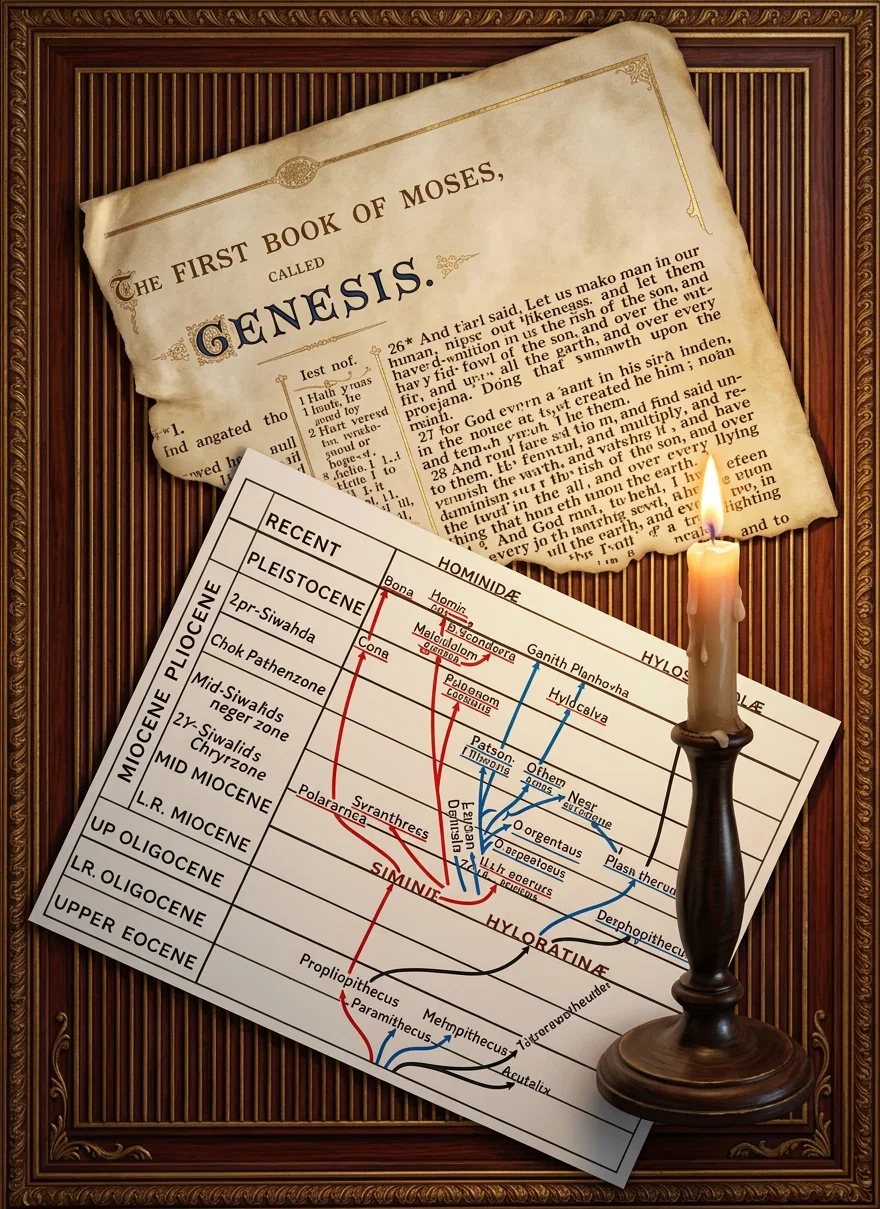
Here are contrasted the man-story of the evolution of man, and the God-story of the creation of man. The former is taken from Current Opinion for December, 1919, and is a diagrammatic representation of the successive geologic periods and the lines of descent of man and apes. Notice that Genesis gives the story complete, there is no missing evidence, the beginning is laid bare, while the evolutionist’s diagram does not even attempt to show a beginning. The four lines at the bottom cannot be traced back to a common beginning. Which of the two stories is the most clear and simple, the most believable? For which is there the most proof? Which is most scientific?
And love that makes life worth living is also a mystery. Have you ever read a scientific definition of love?—No, and you never will. Why?—Because a man does not know what love is until he gets into it, and then he is not scientific until he gets out again. And even if we could understand the mysterious tie that brings two hearts together from out the multitude, and on a united life build the home, earth’s only paradise, we still would be unable to understand that larger mystery which manifests itself when a human heart reaches out and links itself to every other heart.

We Are Surrounded by the Mysterious

We are encouraging children to raise vegetables, and a little child can learn how to raise the vegetable, but no grown person understands the mystery that is wrapped up in every vegetable that grows. Let me illustrate: I am fond of radishes; my good wife knows it, and keeps me supplied with them when she can. I eat radishes in the morning, I eat radishes at noon, I eat radishes at night, I eat radishes between meals—I like radishes. I plant radish seed—put the little seed in the ground—and go out in a few days and find a full-grown radish. The top is green, the body of the root is white and almost transparent, and around the outside of the root I sometimes find a delicate pink or red. Whose hand caught the hues of a summer sunset and wrapped them around the radish root down there in the darkness in the ground? I cannot understand a radish. Can you? But I like radishes. Don’t you? If one refused to eat anything until he could understand the mystery of its growth, he would die of starvation; but mystery does not bother us in the dining room—it is only in the Church that mystery seems to give us trouble.

The Watermelon Miracle

If there is among you anyone who has been presumptuous enough to attempt to confine the power and purpose of God by man’s puny understanding, let me persuade him to abandon this absurd purpose, by the use of anillustration which I once found in a watermelon. I was passing through Columbus, Ohio, some years ago, and stopped to eat in the restaurant in the depot. My attention was called to a slice of watermelon, and I ordered it and ate it. I was so pleased with the melon that I asked the waiter to dry some of the seeds, that I might take them home and plant them in my garden. That night a thought came into my mind—I would use that watermelon as an illustration. So the next morning, when I reached Chicago, I had enough seeds weighed to find out that it would take about five thousand watermelon seeds to weigh a pound, and I estimated that the watermelon weighed about four pounds. Then I applied mathematics to the watermelon. A few weeks before, some one, I knew not who, had planted a little seed in the ground. Under the influence of sunshine and shower, that little watermelon seed had taken off its coat and gone to work; it had gathered from somewhere two hundred thousand times its own weight, and forced that enormous weight through a tiny stem and built a watermelon. On the outside it had put a covering of green, within that a rind of white, and within that a core of red, and then it had scattered through the red, little seeds, each one capable of doing the same work over again. What architect drew the plan? Where did that little watermelon seed get its tremendous strength? Where did it find its flavouring extract and its colouring matter? How did it build a watermelon? Until you can explain a watermelon, do not be too sure that you can set limits to the power of the Almighty, or tell just what He could do, or how He would do it. The most learned man in the world cannot explain a watermelon, but the most ignorant man can eat a watermelon and enjoy it. God has given us the things that we need, and He has given us the knowledge necessary to use those things, and the truth that He has revealed to us is infinitely more important for our welfare than it would be to understand the mysteries He has seen fit to conceal from us.

Here Is Good Advice for the Critic

So with religion; if you ask me if I can understand everything in the Bible, I answer: No. I understand some things today that I did not understand ten years ago; and if I live ten years longer, I hope some things will be clear that are now obscure. But there is something more important than understanding everything in the Bible. It is this: If we will only try to live up to the things that we do understand, we shall be kept so busy doing good that we will not have time to worry about the things we do not understand.
In Fred Emerson Brooks’s poem “The Grave Digger,” there is one stanza that is in point here:—
If Chance could fashion but a little flower, With perfume for each tiny thief, And furnish it with sunshine and with shower, Then Chance would be creator, with the power To build a world for mankind.
But Chance cannot fashion even a little flower; Chance cannot create one single thing that grows. Every living thing bears testimony to a living God; and if there be a God, then every human life is a part of that God’s plan. And if this be true, then the highest duty of man, as it should be his greatest pleasure, is to try to find out God’s will concerning him and do it.
If one accepts the miracle as a manifestation of God’s power, he grows in his appreciation of that power as he contemplates its infinitude. He beholds it in the far-flung limits of the universe,—in blazing suns and whirling planets and myriad stars, each moving in silent obedience to the Creator’s will; he feels it in the earthquake and in the trembling of the volcano; he measures it in the lightning’s flash and in the storm at sea; and he finds inspiration in the rocky peak, the deep gorges, and the waterfalls that abound in the land “where the hand of God is seen.”
And who can study God’s plan, comprehending the universe and yet minute in detail, without being overwhelmed by the presence of an infinite mind that designed the whole and without whose continued care the world would be engulfed in chaos? Not a heart could beat nor could the lungs expand if the movement of these organs were left to the voluntary act of man. But God has relieved His creatures of concern about blood and breath, that man, freed from a labour beyond his power, may employ his time in the service of his Maker.
Continue reading: Around the World