Your ShelfYour Projects

Signs of the Times, Vol. 36, No. 46.

Thanksgiving

Signs of the Times

Nov 24, 1909

Pacific Press Publishing Association · Mountain View, California · Nov 24, 1909

Thanksgiving

BY FLORA E. WARREN
Our Father, at Thy throne we humbly bow / With glad thanksgiving, and before Thee now / In adoration we will loud exclaim, / “All praise and glory to Jehovah’s name!” / For Thou, O God, hast magnified Thy Word / And made it plain, and we have seen and heard / That every soul may know Thy love and power, / And hear Thy call in this—salvation’s hour; / And every heart may from its sin be free; / May choose to live, and worship only Thee.
We thank Thee for this Word of truth divine, / Which Thou hast caused in our dark hearts to shine; / We thank Thee for this Lamp to guide our feet / Into all truth, and happiness complete.
We thank Thee Thou hast opened to our view / Thy wondrous Heart of Love, eternal, true; / Hast given Jesus Christ, the Word, the Life, / To speak good-will to men, to end all strife. / We thank Thee, Father, for our Saviour, Friend, / Has promised to be with us to the end.
We thank Thee for His power to conquer sin / In sinful flesh—where evil sought to win. / We glory now in Him who drained the cup / For men, and pleads, “How can I give thee up?”
We thank Thee Thou who knowest every need, / Hast full supplied; dost still with sinners plead / To turn from sin’s short, sorrow-laden way, / To find true joy, and never-ending day.
Our God, we thank Thee Thou wilt help us do / Thine own good will, if we but ask Thee to. / We thank Thee that Thine ear does ever hear / The faintest cry for help, for Thou art near.
The thank Thee, Father (for Thy Word is plain), / That Jesus soon will come to earth again, / To take His people to their home above, / Where all is life, and peace, and endless love.
We thank Thee Thou hast told us He is near, / That we may now rejoice, and need not fear; / But with the saved of ages with Christ reign, / And sing, “All worthy is the Lamb once slain! Amen.”

OUR BIBLE BAND

Schedule for Week Ending December 4, 1909

Day Date Morning Evening
Su. Nov. 28 Eze. 33, 34 1 Peter 5
Mo. " 29 " 35, 36 2 Peter 1
Tu. " 30 " 37, 38, 39 " 2
We. Dec. 1 " 40, 41 " 3
Th. " 2 " 42, 43, 44 1 John 1
Fr. " 3 " 45, 46 " 2
Sa. " 4 " 47, 48 " 3

Suggestive Notes

Our Old Testament lessons begin with Ezekiel 33 and close with the book. A wonderful chapter is 33. It seems as tho it were almost God's last effort to appeal to His children. He emphatically tells them that He has no pleasure in the death of him that dieth, but pleads that they will return to Him and live.
The latter part of the great book is filled with promises of what God would do for His children then if they would but return to Him.
The sanctuary presented in chapters 40 to 48 was a provisional sanctuary, if they would but be “ashamed” of their iniquities. They were not ashamed; they went on in their apostasy; and the sanctuary, and the wonderful promises therewith, were but feebly met in the sanctuary built by Zerubbabel. That it does not have reference to a future sanctuary is clearly evident from the fact that sacrifices were to be offered in that temple; but in God's plan, to offer sacrifices now would be to annul the offering of Christ.
Our New Testament lessons include the last chapter of 1 Peter, 2 Peter, and the first three chapters of 1 John. 2 Peter is one of the books which has been attacked by the Higher Critics; but it bears its own stamp of truth, and its prophecies, clearly fulfilled in the Christian dispensation, are an abundant proof of its inspiration. These prophecies, that forewarn the children of God of the evil snares of the enemy, that enemy would like to take out of the way. All the more they should be prized by God's children. They do well that they “take heed” to them.
The epistle of John was written by John the beloved disciple. It very closely resembles the fourth Gospel. Whether it was written before or after that, can not be determined. The date is fixed from 90 to 94 or 95, near the close of the first century. The place where it was written is generally thought to be Ephesus. The whole appeal of the epistle is for true fellowship with God—that fellowship which brings light and gladness, and which results in keeping all the commandments of God.

Question Corner

2979.—Effect of Multiplied Translations

Are not the different versions of the Bible, with their different renderings, likely to engender doubt as to the inspiration and reliability of any of them? W. M. C.
It does not so seem to us, any more than the rendering of the Scriptures into the 500 or more languages and dialects in which it has been translated. To us it confirms the Scriptures. All the differences that there are in all the various renderings into English do not make enough difference in doctrine so as to change the teaching of the Bible. It may alter some texts. A better rendering may show that some text which has been used to support some doctrine, does not support it; and yet if the doctrine is worthy of support, there will be other scriptures sufficient, or the general teaching of the Bible will support it.
The whole aim of the child of God ought not to be to desire a translation that is in harmony with his views; his whole soul ought to go out into the question, What does the Father say in His Word? And the better translation that he could get from the earlier copies, ought to be the one which would best satisfy.
Our Common English Version was translated from what would be called late copies of the original; that is, copies of copies of copies for centuries. The American Revised Version has been compared with the very earliest original copies which have been found. This is especially true of the New Testament. These copies very clearly show that they were very early copies; very much nearer the time of our Lord. One was found, for instance, in a convent near Mount Sinai; another one in the Vatican in Rome; another in Alexandria, Egypt; all entirely different copies, one not copied from the other, and each confirming the other in all the great general particulars.
Every additional copy of this kind, every additional good translation, confirms the Scriptures of truth, leads some to read it who might not otherwise read it, and tends to spread abroad the knowledge and glory of God.
It is not difficult to imagine how we would feel if we were to receive a letter from a dear relative who had left us a large fortune on certain conditions; that letter written in the Bengali language, for instance, or the Sanskrit, a language of which we are totally ignorant. That letter had been copied several times before it reached us; our copy perhaps being the fifteenth or twentieth which had been made. Naturally we would go to the best scholar we could to get a translation. That translation furnishes us very much satisfaction and joy; but it leaves some doubts; we are not clear in regard to the meaning of some passages. We find that there are earlier copies; copies which are nearer the time of the writing of that letter. We search and find those, we take them to still other scholars. The translation of these earlier copies confirms us all the more in the blessings and bounties which came to us through that letter. We learn of still earlier copies, of still better scholars of the language in which the letter was written. Again we obtain a translation. We find different renderings sometimes, very minor differences; but in all the great things of which the letter speaks, there is no difference. Would any of these translations lead us to doubt? Nay, but each would confirm all the others, and all would confirm and establish our faith that the letter was what it purported to be, and that the message which it brought to us was in every wise genuine.

2980.—Building of the Temple and Going Forth of the Commandment

How do you explain Ezra 6:15, the sixth year of Darius, or B.C. 515, when we say that the temple was first begun in 457, or the 7th year of Artaxerxes? F. L. R.
We do not know that any one has said that the temple was begun in B.C. 457. Really the temple was begun under the decree of Cyrus, as recorded in the first two chapters of Ezra. The date B.C. 457 marks another event, and that is the going forth of the commandment to restore and to build Jerusalem, as predicted in Dan. 9:25. That commandment was the commandment of God. It was carried out by three different kings, and could not be said to have gone forth in its fulness until the last king had acted. See Ezra 6:14: “And they builded, and finished it, according to the commandment of the God of Israel, and according to the decree of Cyrus, and Darius, and Artaxerxes king of Persia.” The decree of Artaxerxes was in the 7th year of his reign. Ezra 7:7. And the seventh year of his reign was B.C. 457.

2981.—Esteeming One Day Above Another

A text in Rom. 14:5, 6 reads: “One man esteemeth one day above another: another esteemeth every day alike. Let every man be fully persuaded in his own mind. He that regardeth the day, regardeth it unto the Lord; and he that regardeth not the day, to the Lord he doth not regard it.” Could this text be taken to refer in any way to those who do not think it essential to regard the Sabbath day as binding on a particular day? F. J. S.
We so many times miss the great thought of the Scripture by dwelling upon isolated portions of it. Romans 14 has its lesson, and it is a wonderful lesson. Previous to this the apostle has set forth the duties and privileges of the Christian. He has told us how God takes man from sin and makes him a child of grace. He has told us, in the 8th chapter, that grace makes him obedient to God’s law, so that the law of life in Christ Jesus makes him free from the law of sin and death, and that he walks by the Spirit, and fulfils the righteousness of the law; that is, its every requirement. The apostle still exhorts to faithfulness as in the last part of the 13th chapter; yet he also foresaw that there would be certain scruples among the disciples on account of nationality, or birth, or previous training, and so he urges that the least in faith be received, yet not for “decision of scruples,” or to “doubtful disputations,” or the “judging of his doubtful thoughts;” and then he gives illustrations of this. One man has faith to eat all things, but he that is weak eats herbs. Neither should judge the other. Then he gives us one of the striking thoughts of the chapter. “Who art thou that judgest the servant of another? to his own lord he standeth or falleth.” Now, this does not mean not judging the world, or not judging those who are disobedient; it is not judging the obedient ones who may differ from us in the matter of non-essentials. For a servant is one who obeys.
Then he uses another illustration. Many of these Roman Christians had been Jews, and they had learned to regard the feasts of the Passover, and Pentecost, and ingathering of fruits, and new moons, etc. Read as in the American Revised Version: “One man esteemeth one day above another: another esteemeth every day alike. Let each man be fully assured in his own mind. He that regardeth the day, regardeth it unto the Lord: and he that eateth, eateth unto the Lord, for he giveth God thanks; and he that eateth not, unto the Lord he eateth not, and giveth God thanks.”
You will notice that the Revised Version omits a portion that is in the Authorized Version, but which does not really belong to the original text. The great thought is that one should not judge his brother. God has not made us judge. We can proclaim His truth; we can declare to the people His Word, and assure them that they must all stand before the judgment-seat of Christ; but the judgment is reserved to Him. Yet the fact that we are not to judge others nor others judge us is no proof that either they or we are correct, nor should we gather such a thought from the apostle’s words. Man may not judge us even tho we do wrong, but before God’s judgment all must appear. “Each one of us shall give account of himself to God. Let us not therefore judge one another any more: but judge ye this rather, that no man put a stumbling-block in his brother’s way, or an occasion of falling.”
One other thought in connection with this as a part of the teaching of the Word of the Lord, is that in the great judgment-day when we shall all stand before God’s judgment-bar, the great rule of judgment will be His holy law. Eccl. 12:13, 14; James 2:8-12.

2982.—Belgian Hares

Is it a good thing to raise Belgian hares for the market? Is it in harmony with the great Threefold Message? B.
The editor could only say that it is a business in which he would not wish to engage, and yet he would not wish to sit in judgment upon any one who is engaged in that work. We certainly would not consider hares the best of food in the light of the law which God has Himself given in Leviticus 11 and Deuteronomy 14. Hares are quite susceptible to germ diseases and are used largely for experiments in this line because of that. It would seem that a person could turn his abilities and talents to a better business and one which would be equally profitable and much more satisfactory.

The Light of Prophecy

By L. A. Reed
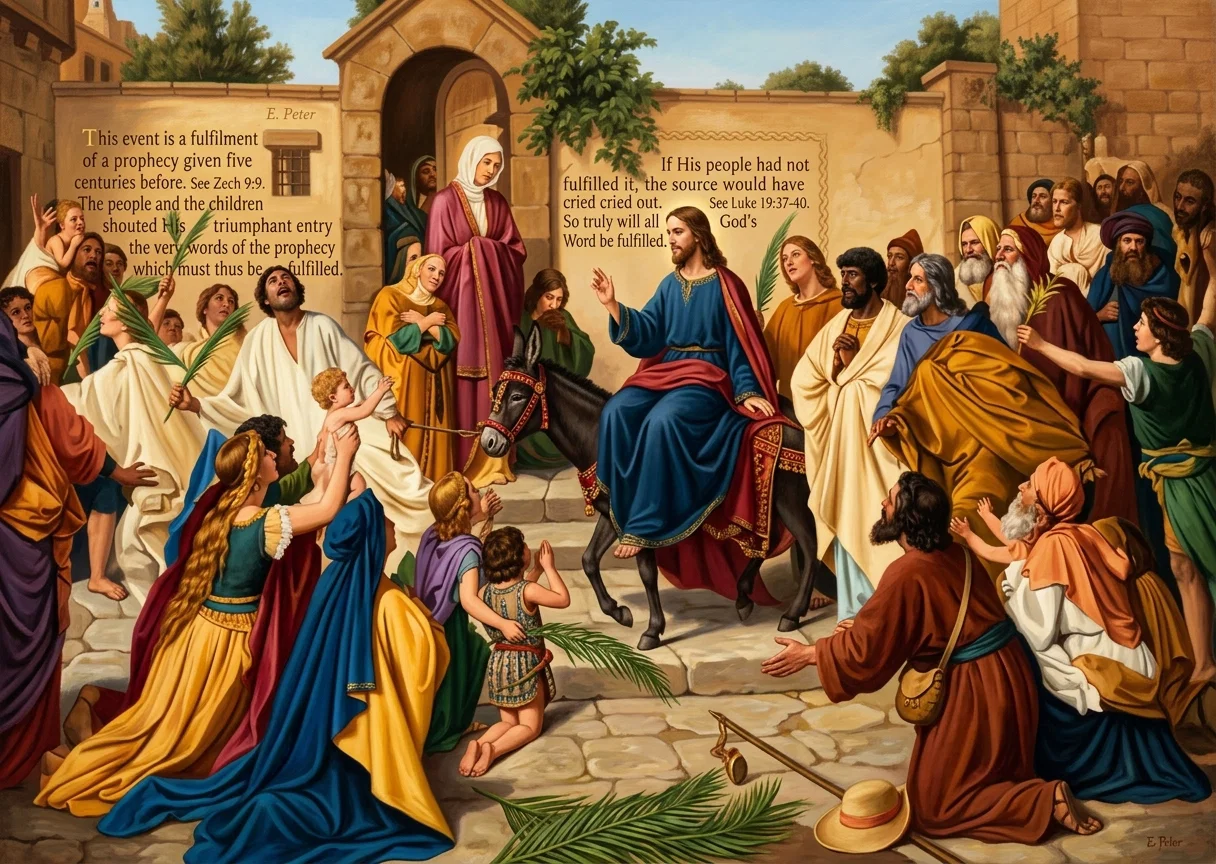
CHRIST ENTERING JERUSALEM
In every age there are those who choose to believe that God does not concern Himself with the affairs of men. Others there are who hardly dare hope that God condescends to give attention to mankind. But there are a few who believe and teach that God takes a deep, all-absorbing interest in humanity, and gives light from His Word for every age.
The Word is very emphatic with reference to this. “Surely the Lord Jehovah will do nothing, except He reveal His secret unto His servants the prophets.” Amos 3:7. The record of the Bible is one vast testimony to this principle.
Before God destroyed the world by a flood, Noah faithfully warned the people then living, and preached to them of the coming of the Deluge, and was occupied in preaching and practising this truth for one hundred and twenty years.
When God was about to destroy Sodom, He informed every person that would in any wise listen to His word, and some were told who laughed at the warning. Every one whom there was the slightest hope of saving was given a warning.
Before the Romans came and besieged and captured the city of Jerusalem, through Christ a warning was sent of the coming event. And not only so, but a sign was given for those in the city, enabling them to escape from the awful doom. That sign was the encompassing of the city by the Roman army; and every believer, when he saw that sign, made ready to escape. The wording of this preconcerted signal had called for haste. “Let him that is on the housetop not come down to take anything out of his house.” Each one who valued his life was to flee when he saw the sign. The Roman army encompassed the city, and then withdrew; and every Christian inside the city fled when that army withdrew, and escaped, not only from Jerusalem, but from the awful calamities that accompanied its siege and overthrow.

Prophecy a Light

So there are many warnings in the Word of God for our own day. There is a word of prophecy for our time, which we, living in this age, should heed. As the Word says, “We have the word of prophecy made more sure; whereunto ye do well that ye take heed, as unto a lamp shining in a dark place, until the day dawn, and the day-star arise in your hearts.” 2 Peter 1:19. There it is plain enough. We “do well” to “take heed” to the “word of prophecy,” just as we follow the light of a lamp when it is shining in a dark place. And thus we are certain of knowing where we are in this dark world. We are able to move unerringly amidst the surrounding darkness, because we have a light. And in so doing we do not “follow cunningly devised fables.” “For no prophecy ever came by the will of man: but men spake from God, being moved by the Holy Spirit.” Verses 16 and 21.
This principle, of God’s announcing the judgment before it takes the world, has been true, not only of those great things in which His power has been visibly manifested, but it has been true as well in the events of the nations where His providence, though often unrecognized, is constantly at work.
About 600 years before the birth of Christ, an outline of the world’s history was given, the number of great universal empires announced, and the order of their succession, with a delineation of their major characteristics, given. One of these, the simplest in its form of all, is given in the second chapter of Daniel.
When the Babylonian empire had reachedthe pinnacle of its glory, and when its power was centralized in its mightiest king, Nebuchadnezzar, God’s providence outlined to him in a remarkable way the history of this world to the end of time, yea, more, into the ages of eternity.

A King’s Dream

The simple story as recorded there, is an intensely interesting one. In the providence of God the king had a dream, and the visions of the night so impressed his heart and mind that it is his all-absorbing desire to know its meaning.
In his perplexity, naturally he turns to the great men, the wise men, the seers of his realm, only to be deeply disappointed. He asks of them the dream, and the interpretation of it. But they ask the king to tell the dream, and then they will put to it such interpretation as they can conjure up. He tells them that only on condition that they tell the dream will he be sure the interpretation is correct; that if they do not do this they will be destroyed; but that if they do it, he will honor them with position and with wealth. And then they flatly tell him that no human being can do it, that only the gods, whose dwelling is not with men, are equal to such a task; thus acknowledging that they have really no connection with divine forces and supernatural agencies. And so the decree of the king goes forth to take all the wise men in the realm, and put them to death. And Daniel and his companions are sought with the rest, to be slain.

The Dream

At Daniel’s earnest request, time is granted. Then he and his three companions join in prayer; and in the night-season the marvelous dream of the king is repeated to Daniel, with a full understanding of all its import. Then, thanking God for the revelation of the secret, and happy and confident because his Maker has thus supported him in the hour of trial, he goes boldly and asks to be admitted to the king.
The dream, we find, was that of a mighty image, a man of majestic form and wonderful glory, with an aspect terrible. The head of this image was of fine gold, its breast and its arms of silver, its body and thighs of brass, its legs of iron, its feet part of iron and part of clay. Then, as the king watched the image, he saw a stone cut out without hands, that smote the image upon the feet, and broke them in pieces; and the whole image, the iron, the clay, the brass, the silver, and the gold, became like the chaff of the summer threshing-floors, and the wind carried them away, so that no place was found for them, and the stone that smote the image became a great mountain, and filled the whole earth.
Daniel, in announcing this dream, this wonderful vision of the king, said that God had revealed it to him, and that it was the “God in heaven that revealeth secrets,” and had made known to the king “what shall be in the latter days.”
In the 29th verse of this chapter, Daniel declares that the king, as he retired for the night, was thinking of the future, wondering what was coming hereafter, and that God had taken this means of answering the questions of the king. Verses 36 to 45 give the explanation of the dream. The different metals represent different kingdoms which were to appear upon the earth, the first one being then in existence. The kingdom of Babylon was represented by the head of fine gold. The breast and the arms of silver represented an inferior kingdom which was to come after the Babylonian kingdom, and which we know by history was Medo-Persia. The body and thighs of brass were to be the third kingdom to bear rule over all the earth, and this every one knows was the kingdom of Greece, headed at first by Alexander the Great.
The iron, the prophecy states, is the fourth kingdom, which should be as strong as iron, forasmuch as iron breaks in pieces and subdues all things; and as iron that crushes all these metals before mentioned, so it should break in pieces and crush. This we know was “the iron monarchy of Rome.” The mixture of the iron and the clay in the feet and toes is explained to mean the divided condition of the fourth kingdom, and is absolutely in accordance with the facts. Rome was broken up during the years from 356 to 476 A.D., and divided into ten, at times less kingdoms; and a number of the modern nations of Europe are the remnants of this divided empire.
In the interpretation, Daniel said that the representatives of these nations would intermarry; they would seek to unite, “but they shall not cleave one to another, even as iron doth not mingle with clay.” Any one who knows anything at all of the history of Europe, knows of the intermarriages, of the efforts toward union, of the struggle for a universal empire; and he knows also that all such efforts have been absolutely futile. Rome once divided is divided still, and divided it will be to the end of time; for the announcement comes, “In the days of those kings shall the God of heaven set up a kingdom which shall never be destroyed, nor shall the sovereignty thereof be left to another people; but it shall break in pieces and consume all these kingdoms, and it shall stand forever.”

The Coming Empire

That last, the fifth great universal empire, is to occupy the same territory occupied by the four preceding empires. That is plain by the dream and the interpretation. The stone that smote the image became a great mountain, and filled the whole earth. It is therefore a universal empire. Hence it is to occupy the territory held by these other empires. And last of all, mark it, it destroys, utterly destroys these preceding nations. They become like the chaff of the summer threshing-floor, and are carried away, and no place is found for them. And the stone that smote the image becomes a great mountain, and fills the whole earth.
This destruction of the nations upon the setting up of the fifth universal and eternal empire of God, is not at all in harmony with that dream of the soothsayers of to-day who talk of peace and safety, and of a gradual dawn of the millennial reign of Christ. The picture in the dream is of a stone striking the image upon the feet, upon the part especially representing the nations now in existence, and crumbling them to dust, sweeping them off the face of the earth, no place whatever being left for them, and the place formerly occupied by them being taken by the empire of Christ. This is plain and explicit.
And since it is plain, since it is clear to all that God’s Word has told the truth, that history has repeated, in fact, what prophecy foretold in the Word, it naturally follows that what is yet to be is as certain as that which has already been fulfilled. And now what is our position in reference to it?
When God sent the message that He would destroy the world with a flood, thousands rejected that message, scorned the warning, and were lost. The few, namely eight souls, believed God’s Word, entered the ark, and were saved.
In the days when God destroyed Sodom, the many remained in the city, and were lost in the fires that consumed it; but the few, Lot and a portion of his family, heeded God’s Word, and just three of them were saved.
In the time of the destruction of Jerusalem, the Jews remained in the city, fought among themselves, and against the Romans, and perished miserably. But the Christians, believing and following the Word, escaped from that awful calamity.
What shall we do in our day? Shall we be among the unbelievers, the scoffers, and be caught in the judgments of God? Or shall we be among the few who believe and are saved? Already the divided kingdoms of Rome have been in existence for years. Other prophecies of the Scripture show us that we have come to the time represented by the hurling of the stone against the image, and the utter destruction of the image; in other words, that we have come to the time when God is about to set up the kingdom of Christ. Are we ready for the great event? Are we already subjects of that kingdom, and thus prepared to enter into that inheritance?
Remember, the prophecy is like a light shining in a dark place. We do well to take heed to it. Rest assured that God will do nothing but He reveals His secret to His servants the prophets. And now that “the lion hath roared; who will not fear? The Lord Jehovah hath spoken; who can but prophesy?”

The Call

“Go ye into all the world, and preach the Gospel.” Mark 16:15.
The harvest-field is waiting; O, come with sickles bright, Nor tarry not nor linger, But work with all thy might.
The evening shadows gather; The night will soon be here; The harvest call is sounding; O, come from far and near.
The precious grain is falling; O, tarry not nor wait, But haste with eager footsteps, For soon, ’twill be too late.
HENRIETTA EDGAR.
Flint, Michigan.

The Proof That Convinces

What people see is more convincing than what they hear. Therefore it is what they see of the power of Christ in men's lives, rather than what they are told about it, that convinces them. The inventor who can show a successful working model of his invention, will convince others of its success where a 10,000-word explanation, no matter how clear and reasonable, would leave them skeptical. “A man who lives right and is right has more power in his silence than another has by his words,” said Phillips Brooks.—Sunday School Times.

Convinced by Surgery

The “Quiver” has the following experience of a believing Japanese, which is worthy of note:
“The visible achievements of Christianity have always been a powerful argument on its behalf. The man who is healed is always a witness to the efficacy of the physician. Paul, for instance, wrought miracles in the name of Jesus Christ, and people saw and believed. There are still miracles being performed in Christ’s name, tho so many eyes are blind to them. A Japanese evangelist once said to a group of his countrymen: ‘To-day I attended a surgical clinic, and saw the foreign surgeon preparing to remove the cataract from the eye of an old lady. I wondered thus to myself: Suppose now we Christians are mistaken, and that instead of one God there are many gods, and that the one who made the foreigners did not consult with the one who made the Japanese, and as a result there is a difference in the minute anatomy of the eye, and so this operation proves a failure. But no such thought seemed to disturb the doctor. He cut into the eye in confidence, took out the cataract, and the patient could see. Truly there is but one God, the Creator and Father of us all, and we are brethren.’”

What the Word Says

1. The Son of God once came as Jesus the anointed of Jehovah, a Teacher, an Example, a Sacrifice for man.
“That holy thing which shall be born of thee shall be called THE SON OF GOD.” Luke 1:35.
“But thou, Bethlehem Ephratah, . . . out of thee shall HE COME FORTH unto Me that is to be ruler in Israel; whose goings forth have been from of old, FROM THE DAYS OF ETERNITY.” Micah 5:2, margin.
2. His first coming demands a second coming.
“So Christ was once offered to bear the sins of many; and unto them that look for Him shall He appear the SECOND TIME without sin unto salvation.” Heb. 9:28.
3. As His first coming was literal and personal, so shall His second coming be.
“While they beheld, He was taken up; and a cloud received Him out of their sight. And while they looked steadfastly toward heaven as He went up, behold, two men stood by them in white apparel; which also said, Ye men of Galilee, why stand ye gazing up into heaven? THIS SAME JESUS, which is taken up from you into heaven, shall SO COME IN LIKE MANNER as ye HAVE SEEN HIM GO INTO HEAVEN.” Acts 1:9-11.
4. All will see Him when He comes.
“Behold, He cometh with clouds; and EVERY EYE SHALL SEE HIM.” Rev. 1:7.
“And then shall THEY SEE THE SON OF MAN coming in a cloud with power and great glory.” Luke 21:27.
5. It will not be a coming in stillness and quiet, but in power, in pomp, in glory.
“For the LORD HIMSELF shall descend from heaven with a SHOUT, with the VOICE of the ARCHANGEL, and with the TRUMP OF GOD.” 1 Thess. 4:16.
6. He will come in overpowering glory.
“For the Son of Man shall come in the GLORY OF HIS FATHER with His angels.” Matt. 16:27.
7. At His coming, those who have rejected Him shall perish.
“And then shall THAT WICKED be revealed, whom THE LORD SHALL CONSUME with the Spirit of His mouth, and SHALL DESTROY WITH THE BRIGHTNESS OF HIS COMING.” 2 Thess. 2:8.
“As wax melteth before the fire, so let the wicked perish at the presence of God.” Ps. 68:2.
8. The righteous dead will be raised to life when He comes.
“For the Lord Himself shall descend from heaven with a shout; . . . and the DEAD IN CHRIST SHALL RISE first.” 1 Thess. 4:16.
“We shall not all sleep, but we shall all be changed, in a moment, in the twinkling of an eye, at the last trump; for the trumpet shall sound, and the DEAD SHALL BE RAISED INCORRUPTIBLE, and we shall be changed.” 1 Cor. 15:51, 52.
9. His people will then enter upon their reward.
“Behold, I COME QUICKLY; and MY REWARD is with Me, to give EVERY MAN according as his work shall be.” Rev. 22:12.
10. Christ will then take His people to the mansions prepared in the city of God.
“Ye believe in God, believe also in Me. In My Father’s house are MANY MANSIONS: . . . I go to prepare a place for you. And if I go and prepare a place for you, I WILL COME AGAIN, and RECEIVE YOU UNTOMYSELF; that where I am, there ye may be also.” John 14:1-3.
11. He will then take His throne and begin His everlasting reign.
“When the Son of Man shall come in His glory, and all the holy angels with Him, THEN SHALL HE SIT UPON THE THRONE OF HIS GLORY.” Matt. 25:31.
12. Then will His people share His reign.
“And the KINGDOM AND DOMINION, and the greatness of the kingdom under the whole heaven, shall be given to THE PEOPLE OF THE SAINTS OF THE MOST HIGH, whose kingdom is an EVERLASTING KINGDOM, and all dominions shall serve and obey Him.” Dan. 7:27.
13. There will be signs of His coming.
“And THERE SHALL BE SIGNS in the sun, and in the moon, and in the stars; and upon the earth distress of nations, with perplexity; the sea and the waves roaring; men’s hearts failing them for fear, and for looking after those things which are coming on the earth: for the powers of heaven shall be shaken. And THEN SHALL THEY SEE THE SON OF MAN COMING in a cloud with power and great glory.” Luke 21:25-27.
14. This coming is the culmination of the blessed hope of the ages.
“Looking for THAT BLESSED HOPE, and the GLORIOUS APPEARING OF THE GREAT GOD AND OUR SAVIOUR JESUS CHRIST; who gave Himself for us.” Titus 2:13, 14.
Continue reading: The Coming of the Master