Your ShelfYour Projects

Review and Herald, Vol. 89, No. 14.

OUR CHANGEFUL DAY

Review and Herald

Apr 4, 1912

Review and Herald Publishing Association · Takoma Park Station, Washington, D. C. · Apr 4, 1912

OUR CHANGEFUL DAY

WORTHIE HARRIS HOLDEN
It was a day that symbolized our life,— That changeful day in March,— For ’neath the blue-domed arch Across the smiling sun a cloudlet strayed, And flakes of snow their playful frolic made In air; and then a shower of rain-drops came, Close followed by a rainbow to proclaim God’s promise; and the while, through all the strife, Near the horizon was a field of blue That kept unsullied all the March day through.
So faith assures a constant sky serene O’er all our varied life, With much vexation rife, And through the wintry snow or summer rain Its undisturbed repose will e’er retain: And for each trial some precious promise given Will span the cloud and bid us look to heaven, Where still a patch revealing blue is seen; So thoughtful is our Father’s care to smile His love through mists that cloud earth’s “little while.”

THE “ROME AND MARRIAGE” AND “CATHOLIC PRISONS” NUMBER

AN ARSENAL OF INFORMATION

Recent despatches and interviews published in the leading American dailies, show that Rome’s eye is upon the “Protestant Magazine.” She fears our fearless yet dignified propaganda.
A letter from Rome to the New York “Sun,” July 11, 1892, reveals the plan of the Papacy for America: “What the Church has done in the past for others SHE WILL NOW DO FOR THE UNITED STATES.”
A government official in Washington, D. C., writes: “American Protestantism is in need of just such a publication.”

PARTIAL CONTENTS

Double Frontispiece—Photograph of Holy Cross Church Baptism Certificate (Perth Amboy, N. J.), Showing Rome’s Insult to American Marriage Laws.
Protestantism and Catholicism (cover).
A Girl’s Escape From a “House of the Good Shepherd.”
Rome and Marriage Laws.
The Mediation of Christ.
Reply to Attack by “Catholic Truth Society” Upon This Magazine.
Cardinal O’Connell Above Governor Foss?
“Another God Upon Earth.”
Rome Capturing America.
Is America to Become Catholic?
Protestantism in the Sixteenth Century, and Other timely articles, news notes, etc.

SPECIAL OFFER ON TEN, ONE-YEAR

Ten copies, one year, to one address, or to 10 separate addresses, only $1.50, or 15 cents each. Sender may include his own name as one of the ten. This number should be placed in the hands of every editor, attorney, clergyman, city and county official, and public-school teacher in your county. We can furnish the names and addresses.
A few of the following bound volumes are for sale: Vols. I and II (1909-10), in one, cloth covers only, each $1.75, post-paid; Vol. II (1910), paper covers only, each, 50 cents, post-paid; Vol. III (1911), cloth, 90 cents, paper, 50 cents, post-paid.

Please Order Through Your Tract Society
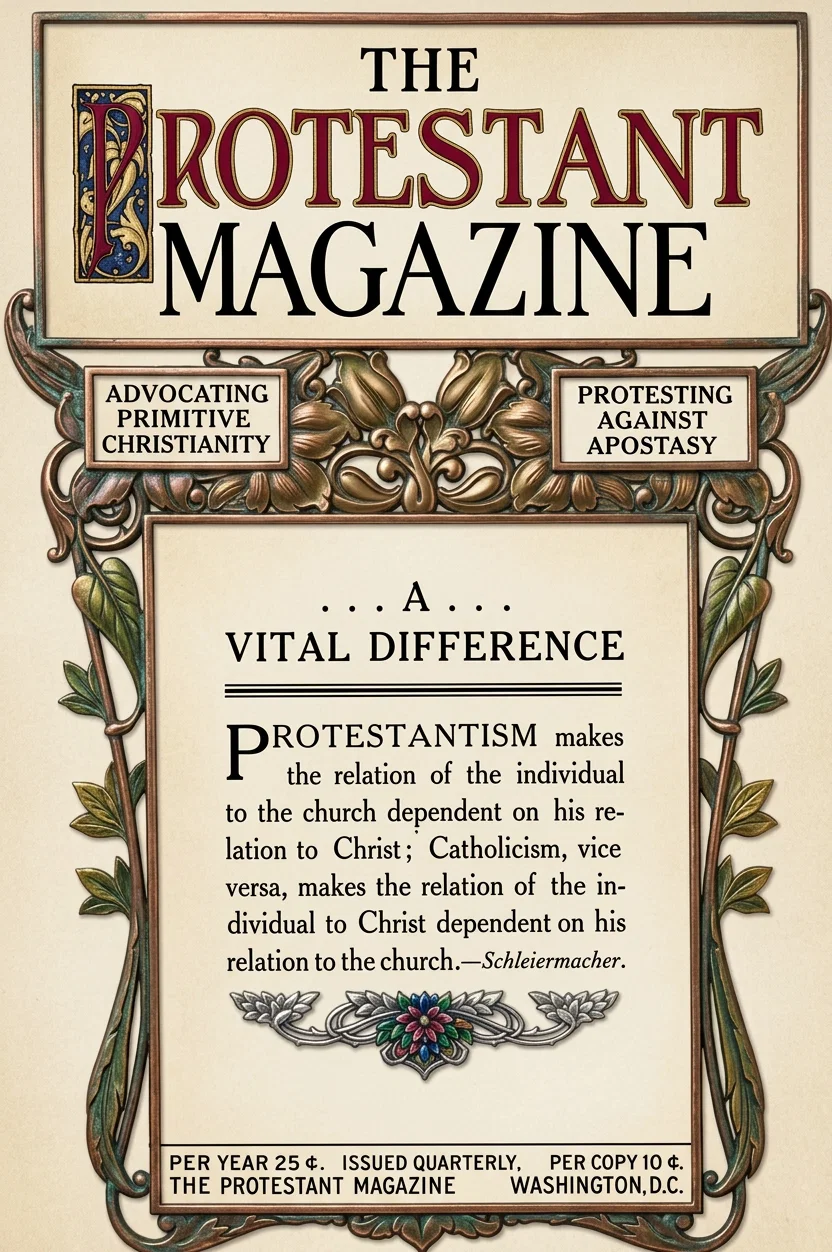
If you do not know your Tract Society address, send to “The Protestant,” Washington, D. C.
A GOOD PROPOSITION FOR AGENTS

A GOOD PROPOSITION FOR AGENTS

PRICES: 25 cents a year, 10 cents a copy; 5 to 40 copies, 5 cents each; 50 or more copies, 4 cents each. Send 10 cents for sample copy. Better still, send $1.00 for 20, or $2.00 for 50. Discount to agents on yearly subscriptions.

THE MAY NUMBER OF LIFE & HEALTH NOW READY!

“California’s Big Trees” Cover, in Three Colors
Sixty-Seven Articles
Over 40 Illustrations
An intensely practical as well as a beautiful and instructive number. Its articles are VITAL TO HEALTH!
Questions and Answers.—In this new and popular department the editor replies to questions asked by subscribers. SUBSCRIBE NOW. Send $3.00 for 5 years; $2.00 for 3 years; or $1.00 for one year.

PARTIAL CONTENTS

Frontispiece, Avalon, Santa Catalina Island, California.
God’s Great Out-of-Doors, by George Wharton James.
Bournville, the Garden Village, by G. H. Heald, M. D.
How to Escape the “White Plague,” by A. B. Olsen, M. D.
Keeping Young in Looks, by William J. Cromie.
Faulty Foot-Wear, X-ray photographs of normal and of deformed foot.
Nuts and Nut Foods, by George E. Cornforth.
Typhus and Typhoid.
“Prohibition Does Not Prohibit.”
Questions and Answers.—Sour-Milk Tablets—Yeasts and Ulcers—Exercise for the Voice—Cold-Sores—Water Test—Flies and Typhoid—Tuberculosis—Human and Bovine—Ivy-Poisoning—Pimples—Hookworm Treatment—Greasy, Falling Hair.
Current Comment.—“Personal Liberty”—Contaminated Oysters—Overeating Menaces the Race—Smallpox and Vaccination, etc.
The Saloon and Insanity.
Treatment of Simple Catarrh.
Diseases in Public Roller-Towels.
Leprosy in New York, and many other articles.
Single bound volumes for 1908, 1909, 1910, and 1911, half leather covers only.
Each, post-paid ........ $1.75

Send All Orders Through Your Tract Society

If you don’t know your Tract Society address, ask “Life and Health,” Washington, D. C.
Cover Design Printed in Three Colors

EARN YOUR OWN SUBSCRIPTION

By sending us two new subscriptions at $1.00 each, you may earn your own yearly subscription.
Send $2.00 for 50 copies; sell 20 to get your money back; then sell or give away the other 30 copies in the interests of true health reform.

PRICES

$1.00 a year, 10 cents a copy; 5 to 40 copies, 5 cents each; 50 or more copies, 4 cents each.

Service for Christ; Its Meaning

MRS. E. G. WHITE
Practical Christianity means laboring together with God every day; working for Christ, not now and then, but continuously. A neglect to reveal practical righteousness in our lives is a denial of our faith and of the power of God. God is seeking for a sanctified people, a people set apart for his service, a people who will heed and accept the invitation, “Take my yoke upon you, and learn of me.” How earnestly Christ prosecuted the work of our salvation! What devotion his life revealed, as he sought to give value to fallen man by imputing to every repenting, believing sinner the merits of his spotless righteousness!
How untiringly he worked! In the temple and the synagogue, in the streets of the cities, in the market-place, in the workshop, by the seaside, among the hills, he preached the gospel and healed the sick. He gave all there was of himself, that he might work out the plan of redeeming grace.
Christ was under no obligation to make this great sacrifice. Voluntarily he pledged himself to bear the punishment due to the transgressor of his law. His love was his only obligation, and without a murmur he endured every pang and welcomed every indignity that was part of the plan of salvation. The life of Christ was one of unselfish service, and his life is our lesson book. The work that he began we are to carry forward. With his life of toil and sacrifice before them, can those who profess his name hesitate to deny self, to lift the cross and follow him? He humbled himself to the lowest depths that we might be lifted to the heights of purity and holiness and completeness. He became poor that he might pour into our poverty-stricken souls the fulness of his riches. He endured the cross of shame that he might give us peace and rest and joy, and make us partakers of the glories of his throne.
Should we not appreciate the privilege of working for him, and be eager to practise self-denial and self-sacrifice for his sake? Should we not give back to God all that he has redeemed, the affections he has purified, and the body that he has purchased, to be kept unto sanctification and holiness?
The apostle Paul had learned the meaning of true service when he wrote the words, “I am debtor both to the Greeks, and to the Barbarians; both to the wise, and to the unwise. So, as much as in me is, I am ready to preach the gospel to you that are at Rome also. For I am not ashamed of the gospel of Christ: for it is the power of God unto salvation to every one that believeth.”
In what sense was Paul debtor both to the Jew and to the Greek? To him, as to every disciple of Christ, had been given the commission, “Go ye into all the world, and preach the gospel to every creature.” In accepting Christ, Paul accepted this commission. He realized that upon him rested the obligation of laboring for all classes of men,—for Jew and Gentile, for learned and unlearned, for those occupying high positions and for those in the most lowly walks of life. From a zealous persecutor of the followers of Christ, Paul became one of the Saviour’s most devoted and effective workers. Suddenly arrested in his career of persecution, he was given a view of the Saviour, and a complete transformation took place in him. Henceforth his life was wholly devoted to the crucified One.
Paul’s calling demanded from him service of varied kinds,—working with his hands to earn his living, traveling from place to place, establishing churches, writing letters to the churches already established. Yet in the midst of these varied labors, he declared, “This one thing I do.” One thing he kept steadfastly before him in all his work,—to be faithful to Christ, who, when Paul was blaspheming his name and using every means in his power to make others blaspheme it, had revealed himself to him. The one great purpose of his life was to serve and honor him whose name had once filled him with contempt.
Paul’s one desire was to win souls to the Saviour. Jew and Gentile might oppose him, but nothing could turn him from his purpose. Henceforth his testimony was, “Yea verily, and I count all things to be loss for the excellency of the knowledge of Christ Jesus my Lord: for whom I suffered the loss of all things, and do count them but refuse, that I may gain Christ, and be found in him, not having a righteousness of mine own, even that which is of the law, but that which is through faith in Christ, the righteousness which is of God by faith.”
Christian reader, let the great purpose that constrained Paul to press forward in the face of hardship and difficulty, lead you to consecrate yourself wholly to God’s service. Whatever your hands find to do, do it with your might. Let your daily prayer be, “Lord, help me to do my best. Teach me how to do better work. Help me to bring into my service the loving ministry of the Saviour.”
The responsibility of each human agent is measured by the gifts he holds in trust. All are to be workers; but upon the worker who has had the greatest opportunities, the greatest clearness of mind in understanding the Scriptures, rests the highest responsibility. Every receiver should hold himself accountable to God, and use his talents for God’s glory.
Success in the work of God is not the result of chance, of accident, or of destiny; it is the outworking of God’s providence, and the award of faith and discretion, of virtue and persevering labor. It is the practise of the truth that brings success and moral power. The bright rays of the Sun of Righteousness are to be welcomed as the light of the mind; the principles of the character of Christ are to be made the principles of the human character. All man’s attainments, all his capabilities, are to be laid at the foot of the cross of Calvary. His own righteousness is to be surrendered. Counting all things but loss for the excellency of the knowledge of Christ Jesus the Lord, with the meekness and humility of a little child, he is to receive the engrafted word, which is able to save the soul.
“God so loved the world, that he gave his only begotten Son, that whosoever believeth in him should not perish, but have everlasting life.” This is the love that is the fulfilling of the law. He whose heart is filled with compassion for fallen man, who loves to a purpose, will reveal that love by the performance of Christlike deeds. True Christianity diffuses love through the whole being. It touches every vital part,—the brain, the heart, the helping hands, the feet,—enabling men to stand firmly where God requires them to stand, lest the lame be turned out of the way. The contemplation of him who loved us and gave himself for us, will make the life fragrant, and give power to perfect a Christian experience.
We can, we can reveal the likeness of our divine Lord. We can know the science of spiritual life. We can glorify God in our bodies and in our spirits, which are his. Christ has shown us what we may accomplish through cooperation with him. “Abide in me,” he says, “and I in you.” This union is deeper, stronger, truer, than any other. The heart must be filled with the grace of Christ. His will must control us, moving us, by his love, to suffer with those who suffer, to rejoice with those who rejoice, to feel a deep tenderness for every soul in weakness, sorrow, or distress.
If we are partakers of the divine nature, we shall reach forth a helping hand to those in need. Christ’s heart was ever touched with pity at the sight of woe. He died on Calvary to lift from men the penalty of transgression. He came to our world to make it possible for sinful human beings to obtain salvation. He wept over the sorrow and suffering he saw on every hand. But he would not fail nor be discouraged. He must believe, and press forward, that a fallen race might gain eternal life.
Laborer for God, cease not to pray. If the answer tarry, wait for it. Lay all your plans at the feet of your Redeemer. Let importunate prayers ascend to God. If it be for his name’s glory, the words will be spoken, Be it unto thee according to thy word.
“All things, whatsoever ye ask in prayer, believing, ye shall receive.” These words are a pledge that all that an omnipotent Saviour can bestow will be given to those who trust in him. As stewards of the grace of heaven, we are to ask in faith, and then wait trustingly for the salvation of God. We are not to step in before him, trying in our own strength to bring about that which we desire. In his name we are to ask, and then act as if we believed in his efficiency to send the answer.

On the Other Side

WORTHIE HARRIS HOLDEN
’Twill seem so brief on the other side, This storm and wind and the changing tide, For love must measure by gain, not loss; And crowns will outweigh every irksome cross When safe in the harbor we ride.
’Twill seem too little,— our toilsome care To search far and wide for jewels rare,— For close to those pierced hands and feet Each sacrifice will be deemed most sweet To lay at his footstool there.
’Twill seem such bliss when we hear his voice That now just the thought makes my soul rejoice; Though many earth-voices would lead astray, They can not molest us nor cause dismay If we ever make him our choice.
O, to dream of the better land is rest! But the thought that delights my heart the best Is that Christ will lead us forevermore To pleasures unknown, on that happy shore, The far-away land of the blest.

Deal Gently With the Erring

GEO. O. STATES
I was deeply interested in Elder Daniells’s article in the REVIEW of December 7 on the “Great Revival Movement,” and believe it is started as God would have it—“with our ministers seeking the Lord, and obtaining an individual experience with God.” When I think of some who have once been earnest, God-fearing members but who are now indifferent or opposing the truth, some who were once earnestly laboring to spread the message and are now without hope, or are working to tear down what they once labored so faithfully to build up, I wonder if something could be done to help these dear ones to see that the message is fast closing, and to induce them to take their stand once more to help swell the loud cry of the message.
Certainly there are some of this class who may be reached if the right course is taken. No doubt some in their solemn reflections are not satisfied, and are seriously thinking as they see the wonderful spread of the work. Surely this is God’s message to prepare a people for the Lord’s coming, and my salvation depends on taking my stand with the remnant, doing all I can to help carry forward the great work committed to that body.
At one of our early camp-meetings in Michigan there was present from the beginning much of God’s Spirit. The leading brethren thought of one of our ministers who had given up the truth. The thought was, “If he were only here, he would surely take his stand.” They had sent a telegram, and the next day as the train stopped at the ground a large company was there to welcome him. The following Sabbath, when the invitation was given for those to come forward who wished to seek the Lord, he was the first to respond. As he came to the front seat, Brother White met him, praising the Lord. That was a day long to be remembered, and the Spirit of God was poured out upon his people. This brother returned home, arranged his business, and once more began to preach the message. All he needed was a helping hand reached out in loving sympathy. He labored faithfully for years, and died in the blessed hope.
Over twenty years ago the writer was laboring in the Colorado Conference with one of our ministers. Together we planned the conference work, were together in tent work and in visiting churches. Finally he became discouraged and gave up the truth. My work called me to other fields, and I had not heard from him in fifteen years, when two years ago I was happily surprised to get a letter from him. He told me something of his past. He was living in an Eastern city and was receiving a large salary, but it required Sabbath work, and he was not satisfied. He was longing for the way to open so he could once more live the truth.
We had some further correspondence, and in a few months he resigned his position, went to the church the following Sabbath, took his stand, and was warmly welcomed by the church-members. That brother now sleeps, and I have no doubt will come forth in the first resurrection.
It is not censure but encouragement these dear ones need. The Saviour’s course with Peter contains an important lesson for us all. In the midst of Christ’s deepest trial Peter was overcome by the weakness of the flesh, and denied him with cursing, “and the Lord turned, and looked upon Peter.” Peter went out and wept bitterly. That tender look of love and sympathy broke Peter’s heart. There was no censure, but only loving sympathy, and that was too much for Peter. That Sabbath was indeed a sad day to the disciples, and especially so to him. The Lord knew Peter was in danger of giving way to discouragement; and so the angel, in sending the disciples word of the resurrection, said, “Tell his disciples and Peter.” O the wonderful love manifested in the Saviour’s solicitation for the one who had denied him! and what a lesson for us in dealing with the erring!
Cedaredge, Colo.

T. E. BOWEN

Job’s Experience—No. 4

T. E. BOWEN

WHEN the words of Job were ended, and these three men ceased to answer him, “because he was righteous in his own eyes,” and after one other young man who had been listening had spoken also, God granted Job’s request. Job had said, in his closing remarks to his three tempters: “Oh that One would hear me! behold, my desire is, that the Almighty would answer me;” and before, “Oh that I knew where I might find him! that I might come even to his seat! I would order my cause before him.” This prayer is now to be answered, only God is coming to him, instead of his going to God’s throne.
Presently a mighty whirlwind passed by Job’s home in the land of Uz. God was in this whirlwind. That God had been listening to all these words, is clear from his first question: “Then the Lordanswered Job out of the whirlwind, and said, Who is this that darkeneth counsel by words without knowledge?” And that he had come down in answer to Job’s challenge and repeated prayer is evident, for he continues: “Gird up now thy loins like a man; for I will demand of thee, and answer thou me. Where wast thou when I laid the foundations of the earth? declare, if thou hast understanding.”
Job is silent. He is startled by this first question. Truly, it is God talking. It is he who laid the foundations of the earth. That it was the Son of God who had come down is very evident; for he it was who had brought into existence all the creation of God; for “without him was not anything made that was made.”
Answer after answer is demanded of Job, each one wholly beyond his power. “Whereupon are the foundations thereof [the earth] fastened [“made to sink,” margin]? or who laid the corner-stone thereof; when the morning stars sang together, and all the sons of God shouted for joy?” “Hast thou commanded the morning since thy days; and caused the dayspring to know his place? . . . It [the earth] is turned as clay to the seal,” the earth on its axis, no doubt, being here described. “Canst thou bind the sweet influences of Pleiades, or loose the bands of Orion? Canst thou bring forth Mazzaroth in his season? or canst thou guide Arcturus with his sons?”
The Lord then comes to the things in the earth itself, and asks Job about the beasts, the birds, the great leviathan of the deep, the behemoth, every question being so worded as to make Job appear infinitesimally small in his own eyes. He is utterly bewildered, and at a complete loss to know what to think. At last the Lord gives his servant an opportunity to speak. “Moreover the Lord answered Job, and said, Shall he that contendeth with the Almighty instruct him? he that reproveeth God, let him answer it. Then Job answered the Lord, and said, Behold, I am vile; what shall I answer thee? I will lay mine hand upon my mouth. Once have I spoken; but I will not answer: yea, twice; but I will proceed no further. Then answered the Lord unto Job out of the whirlwind, and said, Gird up thy loins now like a man: I will demand of thee, and declare thou unto me. Wilt thou also disannul my judgment? wilt thou condemn me, that thou mayest be righteous?” Then follow two chapters of further pointed questions.
In this last question God points out Job’s sin. In his contending with these men, in his efforts to convince them that he was righteous, he had unconsciously “condemned” God. Such disannul God’s judgment, God’s decision concerning man. “As it is written, There is none righteous, no, not one.” Rom. 3:10. If Job were righteous of himself, then God’s findings were untrue; and further, he would need no Saviour, as any man who can maintain before God that he is righteous, would be able to save himself.
Self-righteousness—how insidious it is! How hard for the one cherishing it to discover it in himself! Job did not realize that he cherished it. The long array of questions which God propounds to Job gives us an idea of the offensiveness of self-righteousness in a servant of his. Does not this record of Job’s experience contain one of the deep lessons to us upon whom the ends of the world are come? Is not one of the greatest dangers confronting us couched in the same self-confidence, trusting in some kind of works we may have done, as did Job, rather than constantly giving God the glory? “Buy of me gold tried in the fire,” is the counsel of the heavenly Merchantman. “Thou sayest, I am rich.” This was how Job felt and talked until God began to speak.
Once more opportunity is given Job to speak, and he said: “I know that thou canst do everything, and that no thought can be withholden from thee. Who is he that hideth counsel without knowledge? therefore have I uttered that I understood not; things too wonderful for me, which I know not. Hear, I beseech thee, and I will speak: I will demand of thee, and declare thou unto me. I have heard of thee by the hearing of the ear; but now mine eye seeth thee. Wherefore I abhor myself, and repent in dust and ashes.”
Ah! here is the secret. Man can be filled with himself, and will trust in his own goodness and count upon his own righteousness, unconsciously perhaps, so long as he is contented with hearing of Christ Jesus the Lord; but let him once get a real view of the blessed Son of God, and in an instant all his comeliness turns into corruption. That view still brings forth the “I abhor myself, and repent in dust and ashes,” as it did in God’s servant of old.
Job is truly humble now. All his self-sufficiency is gone. His captivity is about to be turned, yet there remains one more test. And in this, even though it is hard to do, Job comes off victorious.
“And it was so, that after the Lord had spoken these words unto Job, the Lord said unto Eliphaz the Temanite, My wrath is kindled against thee, and against thy two friends: for ye have not spoken of me the thing that is right, as my servant Job hath. Therefore take unto you now seven bullocks and seven rams, and go to my servant Job, and offer up for yourselves a burnt offering; and my servant Job shall pray for you: for him will I accept.”
This is a most humiliating requirement for all, not excepting Job. But as these three men come to him, Job humbly prays unto God for them. The record says, “And the Lord turned the captivity of Job, when he prayed for his friends.” God’s heart of pity was touched at the scene of his servant humbly pleading for these men who had so tried him; and when he could pray, God could work; and he did. How is it with us? Are there some in the church for whom we do not care especially to pray? Perhaps our captivity will be turned, too, when we begin to pray for them.
After this Job lived one hundred forty years, had seven sons and three daughters, and a large store of earthly possessions was once more entrusted to him by his Heavenly Father.
Job triumphed when he came to see himself in the light shed about him by the presence of the Son of God. All boasting is excluded at the cross of Christ. No one can glory in his own wisdom, in his own wonderful works, in his own righteousness, before God. Continuing to hide in the cleft of the Rock, continuing to proclaim our own unworthiness and in humility uplifting the perfect One, we are safe, and our victory is assured. We need Christ’s righteousness constantly imputed to us. “I will not leave you comfortless: I will come to you. Yet a little while, and the world seeth me no more; but ye shall see me: because I live, ye shall live also.”
Let us not be satisfied until we see Jesus with the eye of faith now, and a little from this, with Job, we shall see “this same Jesus” coming in the clouds, our glorious Redeemer, whom we shall see, as well as he, for ourselves, and not for another.
Washington, D. C.

God's Lessons of the Night

DANIEL NETTLETON
“The darkness he called night.” Gen. 1:5.
WERE we to walk with the Lord and listen to his teaching from the written Word and from the open book of nature, our hearts would burn within us, and we should exclaim, with the great apostle, “O the depth of the riches both of the wisdom and knowledge of God!”
The Lord’s school is open day and night. All who will may go to this school and be taught of God. But during the day men are so anxious and busy about many things, and, like Martha, are not choosing the better part, that God can not get their attention. “For God speaketh once, yea twice, yet man perceiveth it not. In a dream, in a vision of the night, when deep sleep falleth upon men, in slumberings upon the bed; then he openeth the ears of men, and sealeth their instruction.” He makes not only the outgoings of the morning, but also the coming of the evening, a time of rejoicing and a season of helpful instruction.
Though all the angels should cease their singing, and all men refuse to praise the Lord, yet the heavens would declare his glory, and the firmament show his handiwork. Day unto day would utter speech, and night unto night show knowledge.
The great temple of God is ever resounding with its Maker’s praise. The trees clap their hands, the floods lift up their voices, the mountains and hills break forth into singing, and the starry hosts of night are—“Ever singing as they shine,” The hand that made us is divine.”
He has promised that if we follow on to know the Lord, his going forth to usshall be as the morning, and his blessing upon us as the dew of night.
In the tension of the times in which we live, how difficult it is to get an opportunity to be alone with God for meditation and prayer! In this time when many are running to and fro and knowledge is being increased; in these days of newspapers, automobiles, and flying-machines, men have little or no time for the Bible and prayer. Our daily life is full of stir, noise, and outward show. Men are in the great rush of money-getting and pleasure-seeking, and our religious life takes the form of this age of intense activity. There is too much bustle and outward show about our religion. God said he would be as the dew unto Israel. The dew comes unobserved and in the quiet of the night, and settles upon us as the dew of night.
Those who read the Bible will see that God has a “night-school.” It was at evening that the angels came to Sodom; and before the morning dawned that wicked city was in flames.
It was in the evening that Isaac went out into the field to pray.
It was in the solitude of night, by the light of the moon and stars, that Nehemiah beheld the desolation of Jerusalem, and there, at night, on his knees alone with God, he won a greater victory than any king with all his armies.
Daniel and his companions sought God to know the king’s dream, and “then was the secret revealed unto Daniel in a night vision.”
In a night-school Nicodemus learned the important and precious lesson, “Ye must be born again,” from a Teacher who came from God.
On the stormy Sea of Galilee in the fourth watch of the night, Jesus came to his toiling and frightened disciples, and spoke those blessed words, “Peace, be still.”
Paul and Silas prayed at night in the jail, and God sent an earthquake and shook the old penitentiary from turret to foundation-stones, and that night souls were born into the kingdom of Christ.
An angel visited Paul by night on a stormy sea, and he came forth to the seamen and captain of the ship with words of courage and good cheer.
Jesus chose the night season for private meditation and communion with his Heavenly Father. We read of his rising up a great while before day and going to a solitary place for prayer. Again, it is recorded of him, “He went out into a mountain to pray, and continued all night in prayer.”
The transfiguration was a night scene of glory. Jesus took three of his disciples and went up into a mountain to pray; and as he prayed, his countenance was altered, and he was transfigured. We shall also be altered and transfigured if we pray as he prayed.
If we would seek the Lord by day or by night as these men of the Bible did, we should have similar experiences. And would not the angels’ visits, and the victories over self and sin, and the great things accomplished for God be worth all our time and effort? God has promised to hear and answer our prayers when we seek him with all our hearts. His thoughts to us-ward are thoughts of peace, and he desires to give us a happy future, but he can not put his blessing upon a “wicked and slothful servant.” Nicodemus became a disciple of Christ, a helper in the time of his great need, because of that night visit with Jesus. Moses became God’s messenger to Pharaoh and the deliverer of Israel from Egyptian bondage because he turned aside to commune with God at the burning bush.
When Jesus came down from his night of prayer in the mountain, he found the poor and needy waiting to be helped by his holy ministry, and he continued to go about doing good and healing all who were oppressed by the devil. So when we come from the quiet seasons of communion with God, our faces will shine with holy joy, and we, too, shall be like the dew unto Israel.
Port Townsend, Wash.
Continue reading: The God of the Bible