Publishing Department

7%

Review and Herald Publishing Association · Takoma Park Station, Washington, D. C. · Nov 18, 1915

FromReview and Herald, Vol. 92, No. 57.

Read the full edition

Publishing Department

N. Z. TOWN — General Secretary W. W. EASTMAN — N. Am. Div. Secretary

Literature Sales During 1914

ELDER H. P. HOLSER, one of the pioneers in this message, in speaking of the publishing work in 1890, the year that our first canvasser was sent to a field abroad, says:—
“The past few years have taught us something of the part that the art of printing will act in the closing work. The publishing work is like the proposed machine of Archimedes, except that it has the advantage of having a place to stand to move the world; but the great power of the press will be of little effect if its products are not placed in the hands of the people. This work of circulating the printed page will, doubtless, be one of the greatest in the closing message.”
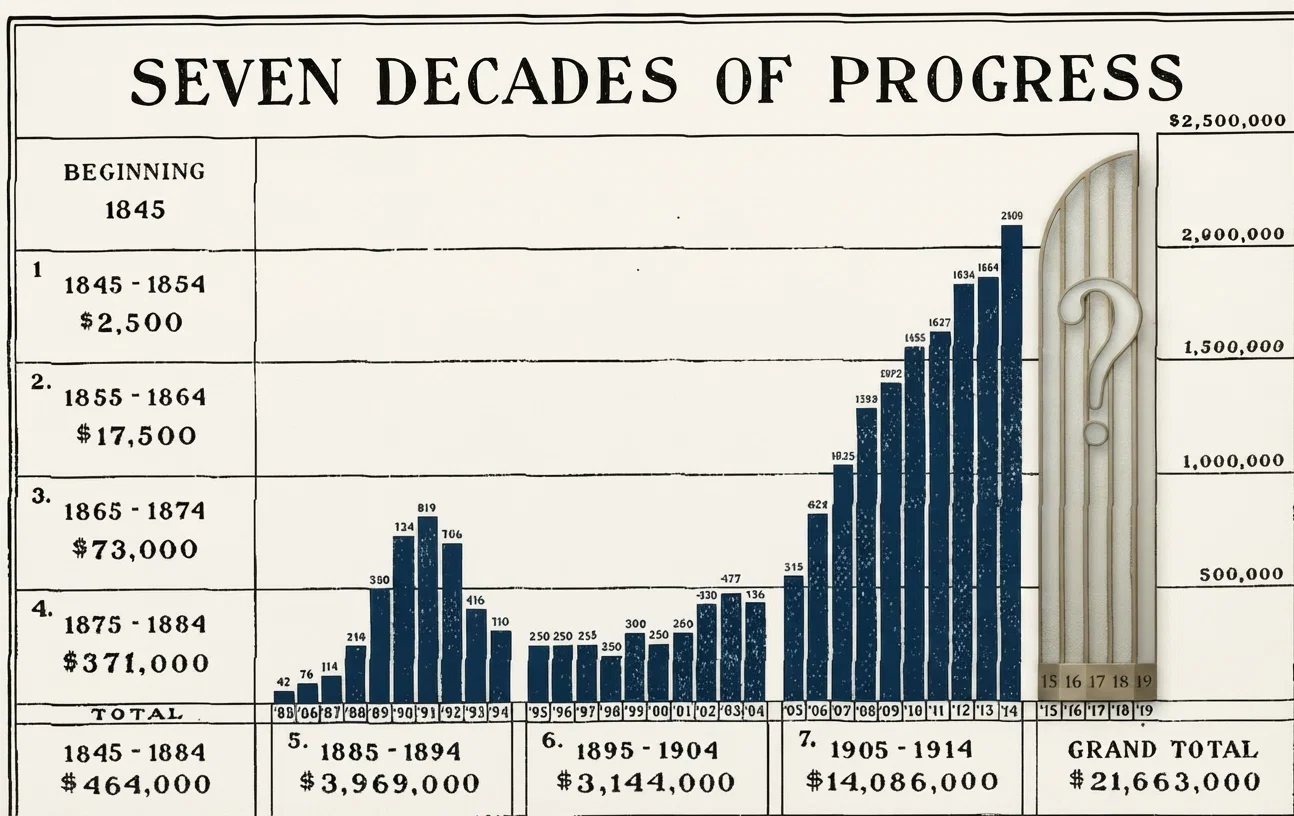
SEVEN DECADES OF PROGRESS
These statements, written twenty-five years ago, were prophetic of what we are witnessing today. If our literature work did have the advantage of a place to stand and was moving the world in 1890, how much stronger a place it occupies today, and how much greater influence it is having in turning people’s attention to the truth.
In 1890 we had seven publishing houses and branches, whose assets were $959,260.95. We were publishing at that time 24 periodicals, and were issuing literature in 12 languages. At the present time we have 39 publishing houses and branches, with assets amounting to $1,602,846.58, in which are employed 735 persons in the production of denominational literature. The last two publishing houses to be added to the list are that of Iceland, in the Far North, and that of the Philippines, in the Far East. Our literature is issued in the form of approximately 375 bound books, 350 pamphlets, 1,300 tracts, and 134 periodicals, in 80 different languages. There are 2,076 colporteurs engaged in the distribution of this literature, 885 in North America, and 1,191 in other countries.
With the close of 1914 our publishing work completed seven decades of history. The accompanying chart gives a graphic representation of the development and growth of this branch of the work during these years. At the left-hand side of the chart the first four decades are given, one below the other, beginning with 1845. The total value of literature circulated during those forty years amounted to $464,000. Beginning with the fifth decade, the chart shows the growth of the work year by year. We regret that this chart does not represent a steady growth upward, but, like Israel of old, when we arrived at Kadesh Barnea, in 1891, we turned back and wandered several years in the wilderness because of our unbelief. But, thank God, there were a few Calebs and Joshuas who never lost faith in our literature work, and who have had a large part in bringing about the splendid results we see today.
Our hearts were made glad when, in the year 1907, we passed the million-dollar mark. We then began to look toward $1,500,000, and were able to pass this mark in the year 1910. Since that year, we have had our goal set at $2,000,000. In the first part of 1914, we had high hopes of reaching our goal. When the war broke out in Europe, our faith almost failed; but the Lord has been better to us than all our hopes, and the year’s summary, which we have just completed, shows a grand total of $2,109,000, a gain of $240,000 over the previous year. The grand total for the seven decades amounts to $21,663,000. It is interesting and also encouraging to see that the value of literature circulated during the last decade is almost twice as much as that of the previous sixty years, and the amount circulated during 1914 is larger than the grand total for all the forty-five years from the beginning, in 1845, to 1890, when Elder Holser expressed such confidence in our literature work.
The question now arises, What shall our future records be? We have left space on our chart for the next five years, and have placed the possible goal at $2,500,000. If time lasts, we believe that, with the blessing of God, we shall not only reach this goal, but pass far beyond it during the years indicated on the chart.
In closing his article, Elder Holser says:—
“The work of the colporteur will never move of itself. It will probably become more difficult as more of our publications are circulated and greater opposition is raised, but our increasing experience and zeal should far more than counterbalance the increasing obstacles. As we near the end, our faith should lead us to exertions beyond human power. We should lose sight of the world and its attractions, and bend all our energies to spread the closing message. The climbing may be hard, but let us persevere. Soon the shining summit of glory will be reached, and oh, the bright fields of Eden that will then spread out before us! The eternal weight of glory will then be ours.”
Shall we not at this time manifest the same faith and confidence in the possibilities and importance of our literature work?
N. Z. Town.