Current Events in the Light of Prophecy
3%

Review and Herald Publishing Association · Takoma Park Station, Washington, D. C. · Nov 11, 1915

FromReview and Herald, Vol. 92, No. 56.

Read the full edition

Current Events in the Light of Prophecy
(Reading for Monday, December 13)

Current Events in the Light of Prophecy

J. T. BOETTCHER
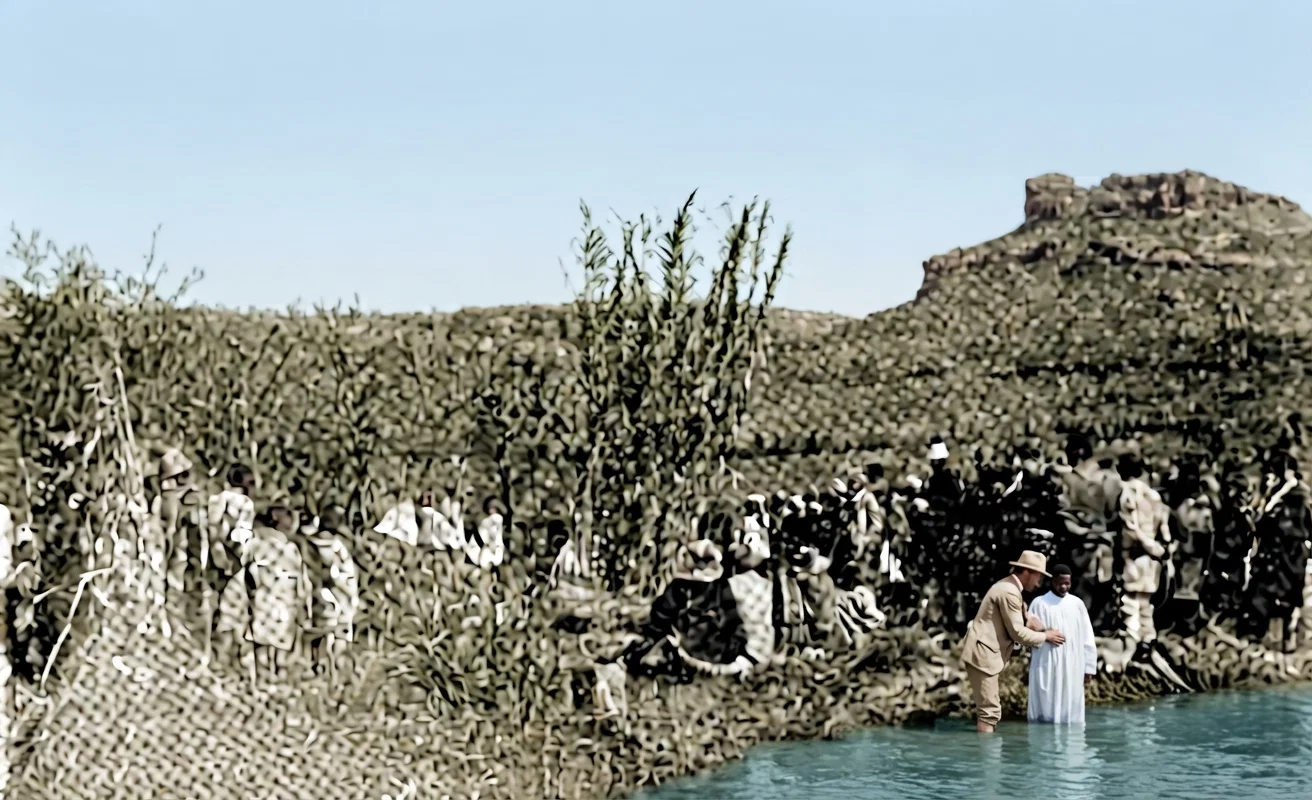
Photo by H. C. Olmstead
“THAT ye may be mindful of the words which were spoken before by the holy prophets, and of the commandment of us the apostles of the Lord and Saviour.” 2 Peter 3:2.
Looking forward with a prophetic eye, the apostle sees the condition of the world just prior to the Lord’s return. He beholds the scoffers who wear the cloak of religion, but walk after their own lusts, speaking lightly of Christ’s second coming, even saying that these things have always been so, no change having taken place nor will any take place so long as time shall last. At that very time he bids the “beloved” to be “mindful of the words which were spoken by the holy prophets.” The “beloved,” therefore, will consider the sayings of the prophets as of the greatest importance. All the events taking place around them will be measured and weighed in the light of this “sure word” which has never failed. Any Christian who puts his trust in that which God has said will have a sure hope and a firm foundation for his faith. He will not be like a reed shaken with the wind. He will not give place to speculations, but rather become grounded in every line of the message.
Let us consider what some of the prophets have said of our times. Again and again we have traced the lines of prophecy in the book of Daniel which tell of the rise and fall of kingdoms, and have found them to be perfectly reliable. Whenever we have gone over these wonderful truths we have received fresh hope and new courage. We can say with confidence, “For we have not followed cunningly devised fables, when we made known unto you the power and coming of our Lord Jesus Christ.” The thought of Christ’s second coming did not originate in the mind of some fanatic, but God himself is the author of it. It is his will that “the children of the day” shall be intelligently instructed on all points of present truth.
Luther tells us what we are to learn from the prophet Daniel. In his notes on Daniel 7, he says:—
“In this chapter begin the visions and prophecies of the coming kingdoms, but particularly of the kingdom of Christ; because of this, all these visions are given. First of all he sees the four kingdoms which were shown him in the second chapter in the great image. Here he sees them again under another figure, namely, four beasts. But he is mostly concerned about the fourth beast, the Roman kingdom, for under this Roman kingdom the greatest thing on earth should take place, namely, Christ would come to redeem men, and the world come to an end.”
A little farther on he says:—
“The fourth beast, with the iron teeth, is the real guilty one. It is the last one, namely, the Roman kingdom, under which the world shall come to an end.”
Luther was a believer in the personal coming of Christ. He believed, however, that all earthly power would give way to this heavenly kingdom. In looking around in the world we see as never before a mighty struggle going on. What does it all mean? That is the question every one is earnestly asking of his neighbor. The only answer which can satisfy the soul is found in Rev. 11:15-19. Here we are told that thenations are angry, and at that time the kingdoms of this world are to become the kingdoms of our Lord, and his Christ; and that he shall reign forever and ever. Whenever some great crisis is pending, then mighty forces are at work. The greatest crisis in the history of this world has come, and every one of us will have to decide on which side we are going to stand. No one can remain passive.
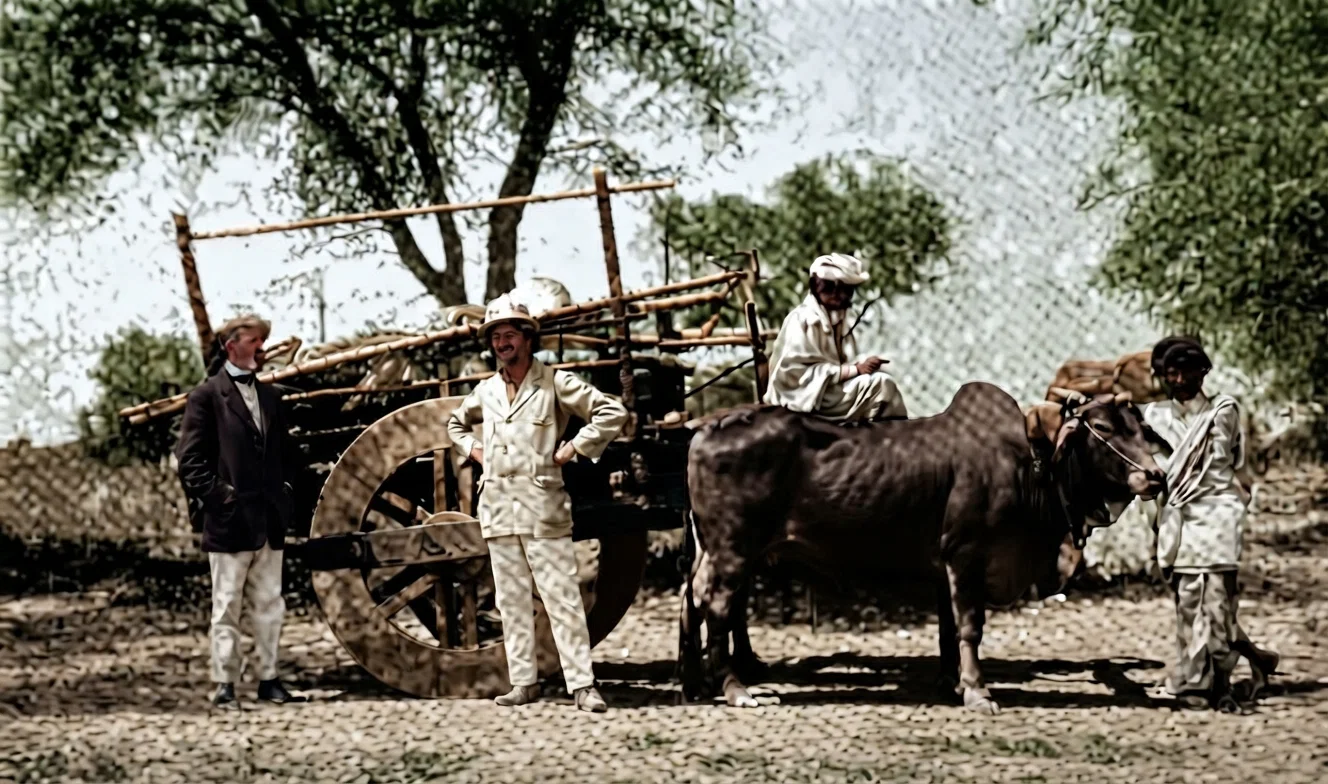
F. H. LOASBY AND DR. MANN ITINERATING IN THE PUNJAB, INDIA
A very significant sign of our times is the multiplication of inventions. In olden times one did not know very much of what was going on in the world save in his own neighborhood. If all went well there, that was as much as he cared to know. But times have changed. The telegraph and cable have so closely joined one country to another that the earth seems to have grown smaller. Any event of importance which takes place in the remotest corner of the globe is before night called out by the newsboys on the streets of our large cities.
The whole human family is in a state of unrest, like a storm-beaten sea. What will be the final outcome? The Saviour describes it in the following words:—
“And there shall be signs in the sun, and in the moon, and in the stars; and upon the earth distress of nations, with perplexity; the sea and the waves roaring; men’s hearts failing them for fear, and for looking after those things which are coming on the earth: for the powers of heaven shall be shaken.” Luke 21: 25, 26.
We have seen this very thing with our own eyes; yea, we have lived right in the midst of it. With anxious fear we lived day after day, not knowing what the morning of another day might bring. We did not know whether we should be taken prisoners, or perchance be banished to some remote part. But what are such things to God’s children except a new token of the soon-coming Saviour? Even as I write these lines I am compelled to be away from my office and home. As a people we must lift up our heads when we see these things, because our redemption draweth nigh.
[This reading from Brother Boettcher had to pass the Russian censor, and was thus delayed many days. In fact, we did not know whether we should get it at all.]
The belief in the near advent of the Saviour will not make a set of indolent fanatics of us, who say that if the coming of Christ is so near, what is the use of planting or laboring with our hands? Why should we repair our houses, or keep the farm in good condition? Or why should we try to pay off our debts? Any one who thinks thus does not understand the words of Christ in Luke 19:13, when he says, “Occupy till I come.” We are to be diligent in temporal affairs, though it should not be with the motive of accumulating property, but to help sustain God’s cause. We are to put forth greater efforts in view of the solemnity of the times than we ever have in the past. We ought to see how God goes before us to open the doors, so that we can truly say, “The harvest is ripe.”
In the great missionary movement of our day we can see the hand of God at work as never before. The summer of 1910 will long be remembered by those who are interested in missions. It was in Edinburgh that the World’s Mission Congress met. Men of all denominations and missionaries from all over the world came together to consider mission problems. They were united in one thing, to have the gospel trumpet sounded to all the world in this generation. Not only were words spoken and resolutions passed, but earnest prayers were offered by these men. The lives of men and women were laid upon the altar of God and dedicated for service. A fire was kindled which was to burn unto the ends of the earth. And this fire ought to burn in the heart of every loyal Seventh-day Adventist, for unto us is committed the very incense to keep the fire burning, so that it shall ascend up before God as a sweet savor.
One of the greatest signs was to be seen in the spread of the gospel message. Let us not forget that it was only in 1871 that Japan for the first time sent a number of men west to make observations. In 1889 Japan adopted a constitution. Before that time no one was permitted to leave the country. But what a wonderful change has come over that beautiful land during the past twenty years. Only a little more than ten years ago it was not permitted to preach the gospel in Japan. Now it is reported that there are 250,000 adherents to Christianity in that country. Our own membership there is over three hundred.
What is true of Japan is also true of China. Sir Robert Hart, who is well acquainted with conditions in China, once said that during the forty-five years of his stay in China the country was like a closed room, with no possible chance for a breath of fresh air. But during the last five years it is like a room with doors and windows thrown wide open. We began our work there only thirteen years ago, and have had more than one hundred conversions a year.
Korea permitted the landing of foreigners for the first time in 1883, but the full awakening did not come until 1907. Our work began there in 1904. Elder Daniells says of the work there: “To-day the whole field is wide open to us, and the conditions are most favorable.”
Who of us can fail to see the hand of God in this mighty work of the Holy Spirit? Those of us who follow the reports from all over this world as they appear in the REVIEW from week to week, must believe that God is in this movement, and that the harvest will be soon ended.
Jesus is the light of the world; but he shines through his faithful followers. He will have the last word to say in the history of this world; but it depends on us as to whether we shall have a part in the kingdom of God. Our faithfulness may hasten his coming. It is not only the great and mighty deeds which will be noticed by our Heavenly Father, for we read, “He that is faithful in that which is least is faithful also in much.” Let us therefore know that in the forward movement of the gospel we see the handwriting on the wall of time, that God hath numbered the earthly kingdoms, and soon they shall be finished.
There is a belief among many Christian people that the world is growing better. But the Bible plainly teaches the opposite. We see oppression all about us. It is very evident that there will be but a remnant saved when Christ comes. The Lord has pointed out, as it were, the very thoughts of men. The tenth psalm ought to be read and studied during this week of prayer, for it gives light upon conditions as we see them. The righteous ask the question of God: “Why standest thou afar off, O Lord? why hidest thou thyself in times of trouble? The wicked in his pride doth persecute the poor.” I have heard people say openly, “If there is a God, how can he look upon all this trouble in the world? Look at the fatherless, the cripples, the widows, and the homeless. How can God keep silent?” God sees it all, my brother, and a day of retribution is comingwhen every man shall receive his just reward.
In many countries we see the servants of God persecuted. They are blamed for anything which may go wrong, just as it was in the days of Elijah. Opposition to the truth is usually greater in the rural districts than in the cities. In the former the people are more closely observed by those who have charge over them. They are bound by old customs, and anything new is looked upon with suspicion. The psalmist says: “He sitteth in the lurking places of the villages: in the secret places doth he murder the innocent: his eyes are privily set against the poor.” Those who are put under the scourge of the law and led off by wicked men feel just as any other person would. They even have to hear their oppressors say: “God hath forgotten: he hideth his face; he will never see it.” But from the depth of their soul the righteous cry out: “Arise, O Lord; O God, lift up thine hand: forget not the humble.” The Lord has not forgotten his people. “For he that toucheth you toucheth the apple of his eye.” Zech. 2:8.
When Jesus comes he will find some of his faithful children banished. Some will be within prison walls, associated with outlaws and murderers. Others will have been driven from home and friends for the truth which they prize more than their lives. However, mighty angels of God are about his chosen ones, though only the eye of faith can see them, and to such the beloved John desires to be accounted a brother. He speaks of his experience so that others may be comforted:—
“I John, who also am your brother, and companion in tribulation, and in the kingdom and patience of Jesus Christ, was in the isle that is called Patmos, for the word of God, and for the testimony of Jesus Christ.” Rev. 1:9.
The true people of God have never been wanted in this world. From the very beginning they have been hated because of their fidelity to their Maker. Peter recognizes this also, having passed through the same experience himself:—
“Beloved, think it not strange concerning the fiery trial which is to try you, as though some strange thing happened unto you: but rejoice, inasmuch as ye are partakers of Christ’s sufferings; that, when his glory shall be revealed, ye may be glad also with exceeding joy.” 1 Peter 4:12, 13.
God only wishes to try our faith and make us partakers of the sufferings of Christ. Anything which we may be called upon to pass through we will not consider a hardship but rather joy. God’s reward of eternal life, bestowed upon his chosen ones, will far outweigh all the trials. We must be faithful to his truth. It is through the truth that God has freed us from the slavery of sin. If we are true to principle, our God will work out the problem for us.
We are to learn lessons from the events around us. In the countries which are at war every one is busy doing something for the fatherland. Some are out in the heat of the battle. Others keep the food supply going. Still others at home are preparing clothing, while others, as physicians and nurses and helpers, are looking after the wounded. In my neighborhood there is a large school, and I see the children at work making bandages. They cannot do the larger tasks, but their little fingers can do this lighter but necessary work. As citizens of a heavenly country, shall we be less diligent in helping to carry forward the spiritual warfare?
We believe that Christ is now finishing his work for mankind in the heavenly sanctuary. He stands there pleading for those who have accepted his righteousness. But the sinner will be shut out unless he believes on the Saviour as his real sacrifice. How can we keep our peace at such a time as this? Every one of us must have a part in this work of saving the lost. We must put ourselves upon the altar, with our sons and daughters, and our earthly goods, dedicating all to God’s cause, so that we may truly say: Lord, here am I, with all I have and am; take me and use me. What are earthly possessions worth in these days? I have seen men, women, and children leave all they possessed in this world, and flee from the foe to save their lives. The life truly is worth more than all else.
But we must not only be saved ourselves, we must seek to save others. Some may be called to go into the mission fields, while others must remain at home. If we dedicate ourselves to the service of the Master, he will make of us a mighty power in his hands.
“One man of you shall chase a thousand: for the Lord your God, he it is that fighteth for you, as he hath promised you. Take good heed therefore unto yourselves, that ye love the Lord your God.” Joshua 23:10, 11.