Our London Letter

3%

Pacific Press Publishing Association · Mountain View, California · Dec 6, 1910

FromSigns of the Times, Vol. 37, No. 48.

Read the full edition

Our London Letter

THE public mind is in a state of suspense. Many difficult problems are awaiting solution, and many more are coming into view.

The Remarkable Year

The supreme interest still gathers around the secret conference which it is in progress between Mr. Asquith on the one side, with three associates, and Mr. Balfour on the other, with a similar number of supporters. There is an intense desire to know what is to be the outcome of the conference. Its prolongation through so many months is accepted as proof that it will not be altogether futile; but the few in whose breasts the secret is locked, only open their mouths to exhort to patience and confidence. Meanwhile the rival political parties are standing still, waiting till their respective leaders in the conference shall reach some definite conclusion. The king’s coronation is all the time drawing rapidly nearer, and it will never do to have the country engaged in a desperate conflict when that happy event takes place.
In a recent speech, Mr. Asquith said that the year which is closing may in all sobriety be described as an “annus mirabilis” in modern British politics. To begin with, there was the rejection, for the first time in living memory, of the whole of the Budget by the House of Lords. This brought about the dissolution of Parliament while yet the Liberal party had an overwhelming majority in the House of Commons. Then came the general election, and the return of an almost equally divided house, the Irish party holding the balance of power. Next the sudden death of the king interrupted the constitutional struggle, and this opened the way for what Mr. Asquith called “an unprecedented experiment” in the shape of the conference between the leaders of the Liberal and Conservative parties, with a view to seeing if some scheme could not be devised for dealing with the House of Lords which would command general support, and avoid the necessity of involving the new king.

Government Finance

Field Marshal Viscount Kitchener, perhaps the greatest living active soldier
The financial projects of the government are going vigorously forward. The work of valuing all landed property for purposes of taxation is eliciting a good deal of grumbling from those affected, but sympathy for these unfortunate victims is confined to a comparatively narrow circle. Mr. Lloyd-George, the chancellor of the exchequer, has been saying some striking things about the contrast between the affluence of a comparative few and the miserable condition of the many, and has made it plain that all his interest and sympathy are for the poor. He holds up to scorn the wealthy man whose agents, working early and late, can not in thirty days succeed in getting together all the particulars of his landed property, and who yet objects to paying a tax that will ameliorate the condition of people living in dirt and squalor. The chancellor says: “I tell you frankly that altho for the best part of my life I have lived among the people, I never realized, until I came to administer the Old Age Pensions Act, the appalling mass of respectable, industrious, independent, proud poverty that lives among us. This poverty is not confined to this country, but it causes more misery here than elsewhere, for ours is a hard climate for poverty.”
Lord Morley, one of the greatest living Englishmen
Such utterances as these are making Mr. Lloyd-George intensely popular among the poor, and they look with confidence to him for further energetic action in their behalf. He has already promised to introduce a bill providing insurance against unemployment.

Discontent, Labor Strikes, Etc.

Such an attitude on the part of a responsible and highly placed officer of the government naturally encourages the demands of those who are discontented, and often justly so, with the conditions under which they labor. Of late we have been passing through a long succession of strikes, some of them of vast proportions. Most of these seem to come about through friction between employers and workpeople rather than because of any serious issues. One of the great railway systems in the North of England was paralyzed for many days by reason of a strike among its employees, who complained bitterly that altho there was a board of conciliation which was supposed to take cognizance of all complaints on either side, they were still treated in a high-handed fashion by the representatives of the railway company sitting on that board, and could get no real satisfaction. Another great industry, the boiler making, has also been disorganized, this time by a lockout on the part of the employers, on the ground that notwithstanding the agreements made between masters and trades-union, individual workpeople would persist in taking matters into their own hands and going out on strike independently when they pleased. The masters have resolutely refused to resume work until the trades-union give solid guarantees that this independence shall cease. So far the trade-union leaders and the workmen have been unable to agree among themselves over checking this insubordination, and so the lockout continues.
Dom Manuel, the late king of Portugal
In Manchester, the center of the cotton industry, a hundred and fifty thousand persons were involved in a strike due to the refusal of one man to do work which he did not think he should be called upon to do. The people, regarding this case as typical of the unjust attitude of the employers, were quite prepared to come out in vast numbers, notwithstanding the insignificance of the issue.
The real trouble in most of these strikes is the lack of confidence between the masters and the employees. Altho terms of peace are arranged, agreements entered into, and conciliation boards for settling questions in dispute are set up, the old spirit and attitude continue unchanged on both sides, and before long the trouble breaks out afresh. The same lack of confidence is now appearing in some of the unions themselves; the workers refuse to be bound by their leaders, because they do not trust their representatives to stand up faithfully for their interests.

A Political Setback to Labor

One of the biggest problems now before the government is the demand of the Labor party for the reversal of what is called “the Osborne judgment.” The trades-union make a small weekly levy on their members for political funds, and with these they help to maintain the Labor members who have entered Parliament. A dissenting member of a trade-union named Osborne, backed up by moneyed people, brought an action against his trade-union forusing its contributions in political expenditure, and the decision of the Court of Appeal was that such political expenditure was illegal. According to this judgment, no trade-union can support a representative in Parliament or engage in political campaigns. The Labor party are loudly demanding that this condition of things shall be changed by the passing of an act which will set them free to do what they please with their funds.
The Liberal Government, which depends partly for support on the Labor members, will be compelled to meet this demand; but it is exceedingly likely, when the matter comes to be dealt with, that the Labor party will seek to have it dealt with in such a way that their power to do as they please will never again be questioned, and this may mean that they will formulate demands that the more moderate section of the Liberal party will be unwilling to grant. Mr. Ramsay Macdonald, M.P., one of the leaders of the Labor party, says that when the confusion is cleared up “the unions ought not to be asked to accept any limitations to their action which will hamper them in their main statutory liberty to regulate the relations between employers and employed.” “The trade-union,” says Mr. Macdonald, “is not a friendly society; it is an industrial protective organization built up with fighting efficiency in view.” Nothing in the way of a reversal of the Osborne judgment will be satisfactory therefore, to the Labor party that does not secure the “fighting efficiency” of the trades-union. But this fighting efficiency is the very thing that the
capitalists and employers want to keep in check, and we may therefore expect a stern conflict over this question. When the matter is once opened for legislative settlement, the Labor party will seek to take the fullest advantage of the opportunity.

Home Rule for Ireland

Another interesting feature of the political situation is the almost entire conversion of the Conservative or Unionist party to the idea of “Home Rule” for Ireland. It was suggested by the writer in the “Times” that the present constitutional conference should be merged into a larger one for the purpose of dealing with the Irish problem as well as with the House of Lords; and almost the whole of the Conservative press hailed the idea with welcome. It seems very evident that the opposition to the granting of Home Rule to Ireland is now dead. The Canadian model is regarded on all hands as one that may well serve for the case of Ireland.

Portugal and Its Dethroned King

The revolution in Portugal has caused but little surprise in this country. Dom Manuel has found an asylum here, but nothing more. King George has paid him a visit, but one without any political significance.
The present situation of affairs in Persia is regarded with much dissatisfaction in this country. There is no desire to be found in partnership with Russia in the dismemberment of Persia; rather there is a feeling of disgust that it should have been possible for a meeting of Turks in Constantinople to appeal to Germany for the protection of Islamic interests against England and Russia. It is acknowledged with regret that England’s influence in the East is diminishing, while that of Germany is in the ascendent.

Naval Rivalry

The naval rivalry between England and Germany still occupies a good deal of public attention. One day the report is circulated that Germany has fallen behind her ship-building program, the next we hear that she is accelerating it. It seems difficult to get at the exact facts. The last naval development on this side is the manufacture of 13.5-inch guns, which are to be mounted on all the latest ships. The 12-inch gun, the biggest yet mounted on the German vessels, will throw a shell weighing 850 pounds; but the 13.5-inch weapon casts a shell of 1,250 pounds, capable of penetrating twenty-two inches of Krupp’s armor-plate at a distance of five thousand yards. Germany’s answer to this move is announced in the form of a 14-inch gun. In future, weapons of this enormous power will constitute the primary armament of first-class fighting vessels.
A new 21-inch torpedo has also been introduced to take the place of the 18-inch. The new torpedo has a range of about seven thousand yards, and carries an explosive charge of over 250 pounds of guncotton at a speed exceeding forty knots an hour. To provide for such developments as this, a naval loan of £100,000,000 is discussed.
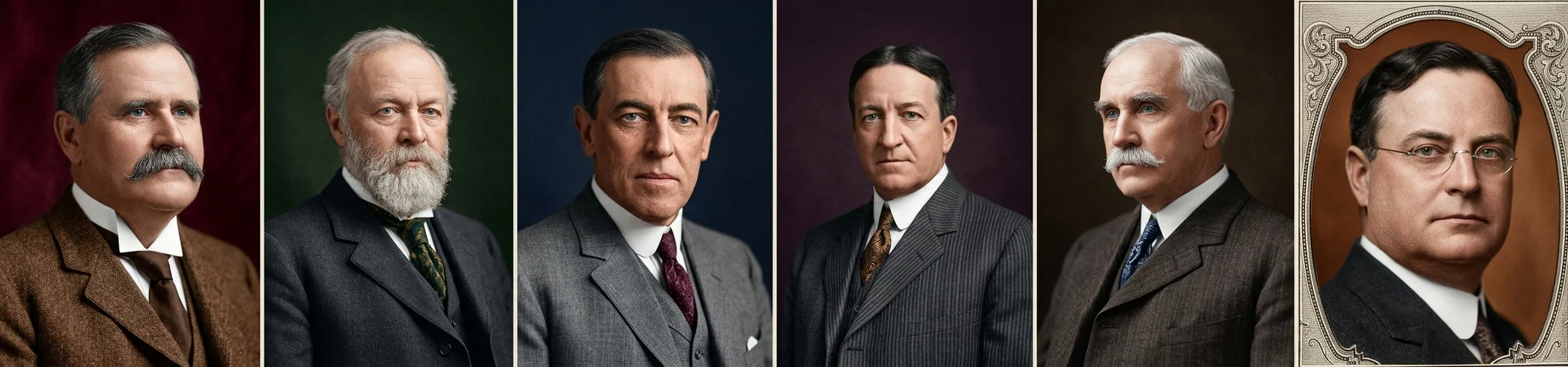
A row of prominent governors-elect, around whom great interests centered in the recent election. Beginning with the left they are in order as follows: Eugene N. Foss, of Massachusetts; Simeon E. Baldwin, of Connecticut; Woodrow Wilson, of New Jersey; John N. Dix, of New York; Judson Harmon, of Ohio; Hiram M. Johnson, of California. The first five are Democrats who were elected in strong Republican states, with large majorities. Mr. Harmon, of Ohio, is now serving as governor in that state.
It is noticeable that the feeling in favor of a conscript army is growing rapidly in strength. A few years ago it was only here and there that some isolated alarmist urged such a measure; now it seems as tho it is the opponents of conscription that occupy the isolated position. It would not take very much at the present time to induce this country to adopt some system of compulsory military service.

Persons of Note

The retirement of Lord Morley from his office of secretary of state for India marks the practical withdrawal from public affairs of another of the famous men of the last generation. Lord Morley has attained high distinction in both literary and political life. A quarter of a century ago, when he became secretary for Ireland under Mr. Gladstone, the doubt was freely expressed whether he was justified in forsaking the front rank in literature for what must necessarily be a third or fourth rank in politics. “Honest John” has not only vindicated the step he took, but, by his biography of William Gladstone, has established his position more firmly than ever in the literary world. His work as secretary for India has been severely criticized, but he has introduced important reforms in the direction of bestowing larger representation upon the people of India in the government of their great country.
Lord Kitchener has been a source of some perplexity to the government. Different positions have been offered him, but he has declined them. One section of the press demands that he be entrusted with the task of overhauling the war office and putting it on a basis of practical efficiency, a position that, according to the critics, it by no means occupies at the present time.
Thinking men are recognizing that society and the nations are rushing on to some tremendous crisis. The other day one writer said: “At the Edinburgh Missionary Conference we were told that the next few years would decide the destiny of China. Perhaps that word is just as true of Europe.”
W. T. BARTLETT.
— —