The Lord’s Coming Premillennial

6%

Review and Herald Publishing Association · Takoma Park Station, Washington, D. C. · Jun 7, 1915

FromReview and Herald, Vol. 92, No. 28.

Read the full edition

The Lord’s Coming Premillennial

By Rev. W. H. Griffith Thomas, D. D.
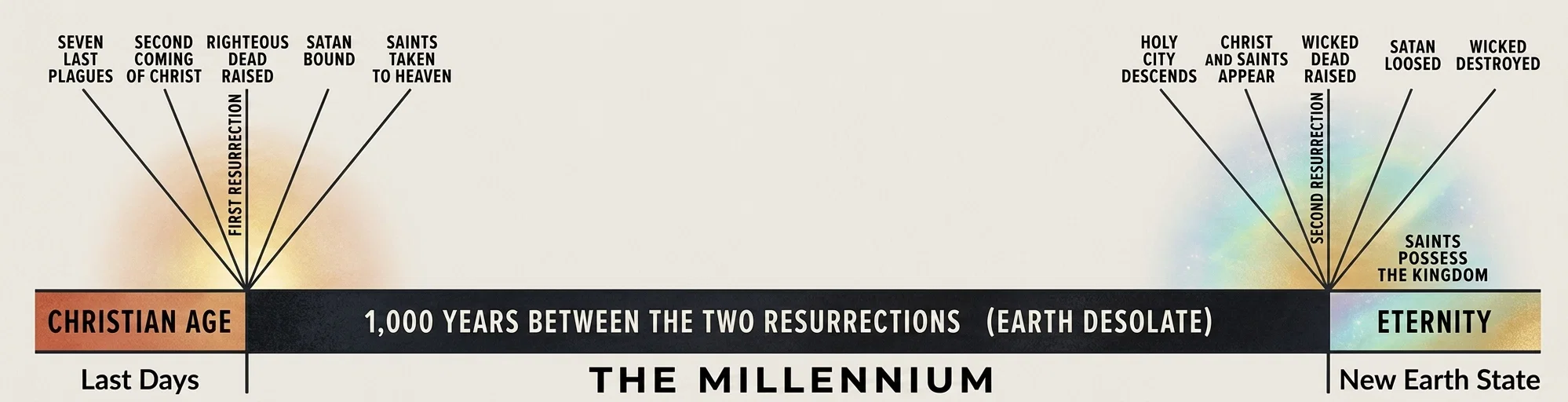
The evident interest concentrated just now on the coming of Christ is most welcome. It is true that the study of eschatology in the hands of modern criticism is marked by many misconceptions and errors, but, in the ultimate result, it is hoped and believed, will be increased attention to the New Testament teaching on the coming of our Lord. Now, while it must be admitted that there are differences of opinions on the subject between Christian men, it may fairly be said that only one of these is really fundamental. This, however, is certainly vital, because if one view is right the other must be wrong. The reference is, of course, to the question whether Christ will come before or after the millennium, by which term is usually understood a period of peace and almost total freedom from evil. It is obvious that both these views cannot be right; for if he comes before or after this period (be it a thousand years in duration or not), the whole perspective of teaching is necessarily affected. As it is the opinion of the writer that the New Testament teaches plainly the coming of Christ as premillennial, the present paper is addressed to the proof of this contention.
All evangelical Christians believe that Christ is coming again, and that this coming is personal. While spiritually he has never left his people, he has still to make a personal appearance from heaven. Acts 1: 11; 1 Thess. 4: 16; Heb. 9: 28; John 14: 3. This coming has been the hope and cheer of the church for centuries, and the supreme object of anticipation and effort. . . .
Those who believe that Christ will come first, that is, before the time of righteousness, are called premillennialists.
On the other hand, many Christians believe that the whole world is to be brought into allegiance to Christ gradually during this dispensation, and that as the world becomes more thoroughly Christianized there will be peace, improved social condition, a diffused knowledge, elevated human standards, and many other beneficial changes. All this is to be the result of the spread of Christ’s kingdom. His rule will be a spiritual one in individual hearts and communities. And when the happy time, usually called the millennium, has run its course, Christ will return to judge the living and the dead and to bring earth’s story to a conclusion. Those who hold this view are called postmillennialists.
That the former view seems more in harmony with Scripture is urged from the following considerations:— If the millennium is to be reached by the gradual regeneration of the world, it is clear that the coming of Christ must be in a very remote future; and this being so, it is difficult if not impossible to see how Christians can “watch” and “wait” for an event which it is certain cannot occur for at least a thousand years. The various passages which press home the duty of watching and waiting seem to be impossible of any such interpretation. Mark 13: 35-37; Luke 12: 35, 36; 1 Thess. 1: 10; Phil. 3: 20. The question has often been asked whether such statements as these would have any point for us if the divine plan were that Christ is not to come again until after the millennium.
The Scriptures do not appear to teach that the world is to become increasingly better during this dispensation. On the contrary, good and evil are said to exist and grow side by side till the end. Without pressing the metaphors of the parable of the sower, wherein there are three failures to one success, the teaching of the parable of the tares and of the dragnet seems to indicate that there will be no universal victory of Christianity before Christ’s return. If good and evil are both to “grow together until the harvest,” it will be impossible for the gospel to meet with universal acceptance in the present dispensation. Judging from what we know of nearly nineteen centuries of church history, and especially keeping in view the present condition of the world, it is impossible to contemplate a process in which all evil is gradually overcome until at last the earth is covered with righteousness as the waters cover the sea. . . .
Moreover, Scripture represents the close of this dispensation as a time of special activity of evil. Evil is predicted as everywhere increasing. Christ spoke of iniquity abounding (Matt. 24: 3, 6, 12, 21), and with this agree the words of the apostle Paul about perilous times in the last days (2 Tim. 3: 1-5). Indeed, he goes further and describes what he calls “the mystery of iniquity,” which is to reach its climax in the “man of sin,” who is to be destroyed by Christ at his coming. 2 Thess. 2: 1-10. Even the professed church is spoken of in terms that imply departure from God, such expressions being found as “the love of many shall wax cold,” “having a form of godliness,” and “because thou art lukewarm.” All these indicate not a state of improvement but of growing degeneracy, and a climax of evil at the end. . . .
According to the postmillennial view, the rule of Christ through the period of his kingdom remains indirect, a spiritual rule in individual hearts, which will not interfere with human government exercised by ordinary men. But it is submitted that the teaching of Scripture concerning the kingdom of Christ is that of a direct and definite rule, manifested in the person of Christ, and destroying and displacing human governments. This seems to be the clear teaching of passages in the Psalms and the prophets. Ps. 2: 6-8; 22: 27, 28; 72: 7-11; Isa. 9: 6; Jer. 23: 3, 6; Dan. 2: 44; 7: 13, 14. To the same effect is the teaching of the New Testament. The parable of the nobleman who went into a far country to receive a kingdom and to return, suggests a kingdom that shall be established on his return. Luke 19: 11-27. There are also other references to the setting up of Christ’s kingdom. Luke 1: 31-33; 22: 29, 30. The apostle Peter had the same general truth in his mind when he associated the restoration of all things mentioned in the Old Testament with the coming of Christ from heaven. Acts 3: 19-21. All this argues for a definite personal coming which will result in the establishment of his kingdom.
One of the clearest Scriptural proofs of this position is that according to the New Testament the establishment of Christ’s kingdom follows, not precedes, his second coming. Our Lord’s teaching of the future speaks of his appearance “immediately after” a tribulation, thereby suggesting that no universal peace will be the immediate precursor of his coming. Matt. 24: 21-24, 29-31. Indeed, Scripture describes the condition of the earth at the coming of Christ as one of terrible wickedness, not of millennial blessedness. Luke 17: 26-32. There does not seem any room here for a period of holy peace prior to the coming of Christ. The passage from the first Gospel just mentioned is sufficient to establish the truth of the doctrine that Christ’s coming must be premillennial. It is, therefore, impossible to believe in any universal sway of righteousness on this side of the coming of Christ, and in agreement with this the New Testament associates that coming with the establishment of Christ’s kingdom. Matt. 25: 31; Luke 19: 15; 2 Tim. 4: 1.
Christ’s own testimony is not less definite and distinctive. “Then shall appear the sign of the Son of man in heaven; and then shall all the tribes of the earth mourn.” Matt. 24: 30. It is difficult to see what need there can be of such mourning if the various moral and religious agencies shall have accomplished their purpose. The same great truth is found almost everywhere in the book of Revelation. Rev. 1: 7; 6: 15-17; 11: 15-18. The last passage is particularly noteworthy, for the time referred to is when “the kingdom of the world is become the kingdom of our Lord, and of his Christ.” But it proceeds to say, “The nations were wroth.” Here again the anger is incredible, and also the reference to those who “destroy the earth,” if there has been a gradual improvement in the state of mankind. . . .
Two chief objections to this view remain to be considered. It is sometimes said that to favor the literal fulfillment of these prophecies is to materialize them and to involve us in insuperable difficulties. But it is submitted that even though difficult, the literal fulfillment is the most natural. The prophecies relating to Christ’s first coming were all literally fulfilled, and no one is at all perplexed by the thought of a divine incarnation or a literal crucifixion. . . .
Since, therefore, we have already experienced the literal fulfillment of the prophecies referring to Christ’s humiliation, there is no reason why we should not believe in a similar literal fulfillment of the prophecies relating to his glory.
It is sometimes said that two parables, the mustard seed and the leaven, indicate a gradual conversion of the world. It may be pointed out that these parables must somehow or other be harmonized with the teaching of the others uttered at the same time. The teaching of the parables of the sower, the tares, and the dragnet is beyond question. They foretell good and evil as existing and growing side by side. It is hardly likely, then, that the mustard seed and the leaven teach anything inconsistent with Christ’s own interpretation of the first two parables.
For these reasons it is submitted that the premillennial view is most in harmony with Scripture, proving that the expectation of the gradual conversion of the world till the millennium is reached, is really opposed to Scripture.—The Bible Magazine, May, 1915.