That the seventh day of the weekly cycle, the day on which the Creator rested, was set apart at the creation of the world as the Sabbath of Jehovah;
That it was enjoined in the decalogue, and kept by patriarch, prophet, and the faithfully obedient, for the first four thousand years of earth's history;
That it has been kept by some Christians from the first advent of Christ to the present time, as can be clearly proved by history;
That, notwithstanding this, the great majority of professed Christians are observing with more or less devotion and strictness the first day of the week, commonly called Sunday;
That it is not a settled question, but is the most widely agitated religious question in the world at the present time, not only in religious circles, but in municipal councils, in courts of law, and in State and national legislatures;
That these facts, and others which might be mentioned, have led many thousands of earnest-minded men and women to examine anew the evidences on which Sabbath observance and Sunday observance are based.
Anxious Questioning
Out of this agitation the following questions have arisen in many anxious hearts:—
“Who changed the Sabbath?”
“Was it not changed by Christ at his crucifixion or resurrection?”
“Did not the apostles change the Sabbath?”
“By what power was it changed?”
These questions we hope to answer in this article, and the sources from which we wish to draw our evidence concerning this change are the Bible and reliable historical testimony in harmony therewith.
What the Scriptures reveal, every sincere Christian Protestant will accept. A counterfeit coin is no nearer genuine because of having been so considered by honest men for many years; and he would be a foe to the government and law who would continue its circulation after he knew it to be spurious. Neither is error any less error because of having been considered truth by the good of past generations. What does the Bible say?
Let us inquire what the prophets said Christ's attitude would be toward that law of which the Sabbath is a part; and how these prophecies were fulfilled by Christ in his teaching and example.
What Did the Prophets Say?
1. Through Moses it is declared that Christ would not come as a lawgiver, but as a teacher of God; not of a new doctrine of his own, but the words which God would give him. Thus saith the Lord through the prophet:—
“I will raise them up a Prophet from among their brethren, like unto thee, and will put my words in his mouth; and he shall speak unto them all that I shall command him. And it shall come to pass, that whosoever will not hearken unto my words which he shall speak in my name, I will require it of him.” Deut. 18: 18, 19.
2. The Lord tells us through Isaiah that when Christ, the manifestation of Jehovah's righteousness, came, he would not degrade or repeal God's law, but would please God by magnifying it and making it honorable.
“The Lord [Jehovah] is well pleased for his [Christ's] righteousness' sake; he [Christ] will magnify the law, and make it honorable.” Isa. 42: 21.
That this refers to Christ, see verse 19 of the same chapter.
3. The Spirit of Christ spoke through the prophets. 1 Peter 1: 10, 11. Christ, speaking by that Spirit through David, his great ancestor, said of himself at his first advent:—
“Lo, I come: in the volume of the book it is written of me, I delight to do thy will, O my God: yea, thy law is within my heart.” Ps. 40: 7, 8. Compare with Heb. 10: 5-10, where this scripture is applied to Christ.
Christ's Teaching and Example
1. Christ by his own mouth declares again and again that he came not to give a new law, but to teach God's will, or law. Note the following among many:—
“I do nothing of myself; but as my Father hath taught me, I speak these things.” John 8: 28.
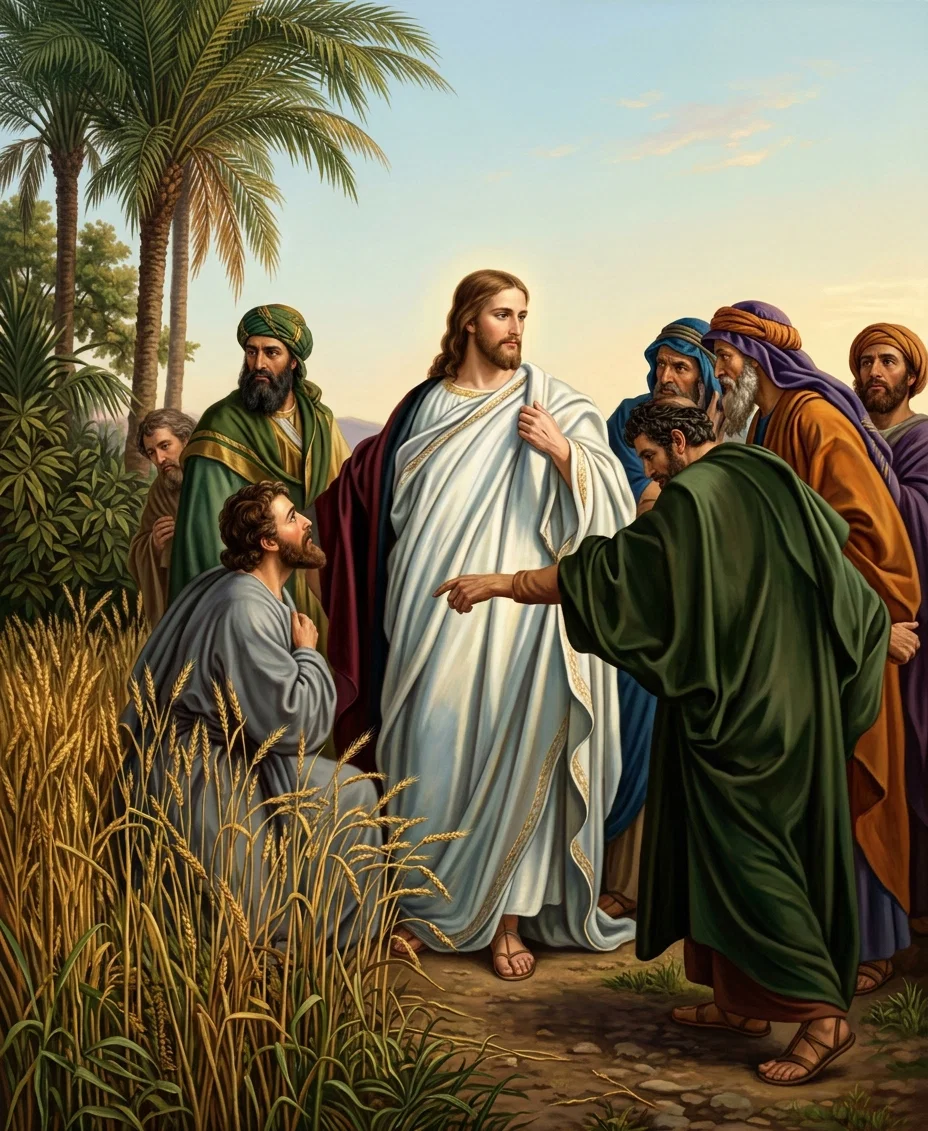
THE SON OF MAN IS LORD ALSO OF THE SABBATH DAY
“I have not spoken of myself; but the Father which sent me, he gave me a commandment, what I should say, and what I should speak.” John 12: 49.
2. As the prophet declared, he magnified God's holy law, and thus showed the honor which belonged to it. “Hear ye him:—
“Think not that I am come to destroy the law, or the prophets: I am not come to destroy, but to fulfil. For verily I say unto you, Till heaven and earth pass, one jot or one tittle shall in no wise pass from the law, till all be fulfilled. Whosoever therefore shall break one of these least commandments, and shall teach men so, he shall be called the least in the kingdom of heaven; but whosoever shall do and teach them, the same shall be called great in the kingdom of heaven.” Matt. 5: 17-19.
It is difficult to see how language could be stronger. The Son of God came not to destroy the law, but to fulfil. To fulfil a law is to do it. See Gal. 6: 2. He goes even further than this: he declares, in the clearest possible language, that he did not come to change it, even to the extent of a jot (or yod), the smallest letter in the Hebrew alphabet, or to a tittle, a little point which serves to distinguish one letter from another.
Certainly the fourth commandment, which declares that “the seventh day is the Sabbath of the Lord thy God,” and gives the reason therefor, could not be changed to read, “The first day is the Sabbath,” with the requisite reason, without changing many jots and tittles.
Christ further declares that “till heaven and earth pass” no such change should take place. In Luke 16: 17 he thus states the impossibility of changing that law, “It is easier for heaven and earth to pass, than one tittle of the law to fail.” Why?—Because heaven and earth might pass, and God could create another heaven and earth in their place without affecting his deity; but if his law should fail, or be shown to be imperfect, his government would be impeached, and the very integrity of his character would be shattered. For his commandments are an expression of his righteous character (Ps. 119: 172), and his “righteousness shall not be abolished” (Isa. 51: 6).
In fact, the first day of the week, in the very nature of the case, could not be the rest day of God, for the Creator never rested on that day.
Christ further declares that whosoever breaks even so much as one of the least of the precepts of that law of which the Sabbath is a part, shall be called the least, or, as translated in the “Living Oracles,” by Campbell, MacKnight, and Doddridge, “of no esteem,” in the kingdom of heaven; but the teacher and doer of them shall be great in that kingdom. He then shows how far-reaching is that law. Its righteousness extends not alone to the outward act, but to the very heart motives which prompt the act, so that cherished hatred is a transgression of the sixth commandment, and cherished lust, of the seventh. Matt. 5: 20-22, 27, 28. Truly, he magnified the law, and made it honorable.
3. He came to do God's will; God's law
was in his heart. Did he keep the law? Hear him:—
“I have kept my Father's commandments, and abide in his love.” John 15: 10.
“And he came to Nazareth, where he had been brought up; and, as his custom was, he went into the synagogue on the Sabbath day, and stood up for to read.” Luke 4: 16.
When reproved by the Pharisees for breaking the Sabbath in healing the sick, he defended himself by an appeal to their own practice, and concluded by saying, “Wherefore it is lawful to do well on the Sabbath days.” “Lawful” means according to law. His work was therefore according to the law of the Sabbath, the fourth commandment, and is a positive proof that he observed it according to that law.
Christ died to save men from sin. Matt. 1: 21; Titus 2: 14. But “sin is the transgression of the law.” 1 John 3: 4. Christ, therefore, died to save men from transgressing his law. The law was so holy as to demand the death of the Son of God in order to release man from its claims. The law was honored before heaven and earth in the death on the cross of the spotless Lamb of God.
Of the followers of Christ it is said that they “rested the Sabbath day according to the commandment.” Luke 23: 56. The apostle Paul declares that faith establishes the law in the heart of the believer (Rom. 3: 31); and that the righteousness of the law is fulfilled in those who walk after the Spirit, while the carnal mind is not subject to the law of God (Rom. 8: 7). In harmony with all this, the apostle James bears the following testimony to the obligation, the enemies, and the perpetuity of the law of ten commandments:—
“If ye fulfil the royal law according to the scripture, Thou shalt love thy neighbor as thyself, ye do well; but if ye have respect to persons, ye commit sin, and are convinced of the law as transgressors. For whosoever shall keep the whole law, and yet offend in one point, he is guilty of all. For he that said [‘that law which said,’ margin], Do not commit adultery, and also, Do not kill. Now if thou commit no adultery, yet if thou kill, thou art become a transgressor of the law. So speak ye, and so do, as they that shall be judged by the law of liberty.” James 2: 8-12.
The psalmist says: “O how love I thy law! it is my meditation all the day. Thou through thy commandments hast made me wiser than mine enemies: for they are ever with me.” Ps. 119: 97, 98. And the same voice of love is echoed by the beloved disciple: “For this is the love of God, that we keep his commandments; and his commandments are not grievous.” 1 John 5: 3.
From the preceding (and much more testimony might be given), it is clearly evident that neither Christ nor his apostles abrogated, repealed, or changed God's law, or any part of it. They taught its absolute integrity and perpetuity. Christ, our great and only Example, kept it; and we are commanded to follow him (John 21: 22), to walk as he walked (1 John 2: 6).
By Whom Was the Change Wrought?
The Sabbath has never been changed by divine authority. It remains forever the same. Who, then, did make the change from the seventh to the first day of the week? Do the Scriptures reveal this?—Yes, most clearly. As far as five centuries before Christ, the prophet points out the power that should think to lay its hand upon the law of Jehovah, should wrench thence the commandment which expressly points out the jurisdiction and power of the great Lawgiver, and should substitute in its place a law that would turn men from the worship of the true God; and we also have the confession of the power itself that it has done this deed. Note the evidence:—
The Prophetic Prediction
1. The apostle Paul said to the church of Christ:—
“For I know this, that after my departing shall grievous wolves enter in among you, not sparing the flock. Also of your own selves shall men arise, speaking perverse things, to draw away disciples after them.” Acts 20: 29, 30.
“Let no man deceive you by any means: for that day shall not come, except there come a falling away first, and that man of sin be revealed, the son of perdition; who opposeth and exalteth himself above all that is called God, or that is worshiped; so that he as God sitteth in the temple [or church—see 1 Cor. 3: 16; Eph. 2: 20-22] of God, showing himself that he is God.” 2 Thess. 2: 3, 4.
The great head of the church is the Lord Jesus Christ (Eph. 1: 22, 23), and the law of the church is the word of God, which came through Christ. Now the only way for a power to oppose God is to enact laws contrary to God's law, and to demand obedience thereto. The only way in which it could exalt itself above God is to demand that its laws shall be obeyed in preference to God's law. The same law promulgated by two rival powers in the same territory would be an impossibility, and would show no distinction between the adherents of the two powers. There must be a difference in the laws, and therefore this power must seek to change God's law, and this change or difference between the law of God and the law of this usurping power must be the very mark of opposition to God and exaltation above him.
2. The work of this power is thus predicted by Inspiration:—
“And he shall speak words against the Most High, and shall wear out the saints of the Most High; and shall think to change the times and the law; and they shall be given into his hand until a time and times and half a time.” Dan. 7: 25, R. V.
Here are given three specifications of crime: (1) He shall speak words against the Most High; (2) he shall wear out the saints of the Most High; (3) he shall think to change the times and the law, evidently of the Most High. We have space to treat of only the2
third specification here. The “law” does not refer to human laws, which every human power has a right to change within proper limits, but to a law which this power could not really change, but only think to change. This must be God's law. The Douay Bible reads, “He shall think himself able” to do this, the Revised Version, “He shall think to change the times and the law.” Wintle and Spurrell read, “Shall presume to change the appointed times and the law.”
The very first “time” appointed of God was the day. See Genesis 1: 1, 2. It began at evening and closed at evening. See Lev. 23: 32; Mark 1: 32. The other “time” appointed of God in the beginning was the week, marked by the Sabbath. A change in the beginning of the day, and a change in the day of the Sabbath, is certainly a change of the appointed “times,” which would change God's law in its most vital part; namely, the fourth commandment, the only commandment in the law which pertains to time, and which requires the sanctification of the seventh day.
We have now noticed a part of the divine predictions of the character and work of the criminal. He opposes and exalts himself above God in presuming to change that very law which Christ or God in the very nature of the case cannot change, and he thinks to change it in that very part which refers to times divinely appointed. This shows that the criminal's work must have reference to the fourth commandment, the only one of the ten which relates to time. Were these predictions fulfilled?
The Confession
The Roman Catholic Church, or the Papacy, declares that she has done the very thing which the prophecy predicted. Note the evidence:—
1. Eusebius, one of the most eminent “fathers” of the Catholic Church, the contemporary, the apologist, and the deifier of the corrupt Constantine, says: “All things whatsoever that it was duty to do on the Sabbath, these we have transferred to the Lord's Day [Sunday].” The “we” to whom he refers are Constantine, Pope Sylvester, and such bishops as himself.
2. The “Doctrinal Catechism,” pages 174, 352-355, offers proof that Protestants are not guided by Scripture. We present two of the questions and answers:—
“Question.—Have you any other way of proving that the church has power to institute festivals of precept?”
“Answer.—Had she not such power, she could not have done that in which all modern religionists agree with her,—she could not have substituted the observance of Sunday, the first day of the week, for the observance of Saturday, the seventh day, a change for which there is no Scriptural authority.”
“Ques.—When Protestants do profane work upon Saturday, or the seventh day of the week, do they follow the Scripture as their only rule of faith?
—do they find this permission clearly laid down in the Sacred Volume?
“Ans.—On the contrary, they have only the authority of tradition for this practice. In profaning Saturday, they violate one of God's commandments, which he has never clearly abrogated,—‘Remember thou keep holy the Sabbath day.’”
3. In another Catholic work, called the “Abridgment of Christian Doctrine,” the Catholic Church asserts its power to change the law, in the following manner:—
“Ques.—How prove you that the church hath power to command feasts and holy days?”
“Ans.—By the very act of changing the Sabbath into Sunday, which Protestants allow of; and therefore they foolishly contradict themselves by keeping Sunday strictly, and breaking most other feasts commanded by the same church.”
4. We give one more testimony from Roman Catholic sources; namely, a letter from Cardinal Gibbons to Mr. John R. Ashley, of Rock Hall, Md.:—
“CARDINAL'S RESIDENCE, BALTIMORE, MD.,
“February 25, 1892.
“JOHN R. ASHLEY, Esq.,
“DEAR SIR: In answer to your first question, directed by the cardinal to reply to your letter, I will say:—
“1. Who changed the Sabbath?
“Answer.—The holy Catholic Church.
“2. Are Protestants following the Bible or the holy Catholic Church in keeping Sunday?
“Ans.—The Protestants are following the custom introduced by the holy Catholic Church.
“3. The Protestants do contradict themselves by keeping Sunday, and at the same time profess to be guided by the Bible only. I am,
“Faithfully yours,
“C. F. THOMAS, Chancellor.”
Such witnesses as the preceding could be greatly multiplied.
These statements and claims of representative men of the Roman Catholic Church are really of great value to the jury of public opinion, and are entitled to great weight in determining the guilt of the accused, especially so as her confession is free and voluntary, given without any pressure whatever. Yet we are not dependent upon the confession of the criminal in proving that the Church of Rome sought to change the law of God in respect to the day to be observed as the Sabbath, for the testimony of history proves that this change was effected through the influence and power of that church, as foretold by the prophecy. This testimony will prove that the change in the day observed was made later than the first century, and will serve to confirm and establish the position already clearly proved by the Scriptures, that Jesus did not change the Sabbath in his day nor at any other time.
A Gradual Change
The change was brought about by a very gradual process, through influences which prevailed in the church at an early date, and it was consummated by the power indicated by the prophecy of Daniel already quoted.
That the observance of the Sabbath was continued after the apostolic era, may be proved by unimpeachable testimony. After the introduction of Sunday observance, the two institutions stood side by side in the Christian church—the usurper, warmed and nourished by a spirit of worldly wisdom, coupled with a pretended veneration for Christ, while the honored Sabbath was gradually suffered to fall into disrepute, until it was finally placed under the ban of papal anathema.
Protestant Testimony
The testimony of the Protestant writers which follows, it should be noted, is not from observers or friends of the seventh-day Sabbath, but of the Sunday. In the language of President Mahan, “Admission in favor of truth from the ranks of its enemies, constitute the highest kind of evidence.” Sir William Domville says:—
“Centuries of the Christian era passed away before the Sunday was observed as a sabbath. History does not furnish us with a single proof or indication that it was at any time so observed previous to the Sabbatical edict of Constantine, in A. D. 321.”
—“Examination of the Six Texts,” page 291.
Chambers's Encyclopedia, free from any bias in favor of the ancient Sabbath, says:—
“By none of the Fathers before the fourth century is it (the first day of the week) identified with the Sabbath, nor is the duty of observing it grounded by them either on the fourth commandment or on the precept or example of Jesus or his apostles. . . .”
“Unquestionably the first law, either ecclesiastical or civil, by which the Sabbatical observance of that day is known to have been ordained, is the edict of Constantine, A. D. 321, of which the following is a translation: ‘Let all judges, inhabitants of the cities, and artificers, rest on the venerable Sunday.’ But in the country, husbandmen may freely and lawfully apply to the business of agriculture; since it often happens that the sowing of corn and planting of vines cannot be so advantageously performed on any other day; lest, by neglecting the opportunity, they should lose the benefits which the divine bounty bestows on us.
“But it was not till the year 538 that abstinence from agricultural labor on Sunday was recommended, rather than enjoined, by an ecclesiastical authority (the Third Council of Orleans), and this expressly that the ‘people might have more leisure to go to church, and say their prayers;’ nor was it till about the end of the ninth century that the emperor Leo, ‘the philosopher,’ repealed the exemption which it enjoyed under the edict of Constantine. And now, the Lord's Day being thoroughly established by law as a sabbath, the fourth commandment would no longer ever be employed by the clergy as a means of persuading them to its observance.—Article ‘Sabbath.’”
Dr. Peter Heylin speaks of the state of things as follows:—
“In this difference it stood a long time together, till in the end the Roman Church obtained the cause, and Saturday became a fast almost throughout all parts of the Western world. I say the Western world, and of that alone, the Eastern churches being so far from altering their ancient custom that in the Sixth Council of Constantinople, A. D. 692, they did admonish those of Rome to forbear fasting on that day, upon pain of censure.”—History of the Sabbath, by J. N. Andrews, page 232.
It was by casting gloom and reproach upon the Sabbath that this work was successfully carried on.
Heylin says of the use of the term “Sabbath,” by the writers of the ancient church:—
“The Saturday is called amongst them by no other name than that which formerly it had, the Sabbath. So that whenever, for a thousand years and upwards, we meet with Sabbatum in any writer of what name soever, it must be understood of no day but Saturday.”
—Id., page 272.
He also states, as quoted on page 373 of the same work, that Petrus Alphonsus, in the twelfth century, was the first one who called Sunday the Christian Sabbath.
Neander says:—
“Opposition to Judaism introduced the particular festival of Sunday very early, indeed, into the place of the Sabbath.
“. . . The festival Sunday, like all other festivals, was always only a human ordinance; and it was far from the intention of the apostles to establish a divine command in this respect,—far from them, and from the early apostolic church, to transfer the laws of the Sabbath to Sunday.”—“Church History,” Rose's translation (London, 1831), Vol. I, page 267.
The Apostate Church Did Change the Sabbath
William Prynne, a celebrated English divine, thus quotes and comments on the twenty-ninth canon of the Council of Laodicea, A. D. 364:—
“Because Christians ought not to Judaize, and to rest on the Sabbath, but to work in that day which many did at that time refuse to do. But preferring in honor the Lord's Day (there being then a great controversy among Christians which of these two days should have precedence), if they desired to rest, they should do this as Christians. Because if they shall be found to Judaize, let them be accursed by Christ. The seventh-day Sabbath was solemnized by Christ, the apostles, and primitive Christians, till the Laodicean Council did in a manner quite abolish the observation of it. . . . The Council of Laodicea, A. D. 364, first settled the observance of the Lord's Day, and prohibited the keeping of the Jewish Sabbath under an anathema. . . .”—“Dissertation on Lord's Day,” page 32.
The Augsburg Confession, drawn up by Melanchthon, says:—
“The observance of the Lord's Day [Sunday] is founded not on any command of God, but on the authority of the church. . . .”—“Cox's Sabbath Manual,” part 2, sec. 10; also “History of the Sabbath,” by J. N. Andrews, page 437.
Lyman Abbott, editor of the Christian Union, says in that paper of Jan. 19, 1882:—
“The current notion that Christ and his apostles authoritatively substituted the first day for the seventh, is absolutely without any authority in the New Testament.”
The Protestant Episcopal Church says:—
“The day is now changed from the seventh to the first day. . . . but as we meet with no Scriptural direction for the change, we may conclude it was done by the authority of the church.”—Explanation of Catechism.
The Christian at Work, in its issue of Jan. 8, 1885, says:—
“The selection of Sunday, thus changing the particular day designated in the fourth commandment, was brought about by the gradual concurrence of the early Christian church, and on this basis, and none other, does the Christian sabbath, the first day of the week, rightly rest.”
The Methodist Episcopal “Theological Compendium” (page 103) says:—
“It is true there is no positive command for infant baptism, . . . nor is there any for keeping holy the first day of the week.”
Bishop Seymour (Protestant Episcopal), quoted in “Why We Keep Sunday,” declares:—
“We have made the change from the seventh day to the first day, from Saturday to Sunday, on the authority of the one holy catholic and apostolic church of Christ.”
Summary
More evidence from the Scriptures and from history might be given, but this is ample in establishing the positions taken. Let us briefly sum up the argument:—
1. The Scriptures foretell the work of Christ and his relation to the divine law, in both his teaching and his practice. He would magnify the law and make it honorable, delight in it, and have it in his heart.
2. This was fulfilled in his life and teaching, as proved by the New Testament writers. He taught its perpetuity and unchangeable nature, that “it is easier for heaven and earth to pass, than one tittle of the law to fail,” and instead of making or authorizing a change in the Sabbath day commanded in that law, he taught how it should be observed, and set an example of what it was “lawful” to do on that day.
3. The Scriptures foretell the work of the Papacy and its relation to the law of God. It would, in addition to other offenses, think to change the times and the law, and hence it is designated by Paul as the man of sin, who opposes and exalts himself above God.
4. This has been fulfilled by the Papacy, as abundantly proved by the confessions of the accused and the concurrent testimony of the eminent historians and writers herein quoted. Shall we charge Christ or his apostles with the crime which the Word of God and the testimony of history lay at the door of the apostate church, and which that church acknowledges to be her own?
This important fact should be noted,—that we do not base our faith, or our argument on this question, upon the testimony of history, but upon the inspired Word of God, and its fulfilment as proved by the testimony of accredited historians. It is proper to go to history to show the fulfilment of God's Word, but it is quite a different thing to go there to learn our duty to God, or to find something which will justify us in doing that for which there is no warrant in the Scriptures. The latter is to abandon the Protestant doctrine, the Bible and the Bible alone as our rule of faith and practice, and adopt the Romish doctrine of tradition instead of the Bible. This is really to reject the Bible and its Author, and accept Rome and her traditions, which make void the word of God.
Conclusion
In conclusion we would call attention to two important points:—
1. The origin of Sunday observance. Let it be remembered that Sunday as a subject of prophecy is Sunday as related to Christianity. The question, then, is, What power or influence established this observance in the Christian church? It was brought in by the working of that influence which finally resulted in the establishment of the Papacy. The Papacy existed in embryo long before Constantine's time. The mystery of iniquity worked even in Paul's day (2 Thess. 2: 7), waiting only till the restraining power of God's Spirit was removed from a backsliding church, when the Papacy in its full strength would be revealed. The root of this monstrous system of evil runs back far into the centuries before its open development, like the tree that sends its taproot far down into the earth beyond the sight of the observer. Through that root the Sunday has found its way into the professed church of Christ; and on that tree it appears as one of the most characteristic fruits. As an institution, Sunday is both pagan and papal; as a rival of the Sabbath of the Lord, it is wholly papal.
2. The Sabbath of the Lord is unchangeable, although this article is entitled “Who Changed the Sabbath?” The Sabbath, like every other part of the divine law, cannot be changed, any more than can the nature or the character of its Author. The law, being an expression of the divine mind and will, must be as unchangeable as the Lord himself, and he changes not. The Sabbath also involves a historical event, and hence cannot be changed, for the facts of history admit no possibility of change. To illustrate: July 4, 1776, was our nation's birthday, Independence Day, as it is sometimes called. This is a fact of history. The same is true of a person's birthday. Can one's birthday be3
changed from the day on which his birth occurred to some other day, on which it did not occur? Can a correct historical date be changed and still be correct?—Manifestly not. It will forever remain true that the Declaration of Independence was signed July 4, 1776, hence no power can change it to some other date.
The same is true of the Sabbath. “Sabbath” means rest. The Sabbath of the Lord is the Lord's rest day. “He rested on the seventh day.” Gen. 2: 2. Can it ever be true that he rested on the first day, or any other day of the week?—Nay, verily. Therefore when the fourth commandment says that “the seventh day is the Sabbath of the Lord thy God” (Ex. 20: 10), it states an unchangeable and eternal fact; hence to call the first day, or Sunday, the Sabbath, or rest day, of the Lord, is to state what is not true, and never can be true, because God's Word declares that the seventh day is the Sabbath, or rest day, of the Lord. God cannot change the day of his rest, or Sabbath, for he cannot deny himself, or his own immutable word, which would be the same thing.
As when we speak of the change of the Sabbath, we refer not to any actual change in the law itself, but to the change which the Papacy has thought to make, and the change which it has effected in the practice of the people in regard to the day of observance.
Dear reader, what power shall we obey? What path shall we choose? Whose Sabbath shall we keep? Shall we obey the Word of God, or hold to the traditions of men? Shall we accept the counterfeit for the genuine? Shall we observe the Sabbath of the Lord, or the rival sabbath of the “man of sin”? Shall we obey the law of God as it came from the Lawgiver, and observe the Bible Sabbath? or shall we obey the law as changed by the Papacy, and observe the Roman Sunday? The Saviour says, “In vain they do worship me, teaching for doctrines the commandments of men.” Matt. 15: 9. “Blessed are they that do his commandments, that they may have right to the tree of life, and may enter in through the gates into the city.” Rev. 22: 14.