[As most REVIEW readers will probably remember, Brother Ising, being a German, and laboring in Egypt, was made a prisoner soon after the war broke out, and placed with many others in the detention camp at Malta.]
It was thirteen months, January 1, since I arrived in this detention camp. The following are some condensed notes on my work during this long period:—
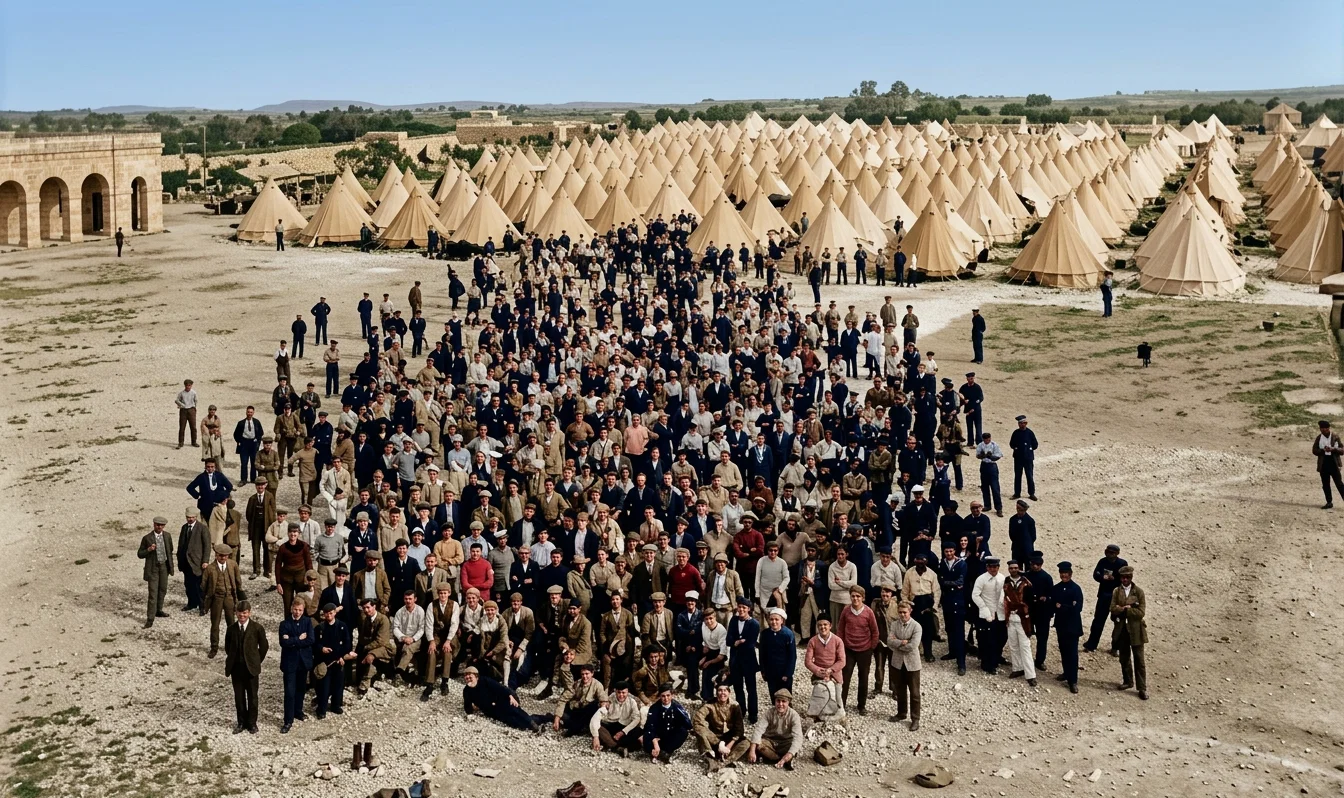
Our camp contains some eight hundred and fifty persons, a motley company from the standpoint of nationality and language, as well as regards trades and occupations. While German is the principal language spoken, there are about ten others used, the predominant ones being Italian, French, Arabic, Turkish, Hungarian, and English. This diversity of speech hinders social intercourse, and is an impediment to evangelistic effort. The great majority, having lived many years in the Orient, have assimilated its peculiar customs and characteristics, much to their spiritual detriment; and the seamen, who are well represented, believe it to be their duty, in view of their socialistic aspirations, to stand aloof from everything that in any way savors of religion. Nevertheless, through the personal touch, many have been found with whom spiritual topics can be discussed with mutual profit. Some of these have attended faithfully the weekly divine services, which it is my privilege to conduct alternately with a missionary friend.
Early last year I distributed 300 German Gospels, and also some whole Testaments which were sent for that purpose by some kind Christian friend. Soon afterward I began a little Bible class with a few persons, in which we studied the books of Daniel and the Revelation, and also some topics of present truth.
VIEW OF ST. CLEMENT'S CAMP, MALTA, EGYPT
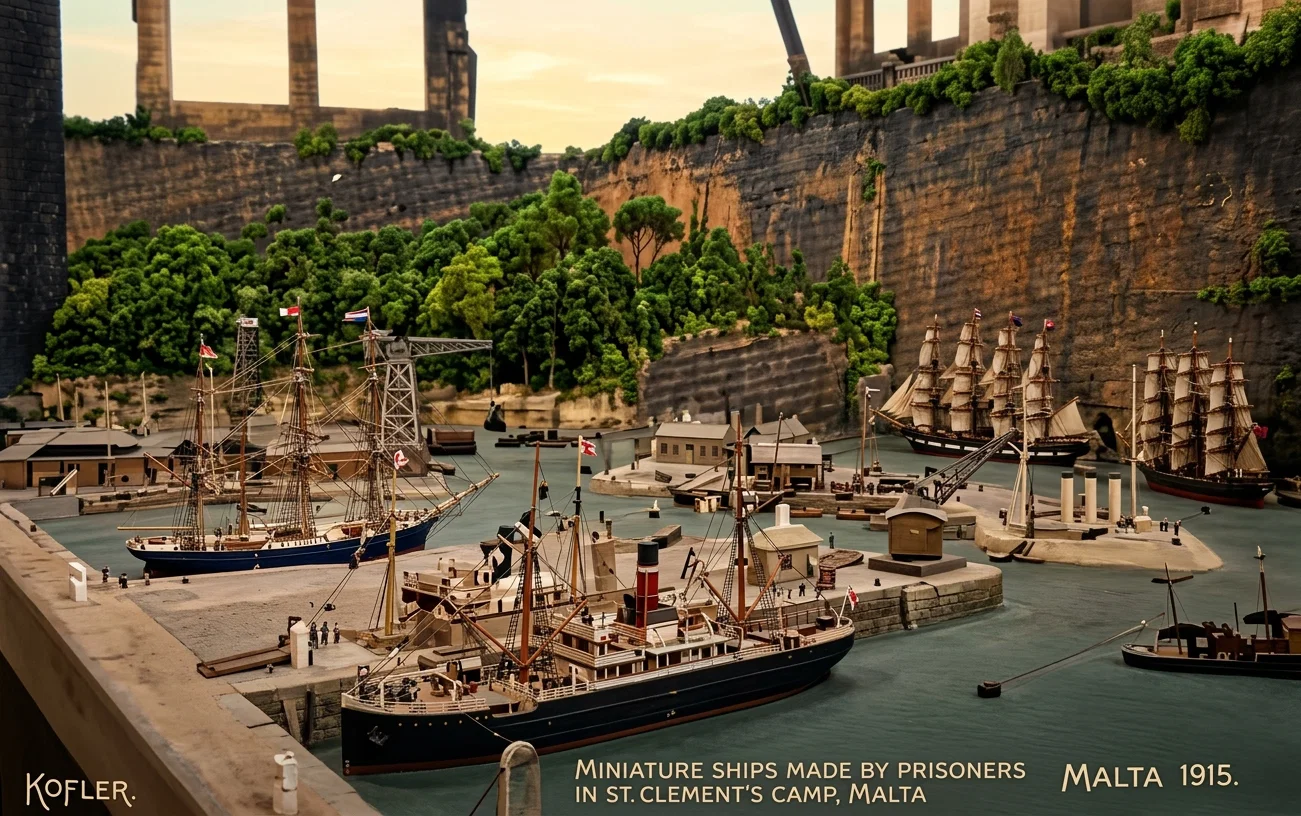
MINIATURE SHIPS MADE BY PRISONERS IN ST. CLEMENT'S CAMP, MALTA, EGYPT
A young sailor, well-educated, one morning dropped into my tent to inquire if I could tell him where he could buy the German book, “The Coming King,” a part of which he had read, with much interest, on the bark “Bertha,” in 1914, while homeward bound from Pisagua. The book was so highly prized by his Norwegian captain that he only reluctantly allowed the young man to read it, lest it become soiled. In Hamburg, he searched for it unsuccessfully in a number of bookstores, and now, having read some copies of the Christlicher Hausfreund, Harold der Wahrheit, and Die Zeichen der Zeit, which I had left with a friend of his, he felt directed to me to learn the proper address. He secured the book, paying for it with the last fifteen shillings he had. The result of our studies was that he soon felt the need of being reconciled with his parents, with whom he had broken off all correspondence after a quarrel some years ago, which had driven him to sea. A reconciliation, and a monthly remittance from them, is the happy sequel to his new spiritual experience.
It has been quite surprising to come across a number of persons who have been in close contact with our cause in widely separated places. My neighbor at table had lived for some time in our old Jerusalem institution; another was a good friend of the new institution, where I often met him. One had attended my tent meetings at Haifa, and another had attended Brother E. E. Frauchiger's meetings at Constantinople. One gentleman remembered visiting, in company with his grandfather, at Weiherweg, Basel; and another with his sister had visited our More Light Societies in Austria; while still another aged gentleman has a cousin in our Chicago church, who wrote me on his behalf. Finally, I was pleased to meet, after twelve years, a schoolmate from our Friedensau School.
For the last two months I have been gathering a group of six semiweekly for a Bible class, and our evening studies in my tent are among the pleasantest hours spent here, when our thoughts are directed heavenward, beyond the things perishable to those of abiding, eternal moment.
Although statistically my evangelistic activity may be reduced to these dry figures,—20 sermons, 171 Bible studies, 68 other gatherings, and 679 visits,—I am confident that in the course of time it will please God to cause some lasting good to spring from these modest efforts, and that his promise as given in Isa. 55: 8-11 will again be proved true.
Besides this work, I have endeavored to make the best use of my time for personal study. Early in April I completed the last ten exercises of New Testament Greek II, but unfortunately nine, with about ninety pages of manuscript, were lost en route. I have been reviewing Arabic, and have practiced for some time with an Egyptian teacher, whom I in turn assisted in the compilation of a small dictionary and a textbook for the study of German in his school. I also touched up my use of German stenography, reading such literature, and at the same time working through a course in English shorthand. In addition I have read extensively German and English literature, forty volumes, including the books of the Ministerial Reading Course for 1914 and 1915, the former of which I had missed because of my travels in Mesopotamia. The12other books were standard works by such authors as Haeckel, Milton, Drummond, Reynolds; General Bernhardi's “Germany and the Next War,” Rohrbach's “Bismarck u. War,” Lord Avebury's “The Pleasures of Life,” Walter Bloem's works on the Franco-Prussian War of 1870-71; also Professor Price's “Fundamentals of Geology,” and “Modern Science and Modern Christianity.”
Some work of a different character has been done in connection with the Relief Committees, of which I have been a member seven months, and recently as chairman of a newly formed committee of five. In the new year I have also started to give English lessons daily to some promising and aspiring young seamen, who are preparing for a higher career. For a change in this routine, I have joined the gymnasium and a male choir. Information on the political issues is supplied in Reuter's telegrams and some papers, and I am a careful reader of the London Daily Times.
It will be seen from these notes that I do not suffer as so many do who find it difficult to fill their time with anything more productive than the discussion of the problematic future. I consider it fortunate to have escaped being elected president of the camp committee a month ago, when the other candidate received the majority of votes, to the satisfaction of the Socialists, who, as they amusingly said, would always prefer a Jew to a parson (Pfaffen), a moralist, for they had no desire to be prayed into heaven.
The general condition in the camp is steadily improving. We enjoy a fair amount of liberty and freedom of action in the camp, which is conspicuous on special occasions, such as festivals and seasons of sporting. August 18 was a notable day in this respect, being the birthday of Emperor Francis Joseph. Besides outdoor tournaments and parading of our young recruits, the main feature of the day was the opening of an exhibition of the most varied artistic productions of the camp, which, considering the rude implements and materials often employed, called forth the praise and admiration of all. His Excellency, the governor of Malta, honored this occasion with a visit. On the occasion of the kaiser's birthday, January 27, there will be a similar celebration, permission for which has been already kindly granted by the authorities. The proceeds from these flow into the camp relief fund.