A Glimpse Into the Village of Shahhad

9%

Review and Herald Publishing Association · Takoma Park Station, Washington, D. C. · May 22, 1913

FromReview and Herald, Vol. 90, No. 21.

Read the full edition

A Glimpse Into the Village of Shahhad

M. D. WOOD
WHEN we first came to Kalyan, India, to live, we wondered where we could get good fresh milk for our use. A neighbor said an old woman from a near-by village brought most excellent milk right to her door every day, and she thought this woman would also supply us. I thanked her, and said I should be on the lookout for her.
In a day or two, a quiet-looking, timid old heathen woman presented herself at my front door. I wish I had her picture to show you. She had on a jacket with short waist and sleeves. Her dress was of dark green, and was tied up about her hips. She had on her wrists a few glass and brass bangles, and an old chain and other native ornaments about her neck. On her head she had a large brass milk-pot, or dota; and in her hand she carried her small brass cup with which she measured the milk. I asked her how she sold it, and she said, “Two annas, or four cents, a seer.” I then asked her if she watered the milk, and she said “No.” (By the way, this is not cow’s milk, but pure buffalo’s milk.) So I agreed to take three seers a day. We boil the milk as soon as it comes, to kill any germs that may be in it; for buffaloes and other cattle often drink muddy water, and it would not be wise to use unboiled milk. In the morning we skim off the rich cream, and always have enough to supply our table with fresh butter.
This same milkwoman sometimes brings us eggs also. One day I gave her a few bananas to eat, and that greatly pleased her. At another time I gave her a large English tomato. Soon she began to bring us eggplants and other green vegetables, and so a friendly feeling has grown up between the old milkwoman and us. She is a poor heathen, but she has a sympathetic heart, and can feel that we are interested in her and her people. One day she brought her old mother to see us, and wanted us to examine her eyes. We did so, and told her that as she was so very old her eyesight could not be restored by the hand of man or drugs. One by one, this milkwoman has brought her son and daughter and other members of the family. She likes to get inside the front door and sit down in the corner and watch us at breakfast or while we have family devotions. She is always quiet and respectful. She thinks Mrs. Kelsey’s little white baby Cathlene is very beautiful, and Cathlene is not afraid of her. A few days ago the woman sat down in the corner and heaved a sigh. We asked her what was the matter. “Oh, my!” she said, “just look at my ankles.” They were badly swollen and were tied up with old rags. I examined them and found they were filled with Guinea-worms. I saw a portion of one hanging out of the flesh. These worms get into the flesh from the drinking of bad water. This is a very common trouble among many classes of people at Kalyan, and we have many such cases at the dispensary.
For several days our milkwoman has not brought the milk, but has sent her daughter instead. So this evening Mrs. Wood, Mrs. Kelsey, and I went to the small village of Shahhad to see our old friend and neighbor. The village road was too rough for our horse and carriage, so we left them and walked across the fields. We saw two small Hindu boys driving home their leisure-loving buffaloes. They directed us to the village. It was just at dusk. We inquired the name of the old woman who brought the milk to our house, and they said she lived on the other side of the village. So on we went, passing by the temple in the center of the village, around which was gathered a group of men and boys. The temple lamps were burning and smoking and gave a dismal appearance and horrid odors. Dumb idols are found in each village, with their devotees sitting about. The people know no better.
At length we came to the home of our friend and patient. We asked if we might enter, and receiving the reply, “Hoy” (meaning yes), we went in. It was merely a barn with a whole row of bullocks, cows, and buffaloes, all tied to a long pole. Just in front of them, stretched out on a cot, lay our milkwoman. A small, smoking lamp without a chimney was brought in. The poor suffering creature turned over in bed, and in a low moan said, “Salaam. I am sick.” Then she asked how the baby was. We looked at her poor ankles, swollen and with worms protruding. She had a slight fever, and was too weak to sit up. We asked her if she would come to our dispensary for a few days, but she said she could not walk and they had no cart. Well, we soon told the neighbors who had carts that they must bring her, and they agreed. As we left, they presented us with two eggs, as a thank-offering. So to-morrow we expect to make a place for her at our dispensary. There we shall treat her and, with God’s blessing, cure her.
On our way out we stopped at the home of Mr. Nargogee, from whom we recently purchased land for our mission. His home was filled with people and cattle. Several women were grinding grain, and they said they were preparing for a great wedding. There they live right in with the goats, sheep, buffaloes, and cows. They can neither read nor write.
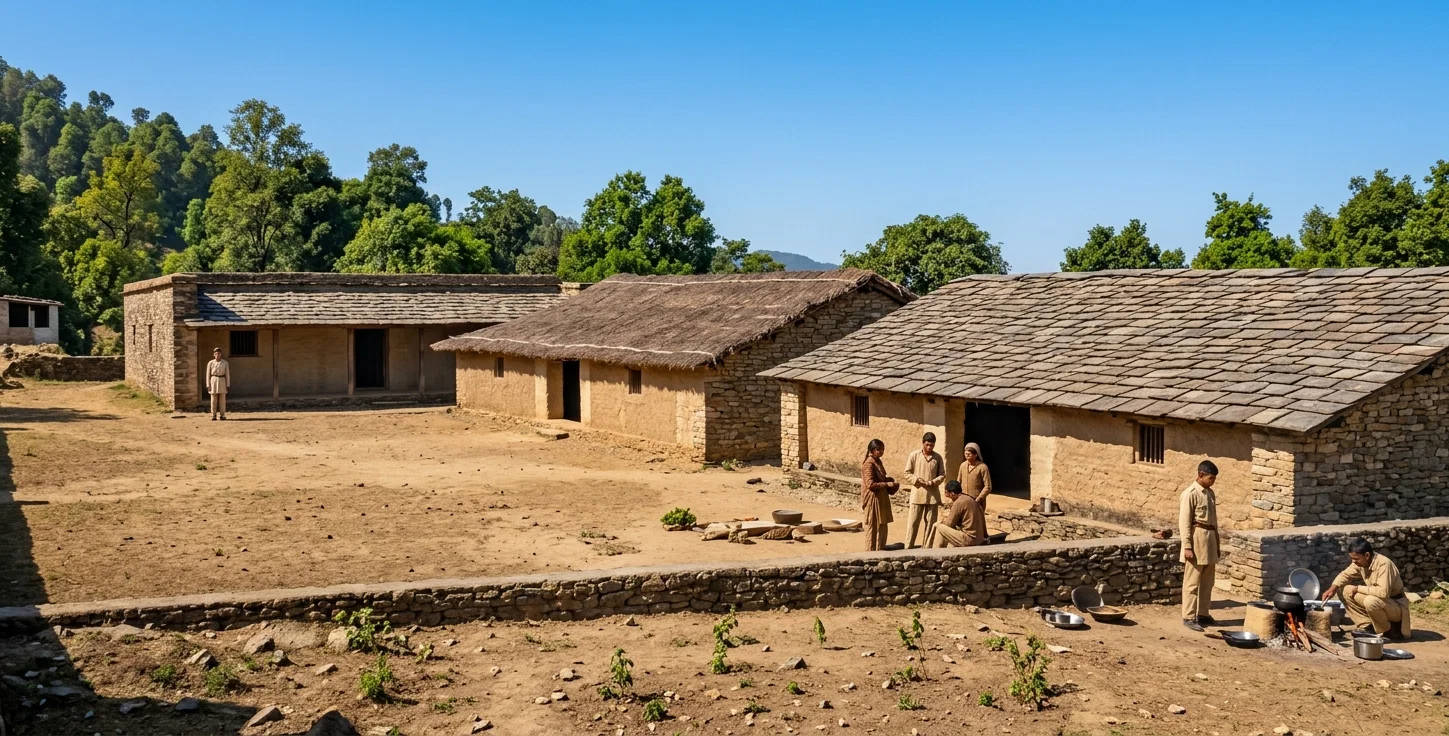
DORMITORIES AND COOK-HOUSE OF THE GARHWAL SCHOOL IN THE HIMALAYAS
They have homes and enough to eat and wear. They fall at the feet of huge stones, believing them to be gods. This is heathen Hinduism, and after hundreds of years no advancement, no improvement, has been made. We cannot read to such a people; they would not come to listen, and are not used to book language. We can not preach sermons to them; they would not like that. But we can minister to their sick and show them the love of Christ. We hope to instruct their children and reach a few of them. It will take a long time to bring them to a state of what we call civilization. Yet Christ died for them, and they need him.
Please pray for the villagers of Shahhad, and also pray for your representatives who try to teach these people of Christ their Saviour.