Song, “Beyond the Smiling and the Reaping,” male quartette.
Life Sketch of Elder G. A. Irwin, read by E. E. Andross. Remarks by Elders E. E. Andross, A. G. Daniells, S. N. Haskell, J. N. Loughborough, O. A. Olsen, and I. H. Evans.
Song, “Nearer, My God, to Thee,” by the choir.
Benediction, by W. W. Prescott.
The pall-bearers consisted of the following-named brethren: W. C. White, Allen Moon, L. R. Conradi, O. A. Olsen, E. W. Farnsworth, and I. H. Evans.
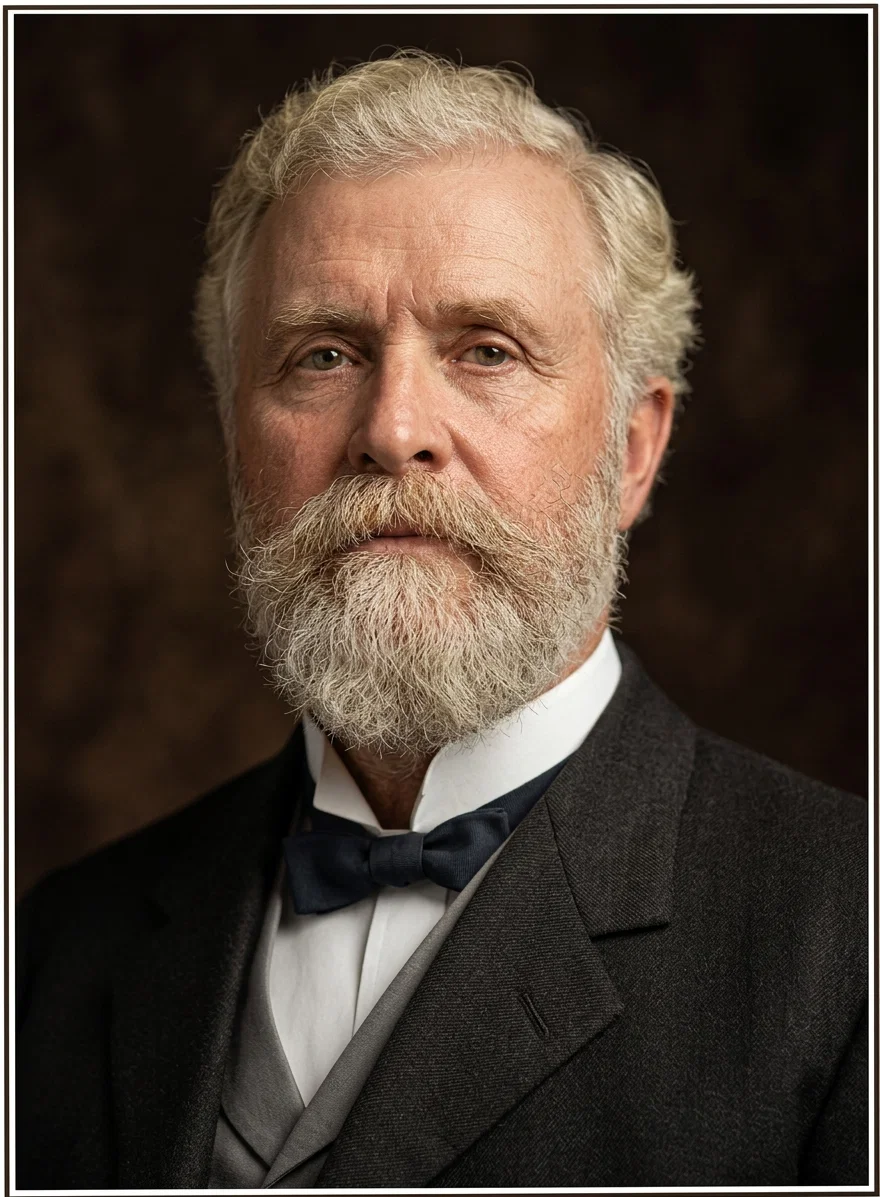
Life Sketch of George Alexander Irwin
E. E. Andross (reading):—
The subject of this sketch was born on Nov. 17, 1844, near Mount Vernon, Ohio. His mother died when he was nine years old, and for some years he lived with relatives, and later worked in Mount Vernon and attended the public schools.
When he was about to enter the high school in Mount Vernon, he accepted the call of his country to enter the army. At the age of seventeen he enlisted in Company I, Twentieth Regiment Ohio Volunteer Infantry. He enlisted for three years, or during the war. As the war did not terminate at the end of the period for which he enlisted, he reenlisted and served eight months more, until the close of the war. During this period of service in the army he took part in seventeen battles and engagements, and served seven months in war prisons, such as Andersonville and Libby. He took part in the grand review which was held in Washington City at the close of the war, and was mustered out immediately afterward. He then returned to his old home in Ohio.
During his imprisonment in Andersonville a copy of Baxter’s “Saint’s Everlasting Rest” fell into his hands, the reading of which led to his conversion. Some time after his return from the army he joined the Congregational Church, and subsequently had his membership transferred to the Methodist Church in the country near the place of his residence.
On Sept. 17, 1867, he was married to Miss Nettie Johnson. As a result of this union an only son, Charles Walter Irwin, was born Nov. 4, 1868.
He lived on the farm for some years, taking an active part in church work and farmers’ organizations, particularly as master of the Knox County grange. However, his most conspicuous work during these years was his earnest labors in the temperance cause, and his ardent advocacy of the prohibition of the liquor traffic.
His knowledge of present truth was first obtained from a series of lectures delivered in the schoolhouse on the corner of his farm by Elder Mann in the winter of 1883-84. The following winter Elders Lindsey and Saxby conducted meetings in the vicinity, at the close of which Brother Irwin accepted all points of present truth, and definitely identified himself with this people.
ELDER GEORGE A. IRWIN
The first position held by him in connection with this message was that of district director. He was given charge of a few churches in the vicinity of his home. Later he acted in the capacity of treasurer of the Ohio Conference, and four years after his acceptance of the truth he was elected president of the Ohio Conference, which position he filled for six years. In 1895 he was appointed director of the Southern field. Having served in this capacity for two years, at the General Conference held in College View, in 1897, he was elected president of the General Conference, which office he held for a period of four years, and was then called to the presidency of the Australasian Union Conference. He served this conference as its president for four years, and in 1905 was elected vice-president of the General Conference for the North American Division. Subsequently he was called to the presidency of the Pacific Union Conference, where he labored for two years.
His last official position was that of president of the board of directors of the College of Medical Evangelists, at Loma Linda, Cal., which position he held at the time of his death, also vice-president of the Pacific Union Conference.
For the past four years there have been frequent admonitions that his health was beginning to fail. The principal cause of his physical ailment has been heart trouble, which was probably brought on by his severe experience in the army, together with the terrible privations and sufferings which he endured in the Andersonville prison. His subsequent career of strenuous labor, both physical and mental, has doubtless hastened the progress of his heart trouble, and thus brought the end of his life more quickly.
The dominant trait of his character was absolute loyalty to the principles which he professed.
He was 68 years, 6 months, and 6 days of age at the time of his death.
An abstract of the remarks of the various speakers follows:—
E. E. Andross: I first met our dear brother sixteen or seventeen years ago. Thereafter I frequently met him, but never was intimately associated with him in labor until the past three years.
Three years ago Brother Irwin was called to the presidency of the Pacific Union Conference, and from that time until his death I was intimately associated with him in labor. We traveled together considerably. He was in our home as our guest. And as the result of our continuous labor together, bearing our burdens together, sharing them together as we did, I came to love him dearly as a father. I do not think that I ever met any one in my public labors to whom I became so closely attached as I did to Brother Irwin. He was a great source of strength and comfort to me in all the perplexities, in all the trials, and cares, and responsibilities that came to me in my public ministry, especially in my official connection with the work during these years. I believe with all my heart today that he sleeps in Jesus, that his course is finished, and that well. I believe that it can be said of him today, as Paul said of his own life when he was nearing its close: “I have fought a good fight, I have finished my course, I have kept the faith: henceforth there is laid up for me a crown of righteousness, which the Lord, the righteous Judge, shall give me at that day.”16
A standard-bearer has fainted, a good and faithful soldier in the midst of the conflict has laid off the armor. A great general has fallen, and that almost at the moment of the final triumph. But now we must take up the conflict as he lays off the armor, and finish the work in righteousness. I shall ever remember with gratitude, and with great pleasure, the months and years of labor during which I have been so intimately associated with this man of God. Not only has a soldier fallen, but a loving, compassionate father, a tender, affectionate husband, one who loved all God’s children everywhere, one upon whose countenance there was constantly a cheery, encouraging, uplifting smile, and on whose lips a word of encouragement for every individual.
Yesterday morning I learned of his physical condition—for some time we have known he was failing, that his health was uncertain—when he was stricken again with great weakness, and I went over to see him. He wanted to visit with me, and we spent nearly an hour together. I little thought that that was the last interview I should ever have with Brother Irwin. After a precious season together, I left him. The physicians, who were in constant attendance upon him, Sister Irwin, and his son were by his side as he sweetly fell asleep. We must bid him adieu today, but in a little while we shall meet him again where parting will be no more.
A. G. Daniells: “Blessed are the dead which die in the Lord from henceforth: Yea, saith the Spirit, that they may rest from their labors; and their works do follow them.” We cannot analyze this scripture; we cannot enlarge upon it. We cannot dwell upon the glorious message with which it is connected. We can not talk of the time when the message is due, nor of the character of the message and its scope in the world. We cannot talk of all that must accompany the giving of this message, and then draw from that the blessed comfort the Lord meant us to have as the laborers and believers fall now and then by the way. But most of us are acquainted with this text, and know its meaning; and, today, while we stand face to face545with one of the saddest and most dreadful things in all the universe, it is our privilege, in the hour of sorrow and mourning, to receive light and comfort and hope from God. And so the Lord uses that inspiring word and that cheering word “blessed.” It would hardly seem appropriate if God had not given it to us, with all that he has done to meet the king of terrors. But the Lord is in command. He rules. He sees, just a little way ahead, when those who fall asleep in Jesus, who die in the Lord, shall come forth gloriously triumphant. It will not seem a second to our departed brother. The next thought, the next second to him, will be the rejoining of us all if we are faithful, and the meeting of the King of kings. I believe that, dear friends; and as I sat here and thought, a great desire filled my heart that God would somehow keep me true to the end. Whatever comes, I want to be true at the last moment, and I am sure we all do.
I have had some close association with our brother. I think I stood by his side personally, physically, in the hour of the greatest crisis of his life. I remember well the morning, and that as I locked arms with him, I said: “Well, Brother Irwin, how does all this look to you?” He said in reply: “Brother Daniells, it is all clear and straight and true. It is right, and I bow to it.” It was always an inspiration to me to see him standing in the battle, drinking the cup, and facing the difficulties, never flinching, always loyal to God. That loyalty was the most notable feature of our brother’s life. I rejoice in the firm belief that all is well with him.
Now, dear friends, the fall of another of our comrades and workers is a great appeal to us today. As I thought the matter over yesterday, after the first dreadful shock that came to me, I said to myself, “I do not know how a man could fall under more beautiful conditions,—here in the midst of an active campaign, shoulder to shoulder with the members of the General Conference Committee, side by side with his comrades, in the bosom of the great family that he loved, and with all the members of his own family by his side.” We who are left should consecrate our whole lives to the speedy finishing of the work.
J. N. Loughborough: My acquaintance with Brother Irwin dates back twenty-two years, to the time when he was elected president of the Ohio Conference. For four years I was very closely associated with him in camp-meetings and preaching from State to State. There were some perplexing things that came up at this time, but we sought God together, and he helped us through every crisis. After Brother Irwin’s return from Australia, I was associated with him considerably in camp-meeting work in Texas, Oklahoma, and Arkansas. I was with him at one time in Arkansas when he became ill and was not expected to live through the night, but we prayed in his behalf, and the Lord heard us and healed him.
I always regarded Brother Irwin as I would a natural-born brother, and when I learned of his death yesterday, I felt as if I was one of the mourners. It seems to me as if this family is my family because of my associations with them.
I know it was a great consolation to Brother Irwin to be here at this Conference and to see what his eyes saw. He was twice here with us on the platform after he came. After we heard he had been so ill, I met him near the cottage and said to him: “Brother Irwin, when the telegram telling us you were so sick came last Sabbath, I wish you could have been here to see the whole congregation unite in prayer. We prayed that God would send an angel to touch you and strengthen you.” His countenance lighted up, and he said, “God did send his angel.”
I believe that our brother died in the Lord. I believe that he died as expressed by the prophet when he said: “Godly men are taken away, none considering that the righteous is taken away from the evil to come.” He also says they “go in peace.” We thank God for this. And when our brother shall awake at the coming of Christ to gather his people in the resurrection, I hope that I shall be there to greet him again, and his family, and other associates in God’s kingdom.
S. N. Haskell: There are some who look upon the doctrine of the nature of man as a gloomy subject. But I think it is one of the most precious doctrines in our faith. God thought so, too, and he left this testimony on record for our encouragement. Through David he says, “Precious in the sight of the Lord is the death of his saints.” Although they have died, God knows all about them. He knows all about their circumstances. He knows where they are. He marks where they are buried, and he watches over them. If we had no greater consolation than this, that the Lord is watching over the graves of his saints, it ought to bring encouragement to our hearts.
There is another text of Scripture that ought to bring great consolation to us. It says that “Jesus wept.” That was at the grave of Lazarus. Jesus sympathizes with human sorrow. He sympathizes with all those who weep at the loss of loved ones or friends, even though they sleep in Jesus.
But there is another thought which seems to be more precious than these, and that is that the next thought of the one who falls asleep in Jesus is the beginning of where he left off thinking when he died. He measures no time when he wakes up in glory to meet his friends.
The question is often raised, Shall we recognize our friends when we get into the kingdom? You remember one expression that Elder Corliss read, that Christ would bring those who sleep in Jesus with him. They will be with Christ. Just as Christ rose, they will rise. Not only will they come forth with immortal flesh, but they will recognize their friends. You remember how Mary recognized her Saviour at the tomb when he rose from the dead. As soon as Jesus said, “Mary, Mary,” in that same tone of voice with which she was so familiar, she at once recognized him. Those who are risen with Christ will be recognized by their friends in the kingdom. They will be known by their voices, and even by the habits they carried with them on this earth. If we are raised as Christ was raised, don’t you think we shall know one another even as he was known?
You may say that our doctrine of the nature of man is dark and gloomy. You may say that we don’t know anything in death; and I am glad that it is so. But the very first thing we shall know will be the resurrection, and the very first ones we shall meet will be those we knew on earth. God knows how to bring us together. He knows how to regulate that matter.
To me there clusters around the resurrection something very precious indeed. I look forward to that time, and I trust that nothing will lead me to make my hope void. I want to see the resurrection of the dead. I want to see Brother Irwin when he comes forth.
We came back together from Australia. We visited different educational institutions, held institutes, and attended some camp-meetings, and we became very intimate with each other. And I cannot recall one circumstance or one word between us that ever left a shade of unpleasantness.
I loved him because I believed that God loved him, and that he was true and faithful to God under all circumstances and conditions. And I expect he will come forth by and by.
O. A. Olsen: The time allotted to this service is altogether too short to do it justice, but I must not be denied the privilege of saying just a word or two.
My acquaintance with Elder Irwin began with his connection with the General Conference, as a member of the committee. In our labors together we have shared conflicts and victories, perplexities and blessings. All our relations have been most cordial and intimate. I have always found him not only a true friend and brother, but firm and decided and faithful to all the principles of this message. I never knew him to shirk any duties or any responsibilities or any care or any labor when he was called upon. He stood at his post faithfully and unflinchingly, doing his utmost in the fear of God. This cause, this message, the triumphing of this truth, was the great joy of his life, and that which absorbed all his interests.
I feel that this whole congregation is a congregation of mourners. One of our fellow comrades, our beloved brother who has ministered to us under so many circumstances, who has brought us comfort and encouragement, who always had a cheerful countenance, always offered a word of cheer and encouragement and comfort,—today we are called upon to pay this tribute of respect; but, as Christ stated to Martha in her mourning, “Thy brother shall rise again.” Yes, she said, “I know that he shall rise again in the resurrection at the last day.” And so do we. We know that our brother shall rise, because he has been faithful to the Lord.
He wanted to attend this meeting, and he really risked his life for it, and fell at his post. I had the pleasure of being united with him as a member of the last committee on which he ever served in this work. He was a member of our nominating committee. We shall remember his earnest prayers and his devotion to this work, and his deep interest in the outcome of this great Conference. I think I also had the privilege of being the last one who had a word of conversation with him. Between eleven and twelve yesterday he sent for me, as he felt his weakness. He wanted to talk with me about our committee work. He wanted to resign, feeling that he was hardly able to go through. I said, as we parted: “No, wait a little; you may get stronger again. We do not feel like546sparing you at all.” I was encouraged when, as I left the room, the doctor said that he hoped after a rest of two days our brother might be around again. So he did not resign. He died at his post.
“Let me die the death of the righteous, and let my last end be like his!”
I. H. Evans: I have known Elder Irwin about twenty years, and my relations with him have been of the most pleasant kind, as all these brethren have stated. I have known him to be a very liberal man, and among my acquaintances I never knew any of our leading men who have given more liberally of their earnings to support the cause of God than Elder Irwin. I heard him say two years ago that for eighteen months past, he had given more to support the cause of God than he had received in salary. There is an army of young men and women that Elder Irwin has educated in this work. I have no acquaintance with any man to my knowledge who has put so many young men and women through our schools to equip them for this work as Elder Irwin has. He wrote me a letter last winter, urging that I accept a young person whom he had in school at that time who would be ready for work in China, and he hoped that it would be possible for the individual to find service in that country as soon as his education was completed. Elder Irwin has helped, not a few, but many of our young people to obtain an education; and in this way, though his services are ended directly in this work, he still must live in the lives and service of many whom he has thus helped. I have been with Elder Irwin on several occasions when he was passing through severe trials. In 1901 on a severe day in his experience, he and I went down to his office and locked the door, and there we shook hands that we would stand by the work of God whatever experience it might lead us to pass through. I was with him in Friedensau two years ago when he passed through a severe trial; and still, night after night as we knelt down to pray, he always remembered the cause of God. He felt that it did not matter what position he held in this work if only the cause of God could prosper. I believe that such a life is worthy the imitation of us who are here.
I have traveled with Brother Irwin many a week—been with him under various conditions. I have never known him to express a doubt concerning this message. I have never known him to express a doubt about the Lord’s coming. I have never known him to express a doubt in regard to the spirit of prophecy. I have never heard him drop a word that one could build on to think that his faith was wavering. He has always looked forward to the triumph of this cause. He gave his life, he gave his money, he gave all the strength he had, that wherever he was laboring in this great work he might build upon a solid basis. And so I believe that this dear brother sleeps and rests from his labors, only waiting the finishing of this work, when he shall enter upon his reward. And there are many others besides who are sleeping, waiting for the morning to come when they shall inherit their reward. It rests with us who are here today to pick the work up where they leave it, to be loyal to every principle of our faith, to work with our might and strength in consecrated effort to push this work to its finishing.