Editorial

2%

Review and Herald Publishing Association · Takoma Park Station, Washington, D. C. · Oct 6, 1910

FromReview and Herald, Vol. 87, No. 40.

Read the full edition

Editorial

The Roman Catholic International Eucharistic Congress
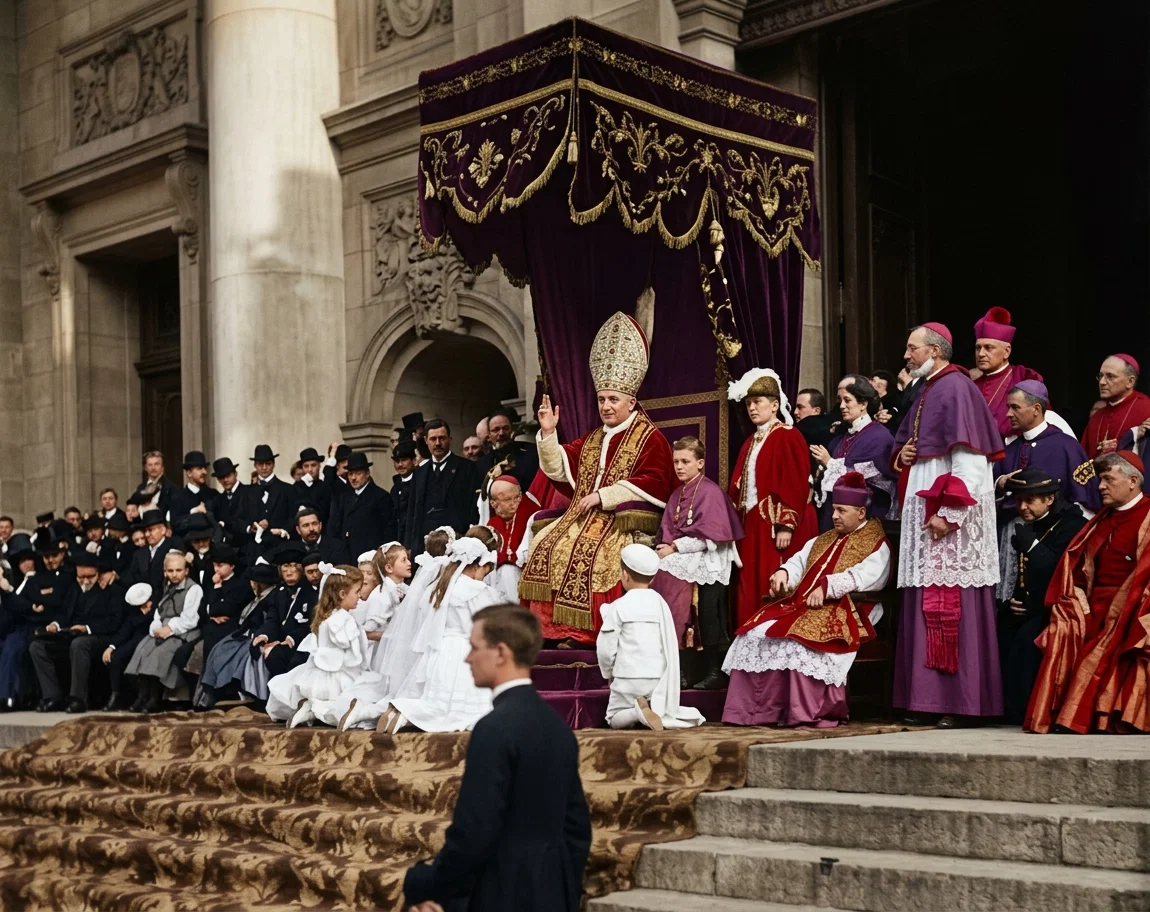
The Eucharistic Congress at Montreal opened on the evening of September 6, with the reading of the Pope’s letter to Vincenzo Cardinal Vannutelli, appointing him papal legate to represent the Pope at the congress.
Following the address of Archbishop Paul Bruchesi, the organizer of the congress, four telegrams were read, two of them being messages from the cardinal legate to the Pope and the king of England, and the other two their replies to him. The telegram to the king thanked him for altering the coronation oath, and assured him of Catholic loyalty, while that to the Pope assured him that those in attendance at this congress laid their persons, labors, and intentions at the feet of “the vicar of Christ,” “the restorer of all things in Christ.” The legate further declared that this Eucharistic Congress demonstrated “for the first time the union of the world, ancient and modern, on religious ground with the Eucharist and the Papacy.”
Expressions heard throughout the congress showed it to be the hope and the undying purpose of the Papacy that through the glorification of the dogma of the Eucharist, or Mass, the whole world shall be brought to the feet of the Pope. This was distinctly set forth in the letter of the Pope, appointing the cardinal as his representative at this congress. He said:—
By this public manifestation the eucharistic bread, unhampered by space and division, will bind together the land which the seas divide, stimulate distant nations to proclaim and vindicate the glory of God the Saviour, and to honor with due loyalty and submission the center of Christian unity, to wit, Christ’s vicar on earth.
Through the influence of that sacrament, the Pope sees, in the future, the whole world honoring him—the center of Christian unity—“with due loyalty and submission,”—a world bowing at the feet of one man, who is to them “God on earth;” but who is, as the Bible declares, sitting in the place of God, and setting himself forth as God.
With that idea in his letter of instructions, the legate made that theme the key-note of his opening address, from which we quote:— Europe extends her hand to America, and this continent, in her sublime fervor, unites with the Old World to exalt together the greatest of the sacraments, under the supreme direction and with the encouragement of the supreme pastor of the church. . . . Then the universal pastor, taking under his charge these new and immense spiritual domains, will show to an astonished universe the Old and the New World realizing before the human race the universality of the church foreshadowed by our Saviour and his apostles. . . . It [the present congress] unites for the first time the Old and the New World in solemn praise of the Eucharist.
THE PAPAL LEGATE GIVING THE PAPAL BLESSING TO THE TWENTY-FIVE THOUSAND SCHOOLCHILDREN WHO MARCHED IN PROCESSION AND KNELT BEFORE HIM
In this eucharistic demonstration the Church of Rome sees a foreshadowing of the time when all the world will flock to her standard, acknowledge her supremacy, bow at her feet, worship at her altars, and loyally submit to her mandates; and wherever she has the power and the numbers which she was able to marshal in the province of Quebec she will see all that. The magnificent reception given to the cardinal legate and the dignitaries of the Church of Rome by the provincial government, is a sufficient guaranty of such homage. The government’s reception to the legate was given on the evening of September 7, in the great dining-room of the Windsor Hotel, and the list of invited guests included the highest dignitaries in both church and state. He had breakfasted with the premier of Quebec at noon; dined with the mayor of Montreal in the evening; sat for an hour while thousands knelt before him, one by one, to receive his benediction; and near midnight, when he withdrew from the government’s reception, thousands were still crowding the corridors of the hotel to catch a glimpse of him, or to receive at his hands the papal blessing.
It was the intention of those having the congress in charge that, when the day of the procession arrived, the 65th Canadian Regiment should march as a guard of honor to the papal legate while he bore the “sacred Host;” and there was much discussion in the press of Montreal over the matter, in view of the fact that the federal authorities had warned the commander of the regiment that it would be unlawful for the regiment to march as a guard of honor for any personage save a member of the royal family. Rome considers her representatives as ranking any member of any royal family, and therefore entitled to the most distinguished escort that can be procured. She desired the escort, and therefore, when the day of the procession arrived, the military escort was there, one of the most conspicuous adjuncts of the eucharistic demonstration.
This was another evidence of the fact that what Rome wants she gets, if she has the power, without regard to legality or illegality. That she wants it, is law enough.
Vigorous protests were made against this unprecedented act; but all were unavailing, as were also the protests against the course of the government in giving the papal legate such a reception as is accorded only to ambassadors of the highest rank. In the Montreal Witness of September 3, a Protestant states the matter in these words:—
It is with much surprise that I note the silence on the part of the press at the attitude adopted by the Dominion government authorities. The secretary of state in his official capacity is delegatedto meet the papal legate on his arrival, thus giving the visit of this dignitary an import of a national character, which goes far beyond the needs of the case. The papal legate is not an accredited ambassador from a temporal power, visiting the court of a friendly country in an official capacity, but is simply a dignitary of the Roman Catholic Church, acting in his ecclesiastical capacity. . . . Why should the Dominion of Canada, through its government, give to this church dignitary a position which is not borne out by his status as an ambassador?
That question was never answered, nor was another answered which asked why a military escort should be given the papal legate, when the government would not give a similar escort to Prince Louis of Battenberg, a member of the royal household.
As further evidence that the government was actually exhausting its storehouse of honors to pander to the papal appetite for pageantry and applause, we note the fact that the papal flag flew at the masthead of the government steamer which brought the papal legate from Quebec to Montreal, and the big gun in Dominion Square boomed out a welcome when the government steamer entered the harbor. There was nothing more that could have been done to honor the Pope and his legate, unless the government had actually turned the province over to the Pope in fee simple. And this was done in symbol when the premier of the province of Quebec knelt at the feet of the papal legate, and kissed his ring, the symbol of his authority. In that act the state bowed its knee and its head to the Pope in token of submission and obedience. That is what Rome expects one day to see done by every ruler in the world. Then will she truly fulfil the specification of the divine Word—“that great city, which reigneth over the kings of the earth.”
One of the most striking declarations made at this congress was contained in the statement of the papal purpose concerning the American continent. Said Cardinal Vannutelli, in his opening address:—
A great event was revealed at the end of the fifteenth century, which Providence reserved to itself to accomplish in modern times. The day upon which He permitted the discovery of America, God said to his church, as he had said to his divine Son: “I will give thee as a heritage all the nations of the earth; I will give thee the innumerable populations of these immense regions, and they will be added to those thou already possessest. . . . Scarcely two centuries and a half [since the establishment of Catholicism in Canada] before Catholic North America will see all these flourishing dioceses attached to the ancient hierarchy of the churches of the Old World.”
Then it was that he declared the universal pastor would show to the astonished universe that there was but one church in the world, and that the one whose visible head occupies the palace of the Vatican. When that church has won North America, she will consider her conquest of the world assured, if not practically complete. With America hers, she will possess “the balance of power;” and with that in her hands, she expects to be able to whip the world into line, and do all that lies in her heart to do.
A slight glimpse at the manner by which she expects to accomplish this was given by Father Terrence J. Shealey, S. J., of New York, in an address on “Retreats for Laymen,” in which he said:—
America is to be the battle-ground of the future, and Catholic laymen must do the fighting. The church can not arm them too early, so that they will be inspired to victory for the kingdom of Christ.
This declaration brings to mind another made at this same congress by Sir Lomer Gouin, the premier of Quebec:—
When the church teaches, we believe; when she commands, we obey; when she is attacked, we defend her.
And this adds significance to the declaration of Bishop Bruneault, of Nicolet, when speaking to an afternoon audience of women concerning the great company of workmen that was to meet in the Church of Notre Dame in the evening. He said:—
This evening the roof of this vast church will resound with the acclamations of an army of valiant soldiers, your brothers, your sons, your husbands, ready to shed their blood for the defense of their religion and their country.
When the shedding of blood is mentioned in connection with the propagation of a religion, it brings to mind the declaration of Cardinal Manning, of England, to the effect that he would plunge all Europe in blood if by so doing he could restore the temporal power of the Pope.
But the purpose of the Papacy for the subjugation of the world does not center on America alone. She has a more general purpose, which covers all the English-speaking countries of the world. Said Archbishop Bourne, of Westminster, England:—
God has allowed the English tongue to be widely spread over the civilized world, and it has acquired an influence which is ever growing. Until the English language, English habits of thought, English literature,—in a word, the entire English mentality,—are brought into the service of the Catholic Church, the saving work of the church is impeded and hampered. Each English-speaking nation can help in this great work,—England, Ireland, Scotland, the mighty United States of America, Australia, New Zealand, South Africa, and the British possessions in India. But the Dominion of Canada can at the present moment, owing to her long and deeply rooted Catholic traditions, render the greatest service of them all, and become a source of ever-increasing and unfailing strength to the universal church.
He stated that Pope Leo XIII had laid upon the order of the fathers of St. Sulpice the duty of continual prayer “that Great Britain might be brought back to the Catholic Church.” He recommended that the Holy See be petitioned to make this burden of prayer still more universal in its scope, “so that prayer might be offered asking that all the English-speaking races be brought to unity of faith and devotion to the Apostolic See.”
For more speedily accomplishing the object which Rome has in view, she is definitely planning a general revival throughout the entire ranks of Romanism, calling every layman into service.
It is interesting in this connection to note the Catholic Church’s estimate of Protestantism, as brought out at this congress. Said Bishop A. Thompson, of Nova Scotia, in the Windsor Hall meeting on the afternoon of September 7:—
The day appears to be not far distant when the religious systems that have departed from the ancient teaching will have become a thing of the past.
The work of the Higher Critic and the result of it among Protestant denominations, have given Rome good reason to conclude that Protestantism is disintegrating, and is no longer a formidable foe. She sees a foreglimmering of her conquest of the world in the movement toward Rome now going on in the Church of England. There was frequent reference to this at this congress.
Monsignor Bourne, archbishop of Angers, France, prophesied that the church would again come into her rights in France. He declared that the “persecutions” of the church there had done more for Catholic France “than had been accomplished during a century of cowardice and inaction.”
In the assistance of Protestants and their contributions toward the expenses of the Eucharistic Congress, Mgr. Paul Bruchesi saw an indication of the restoration of the world to the dominion of the Papacy. Speaking of this assistance, he asked:—
Is this the awakening foretold by many? Is it a step toward doctrinal unity? Are the old-time days returning? This is God’s secret.
The same idea of the Pope’s universal sovereignty was made plain in the Pope’s letter to the legate, in the legate’s telegram to the Pope, in the Quebec premier’s address before the legate, and in the sermon of Archbishop John J. Glennon, of St. Louis, Mo., who declared that in the thousands bowing at Catholic altars at that congress he saw reason tohope that the church was coming into her own again.
What is indicated by this oft-repeated phrase, “the church’s own,” may be judged from the place occupied by the Pope’s envoy wherever he appeared in public at this congress. At every one of these public functions, the legate sat upon a throne, exalted above every other person present, even the representatives of the government,—a tangible illustration of the Pope’s claim to sovereignty over all the kings and peoples of this world. She is the ultimate authority. “When she commands, we obey,” said the Quebec premier; and “when she teaches, we believe.” Said Bishop McDonald, of Victoria, British Columbia: “I know that God has revealed it [the dogma of the Eucharist] because the church teaches it.”
The closing demonstration of the congress was the great procession of Sunday, September 11, which started at 1:20 P. M., and was not ended when darkness closed down over the marching hosts. The procession included religious orders and Catholic societies from all over the Dominion and the United States, and many individuals from far-distant lands. Practically every nation in the world was represented. The streets over which the procession passed were a moving mass of color, uniforms, banners, bands, badges, glittering swords and polished muskets, ecclesiastical robes of purple, scarlet, white, black, and brown. The cynosure of the whole parade was the papal legate, walking under a canopy of cloth of gold, and bearing in his hands the monstrance containing the consecrated wafer, which was supposed to be the very body of the Lord Jesus Christ.
Before the legate walked a number of flower boys dressed in blue and crimson silk, scattering roses in his path. At either side of the legate’s canopy walked the guard of honor, the regiment which could not legally march on this occasion. Behind the legate walked the cardinals in gorgeous robes of crimson silk, whose lustrous folds were held back by priests on either side. As the legate and his attendant left the street to pass up to the repository, where he was to close the congress by the celebration of Mass, he walked over a perfect carpet of roses. From the time that his party left the starting-point of the procession, the chimes of many belfries continued to peal out in honor of “the sacred Host,” which he was bearing, and the exploding bombs in Fletcher’s Field added their noise to the jubilation. The thousands of acolytes and altar boys in scarlet and white, and the three thousand priests in black and white, marching in under the glare of the electric lights, made a picture that will long remain with those who witnessed it. The mighty host fell upon their knees at the elevation of “the Host” in the hands of the legate, and the congress was finished.
What did it all signify? — A mighty movement on the part of the Papacy to bring to itself again the homage of the world. Every such demonstration means a great uplift to the Roman cause in whatever place it is held. It stands for the revival of Catholicism, and it indicates that the time is drawing near when the culminating conflict of the ages will break upon the world.
C. M. S.