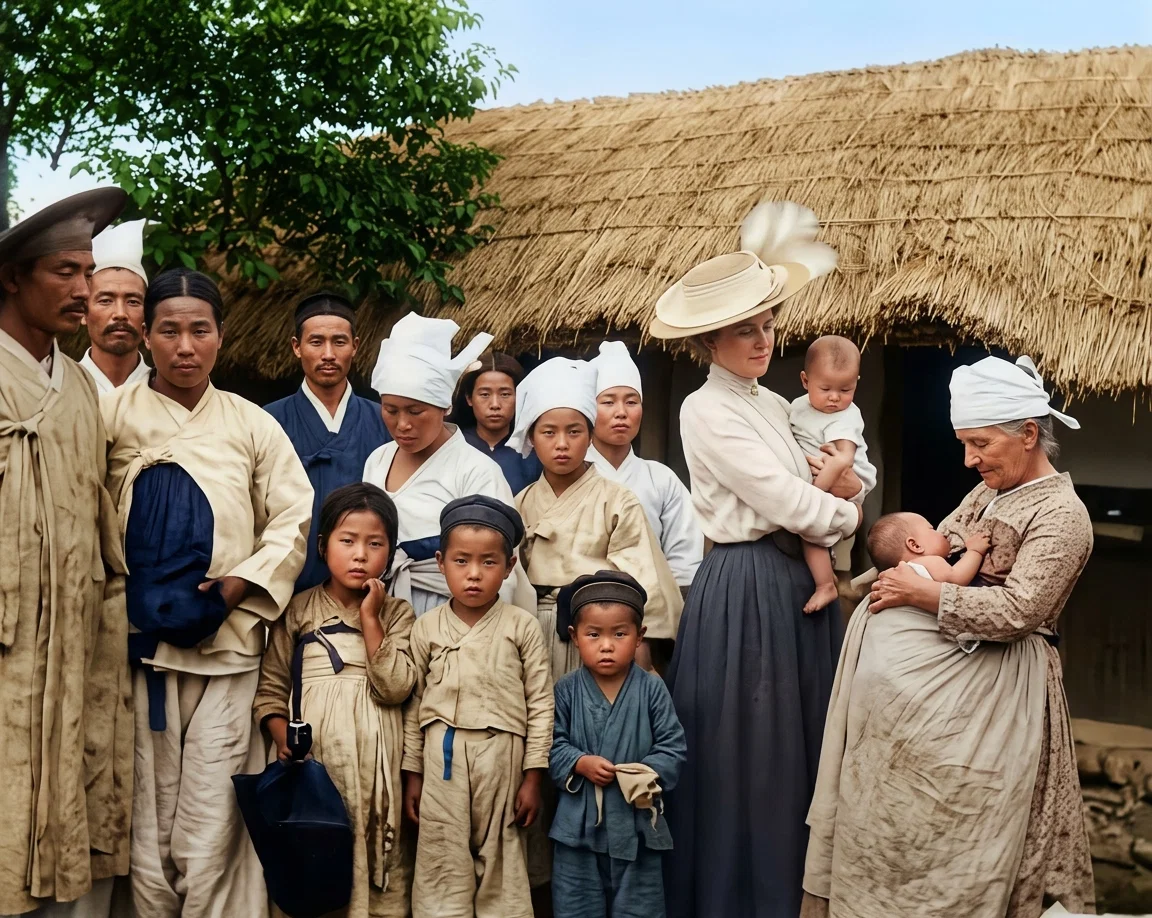
Soonan, Korea

6%

Review and Herald Publishing Association · Takoma Park Station, Washington, D. C. · Oct 20, 1910

FromReview and Herald, Vol. 87, No. 42.

Read the full edition

Soonan, Korea

I. H. EVANS
In company with Elder C. L. Butterfield, and Prof. F. W. Field of Japan, I left Seoul on the morning of July 28, and reached Pieng-yang, the ancient capital of Korea, on the evening of the same day. It had been arranged to hold an evening meeting in the church and school building, which had recently been bought for the little company of believers in this city. We were surprised to meet a company of about seventy, most of whom were Christians, and many of whom were Sabbath-keepers. Among those present I counted twenty-five small boys and ten girls, none of whom were more than fourteen years of age. I was deeply impressed with the courteous behavior of these youth and children in this place of worship, especially as they came to the same building every day for school. When they entered the room, they quickly found the place where they were to sit, and reverently bowed the head in silent prayer. During the entire meeting,—and it lasted until nearly ten o'clock,—not one of these young peoplelaughed, whispered, or in any way made any noise or confusion.
The Lord has especially blessed the work in Pieng-yang during the last two years. The number of believers has increased, and the prospects are more promising than at any time hitherto. A good church-school is conducted, and is well patronized by our people.
Friday morning we proceeded to Soonan, fifteen miles north of Pieng-yang. Soonan is a small country village. Here Elder W. R. Smith, our first missionary in Korea, located. From the government was secured a portion of a hill as a free grant for a school, which has now been conducted for several years. On this land a cheap building, in the Korean style, was erected. This serves also as a chapel.
To accommodate the boys, it became necessary last year to erect a dormitory housing twenty-five students. Already it has become necessary to double the capacity of this building, in order that those who wish to attend the school the coming year may have accommodations. Work will be begun on this addition at once, as school opens on August 28, and it is desired to have the extra room ready then.
SOONAN DISPENSARY BUILDING WITH PATIENTS WAITING TO SEE THE DOCTOR
Already the old buildings are requiring considerable repairs. It is planned that buildings erected in the future shall be of a better grade and more substantial. This will call for a larger investment, but it will be wiser in the long run. The present boys' dormitory, accommodating twenty-five, with sleeping-rooms, kitchen, bath-rooms, etc., cost less than three hundred fifty dollars. It is expected that the addition, if built of cement, will cost twice this amount.
The location of Soonan is very picturesque. In the distance, on nearly every side, may be seen foothills or low mountain ranges. Between the school buildings and these hills stretch the low, rich valley lands, covered with growing rice, Kafir corn, millet, and various vegetables. The air is pure, the scenery beautiful, and the location for an intermediate industrial school all that could be desired.
A few acres of farming land have already been purchased and planted. The millet and Kafir corn look well, and the school will have a fair crop of these cereals as well as a supply of vegetables. While the implements used in farming seem crude to a Westerner, neither the amount nor the quality of work done in a day is so bad.
More farming land in the vicinity of Soonan should be secured at an early date. But few of the Korean believers are able to pay the way of their children through school. But were they abundantly able to meet every expense, it would not be the best training for these young people. They must be taught the dignity of labor before they can become efficient laborers in the cause of God. The school should have plenty of land for farming, that those who need work, and desire it, may have some way to help themselves, and themselves through school. According to the Oriental idea, the student must not do manual labor. It is essential to educate away from this idea, in order to train successful workers.
Brother Howard Lee is preparing to take charge of our educational work in Korea, and it is expected that he will have charge of this training-school. He will be assisted by Dr. Riley Russell and his wife, and by Miss Mae Scott. Their work will be supplemented by native teachers, as required. The demand for this school is most imperative; and when it is equipped, it will fill an important place in the work in Korea.
In addition to the work done in the school, Dr. Russell and his wife have carried on a very extensive dispensary work. During the first seven months of this year, over three thousand patients have received treatment or medicine from this humble medical institution. The dispensary is located in a small Korean house, which we purchased for thirty dollars. The room is about eight by twelve feet, with paper windows and doors. The surgical table is made of two boards, covered with oilcloth. Here the doctor works every day, except Sabbath, week after week; and to him the sick people flock as if their very lives depended on seeing him. All are welcome. The poor man who can not pay one tenth of a cent for his treatment stands on an equality with the well-to-do, who can pay a fair price for all he gets.
Over nine thousand patients have been treated in this humble little dispensary, which will not compare favorably with an ordinary hen-house in America. They come with all manner of human maladies—fever, smallpox, bowel trouble, abscesses, cancers, pelvic diseases, in fact, nearly every form of human ailment,—come in all manner of conveyances, and from great distances,—believing that the doctor can cure them. One poor old woman, who had walked a long way, and was well-nigh tired out, was asked her trouble. She took a paper from her chest, and there was a living cancer about three inches in diameter. When the doctor had done what he could, and advised her to go to a surgeon in Pieng-yang and have an operation, she begged that he would treat her case.
In all my experience I have never seen work that appealed to me as being so truly like that which the Master did, as when I saw this motley crowd standing in the scorching sun, waiting for the hour to come when the dispensary would open. Thirty-five patients were treated one afternoon while I was there. Surely such work deserves a better building, where hot and cold water can be had, and where the sick can find shelter from the storm and the heat while waiting for treatment.
Think of what we have in some places, and the meager number of patients that receive treatment, notwithstanding all the facilities provided, while here, had we an investment of twenty-five hundred dollars, we could treat ten thousand persons a year! The conditions are appalling, the need is beyond utterance; it must be seen to be realized. Then, too, when these poor souls see their ailments helped, their hearts are made tender, and a word about God and his love goes far in carrying conviction to their hearts. Literature is freely distributed to those who will read.
The work in Soonan is prospering, and the Lord is blessing his people in that place.
Shanghai, China.