Quaint Wells of India

6%

Seventh-day Adventist Publishing Association · Battle Creek, Mich. · Jul 28, 1903

FromReview and Herald, Vol. 80, No. 30.

Read the full edition

Quaint Wells of India

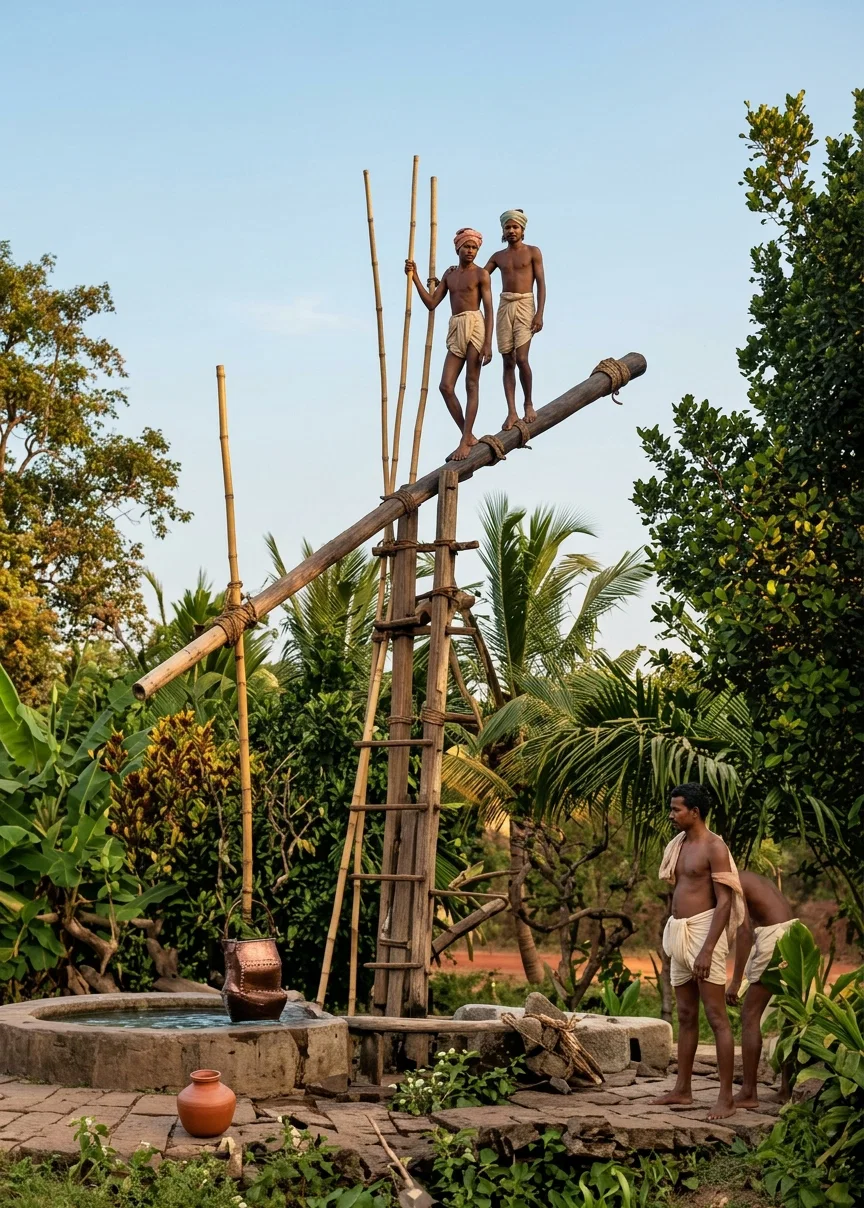
The wells of India are all built alike. They have a large, circular, open top, measuring about ten feet in diameter, and a substantial curbing four feet in height, made of cemented stones, plastered and white-washed. Just outside the walls are upright ladders, the rungs of which are built between posts planted firmly in the ground, and rising skyward fifteen or more feet.
A large bore has been made through a beam of the size and shape of a telegraph pole, at about its center. This pole is suspended by thrusting the top ladder rung through the hole. On the heavy end a large stone is securely bound. On the small end a long, thick, bamboo pole is affixed—parallel to the ladder, and at right angles to the telegraph pole. A huge kettle, made of narrow strips of copper riveted together, hangs from the bamboo. Lashed to each side of the upright ladder are lighter bamboo rods, which rise some distance above the top rung.
To draw the water, two men (coolies) climb the ladder, and tread the telegraph beam, nimbly balancing themselves by curling supple bare feet about the edges. They walk forward to drop the kettle into the well, and then scamper to grasp the tall rods, which are fastened above the ladder sides, and hold on to these until they are safely past the center. Then backward these agile men go until the stone-weighted end raises the dripping bucket.
A third man stands outside the curbing to empty the pail, and to force the emptied vessel back for another filling. During the entire operation all three coolies invariably chant a weird melody to the time of the measured movements.
These wells are fed by underground springs, and are built in paddy (rice) fields, cocoanut and plantation (banana) groves, etc., for irrigating purposes, and by the waysides for the convenience of passers-by.
One of these quaint wells is found just outside the fence of the botanical garden, at the edge of the broad, red-earthed highway, under shady trees. The Damodar School for Farialis is just across the street. The drinking water for the school children is brought from this particular well; and between school sessions the children themselves go to slake their thirst in the cool water.
Fancy my astonishment one day to see four men using this well as a bathing pool. Indignantly I called the head master of the school, and demanded that he stop these public seekers after cleanliness, as I did not understand the Tamil vernacular.
A NATIVE WELL
A NATIVE WELL
The head master kept an alert eye on my face, and tried to see whether the outward expression and gestures would afford him a clue to my spoken words. He was supposedly acquainted with the English language, yet here, evidently, was an unusual combination of words. He quite clearly understood that these men, who now came before us, had but just emerged from the well. They desired a bath; why not take one? What harm could there be in these coolies taking a plunge in a well so long as the well was not on Brahman (pertaining to the highest caste) territory?
My protestation met with blank ignorance; it was void of all meaning to these wondering natives.
In despair I looked about me for assistance of some sort; I was reluctant to part with my audience until they were duly impressed with the enormity of their offense. My eye caught sight of several long strips of white muslin, which had also been washed in the well, and then spread in the sun to dry.
The head master, who was still keeping a watchful eye on my face, saw me looking at the laundry, and immediately decided that he now understood the sense of my argument. He had suddenly remembered that the English-speaking people commonly dislike seeing the undraped human form divine. He gave a sharp command in Tamil, and presto! the four dark figures sped lithely away, snatched the almost dry muslin, and draped themselves on the way, as theyreturned with broad smiles, confident of approval.
I forced an appearance of sternness, and once more tried to focus my objections. My point was the fact that from this well came, not only drinking water for our school children, but also for the entire population from the low, native village near by. This much was very clear, but again it threw not the faintest light on my opposition to the use of the well for personal cleanliness.
As I talked, the dazed coolies would occasionally give a smart toss of the head—done by jerking the chin to the right, which throws the top of the head to the left,—a peculiarly Indian custom, I believe, of giving assent.
Now and again our group received additions from the stream of passing villagers. They, too, joined in trying to see my point, but after a time, instead, saw the point—rather the nine points—on the other side presented by a wayfarer, to the effect that here in the East it is the custom to bathe, to wash clothes, and to drink from the selfsame well when the tanks or fountains are not near.
While bound to accept the situation with what calmness I could muster, you may rest assured the question of ways and means of performing similar functions on home ground was minutely enquired into at the earliest possible moment.—N. Alma Courtright, in The Union Signal.