The Tanganyika Plateau

8%

Review and Herald Publishing Association · Washington, D. C. · Jan 28, 1915

FromReview and Herald, Vol. 92, No. 5.

Read the full edition

The Tanganyika Plateau

One Strategic Point in Central Africa
J. C. ROGERS
It is said by one of the first missionaries from the London Missionary Society to the Lake Tanganyika regions, that this is the center of Africa. He brings a good array of evidence to show that his contention is well sustained. Ethnologically and geographically, he concluded Lake Tanganyika to be the continent’s center. The author of a recent book, “The Great Plateau of Northern Rhodesia,” contends that the center is in the hills some hundred miles south of the lake, where are the sources of the Kongo and the Zambesi.
Recently, while traveling over the hills just mentioned, it seemed to me that here, among these deep, cool watercourses, where, in the early morning, frost is found in July, might well be the middle of the African wilds. On my last trip, ten miles distant, I forded another one of these streams. It runs through what in the wet season would be an impenetrable jungle. In places its depth is surprising; in others, such as my crossing place, it is easily forded in the dry season by removing boots and wading over the rocky reaches in its bottom. Its euphonious name is Mutatoshi. It is a branch of the Kalungwishi, a tributary of Lake Moero and the Kongo. I spent two days along this splendid stream, camping overnight by its banks, and did not hesitate to drink freely of its pure, cool water. I would not do so during the rains, however, without boiling it.
The plateau embraces almost all of Northern Rhodesia, the area of which is not less than one hundred and twenty thousand square miles. Within this, and almost encircled by four lakes, lies the high plateau of forty thousand square miles. The latter appears to me a strategic point for Central African mission work.
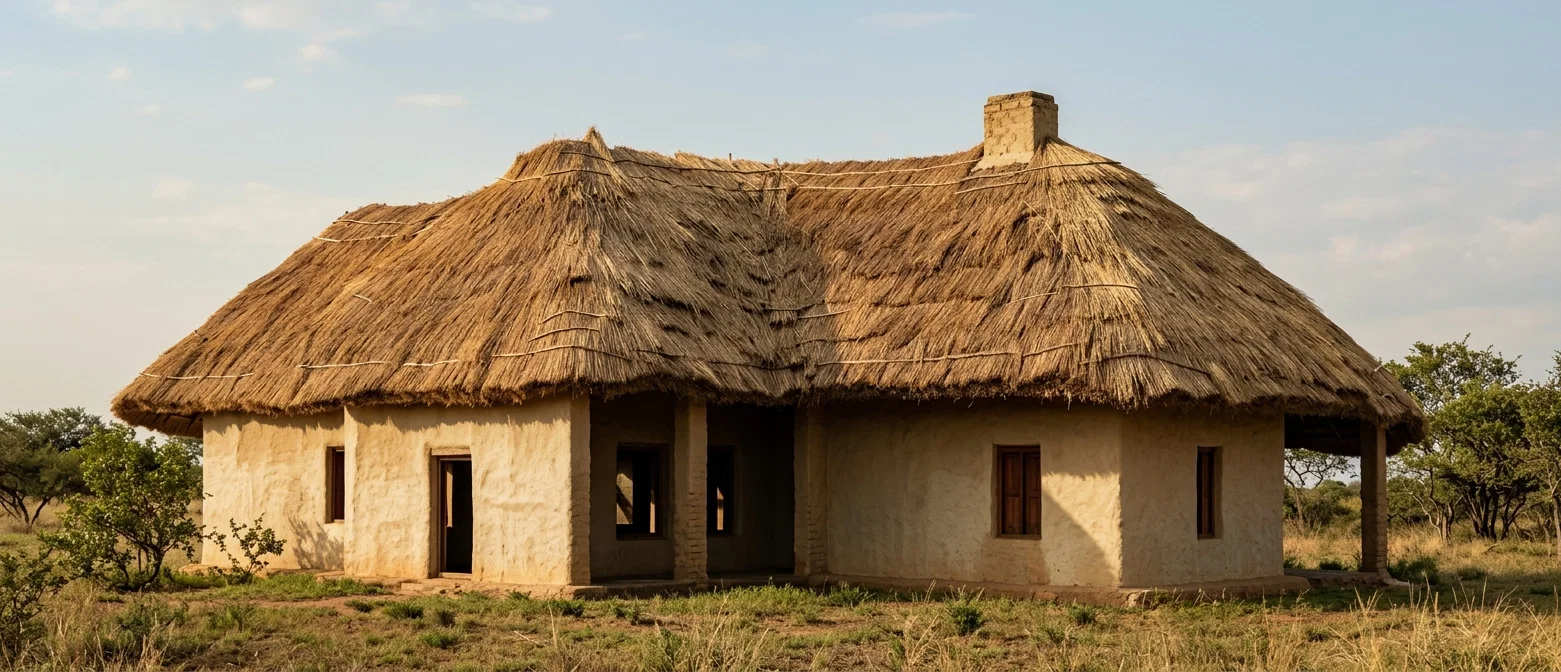
At present it is the most difficult place to reach in all Africa. Before the completion of the German East African railway, this difficulty was greatly enhanced. If I say that, except for the new railway, a man requires three months and a thousand dollars to reach Mporokoso with his baggage and some small housekeeping conveniences, you can understand its isolation. In our outfit there was no stove, furniture, nor musical instrument. Our present stove is a few stones, on top of which rests a square of sheet iron obtained here. On this is the big cooking pot, out of which come our boiled and baked articles of food, even pie and cake, when there are sugar andflour to make them. We sent sixty-five miles last week for provisions. A pound of oatmeal costs fifty-five cents, and a tin of dried peaches one dollar.
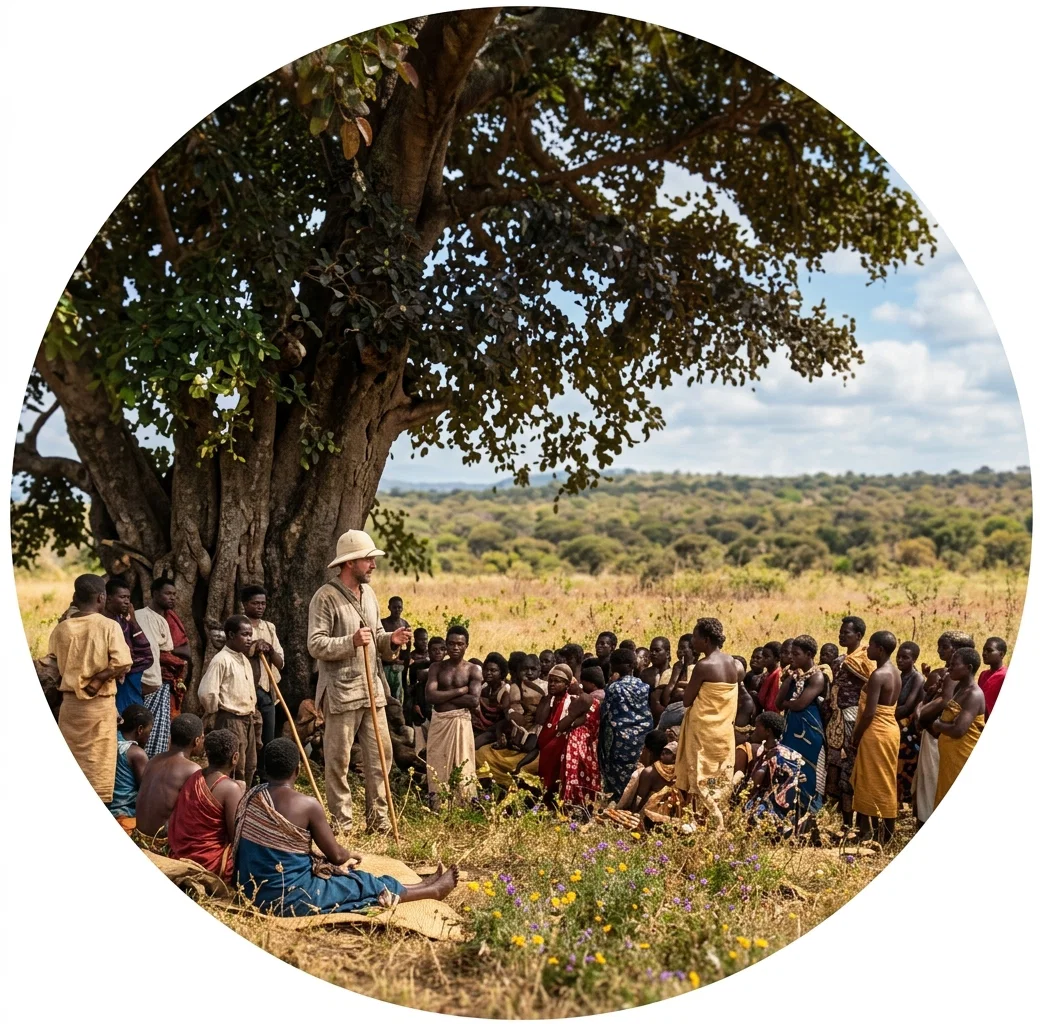
STARTING A SCHOOL UNDER A TREE NEAR MORO-KORO, CENTRAL AFRICA, BY LONDON MISSIONARY SOCIETY
The plateau is the home of many tribes who are only now beginning to “scent” modern civilization and to travel. Some of the venturesome braves go to Johannesburg, Bulawayo, and Salisbury, on the south, and to Elizabethville, in the Kongo State, or to German East Africa, away to the northwest. What they learn of this message they will tell where they go. The means of travel is likely to be rapidly increased. This will also serve to spread the message.
“The climate, in most parts of the plateau, is absurdly healthful for Central Africa.” In this respect it is very favorable for a central station from which the truth can be carried by trained native evangelists. There should be one station well staffed and equipped to give natives a thorough training in the common branches and the simplest methods of caring for the sick. It should have a normally trained teacher, a graduate nurse, a doctor, and a minister. Of course all these cannot be had at once, but this must be the plan. And how small a staff is this compared with, say, an academy at home.
THE LONDON MISSIONARY SOCIETY HOSPITAL AT KAWIMBE,
TANGANYIKA PLATEAU REGION
THE LONDON MISSIONARY SOCIETY HOSPITAL AT KAWIMBE, TANGANYIKA PLATEAU REGION
We are locating near the western boundary of the great paramount Awemba tribe, who were powerful and populous in the days of Livingstone. “We passed through the inner stockage and then on to an enormous hut, where sat Chitapankwa, the Wemba king, with three drummers and ten or more men with rattles in their hands. . . . I declined to sit on the ground, and an enormous tusk was brought to me. The chief saluted courteously.” Livingstone adds later that the tusk on which he sat was sent after him, in addition to his present of a cow, “because he had sat on it.” Giraud passed through the Wemba country twenty years later. He mentioned his inability to return a suitable present, on account of the insufficiency of his goods, for the magnificent presents of the king, Chitimukulu. The interpreter came back with the following message: “Chitimukulu is a great chief, and gives of his bounty without thought of recompense,” which words, so unique from the lips of an African chief, “are worthy,” says the enthusiastic Giraud, “of being inscribed in letters of gold.” The above items are from the book mentioned in my first paragraph.
Two other important tribes are not far from our proposed site, the Alungu and the Washinga. I have seen the local chiefs of these three tribes. They are quite friendly, though they know but little of our faith as yet. One of them called at our home yesterday, with two other local headmen. While we are waiting to select our definite mission site, on account of the military situation, we are becoming acquainted with the people, and with their language, which we are studying. As the grammar is practically the same as the Chinyanja, which we know, and the new dialect will not be so difficult.