On Nov. 27, 1914, at 6:30 A. M., Brother Li Wei Ching, Mrs. Cottrell, and I started by train to visit Ying-shan, our most northern outstation in Hu-peh Province. On leaving Hankow, we first passed through a low, marshy tract, and after that a good agricultural district. By eleven o’clock the mountains near the Ho-nan border were reached, and at a place named Kwang Shui (broad water) we left the railway, and pursued the remaining fifteen miles by sedan chair.
Three of our brethren had walked to the railroad station to meet us, while others came a part of the way to extend their welcome. As it had been quite impossible to rent a suitable chapel in the city of Ying-shan, we found the place of meeting to be at a little market village about three miles in the country. Although there had been no regular evangelist at this place for several months, we were pleased with the way in which the church school and the Sabbath school were conducted, and with the earnest desire to study the message.
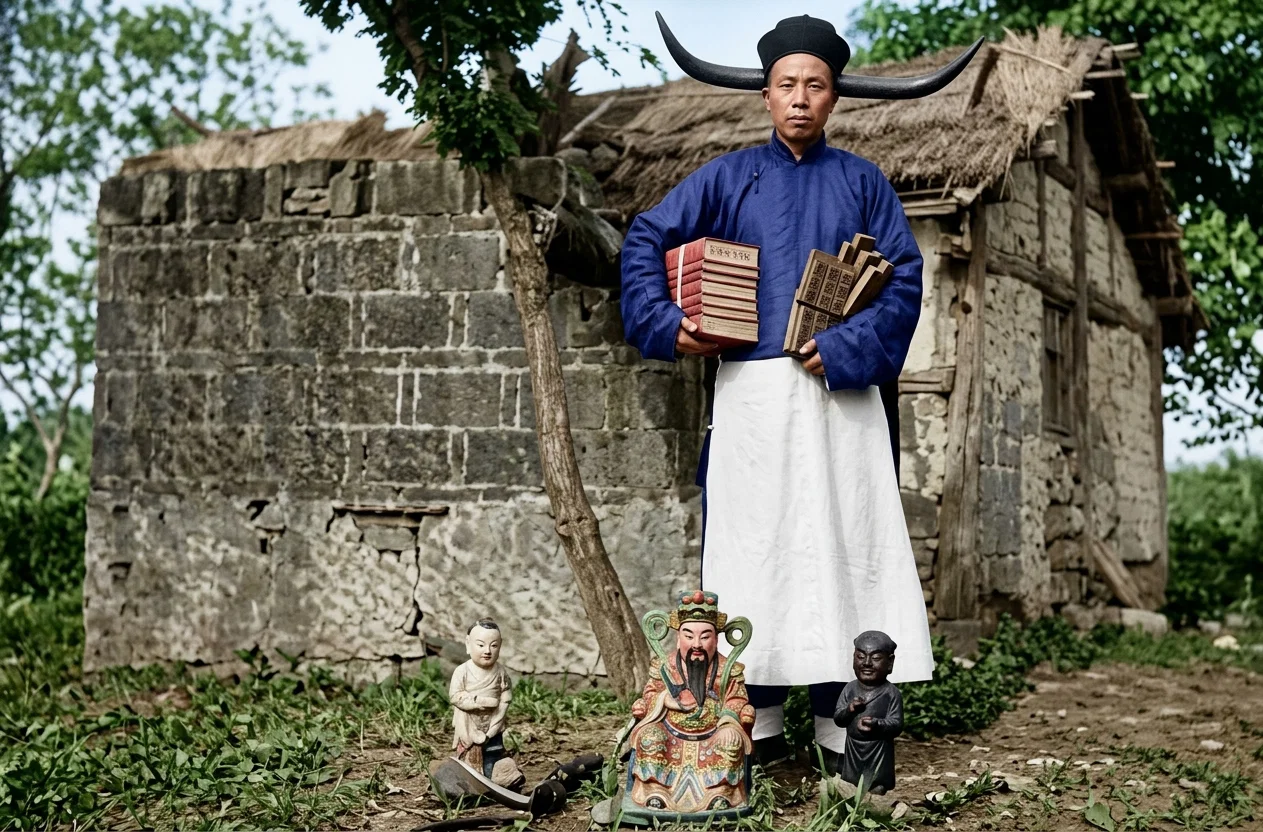
One inquirer requested us to perform Christian marriage for his son. A former Taoist priest, who united with us a year ago, made arrangements to become a colporteur. The accompanying picture shows this brother and one of the idol shrines near his home, where he had in the past so frequently worshiped and officiated. Here we had the pleasure of receiving nine candidates by baptism, and we hope a church may soon be organized.
Returning a part of the way to Hankow by the modes of conveyance already mentioned, we next visited Siao Gan, a city of 40,000 inhabitants, where we have had a chapel and church school for over two years. The rented buildings occupied by our mission are large and well constructed, but being in a quiet section of the town, are not suitable for a strong evangelistic campaign. We hope a better location may soon be found.
At this place, three followed their Lord in baptism. One of these was a man eighty-three years of age. As it was a cold winter day, some feared the feeble old man could not endure the ordeal, but he reassured them. Entering the water with a radiant smile, he was baptized without shudder or struggle, and on nearing the shore, gently brushed aside the extended hands, saying, “Please don’t trouble, I am well able to walk without help.”
To the next outstation is seventeen miles, and of this distance we traveled ten miles by rowboat, four miles on foot, and the remaining three by sailboat. Reaching Chiang Giang Pu, we remained but one night, promising the people that we would return in a few days, and make them a longer visit.
A former Taoist priest, and the shrine where he often officiated before learning to love Jesus. The center idol is the village god, and those on the right and left are the gods of rain and wind, respectively.
A half day’s trip by chair brought us to Ying-cheng, where we stayed one night and spoke to a small company of inquirers, and on the following day went to Lodien. The surrounding country has a somewhat rough, wild appearance, and here and there, either on mountain top or encircled by moat, are large inclosures surrounded by high walls, to serve as refuges or fortresses for the people in case of war or bandit raid.
The people, too, seemed quite untouched by civilization; and as no foreign woman had previously visited that section, large crowds followed us everywhere, and could not be kept out of the house even while we ate our meals. A goodly number at this place applied for baptism, and a few candidates were accepted; but after careful consideration it was decided to ask all to wait for a time to study the gospel more fully.
During this visit, we were given the use of the town theater for public meetings, and many thus heard the “good tidings” for the first time. A number of substantial persons are here enrolled as believers, and the outlook for the future is most promising.12
Returning to Chiang Giang Pu, where we have a school for boys and girls, we received an enthusiastic welcome. The mission compound was decorated with mottoes, flags, and banners, and at night was illuminated with Chinese lanterns. For a part of one evening, the boys stood in line on one side of the open court, and the girls on the other. One side sang a hymn, and the instant it was finished the opposite row started another, and so on, alternately. As a number of the children had good voices, splendidly trained for interior China, the exhibition was pleasing and commendatory. And as we sat listening, Brother Chen, for fourteen years a raving maniac, but who had been clothed in his right mind in answer to the earnest prayer of our brethren, passed quietly in and out, serving cups of hot water to the assembled guests.
During our visit here, ten were baptized, and three young men were accepted as students for the training school in Shanghai. Although a little early, the annual offering was also taken, which amounted to $56.40 Mexican, a splendid gift, and one that meant real sacrifice to most of the givers.
Returning to our home, we spent the week of prayer with the Hankow and Wu-chang churches. Each of the readings was translated verbally. Our Chinese brethren and sisters gave a loyal response, and covenanted with God that by his help during the next year they would live and work for Christ as never before. The native annual offering in these two churches was $66 Mexican.
The week following, we visited the new outstation in Chichuen, which by steamer and sedan chair is a two days’ trip from Hankow. At this place the brethren and sisters warmly welcomed us. A private school building is freely given, which serves for the present as chapel, and home for the evangelist. The believers are mostly farmers of a substantial class, and on Sabbath afternoon six of their number were buried in baptism. We trust that this is but the first fruits of a large ingathering in this new locality.
During 1914, Mrs. Cottrell and I have traveled 1,300 miles in visiting our Hunan and Hu-peh outstations. In so doing, we have journeyed by steamer, sailboat, rowboat, railway train, sedan chair, wheelbarrow, on horseback, and on foot. In all this journey, we have not once traveled in the rain, nor been delayed because of bad weather. Although there has been frequent rain during our stay at various places, when the time came for us to leave, the clouds lifted. For this kind providence we wish to bear special testimony to the favoring hand of our Heavenly Father. About two hundred believers have presented themselves as candidates for baptism, and it has been my privilege to administer this blessed rite to one hundred and three. The others have been advised to study the gospel message a little longer before taking this step.
Photo by R. F. Cottrell
Brother Chen, demon possessed fourteen years, restored by the power of the third angel's message.
The opportunities for work in Central China are apparently limited only by the lack of workers and the scarcity of funds. Could our young people in America but know the conditions, the volunteer corps for missionary service would be doubled; and could the members of our homeland churches see the needs as they really are, I believe there would be five dollars where now there is one, to proclaim this closing message in the great heathen fields.