The Rio Grande Do Sul Conference

6%

Review and Herald Publishing Association · Takoma Park Station, Washington, D. C. · Dec 19, 1907

FromReview and Herald, Vol. 84, No. 51.

Read the full edition

The Rio Grande Do Sul Conference

JOHN LIPKE
The Rio Grande do Sul Conference was organized in 1906. At present it consists of five churches, with a little more than four hundred members. One minister, two licentiates, three Bible workers, and several teachers and canvassers, are our working force.
Our territory is the State of Rio Grande do Sul, Brazil, with about three times million inhabitants. We can divide the field into three parts: the cities and towns, the colonies, the campagna. The cities and towns are few and far apart, and are inhabited by a mixture of Brazilians and foreigners,—Germans, Italians, and a few other nationalities. About thirty per cent of the population can read. The largest city is Porto Alegre, the capital, with about eighty thousand people. Two lines of railway connect some of the cities and towns. The remainder can be reached by wagon or on muleback, often over bad roads.
The colonies are the settlements of foreign farmers, who emigrated from Europe. They live, in general, close together. A good per cent of these can read.
The campagna is like the prairies of Kansas, but not so level. It is mostly inhabited by Brazilians, who live on large estancias, far apart, and raise cattle, etc. One has to travel sometimes from three to five hours on muleback, from one estancia to the other. In the campagna perhaps only ten per cent of the people can read.
From the beginning, our work has been more or less in the colonies, among the Germans. Only of late have we begun to labor in towns and cities, among the Brazilians. Lack of literature and workers speaking the Portuguese, has hindered us. Since our new book “A Vinda Gloriosa de Christo” (His Glorious Appearing) came from the press, we have pushed the effort in the cities. Our canvassers have had good success in cities like Porto Alegre, Santa Maria, and Bage. The daily papers to whose editors they introduced themselves have called the attention of the public to the book, in favorable, short notices. Thus the way has been prepared for good sales. One Protestant minister even, who had bought it, recommended it to his church, and a number of other ministers bought a copy.
At Santa Maria the field seems to be ripe. Our colporteurs found a number interested. One case only I will mention: A young man, an employee of one of the business houses, for some time had a desire to speak with an Adventist. As he could find none in Santa Maria, he decided to visit one of our brethren living near there. He was glad to meet our workers at Santa Maria, and was anxious to learn more of the truth. We hope to see him a laborer in our ranks. He is intelligent and earnest.
As we labor in the cities, we hope to find educated men, who, after a short training, can be used to advantage in the proclamation of the third angel’s message. Natives well trained will be more successful, and can be supported with less money, than a foreigner, who has to learn the language and get acquainted with the customs of the people before he can be successful.
Because the spirit of prophecy has counseled us to put forth strong effort in the cities, we have decided to buy a tent, and we expect to hold our next conference at Santa Maria (which has a population of twelve thousand), and a local camp-meeting in the town of Taquary.
Brother Brack, a German licentiate, is working in the colony of Sao Pedro. At first the way seemed to hedge up, on account of the opposition of some ministers. But the Lord opened the way. A man who had been in bed for weeks, and whom none could help, was restored to health by simple treatments. Prejudice has been removed, and people are coming from far and near, asking for counsel. Doors that otherwise would be closed, are now open as a result of the one successful treatment. This instance shows how important it is that all laborers know how to treat the sick.
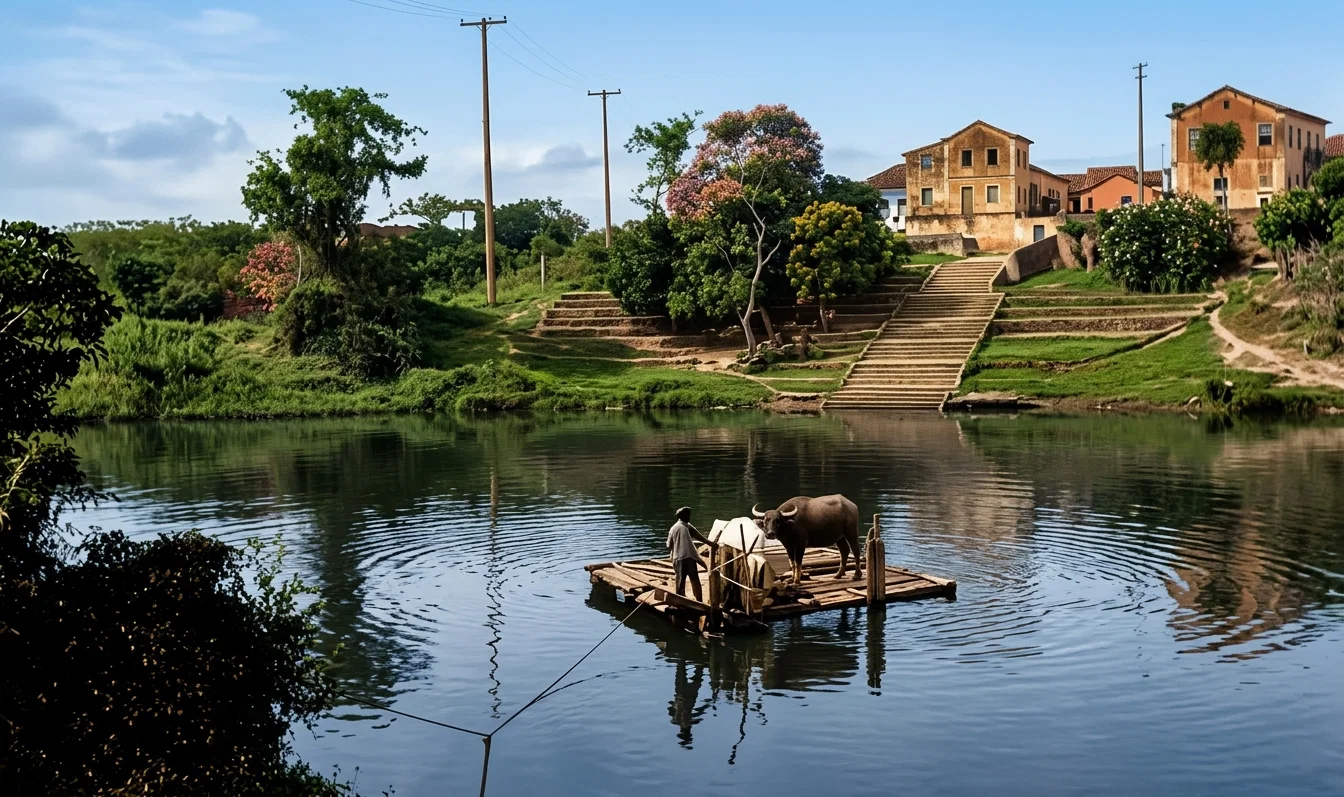
BRAZILIAN FERRY
BRAZILIAN FERRY
Brother Lindermann, a Bible worker, has been in another colony, New Wurttemberg. There he found interested souls, among them a former missionary of the Catholic Apostolic Church. This man is an intelligent German, who studies the truth. We hope to see him embrace the message.
Near Sao Miguel our brethren distributed copies of our Portuguese paper, O Arauto da Verdade. These created an interest among Brazilians. Brother Plantholt, a German, has called for a worker to follow up the interest. But we are sorry to say that at present we have no one suitable to go there.
In looking over the reports of our colleges in the States, I learn that the Spanish language is taught in our schools. This is well. But our young people ought also to study the Portuguese. Brazil needs many foreign laborers. Africa, India, China, also have Portuguese colonies, where no laborer has gone. The Portuguese language needs attention. May God raise up young, consecrated people, who can go forward to proclaim the last warning message in those dark countries where this language is spoken.
Taquary, Brazil.