Living in the Tropics

6%

Review and Herald Publishing Association · Takoma Park Station, Washington, D. C. · Dec 19, 1907

FromReview and Herald, Vol. 84, No. 51.

Read the full edition

Living in the Tropics

B. J. CADY
[Brother and Sister Cady have spent many years in a tropical climate, and have been able to maintain excellent health. They were requested to write out some of the points gained by these years of experience for the benefit of other missionaries just entering upon service in tropical lands. This article is taken from the Union Conference Record, the official organ of the Australasian Union, in the hope it may contain some helpful suggestions to our missionaries in general, grappling with similar conditions found in tropical fields.—ED.]
It has now been over fourteen years since we first came to the Society Islands to labor. Until that time we had always lived in a temperate climate, where the winters were very cold, and the summers short; for we were born, and had spent most of our lives, in Wisconsin, in the United States of America. We have summer all the year round here in the islands; but though the sun is very hot, the sea-breezes help to cool the atmosphere, and the heat is not so oppressive as in some other places. Yet if some cold is needed to “brace one up,” as we often hear, we do not get it here. We have usually kept in good health, and believe that a reasonable regard of the laws of health, which are also nature’s laws, is what has enabled us to keep as well as we have.
We have never had the idea that the foods which are grown in the islands, were not so wholesome as those of temperate climates; but on the contrary, we consider them to be just the food best adapted for this climate, with the addition of bread, which to those who have always had it, seems indispensable. Our diet is composed principally of yam, taro, bread-fruit, sweet potatoes, bananas, mummy apples, mangoes, oranges, the cocoanut, rice, and bread. We have some other fruits and vegetables occasionally which are more rare, and also use some legumes. At times when we have been compelled by circumstances to use much imported foods, we have not enjoyed as good health as when we were living mostly on the native foods. I would say that we do not make a practise of eating the ripe cocoanut meat, though we often eat the soft meat of the green nuts, which is quite digestible and wholesome. The ripe nuts are used mostly in cooking; and though they are very useful for that, it is not good to make a practise of eating the meat as it is; and to eat it between meals is particularly bad. When the meat is grated, and washed with a little water, the liquid from it is strained, and this makes a very good substitute for milk and cream to use in cooking. We can make this very rich, or dilute it considerably with water, just as is needed. We use it for shortening and for flavoring soups, stews, puddings, etc., also for a sauce, and for almost everything for which milk and cream are used, and we think it very wholesome. It is rich in fat, and so furnishes all of that element that is needed in the system.
Our systems do not require so much food in a warm climate as where it is cold; for when it is cold, more food must be burned in the body to keep us warm; and when we come to a hot climate, if we do not cut down our rations, we are more liable to feel weak and feverish, and be troubled with colds and other unpleasant symptoms.
We find that in a hot climate frequent bathing is very essential to health and comfort. We always take a full cold-water bath one or more times each day, if we are where we can have access to the water, and it is usually plentiful here. One who is in the habit of taking cold baths right along, is not liable to be susceptible to colds. And, too, in the hottest weather, when the heat seems almost unendurable, there is nothing equal to the cold plunge or shower-bath to give relief.
Some seem to think that one should avoid exercise as much as possible in ahot climate, but my experience is that we need exercise, only we must be moderate, and not try to rush things too much. It is a good thing to keep busy, but not to work constantly at the same thing. Changing frequently from one kind of work to another, will usually give all the rest and relaxation that is needed. I believe it is very seldom that a worker loses his health simply from overwork, but it is more often caused by hurry, worry, or errors in diet. We, as missionaries, go out to work, not to be waited upon; and if we, with all the light we have on health and temperance, can not keep well and work, how can we expect the ignorant and degraded natives, who are violating nearly every law of their being, to be able to do our work for us, even though they may be used to the climate? We may get accustomed to the climate, too. If we begin right, I think we shall find that the climate will not affect us unfavorably, even at the first. It was so in our experience, for we never enjoyed better health than during our first year in the islands.
Of course we should not dress the same in a warm climate as in a cold one. Men readily lessen the amount of their clothing; but women sometimes cling to their close-fitting garments, to the detriment of their health; and often wear too much clothing, which makes them feel weak and tired; and they think it is caused by the climate. It is customary in these islands for the women to wear loose, flowing dresses; and the white women also wear them at home, and often wear no other style of dress. They are much more comfortable and cool than garments that fit close to the body about the waist, and also more healthful.
One of our experienced laborers, in giving advice to a company of missionaries who were soon to enter the island field, said that one of the first and last lessons we need to learn, is adaptation. That is very true. If we want to make a success in our new field, we must learn to adapt ourselves to the people and their customs as far as is practicable, and we must also learn to adapt our diet, dress, and work to the climate and the conditions.
Disease is very prevalent among the natives of these islands. Venereal diseases are almost universal, and repulsive skin diseases are seen on every hand. We are at times situated where we have to mingle freely with the people, living in the same house with them, and often eating the food prepared by them, though we always do our own cooking as far as possible. The common yellow laundry soap is said to be a good disinfectant, and we always make free use of it, washing our hands with it very frequently after being in contact with the people, and after shaking hands with them. The natives are not very cleanly in their habits, and that is one reason for so much skin disease among them. I am thankful to say that during all our years here, neither my wife nor I have contracted any of the native diseases. When we have felt a cold or fever coming on, we have generally succeeded in stopping it at the beginning, simply by going without a meal or so or by eating less food and drinking an abundance of boiled water. By this simple means we have usually managed to keep well when all around us were suffering with the prevailing epidemic. Fasting is the best medicine I know of to cure, if taken when the first symptoms of indisposition are felt.
The malaria may not be so prevalent here as in parts of Africa, yet we have a great deal of it. When one gets it into the system, he has attacks of fever and chills, and it usually develops into elephantiasis. Where there is danger of malaria, a high and dry location is best for a home, where the sun and wind may have free access. There is much more dampness in low valleys than on the hills. Then the house should be set up a good distance from the ground, so that the air can circulate freely underneath. Too much shade is not good, and rubbish should not be allowed to accumulate in the vicinity of the dwelling-house, for it breeds malaria. (See "Ministry of Healing," pages 274-276.)
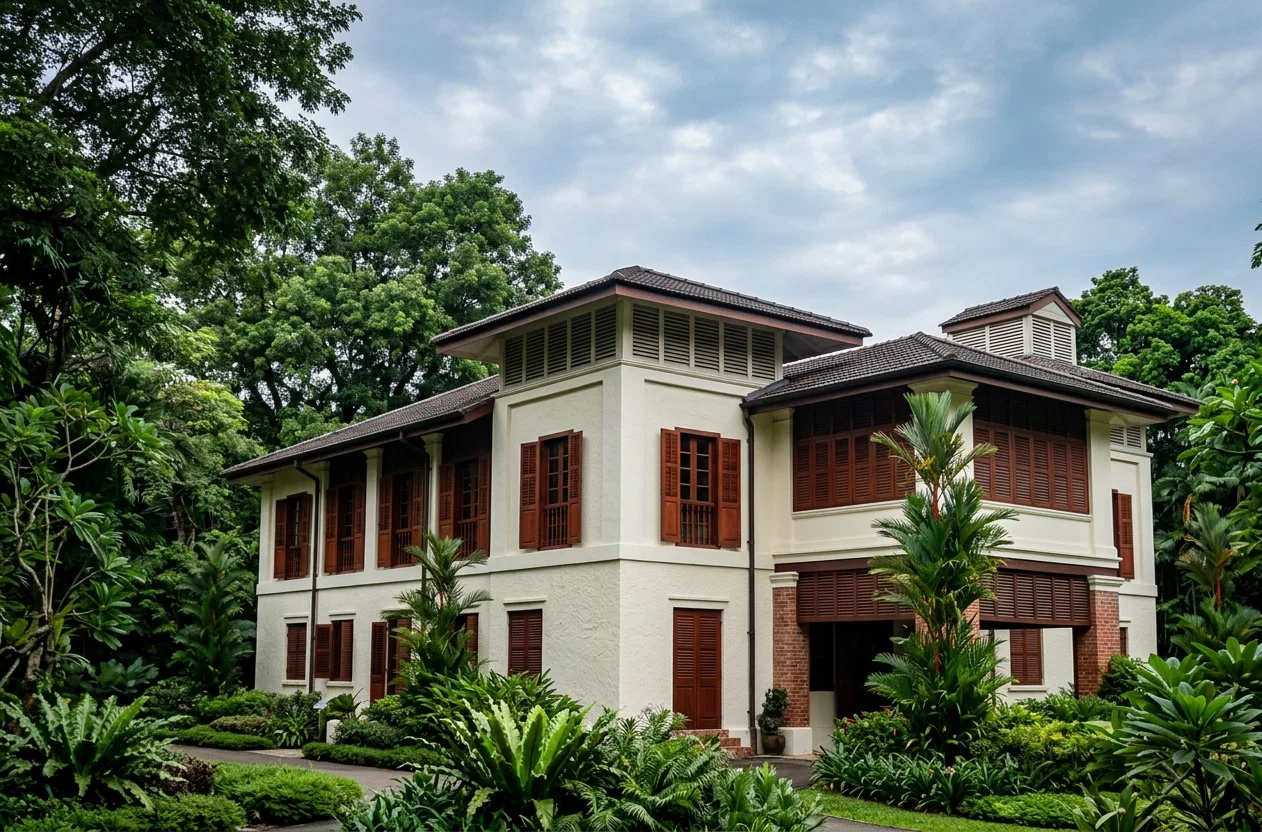
MAIN BUILDING OF SINGAPORE TRAINING-SCHOOL
We have always made a practise of keeping the doors and windows of our sleeping rooms open night and day, so as to get all the pure air we could.
Some white people who come to the islands, seem to think they must live just as they always have lived in the country whence they came, even though everything here is very different from what it was there. We have not felt that it would be heresy to adapt ourselves to the customs and conditions of this country, but have tried to do so as far as it would be consistent with health and right. Many of the customs followed here are the very best for this climate, and where they are good, we want to adopt them, and adapt ourselves to the people as far as possible. When we came, we adopted this country as our home, though I can not say that we felt at home for some time. We are planning to stay as long as the Lord does not call us to take up work elsewhere, or until the Lord comes, and all the work on earth is done. We are looking for a city yet to come, and not until we enter there may we expect to find everything just right and the effects of the curse entirely removed.
Papeete, Tahiti.