The Baltic and the West-Russian Meetings
6%

Review and Herald Publishing Association · Takoma Park Station, Washington, D. C. · Jan 16, 1908

FromReview and Herald, Vol. 85, No. 3.

Read the full edition

The Baltic and the West-Russian Meetings

GUY DAIL
In consideration of its size, its population, and the growth in its membership, it seemed best to the delegates assembled at Riga, October 26, to dissolve the North Russian Mission, and thus pave the way for the organization of two fields instead—the Baltic Conference, and the West Russian Mission. The conference was organized and held its first annual meeting October 26-29, in connection with the Russian Union meeting at Riga; the West Russian Mission held its first yearly session November 3-6, in Loppasch, Volhynia.
The territory of the Baltic Conference comprises the Baltic provinces (Courland, Livland, and Estland), and the governments of St. Petersburg and Pskof, with an area of about seventy-four thousand square miles, and a population of 6,296,300 (it is a little larger than North Dakota, but has over nineteen times as many inhabitants); membership, 383. During the Middle Ages the Lettic tribes of the Baltic Provinces were incorporated by the Knights of the Teutonic Order into the Holy Roman Empire; the reformed religion was accepted in the first half of the sixteenth century, and it brought with it freedom, enlightenment, and education, so that this is the most generally intelligent part of Russia—there are only about three per cent of the people unable to read and write, while it has been stated that of the Russians as a whole, seventy-three per cent can not read and write. The prosperity of the provinces is to be attributed to their excellent system of land tenure, to the skill and energy shown in the cultivation of the soil, and to their commerce and manufactures, as well as to the liberty and intelligence of the people.
During the five sessions of the conference, the forty delegates conducted their business in the most friendly manner, although they represented the Lettonian, the German, the Esthonian, and the Russian nationalities—nationalities that in the world exhibit very bitter race feelings in their dealings one with the other.
The resolutions offer thanks to God for the kind providence which has made it possible for the organization of the conference; express gratitude to the German Union for the help it has rendered the brethren here in the past; call for the establishment of a local poor fund in each church (a tenth of which is to be sent quarterly to the conference poor fund); recommend the circulation of our literature in the four leading languages of their field; agree to the principle laid down by the General Conference, that only such as are faithful in tithes and offerings be chosen for church or conference officers; pledge the loyalty of the field to our plan of raising means for local and foreign missionary work; and insist upon the support of the material fund for “Ministry of Healing”(697 rubles were pledged, and ninety-eight rubles were given in cash toward this object), that the entire retail price of the books sold in Russia may aid in the establishment of the much-needed institutions in that field.
Elders L. R. Conradi, F. Andersson (of Finland), and J. T. Boettcher, and the visiting brethren from various parts of Russia, rendered excellent help at the meeting. In the evening, lectures were held in three localities—one for the Germans, one for the Lettonians, and one for the Esthonians and Russians.
The Sabbath-school contained one Russian, three Estonian, seven German, and ten Lettonian classes, with a membership of 230; donations, 25.8 rubles.
Elder Boettcher was chosen president for the coming year; he will be assisted by five canvassers, four Bible workers, one licentiate, and one minister. We trust our readers will ever remember this new field and its few workers.
The West Russian Mission includes the rest of what was earlier the territory of the North Russian Mission: Poland, and the governments of Kovno, Volhynia, Grodno, Minsk, and Vilna. Here is a field about as large as California, for its area is 159,000 square miles; but it contains 22,061,200 inhabitants (nearly fifteen times as many as live in the “Golden State”), who are to be told of the soon-coming Lord. Our membership here is 270.
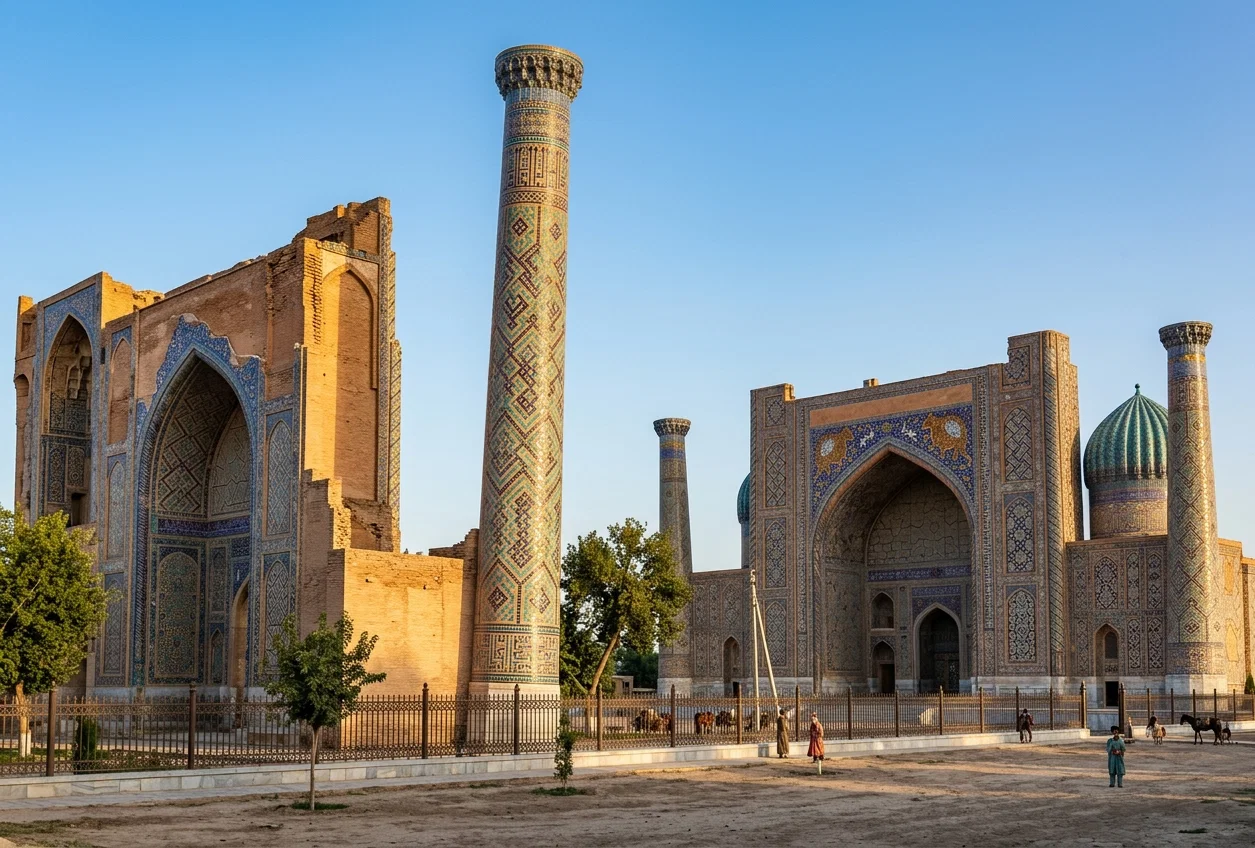
RUINS OF MOHAMMEDAN MOSQUE IN SAMARCAND
Although by far the larger number of the people are agriculturists, still, especially in Poland, there are cotton and woolen mills, engineering works and sugar-refineries, and mines of iron, zinc, and coal; and an increasing trade is carried on not only with the other parts of the empire, but also Polish manufactures are gaining a market in China, Persia, Asia Minor, and the Balkans.
Poles, Jews, Great- and Little-Russians, Lithuanians, and Germans, are the chief peoples of this part of Russia; Roman and Greek Catholics, Protestants, and Mohammedans are met with; so that one sees enough variety, so far as nationality and religion are concerned.
The same general topics referred to in the resolutions for the Baltic Conference were earnestly considered at this meeting. Elder Boettcher's help was highly appreciated. Although they have recently had rather a poor harvest in some parts of western Russia, still the brethren and sisters were so much interested in the institutional work that needs to be done here, that they raised 636 rubles toward the material fund for “Ministry of Healing.” They also manifested a sincere desire to help forward the cause in their field in every way possible. Elder D. P. Gaede was chosen superintendent of the West Russian Mission.
We wish for the dear friends in this field (who are assisted in their labors by two ministers, one licentiate, one Bible worker, and two colporteurs), the richest blessings of God, and a harvest of souls for the Master. To this end may they be remembered as we pray.
Hamburg, Germany.