The Work in Ecuador

8%

Review and Herald Publishing Association · Tacoma Park Station, Washington, D. C. · Feb 20, 1908

FromReview and Herald, Vol. 85, No. 8.

Read the full edition

The Work in Ecuador

GEO. W. CASEBEER
UNTIL recent years the doors of Ecuador were securely closed to the entrance of the gospel, but for the short time it has been open, I suppose there is no other country in South America that has made such rapid strides toward liberty and the complete severing of Rome’s shackles, at least as to the government. There is considerable fanaticism among the people yet, especially in the interior of the country. For some time we have made our home in one of these interior towns, and we note considerable change in the attitude of the people toward us. At first many did not care to have anything to do with us, and seemed very suspicious of all our movements, but now there are few places where we are not cordially received, and many like to inquire about our belief. We have made no public effort yet, but the seed is being sown, of which we are assured that some will fall into good ground.
The people of the coast are much more liberal minded, giving a better chance to present to them the truth, but we have noticed that, if possible, they are more corrupt, and the same mighty power must work, or no real change will appear in the life.
Not long since Brother T. H. Davis and I made a trip on the coast where we had never been before. We had many interesting experiences in getting our literature before the people. On starting out from our home in Ambato, we had very little means, but, better than money, we had God’s precious truth in books and papers, and a determination to place them in the hands of the people. We took a third-class passenger-coach in the train, leaving behind my wife and baby girl with Brother Davis’s three little motherless girls, and thus we went out to the battle. But those who stay by the stuff will receive the same reward as those who are at the front.
We spent most of the night going around Mt. Chimborazo, and although we are almost on the equator, the tropical sun does not seem to have much effect at an elevation of nearly twelve thousand feet, with a strong wind blowingoff the snow-capped mountain. Our third-class coach, being even more open than a stock-car, did not offer much protection from the elements, but as we were in the Lord’s work, we were of good courage, knowing that we shall reap if we faint not. The next morning we crossed the division between the Atlantic and Pacific Oceans, and were soon descending the west slope of the Andes. In a few hours we had descended from about eleven thousand feet to the valley only a few feet above sea-level. In this transit there are many examples in engineering skill. One mountain called “El Nariz del Diablo”—the nose of the devil—is passed by a zigzag in which three tracks, one almost directly above the other, may be seen at the same time hanging on the edge of the rocky precipice. We have many opportunities here to see the grandeur of God’s works, as we are surrounded by the lofty Andean peaks, many of which are volcanoes some extinct and some active. From our place in Ambato, smoke and fire can be seen almost constantly escaping from the crater of the awful Cotopaxi. But the missionary has more to do than contemplate these scenes, for there are souls in the darkness, scattered over mountain and valley, for whom he has the message of salvation.
Brother Davis was very busy selling books and papers to the passengers, while I took care of our baggage, for sometimes people in these countries take what does not belong to them. Our trip to the new province had to be taken by steamers, and as the fare is considerable for third-class, we had to be up and at work for the few days before the ship left, in order to get the needed means for the journey; so we traveled at night in the small river steamers, and during the day canvassed the towns along the banks. After a pleasant trip of several days we landed at Bahia, the principal port of Ecuador, excepting Guayaquil. The next morning we went to work, I going in a log canoe to a small town across the river, to sell small books and papers, while Brother Davis stayed in Bahia, taking orders for “Patriarchs and Prophets.” By night he had taken thirty-one orders, besides selling a number of small books. The next day we finished the town together, and at midnight embarked in a river steamer for our next point,—Chone,—which is a large, flourishing town.
In this country each town has its annual church festival, and as the feast of Chone was drawing near, where many thousands gather from all over the country, we decided to stay a few days to see what we could do. When the feast had well begun, we put up a stand near the market, with our papers and books on exhibition. Here we sold almost all the small books we had taken for the whole province. In this way the truth was scattered throughout a range of territory it would have taken weeks to travel through.
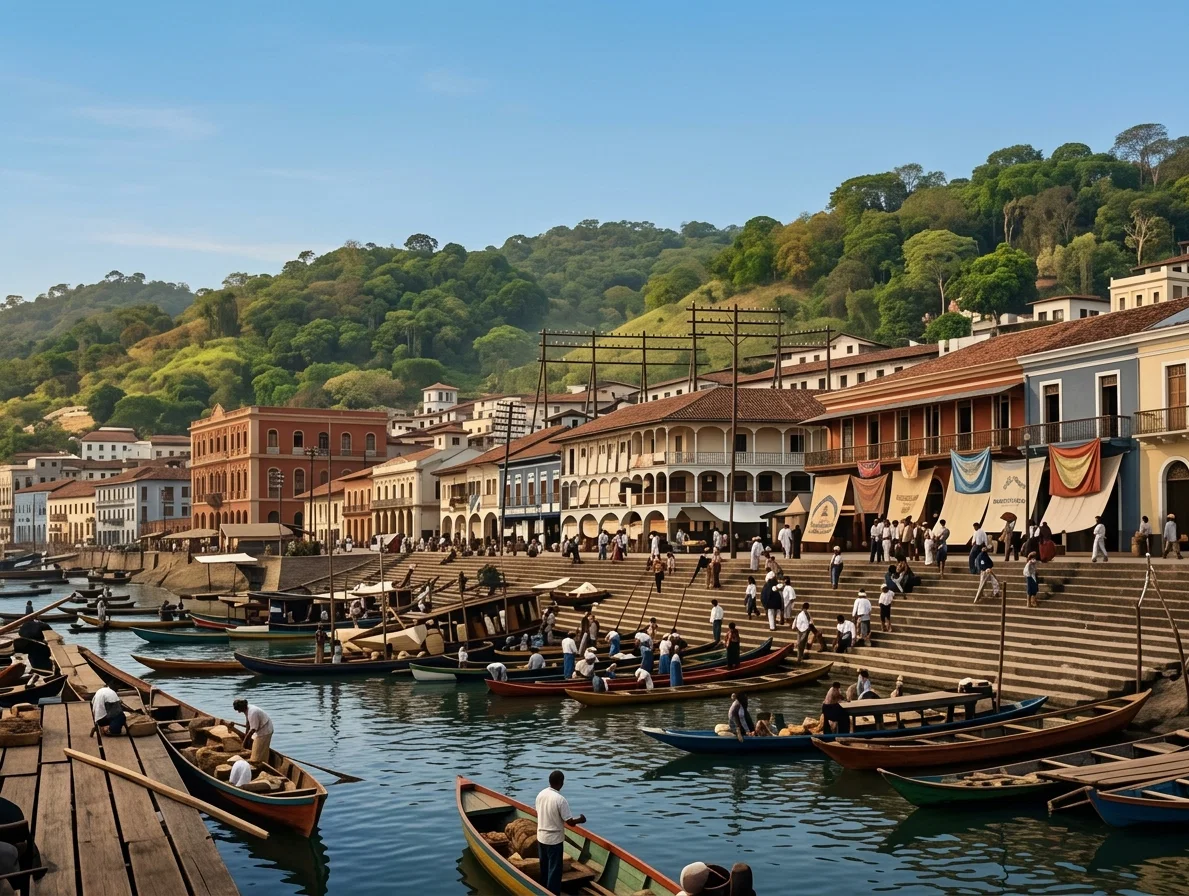
GUAYAQUIL, ECUADOR
GUAYAQUIL, ECUADOR
We hired a room at twenty cents a day right alongside the cathedral. The priest did not trouble us, nor did he manifest much concern about our “stealing his sheep,” for he declared “they were most all goats anyway.” The people on the coast in general have little to do with the priest, and we find many church buildings in ruins. They told me that the priest is needed only three times during their lives—at their baptism as infants, at marriage, and at the time of their death. We were requested to hold meetings at various places, and with the Lord’s help we shall answer these calls as soon as possible.
At Chone there is an opening for a self-supporting missionary. The government school offers one hundred sucres a month, including a house, for some one to take their English classes. This would occupy about an hour a day. At the same place there is a Spaniard who offers sixty sucres a month, with board and room, to teach his children English. These positions could both be filled by one person. Is there any one among our young people whose heart is consecrated to the Lord, who would like to step into this opening before it closes to us? Our Mission Board is taxed to its utmost to keep the work moving that is already started, besides answering the many calls that come from such lands as China and India, where self-supporting missionary work is not so easy. Why can not some of our energetic young people step into these openings, thus advancing the cause we love, without adding materially to its financial burdens? This would also help solve the problem we have in these countries of how to hold the people together after they accept the truth. They have been so accustomed to look to some one else as leader in religious matters that some one is needed to help them become established in the Christian life. Such workers, stationed at different places, would do much to strengthen the work. There are also openings in the colporteur work. During the two months in this new province there was sold about eight hundred dollars’ worth of literature, and then the territory was but touched.
We also have in our territory many thousands of poor, down-trodden, ignorant Indians, who can not read; but they must receive the gospel. I wish that all would read Señor Forga’s appeal for the descendants of the ancient Incas, in the Signs of the Times of Nov. 27, 1907. To work acceptably for this people we must master two new languages,—the Spanish and Quechua, and of the latter there are several dialects. This is no small task, and we have no time to delay. In these closing days the Lord will stir up many hearts to answer these calls. Let us not turn a deaf ear. As I shall be away a few months at our South American Union meeting, Brother Davis will be glad to give information to those who are interested in answering these calls. Enclose a five-cent United States stamp, as its value is easily obtained here.
Ambato.