For a number of years our people have known of a company of native Tamil Sabbath-keepers living in the Tinnevelli District of South India. Mention has been made of them in the REVIEW and other papers from time to time, but not until recently have any definite steps been taken to learn the history and nature of this sect. By their urgent request, in company with Elders Shaw and Enoch, I made a visit to this district, and remained with these people over ten days, during which time I learned much of their history and organization. The reception we were given and the experiences we had during this visit will be described elsewhere.
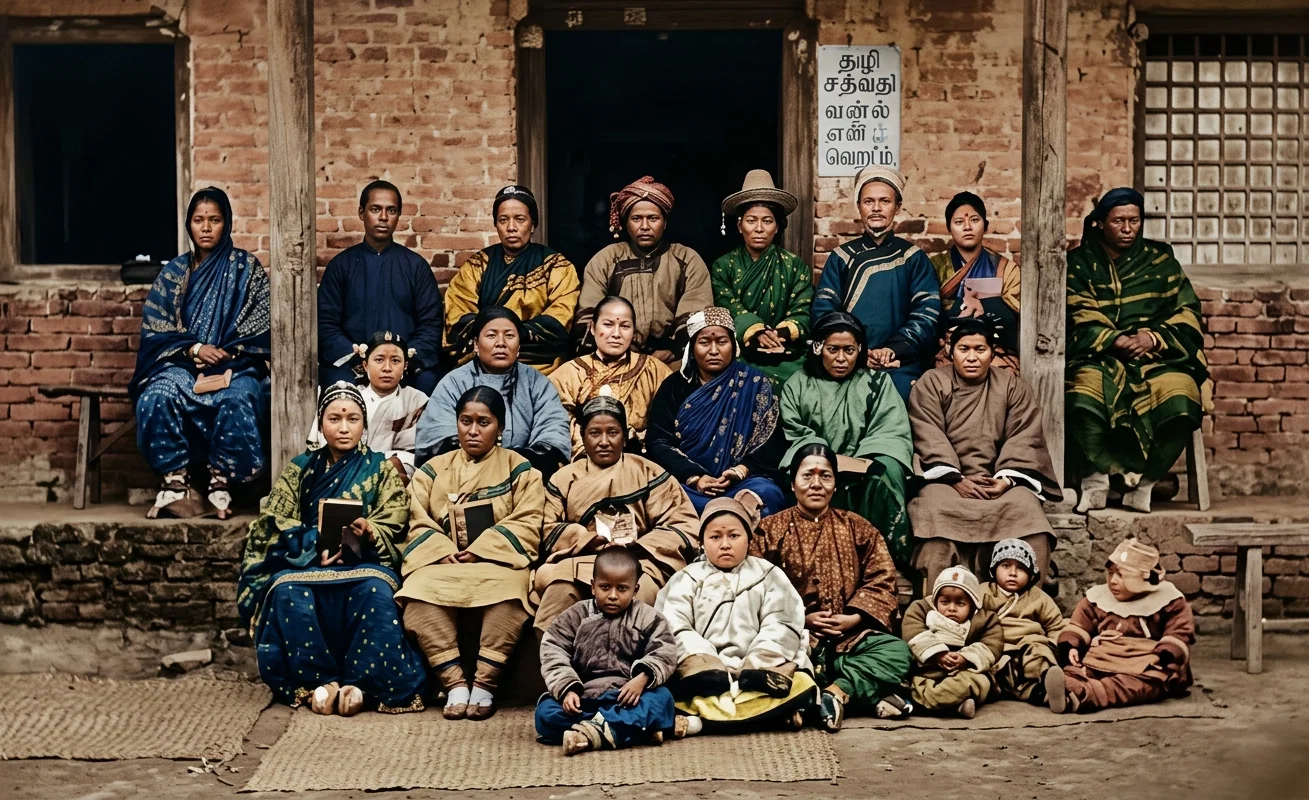
SISTERS ATTENDING GENERAL MEETING, SIANG CHENG
In the year 1845, a native Tamil Christian by the name of A. N. Chattampillai was selected by the Church of England and educated for the priesthood in that faith. He completed this part of his education in 1850, and was about to be ordained as priest when trouble sprang up between himself and the presiding missionary relative to his marriage. It was the missionary's desire that Mr. Chattampillai marry a girl of the mission whom they had educated, and who had considerable money. But the girl not being of his own caste, he refused to be influenced by the missionary's desire, and turned his attentions to a poor girl of his own caste, with but little education, and married her. This step on his part greatly displeased the missionary, and only served to increase their differences.
Because of the hostility and unkind treatment coming from his former associates,16Mr. Chattampillai was compelled to leave his home in Tinnevelli. Desiring to obtain justice at the hands of his superiors, he placed his grievances before the secretary, archdeacon, and bishop of the church both in person and in writing, but was not given any satisfaction.
Having become fully convinced that the Church of England was teaching error in many of her doctrines, and finding nothing in the creeds of other churches to claim his reverence and support, he retired to Madras in 1852, and spent his time until 1856 in a comparative study of different religions and sects. At the end of 1856 he returned to his home, and founded the present sect in 1857. He began preaching his views to the people of his own and other villages until he had a following of over six thousand native Christians, most of them coming out from the Church of England. It seemed for a time that this movement would sweep everything before it, but it was not to occupy an undisputed field very long.
Shortly after the formation of this new sect, the other missionary societies began a war of extermination against it, the larger part of the opposition coming naturally from the Church of England. The missionary in charge of the work in the Tinnevelli District, afterward becoming bishop, issued a threatening proclamation against this new sect, copies of which were posted on the walls and doors of public buildings in many of the surrounding villages. I read with my own eyes the original of this proclamation, signed by the missionary then in charge. It was issued Oct. 5, 1857, and gave the members of his congregation a sort of indulgence while they waged war with the members of this new sect and their leader, Mr. Chattampillai. This document savors strongly of the spirit of popery and the Dark Ages. It justified the people in taking any means they saw fit to stamp out this new organization and bring the leader to repentance. Persecution began to come in real earnest to these people. In the years between 1857 and 1870, more than one hundred court cases, instituted largely upon false charges, were brought against the leading members of this sect. In those days the court and municipal officers were largely influenced by the European missionaries, consequently many of these charges were decided against the members of the new sect, and resulted in the loss of property and in serious damage in many other ways. Scores of them were haled before the courts and committed to jail without bail at a time when their crops, if neglected, would perish in the field. Many who were traders had their business boycotted and ruined. Some of the leaders were handcuffed and led in the public streets in the presence of their friends and relatives, while the heathen mocked them with every indignity. Many of their houses were broken into by mobs, and their women insulted and robbed of their jewels. They were assaulted in their meeting-houses, and every effort was made to exterminate them and drive them from the community. It seems almost incredible that a great deal of this work was sanctioned and even planned by those who professed to be preaching the gospel of Jesus Christ, but they are unvarnished facts supported by the testimony of scores of living witnesses.
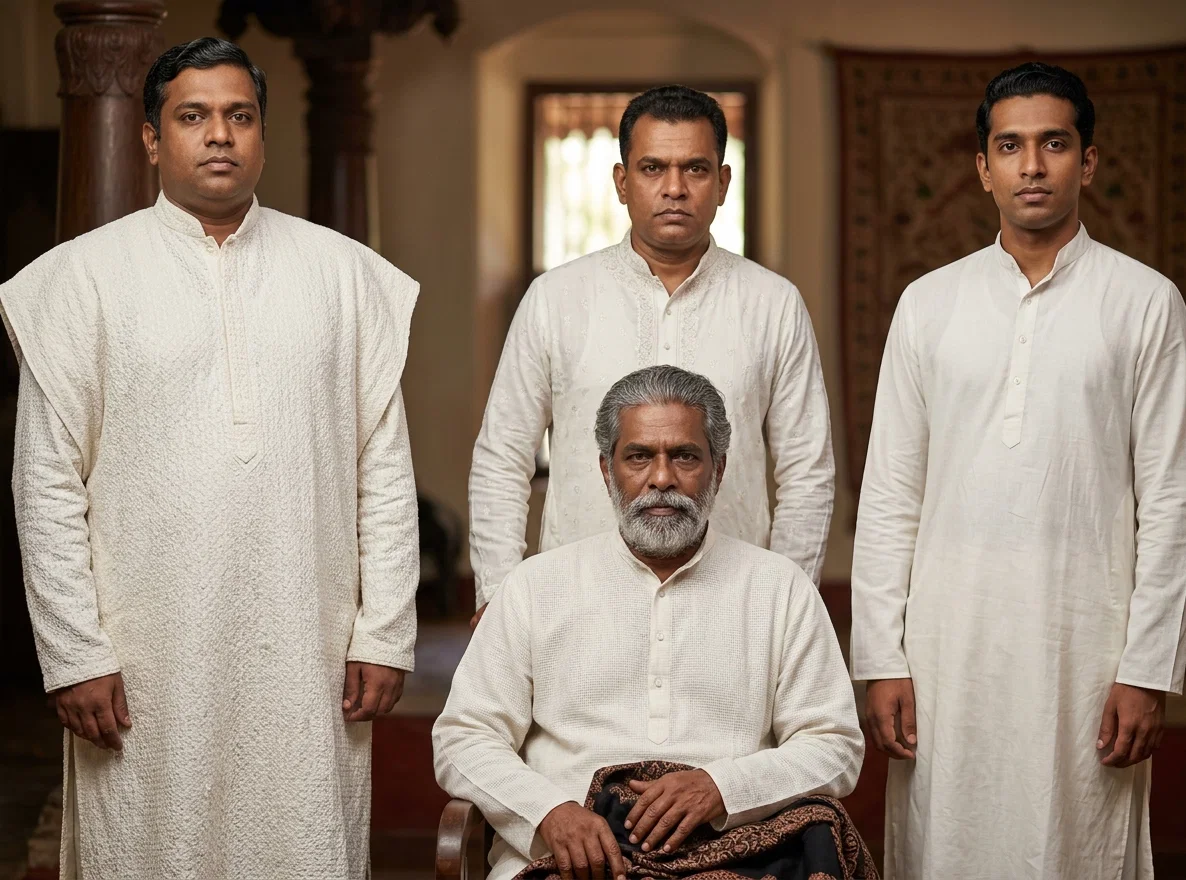
Things went on in this manner with more or less activity until 1883, when a division arose among them concerning some landed titles held in trust by their leader and founder. Differing somewhat in doctrine and church ritual, and desiring to rid themselves of a Pharisaical system of religion to which they had unwillingly submitted themselves, they rejected their leader, and started a new organization on new lines. The founder and his family, together with three or four other families, are all that are left of the original body. They still maintain their church services in their church, which stands only a few rods from the church of the larger body. Mr. Chattampillai is now in his eighty-fourth year, and is growing very feeble. In the accompanying picture he is seen sitting in the chair, while standing in the rear are his three sons. Mr. Chattampillai is a man of great learning, and in his more active days was possessed of a strong personality and ability as a leader and organizer. It is said that at one time he was able to read and converse in sixteen different languages. While visiting him, I was shown through his library, which contains over eight thousand volumes. Among these were books in Hebrew, Greek, Sanskrit, Syriac, Latin, together with the Dravidian languages spoken in South India. His collection of books dealing with theological questions is very valuable, many of them being rare prints.
A. N. CHATTAMPILLAI AND HIS SONS
In 1885 the company that left their founder built a church of their own, in a village of about five thousand, closely adjoining another village, which has served as a headquarters for their organization ever since. This church is described in another article. The people with whom we have to deal at present are those who broke off from the parent church in 1883. At that time they numbered about four thousand, but since then their numbers have been greatly reduced by persecution and apostasy, until at present they number between ten and fifteen hundred. There are about four hundred of them in Ceylon, where they endeavor to carry on their church services on the Sabbath.
These people have a fairly good system of organization. They have a system of government which reminds one very much of the Jewish economy, with a few modifications from the New Testament. They have twelve elderly men chosen by the people to take the oversight of affairs. Six of these are regarded as elders, and hold seats of honor in all their councils and deliberations. However, it was quite noticeable to us that there were a few young men who were active in carrying out new and up-to-date ideas. The work of the other six men corresponds to that of the deacons. They also have deaconesses to look after the interests of the women. They have a secretary and treasurer of ability to look after the funds of the church and make proper disbursement of the same. Their funds, which accrue from tithes, free-will offerings, thank-offerings, first-fruits, etc., are collected into one general fund, and all expenses are met from this. Each officer has his particular work in the church, which is performed in the most punctilious fashion. One has charge of the cash funds, another looks after the offerings and first-fruits, another has the care of the lamps, another the blowing of trumpets, and so on.
The first-fruits are offered every Sabbath in the church as a part of their praise and worship. They esteem it a blessed privilege to give to God on the Sabbath, and giving, to them, is an act of worship just as important as prayer. After the Sabbath is past, these offerings, which consist largely of grains, vegetables, eggs, fowls, etc., are sold to the highest bidder, and the money is put into the common fund.
These people are imbued with a missionary zeal. They feel that they are morally responsible for propagating and keeping alive the truths they possess, especially the Sabbath. The principle upon which their schools are operated is almost identical with that of our church-schools. They will not allow their children to attend schools taught by people who keep Sunday, and they never allow their daughters to marry an unbeliever. Hundreds of these people have grown to manhood and womanhood17without an English education, a thing greatly prized by the native of India, simply because they would not be taught by unbelieving Europeans. Through lack of a good standard of education of their own, many of their bright young men and women have been enticed away to attend other schools, only to be lost to their church in a few years.
Now that these people are acquainted with us and our methods of work, they plead with us to send them help. They are willing to have us teach them in all their churches. They have offered to turn over their entire school system to us to operate after our own standards, and teach all our doctrines to their children. In short, they want us to make first-class church-schools of them. They are anxious to see their young men educated to carry the Sabbath truth all over South India. They have come forward with a generous offer of land on which to build a dwelling-house, if we will come and help them. They have promised to assist us in many different ways in building new buildings and getting our work started.
If ever there was a people who stretched out their hands for help, here is one. Here are hundreds of bright young people who are eager to know the truth. Here is talent and ability, if properly developed and trained, that will carry the third angel's message to all South India. We have prayed for this favorable opening for many months. Now that it has come, are we ready to render them the help they so much need? Thank God, we are able! We believe that while God has been preparing the hearts of these people for his truth, he has also been preparing the hearts of his people on the other side of the earth to come to their assistance when it was needed. Dear brethren and sisters, that time has fully come, and now we look to you, humbly praying that this providential opening for the truth among these Tamil Sabbath-keepers will appeal to every heart and inspire all with greater zeal and sacrifice in spreading this message to all the world. I ask you to carefully read the articles that will follow by Elders Shaw and Enoch, dealing with other interesting features of our visit among these people. We ask to be remembered in your prayers that we may be led of God as we endeavor to lead these people out into the full light of his truth for this time. We need his special blessing.