West Coast of Africa

6%

Review and Herald Publishing Association · Takoma Park Station, Washington, D. C. · Apr 9, 1908

FromReview and Herald, Vol. 85, No. 15.

Read the full edition

West Coast of Africa

D. C. BABCOCK
LEAVING Cape Palmas, on the south-western coast of Liberia, the evening of August 10, we reached Axim Monday morning, August 12. This was our first stop on the Gold Coast. This place is noted for its export of mahogany. Steamers and sailing-vessels were loading logs for different parts of the world. As we viewed the different vessels through the field-glass, we spied the American flag floating on one, and for an instant a homesick feeling crept over us, but we turned away, knowing that this message knows no such feelings.
On Tuesday morning we arrived at Sekondi. Here I met for the first time our dear Brother J. D. Hayford. It was pleasant indeed to counsel with him concerning the work on the Gold Coast. The following morning, Wednesday, August 14, we arrived at Cape Coast Castle, and by ten o’clock we were settled in comfortable quarters. Before pitching our tent, I decided to visit several places down the coast, including Apam, which is the home of Brother F. I. U. Dolphyn, so Monday morning at four o’clock, in company with a boy to carry my luggage and act as interpreter, I started on my journey of eighty miles.
From Cape Coast Castle to Akkra, about seventy miles, the language spoken is principally the Fanti. I noted with much interest the origin of the village names. We left Mowure (pronounced Moree) a little to our right, and the first village of note was Anamabo, first settled by the English in 1753. The story of the origin of its name runs like this: When the natives were exploring the Coast, and reached the present site of the village, they all cried out “Anamabo,” as they saw hundreds of birds perched on a large rock near the seashore. Anama, in the Fanti language, signifies bird, and “bo,” a rock. The castle at Anamabo is built near this large rock, and commands a good view of the sea.
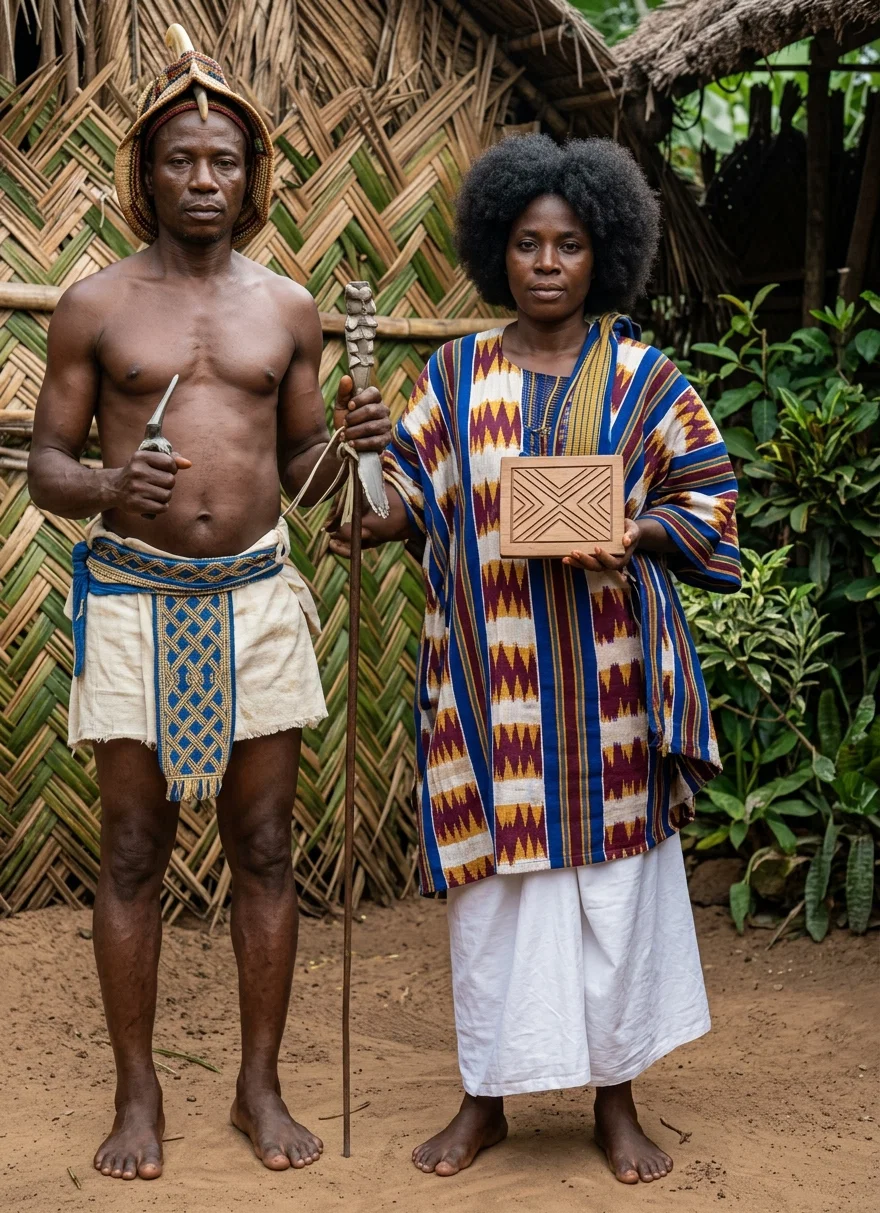
KROO WARRIOR AND WIFE
As we walked through the village, some one called to us, and on going up to the house, we found it was the home of the king. He very kindly offered us refreshments, and when we were ready to go, gave us an invitation to call on our return. I afterward learned that this king was very friendly to our work when Elder D. U. Hale was on the Gold Coast.
We passed through many villages of interest during the day, but as the evening drew near, we began to look for lodging for the night. About six o’clock we reached quite a large village, and my boy began to inquire for a place in which we could sleep. We passed several companies in their fetish worship at the setting of the sun, and came to a large open place in the village, where we sat on a cocoanut log to rest and counsel over our failure to find lodging.
I told my boy to look up the chief of the village, and ask him for a place to sleep.
Presently I noticed, peeping around the corner of the houses, men, women, and children; and I soon saw that their numbers were rapidly increasing. And as they increased in number, they became bolder, until I found myself surrounded by strange-looking people. They crowded closer and closer, until I could see hundreds of them, and from their gestures I knew they were enjoying my situation more than I.
The situation was becoming desperate, and I knew that I must soon do something. My first effort to speak was silenced by a roar of laughter that might be heard a mile away.
One old man, who could speak a few English words, said: “Massa, you want fo’ sleep?” I answered, “Yes;” and then another roar of laughter arose from the hundreds of voices. They began to point their fingers at me, make faces, and I hardly knew what next would follow.
Darkness was gathering fast. My boy had been gone fully one hour, and I could see no relief from my very trying situation. It may seem quite amusing as one thinks of it, but when placed in the actual experience, a person will begin to measure his life by God’s Word.
Soon the crowd began to give way, and I saw my faithful boy coming to my relief. He informed me that I was called before the chief. I wondered what was coming next. I followed the boy, and we soon arrived at the council hall, a large room in the second story of the chief’s house. Here I found fully twenty-five men, old and young, assembled in council over my stopping in the village that night. As I stood before the chief, I can assure you that I mustered all the etiquette I could think of, that was due such a personage, and as he reached out his hand, a sensation of relief permeated my whole being.
After a short conversation through the chief’s interpreter, I was escorted to rooms for lodging. We were well cared for. Our lunch for the evening consisted of keuki, which is a food made by soaking corn in water three days, after which it is ground between two stones by the women. After being ground, it is boiled until well cooked. This, with soup made of dried fish, was our bill of fare.
After the night’s good rest, as theday began to break, we started on our way. A few miles’ travel brought us to another village, where I told my boy we must get breakfast. We at once hunted up the house of the chief, and to my surprise, we found a well-kept room, and a chief who spoke good English. We had not talked long when he asked if I would take something to drink. I politely declined, when he said, “Are you not a missionary?” I answered in the affirmative. He then said, “You must be a Seventh-day Adventist.” I was glad indeed to tell him I was. He then spoke freely of his esteem of Elder D. U. Hale and his work. He expressed his sorrow that others were in his village as educators instead of our own people.
From this chief I learned what caused our difficulty in the village we had just left. There had been severe fighting between the two villages, and more than sixty men had been killed, and I was looked upon as an English officer who had come to make arrests. After a few hours’ rest, making a fire and some good, nourishing food, we resumed our journey.
Freetown, Sierra Leone.