Brother Casebeer and I are on our way to the union conference in Argentina, having left Lima January 22. My wife was just recovering from an attack of malarial fever, and I left little Mora sick in bed with the same disease; but it seemed duty to visit some parts of southern Peru on this trip, to avoid the expense of another voyage.
We disembarked in Mollendo, and went by train to Arequipa, where we spent one day selling the Señales, and taking subscriptions for it, with some success. The next day we went to Puno. The railroad over which we traveled is one of the highest in the world. For more than six hours we were more than fourteen thousand feet above sea-level; and we passed beyond 14,800 feet. There is an abundance of water on these highlands, and even some beautiful lakes; but, owing to the great elevation, little vegetation is produced save moss and a kind of bunch grass. These, however, supply food to large numbers of llamas, alpacas, and vicuñas.
The llamas are the famous beasts of burden of Peru. They are cheap, easily managed, and abundant. They do not carry more than fifty pounds each, so the natives usually drive twelve or more to market with their produce. The alpaca is a sort of sheep, I suppose similar to the alpacas in other parts of the world. The vicuñas are, I understand, peculiar to these regions. They much resemble a goat, but are more beautiful, deer-like animals. Each produces a wool, or hair, which is much used for making yarn and weaving cloth, in which arts the native women show commendable skill and industry.
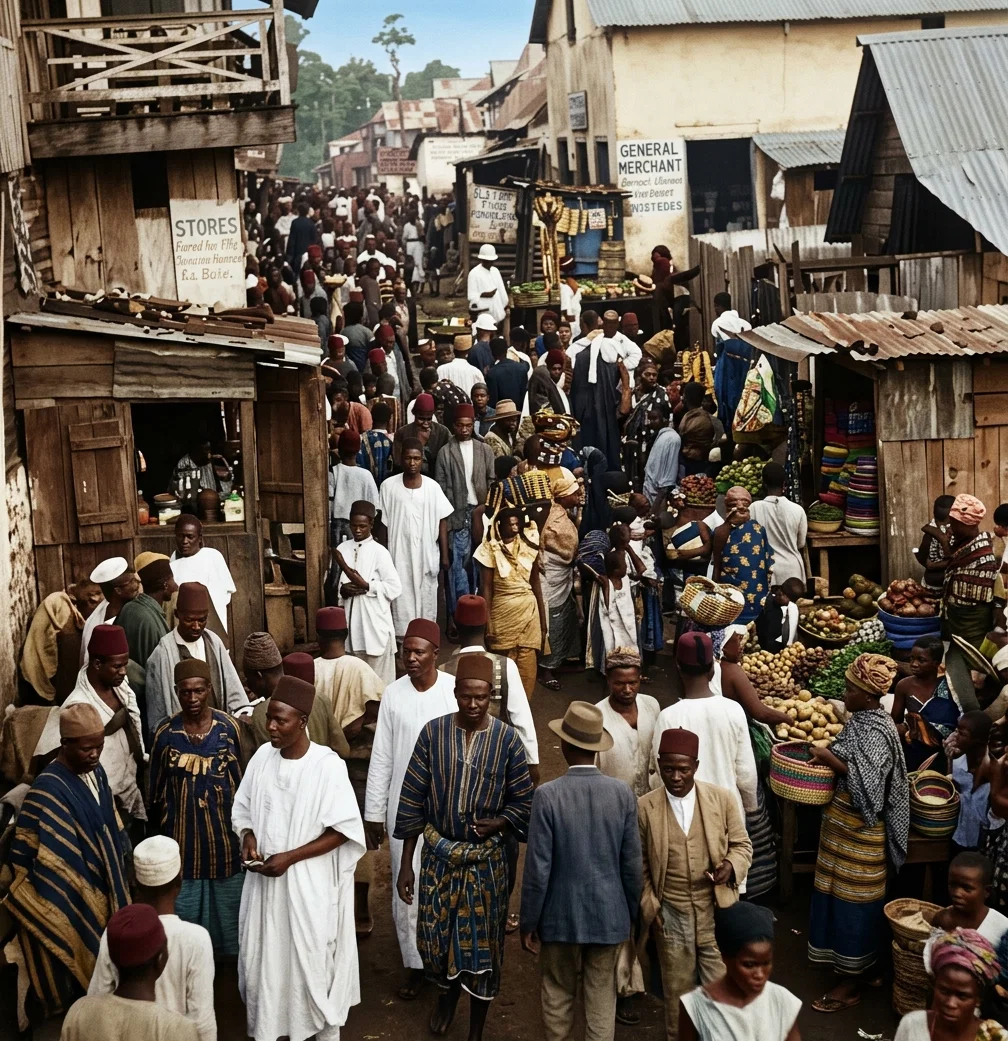
SCENE IN MONROVIA, LIBERIA
Puno is a city of about ten thousand people, situated on the shores of Lake Titicaca. Its well-built adobe houses, with tile or corrugated iron roofs, testified that we were in a country where it rained. I wanted to see a good rainstorm, as I have seen no rain for two years and a half, but I was disappointed: the weather was bright and clear, and the warm sunshine was very agreeable. We did not exert ourselves even to walk very fast. It took most of our energy to keep pumping air into our lungs; for Puno is 12,500 feet above sea-level. Lake Titicaca is the highest navigable lake in the world, about forty miles wide and one hundred thirty long. Upon its waters it is said that the first Inca—Manco Capac—with his wife came down from the sun. Their descendants were known as the children of the sun, and were the royal family of Peru until the time of Pizarro. There are many evidences which show that the early Peruvians were sun-worshipers. But the proud Inca, with his golden treasures, is gone. His people are now little more than the slaves of foreign oppressors. The Indians of the mountains are largely sunk in poverty, ignorance, and vice. If ever a race needed to hear of God's free salvation, it is this one.
Our work is gaining a foothold here in Puno. Some time ago I received a letter written from this place by a man named Morales. He sent in subscriptions to the Señales for himself and a friend. This friend, Peralto, secured seventeen more subscriptions. It was to see these people that I went to this place. Morales had left the city. We found Peralto, a shoe manufacturer in good circumstances. He received us with open arms. He took us to his close friend, Bonefacio Aragón, a subscriber. Seated in the latter's pleasant, well-furnished home, I spoke to these men about an hour, concerning the truth. Their hearts were open, and God gave them faith, and they said, “We want to become members of your people.” We held two meetings, which lasted late into the night. I never saw anything like it before. It seemed as if God gave them faith in our message, and let his converting power rest upon them. There were about twenty present each evening. Three brethren came to the station early in the morning, to see us depart. About fifteen in Puno promised to keep the Sabbath and hold Sabbath-school. The two men first mentioned suggested that they pay for fifty Señales monthly, to distribute or sell. They offered voluntarily to furnish a house and meeting-place free, if I would send them a teacher. To enter the city a stranger, not knowing a single person, and in two days see fifteen or twenty believing, willing to sacrifice and suffer for this blessed truth, was little short of a miracle. Our hearts were filled with gratitude and praise.
But this brings its responsibilities. These dear believers must be educated in the truth. One said, “We have faith, but are ignorant. We must learn more.” I regard this as a most wonderful opening. The two leaders are of more than average intelligence. They are men of property and influence. They are at the head of a large workingmen's society. A large hall is nearly completed for the purposes of this society, these men furnishing most, if not all, the means. Their families are well appearing, intelligent, and obedient.
Now, what can I do? I can not stand the altitude except for two or three days at a time. We have no native laborers who could be of much help to them. And if I could stay there, I have more than I can do elsewhere. God is going before, and opening the way. O that the people of God could sense the burden that is resting upon them! I know of no one in South America whom we can get. All the fields need more help.
Brother Hinckley tells me that he is sure a nurse or two could earn their way in Arequipa. I think the same would be true of Lima. Under a Peruvian immigration law, colonists coming here as laborers or professionals can have their passage paid by the government.
We are having a pleasant voyage. Day after to-morrow (February 13) we reach Valparaiso. May the Lord hasten the day when the work shall be done.