Samoa

6%

Review and Herald Publishing Association · Takoma Park Station, Washington, D. C. · Apr 16, 1908

FromReview and Herald, Vol. 85, No. 16.

Read the full edition

Samoa

C. H. PARKER
IN company with Brother J. E. Steed and family, of South Australia, I left for Samoa, December 20. Brother Steed was appointed to this field at our last Australasian Union council. After a delightful trip of two days and a half, we dropped anchor in the harbor of Apia. Apia is a pretty place, but it has a poor harbor and no wharf. All the steamers must anchor out in the stream.
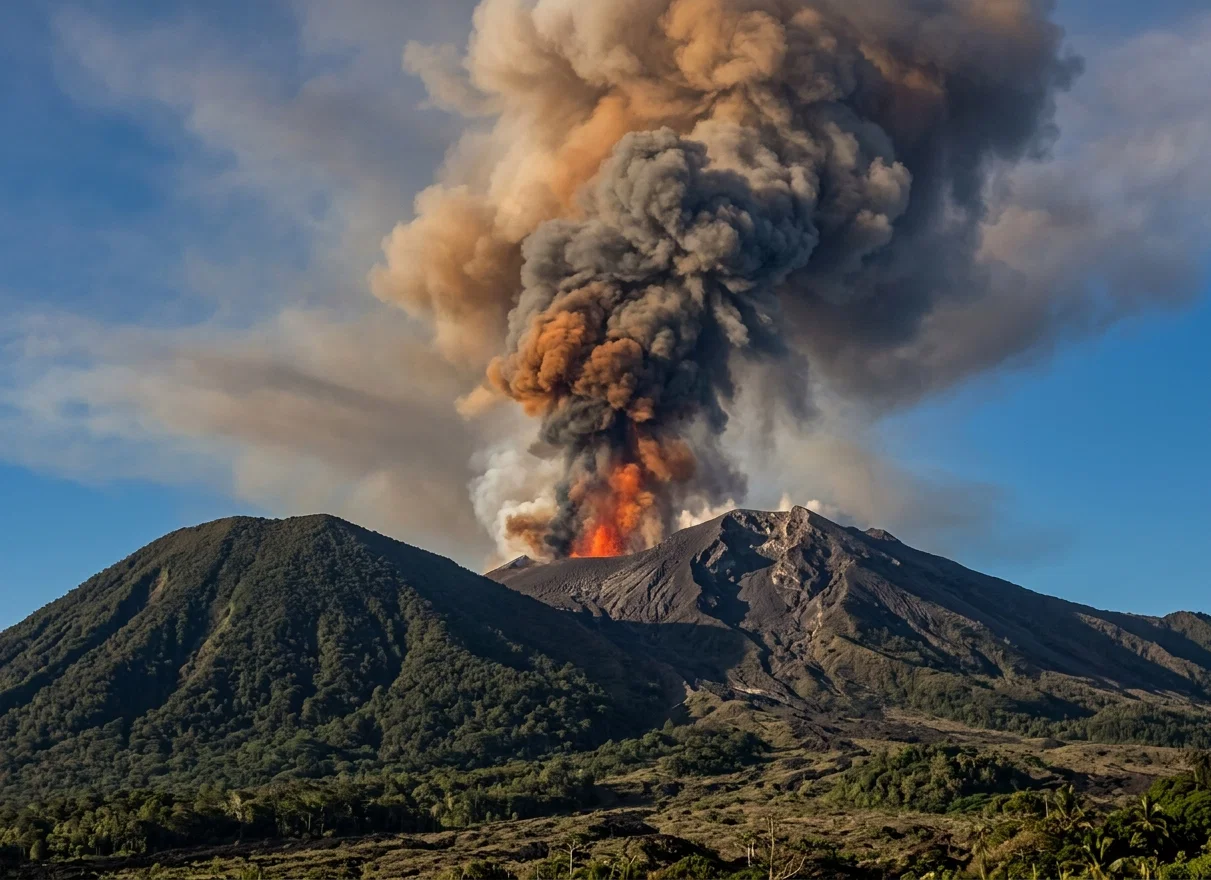
ERUPTION IN SAVAII
ERUPTION IN SAVAII
On the reef in front of the town lie the remains of a German warship which, with American and British war-vessels, was wrecked at the time of the great tidal wave here about twenty years ago.
The Samoan group is composed of about fifteen islands, though all are not inhabited. Savaii is the largest, and is widely known for its volcano, which has been vomiting up a stream of lava for the past two years. Upolu is the most important, on which is situated Apia, the capital. Tutuila next ranks in importance. This island and two others are ruled by the United States. All the rest are governed by Germany.
There are about 381 Europeans, 600 or 700 half-castes, and 33,000 natives. Upolu has about 18,000 of the 33,000, Savaii 10,000, and Tutuila 5,000.
The houses are built oval shape. The floors are of small stones. The sides are curtains made out of the cocoanut leaves, which can be rolled up or let down at will. When the family is at home, the curtains are always up; when away, they are always drawn down. There is no privacy about the home life, as these curtains are always up, and everything that is done can be seen by the passers-by.
The people at Apia, or a great many, have nice horses and buggies. They have copied the Europeans in many of their practises, and love horse-racing. The people in the country are more simple and more free from the vices which are so prevalent in this city.
Our medical work was started here a number of years ago, and through it our faith is quite well spoken of as it had the confidence of the people. The evangelical part of our work has not had so much attention. Just when Brother Delos Lake had reached the place where he could accomplish something for the people he had to leave on account of his health. Brother Floding was able to do something in the way of giving out literature. One after another these dear laborers had to leave on account of their health. Two years have gone by since we had a laborer here, and our sanitarium has stood idle.
At our last Australasian Union Conference council it was decided to send a laborer here to open up the work again. Pastor J. E. Steed, of South Australia, was chosen, and is now located at Apia.
We had a pleasant interview with Dr. Solf, governor of Samoa, and he has opened the door again to our work in Samoa. Perfect freedom is granted. The governor was very kind and courteous.
A small church has now been organized among the Europeans, and we pray that it may have a victorious future. Last Sabbath the ordinances were celebrated in Samoa in the Scriptural method. We had a blessed time.
The London Missionary Society’s ministers are very kind and friendly to us. They are much like brethren of the same faith. This is refreshing as we contrast it with the spirit we have to meet from other denominations in other places.
What we ask for Samoa is your prayers. The nearest way to the work and laborers here is by the throne of God. Hold Brother Steed and his family up before God in the arms of your faith.
Buresala, Levuka, Ovalau, Fiji.